2016 CITROEN C-ELYSÉE gearbox
[x] Cancel search: gearboxPage 82 of 260

80
C-elysee_en_Chap05_conduite_ed01-2016
There is a risk of damage to the gearbox:
-
i
f you press the accelerator and
b
rake pedals at the same time,
-
i
f you force the movement of the
s
elector from the P position to
another position when the battery is
discharged.
If the selector is not in position P
,
when
the
driver's
door
is
opened
or
a
pproximately
45
seconds
after
the
i
gnition
is
switched
off,
a
warning
m
essage
appears
in
the
screen.
F
R
eturn the selector to position P ;
t
he
message
disappears.
When
driving
on
flooded
roads
or
when
c
rossing
a
ford,
proceed
at
walking
p
ace. To
reduce fuel consumption when at
a
prolonged standstill with the engine
r
unning (traffic jam...), put the selector
i
n the N position and apply the parking
b
rake.
Manual operation
Invalid value during manual
operation
Stopping the vehicle
Before switching off the engine, you can e ngage position P or N to place the gearbox in
neu
tral.
In
both cases, apply the parking brake to
i
mmobilise the vehicle.
Operating fault
F Select position M for sequential c hanging o
f the six gears.
F
M
ove the selector towards the + sign to
c
hange up a gear.
F
M
ove the selector towards the - sign to
c
hange down a gear.
It
is only possible to change from one gear to
a
nother if the vehicle speed and engine speed
p
ermit; other wise, the gearbox will operate
t
emporarily in automatic mode.
D
disappears and the gears
e
ngaged appear in succession in the
in
strument
pan
el.
If
the engine speed is too low or too high, the
g
ear selected flashes for a few seconds, then
t
he actual gear engaged is displayed.
It
is possible to change from position D
(automatic)
to position M (manual) at any time.
When
the vehicle is stationary or moving
v
ery slowly, the gearbox engages first gear
au
tomatically. With
t he i gnition o n, i llumination o f
t
his warning lamp, accompanied
b
y an audible signal and a message in the
m
ultifunction screen, indicates a gearbox fault.
In
this case, the gearbox switches to back-up
m
ode and is locked in 3rd gear. You may feel
a
substantial knock when changing from P
to R
and from N to R.
This will not cause any
d
amage to the gearbox.
Do
not exceed 60 mph (100 km/h), local speed
r
estrictions
p
ermitting.
Contact
a CITROËN dealer or a qualified
w
orkshop as soon as possible.
This
symbol is displayed if a gear
i
s not engaged correctly (selector
b
etween two positions).
The
sport and snow programmes are
n
ot available when operating manually.
Driving
Page 84 of 260

82
C-elysee_en_Chap05_conduite_ed01-2016
Stop & Start
Operation
Going into engine STOP mode
The "ECO" warning lamp comes o
n in the instrument panel and the
e
ngine goes into standby:
-
w
ith a 5-speed electronic gearbox , with
the vehicle stationary, when you press
the
brake pedal or put the gear selector in
p
osition N .
A
time
counter calculates the sum of the
p
eriods
in
STOP mode during a journey. It rests
i
tself
to
zero every time the ignition is switched
o
n
with
the key.
The
Stop
&
Start system
puts
the
engine
t
emporarily
into
standby
-
STOP
mode
-
during
s
tops
in
the
traffic
(red
lights,
traffic
jams,
or
o
ther...).
The
engine
restarts
automatically
-
S
TART
mode
-
as
soon
as
you
want
to
move
o
ff.
The
restart
takes
place
instantly,
quickly
a
nd
silently.
Per fect
for
urban
use,
the
Stop
&
Start
system
r
educes
fuel
consumption
and
exhaust
e
missions
as
well
as
the
noise
level
when
s
tationary. Never
refuel with the engine in
S
TOP mode; you must switch off the
i
gnition with the key.
For
your comfort, during parking
m
anoeuvres, STOP mode is not
a
vailable for a few seconds after
c
oming out of reverse gear.
STOP
mode does not affect the
f
unctionality of the vehicle, such as for
example,
braking, power steering...
Driving
Page 85 of 260

83
C-elysee_en_Chap05_conduite_ed01-2016
Going into engine START mode Special cases: START invoked automatically
The "ECO" warning lamp goes o
ff and the engine starts with an
e
lectronic gearbox :
-
g
ear
selector in position A or M, when you
release
the brake pedal,
-
o
r
gear selector in position N and the brake
p
edal
released, when you move the gear
s
elector to position A or M ,
-
o
r
when you engage reverse gear.For
reasons of safety and for your comfort, S
TART mode is invoked automatically when:
-
y
ou open the driver's door,
-
y
ou unfasten the driver's seat belt,
-
t
he speed of the vehicle exceeds 2 mph
(
3 km/h) with an electronic gearbox,
-
s
ome special conditions (battery charge,
e
ngine temperature, braking assistance,
a
mbient temperature...) where the engine is
n
eeded for control of a system.
The "ECO"
warning lamp flashes for
a
few seconds, then goes off.
This operation is per fectly normal.
Special cases: STOP mode not
available
STOP mode is not invoked when:
- t he driver's door is open,
-
t
he driver's seat belt is not fastened,
-
t
he engine is needed to maintain a
c
omfortable temperature in the passenger
c
ompartment,
-
d
emisting is active,
-
s
ome special conditions (battery charge,
e
ngine temperature, braking assistance,
a
mbient temperature...) where the engine is
n
eeded to assure control of a system.
The "ECO"
warning lamp flashes for
a
few seconds then goes off.
This operation is per fectly normal.
5
Driving
Page 89 of 260

87
C-elysee_en_Chap05_conduite_ed01-2016
Cruise control
System which automatically maintains the speed of the vehicle at the value programmed
b
y the driver, without any action on the
a
ccelerator
ped
al.
The cruise control is switched on
m
anually:
it r
equires a minimum vehicle speed of 25 mph
(
40 km/h), as well as the engagement of:
-
f
ourth gear on a manual gearbox,
-
s
econd gear on a or automatic or electronic
g
earbox, in sequential mode,
-
p
osition A on an electronic gearbox or
p
osition D on an automatic gearbox.
The cruise control is switched off
m
anually
o
r by pressing the brake or clutch pedal or on
t
riggering of the trajectory control systems for
s
afety reasons.
It
is possible to exceed the programmed speed
t
emporarily by pressing the accelerator pedal.
To
return to the programmed speed, simply
r
elease the accelerator pedal.
Switching
off the ignition cancels any
p
rogrammed speed value. The
controls of this system are grouped
t
ogether on stalk A.
1.
C
ruise control mode selection thumb
w
heel.
2.
V
alue decrease button.
3.
V
alue increase button.
4.
C
ruise control off/resume button.Steering mounted controls
The cruise control cannot, in any
circumstances, replace the need to r
espect speed limits, nor can it replace the
n
eed for vigilance on the part of the driver.The
programmed information is grouped
t
ogether in the instrument panel screen.
5.
C
ruise control off/resume indication.
6.
C
ruise control mode selection indication.
7.
P
rogrammed speed value.
Displays in the instrument
panel
5
Driving
Page 150 of 260

148
C-elysee_en_Chap09_info-pratiques_ed01-2016
Removing a wheel
Parking the vehicle
Immobilise the vehicle where it does not block traffic: the ground must be level,
s
table and not slippery.
Apply
the parking brake, switch off the
i
gnition and engage first gear* to block
t
he wheels.
Check
that the parking brake warning
l
amp in the instrument panel comes on.
The
occupants must get out of the
v
ehicle and wait where they are safe.
Ensure
that the jack is correctly
p
ositioned at one of the vehicle's
j
acking points.
Incorrect
use of the jack could cause
t
he vehicle to drop.
Never
go underneath a vehicle raised
u
sing a jack; use an axle stand.
List of operations
Do not use a jack other than the one supplied by the manufacturer.
*
P
osition
R
for
an
electronic
gearbox;
P for an
automatic
gearbox.
Wheel with wheel trim
When removing the wheel , first
remove the wheel trim using the
w
heelbrace 1 by pulling at the valve
a
perture.
When refitting the wheel , refit the
wheel
trim, starting by placing its cutout
i
n line with the valve and then pressing
r
ound its edge with the palm of your
han
d. F
R
emove the wheel bolt cover using the
t
ool 3 (alloy wheels).
F
S
lacken the bolts using the wheelbrace 1
o n l y.
Practical information
Page 172 of 260
170
C-elysee_en_Chap09_info-pratiques_ed01-2016
Towing the vehicle
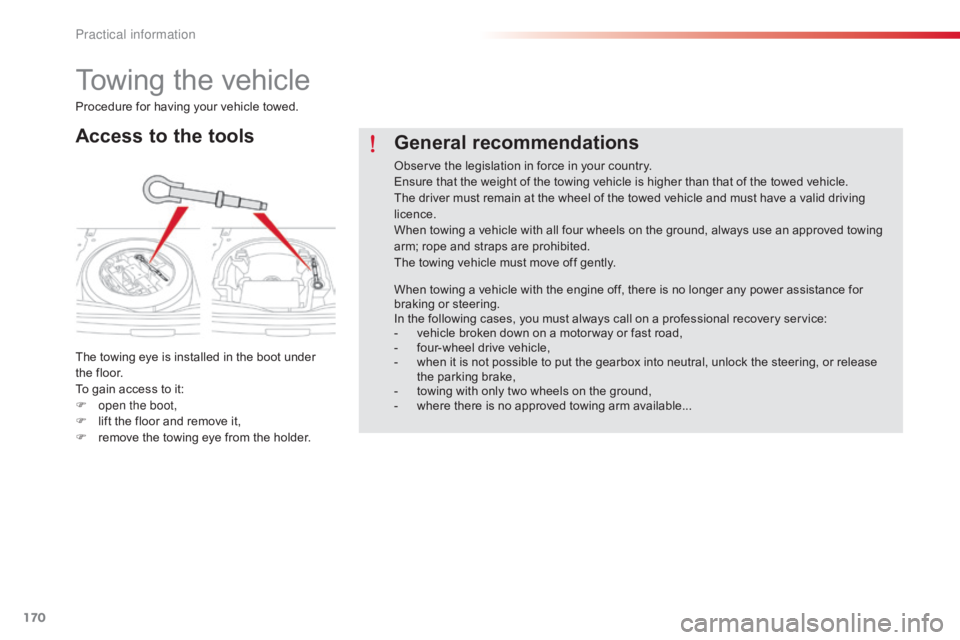
Access to the tools
The towing eye is installed in the boot under the floor.
To
gain access to it:
F
o
pen the boot,
F
l
ift the floor and remove it,
F
r
emove the towing eye from the holder.
General recommendations
Observe the legislation in force in your country.
E nsure that the weight of the towing vehicle is higher than that of the towed vehicle.
The
driver must remain at the wheel of the towed vehicle and must have a valid driving
l
icence.
When
towing a vehicle with all four wheels on the ground, always use an approved towing
a
rm; rope and straps are prohibited.
The
towing vehicle must move off gently.
When
towing a vehicle with the engine off, there is no longer any power assistance for
b
raking or steering.
In
the following cases, you must always call on a professional recovery service:
-
v
ehicle broken down on a motor way or fast road,
-
f
our-wheel drive vehicle,
-
w
hen it is not possible to put the gearbox into neutral, unlock the steering, or release
t
he parking brake,
-
t
owing with only two wheels on the ground,
-
w
here there is no approved towing arm available...
Procedure
for
having
your
vehicle
towed.
Practical information
Page 173 of 260

171
C-elysee_en_Chap09_info-pratiques_ed01-2016
Towing your vehicleTowing another vehicle
F On the front bumper, unclip the cover by p
ressing on the left edge.
F
S
crew the towing eye in fully.
F
I
nstall the towing bar. Put
the gear lever into neutral
(
position
N for an electronic or
automatic gearbox).
Failure to follow this instruction may
c
ause damage to some components
(
braking, transmission...) and the
a
bsence of braking assistance when
t
he engine is restarted.
F U nlock the steering by turning the key i
n the ignition one notch and release the
par
king
b
rake.
F
S
witch on the hazard warning lamps on
b
oth vehicles.
F
M
ove off gently, drive slowly and for a short
di
stance.This
towing is strictly prohibited (risk of
d
amaging your vehicle).
9
Practical information
Page 189 of 260
187
C-elysee_en_Chap10_verifications_ed01-2016
Manual gearbox
The gearbox does not require any maintenance (no oil change).
Refer
to the manufacturer's service
s
chedule for the checking interval for
t
his
c
omponent.
Electronic gearbox
The gearbox does not require any maintenance (no oil change).
Refer
to the manufacturer's service
s
chedule for details of the checking
i
nterval for this component.
Automatic gearbox
The gearbox does not require any maintenance (no oil change).
Refer
to the manufacturer's service
s
chedule for details of the level
c
hecking interval for this component. Brake
wear depends on the style
o
f driving, particularly in the case
o
f vehicles used in town, over short
d
istances. It may be necessary to have
t
he condition of the brakes checked,
e
ven between vehicle services.
Brake pads
For information on checking brake d
isc wear, contact a CITROËN dealer
o
r a qualified workshop.
Brake disc wear Parking brake
If excessive travel or a loss of e
ffectiveness of this system is
n
oticed, the parking brake must be
c
hecked, even between two services.
Only
use products recommended by
C
ITROËN or products of equivalent
q
uality
an
d
sp
ecification.
In
order to optimise the operation of
u
nits as important as those in the
b
raking system, CITROËN selects and
o
ffers very specific products.
After
washing the vehicle, dampness,
o
r
in wintry conditions, ice can form
o
n
the brake discs and pads: braking
e
fficiency may be reduced. Make light
b
rake applications to dry and defrost
t
he
brakes.
Checking
this system must be done by a
C
ITROËN dealer or a qualified workshop.
Unless
there
is
a
leak
in
the
circuit,
a
drop
in
t
he
brake
fluid
level
indicates
that
the
brake
p
ads
are
worn.
10
Checks