2016 CITROEN C-ELYSÉE air condition
[x] Cancel search: air conditionPage 56 of 260
54
C-elysee_en_Chap03_confort_ed01-2016
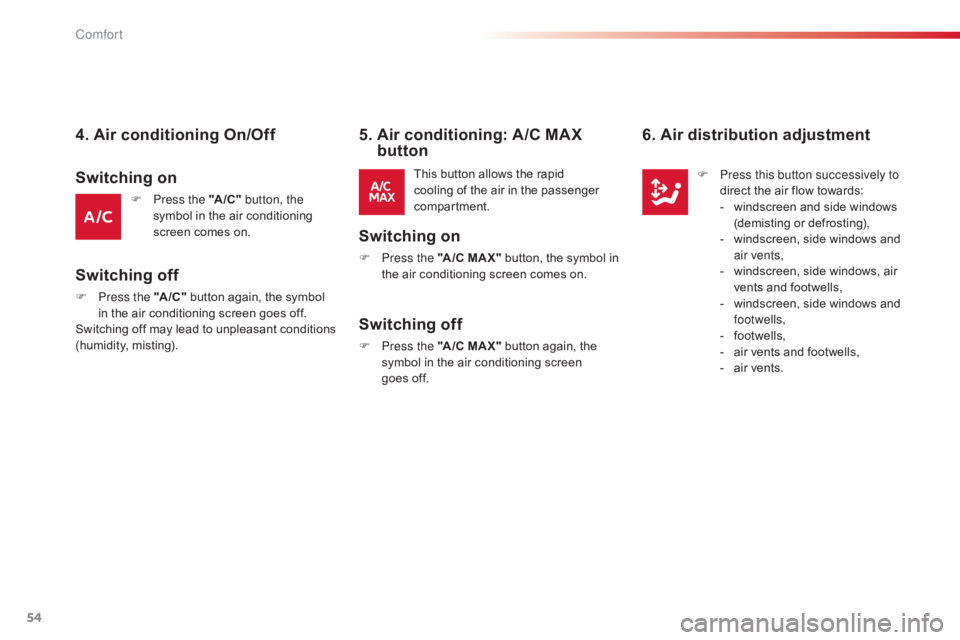
4. Air conditioning On/Off
F Press the "A /C " button, the
symbol in the air conditioning
s
creen comes on.
Switching off
This button allows the rapid cooling of the air in the passenger
c
ompartment.
5. Air conditioning: A/C MAX button
Switching on
F Press the "A /C MA X" button, the symbol in t
he air conditioning screen comes on.
F
P
ress the "A /C "
button
again,
the
symbol
i
n
the
air
conditioning
screen
goes
off.
Switching
o
ff
m
ay
l
ead
t
o
u
npleasant
c
onditions
(h
umidity,
m
isting).
Switching on
Switching off
F Press the "A /C MA X" button again, the s
ymbol in the air conditioning screen
g
oes off.
6. Air distribution adjustment
F Press this button successively to direct the air flow towards:
-
w
indscreen and side windows
(
demisting or defrosting),
-
w
indscreen, side windows and
a
ir vents,
-
w
indscreen, side windows, air
v
ents and footwells,
-
w
indscreen, side windows and
f
ootwells,
-
f
ootwells,
-
a
ir vents and footwells,
-
a
ir vents.
Comfort
Page 57 of 260
55
C-elysee_en_Chap03_confort_ed01-2016
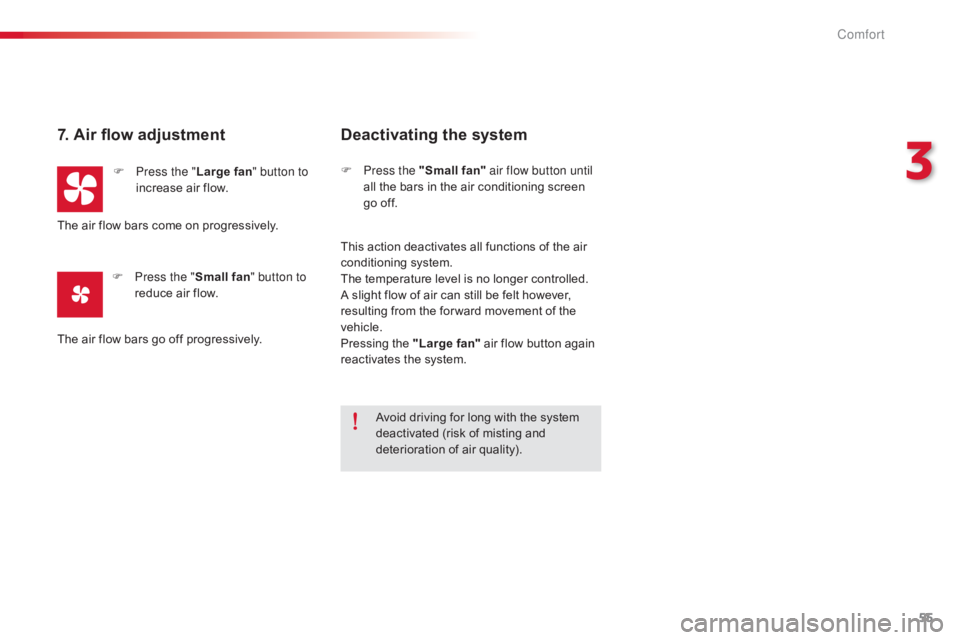
7. Air flow adjustment
F Press the "Large fan" button to
increase air flow.
F
P
ress the " Small fan " button to
reduce
air flow.
Deactivating the system
F Press the "Small fan" air flow button until
all the bars in the air conditioning screen
g
o off.
This
action deactivates all functions of the air
c
onditioning system.
The
temperature level is no longer controlled.
A
slight flow of air can still be felt however,
r
esulting from the for ward movement of the
v
ehicle.
Pressing
the "Large fan"
air flow button again
r
eactivates the system.
The
air
flow
bars
come
on
progressively.
Avoid
driving for long with the system
d
eactivated (risk of misting and
d
eterioration of air quality).
The
air
flow
bars
go
off
progressively.
3
Comfort
Page 58 of 260
56
C-elysee_en_Chap03_confort_ed01-2016
Front demist - defrost
These markings on the control panel indicate the control positions for rapid demisting or defrosting of the windscreen and side windows.
With the heating /
ventilation systemWith the manual air
conditioning system
(without screen)With electronic air
conditioning
(with screen)
F Put the temperature and air flow controls to t
he dedicated marked position.
F
P
ut the air intake control to the "Exterior air
i
ntake" position
(
manual control moved to the right).
F
P
ut the air distribution control to the
"
Windscreen"
p
osition. F
P ress this button. T
he l amp i n t he b utton c omes o n.
F
P
ress this button again to switch
i
t off.
T
he lamp in the button goes off.
F
P ut the temperature and air flow controls to t
he dedicated marked position.
F
P
ut the air intake control to the "Exterior air
i
ntake" position
(
manual control to the right).
F
P
ut the air distribution control to the
"
Windscreen"
p
osition.
F
S
witch on the air conditioning by pressing
t
he appropriate button; the lighting of the
a
ssociated control comes on.
Comfort
Page 59 of 260
57
C-elysee_en_Chap03_confort_ed01-2016
Rear screen demist - defrost
The control button is located on the heating / ventilation or air conditioning system control panel.
Switching on
The rear screen demisting/defrosting can only operate when the engine is running.
F
P
ress this button to demist /defrost the
r
ear screen and (depending on version)
t
he door mirrors. The indicator lamp
a
ssociated with the button comes on.
Switching off
The demisting/defrosting switches off automatically to prevent an excessive
c
onsumption of current.
F
I
t is possible to stop the demisting/
defrosting
operation before it is switched
o
ff automatically by pressing the button
a
gain. The indicator lamp associated with
t
he button goes off.
F
S
witch off the demisting/defrosting of the
r
ear screen and door mirrors, if fitted,
a
s soon as appropriate, as lower current
consumption
results in reduced fuel
c
onsumption.
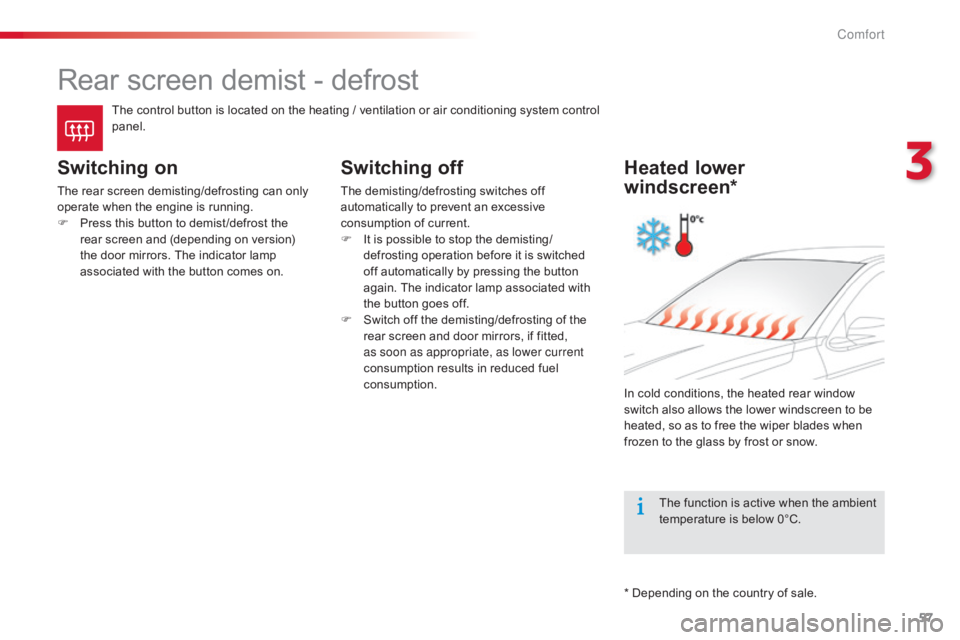
Heated lower
windscreen*
In cold conditions, the heated rear window s
witch also allows the lower windscreen to be
h
eated, so as to free the wiper blades when
f
rozen to the glass by frost or snow.
The
function is active when the ambient
t
emperature is below 0°C.
*
Depending on the country of sale.
3
Comfort
Page 103 of 260
101
C-elysee_en_Chap07_securite_ed01-2016
Under-inflation detection
The under-inflation detection system d
oes not replace the need for vigilance
o
n the part of the driver.
This
system does not avoid the need to
c
heck the tyre pressures (including the
s
pare wheel) every month as well as
b
efore a long journey.
Driving
with under-inflated tyres impairs
r
oad holding, extends braking distances
a
nd causes premature tyre wear,
p
articularly under arduous condition
(
high loading, high speed, long journey).The
inflation pressures defined for y
our vehicle can be found on the tyre
p
ressure label.
For
more information on the
i
dentification markings, refer to the
c
orresponding
s
ection.
Tyre
pressures should be checked
w
hen the tyres are "cold" (vehicle
s
topped for 1 hour or after a journey of
l
ess than 6 miles (10 km) at moderate
s
peeds).
Other wise
(when hot), add 0.3 bar to
t
he pressures shown on the label.
Driving
with under-inflated tyres
i
ncreases fuel consumption.
System
which
automatically
checks
the
pressures
of
the
tyres while driving.
The
system
monitors
the
pressures
in
the
four
t
yres,
once
the
vehicle
is
moving.
It
compares
the
information
given
by
the
four
w
heel
speed
sensors
with
reference values,
which must be reinitialised ever y time the
tyre pressures are adjusted or a wheel
changed .
The
system
triggers
an
alert
as
soon
as
it
d
etects
a
drop
in
the
inflation
pressure
of
one
o
r
more
tyres.
7
S
Page 108 of 260

106
C-elysee_en_Chap07_securite_ed01-2016
Anti-slip regulation (ASR)
and electronic stability
programme (ESP)
The anti-slip regulation (also known as Traction Control) optimises traction to prevent skidding o
f the wheels, by acting on the brakes of the
d
riving wheels and on the engine.
The
electronic stability programme acts on the
b
rake of one or more wheels and on the engine
t
o keep the vehicle on the trajectory required by
t
he driver, within the limits of the laws of physics.
This
is indicated by flashing of this
w
arning lamp in the instrument panel. The
ASR /ESP systems offer
e
xceptional safety in normal driving, but
t
his should not encourage the driver to
t
ake extra risks or drive at high speed.
The
correct functioning of these
s
ystems depends on observation of
t
he
ma
nufacturer's
r
ecommendations
r
egarding the wheels (tyres and rims),
t
he braking components, the electronic
c
omponents and the assembly
a
nd repair procedures used by the
C
ITROËN dealer network.
After
an impact, have these systems
c
hecked by a CITROËN dealer or a
q
ualified
w
orkshop.
Operating fault
Illumination of the warning lamp, accompanid by a message in the
s
creen indicates a malfunction of
t
hese systems.
Reactivation
These systems are reactivated automatically every time the ignition is switched of, or from
3
0 mph (50 km/h).
F
P
ress this button again to reactivate them
m
anually.
T
he lamp in the button goes off.
The
symbol going off in the instrument panel
i
ndicates the reactivation of the ASR and
ES
P systems.
Deactivation
In exceptional conditions (starting a vehicle which is bogged down, stuck in snow, on soft
g
round, ...), it may be advisable to deactivate
t
he ASR and ESP systems, so that the wheels
c
an move freely and regain grip.
Trajectory control systems
Activation
These systems are activated automatically each time the vehicle is started.
They
come into operation in the event of a grip
o
r
t
rajectory
pro
blem. The
display of this symbol indicates
t
hat the ASR and ESP systems are
d
eactivated.
F
P
ress this button button, located on
t
he dashboard (driver's side), until the
c
orresponding symbol appears in the i
nstrument panel screen. T
he lamp in the button comes on.Contact
a CITROËN dealer or a qualified
w
orkshop to have the ASR /ESP systems
c
hecked.
Coasting with the engine off results in a
l
oss of power assistance for the steering.
S
Page 112 of 260
110
C-elysee_en_Chap07_securite_ed01-2016
Airbags
Designed to contribute towards the safety of the occupants in the event of violent collisions.
T
he airbags supplement the action of the force-
limiting
seat belts.
If
a collision occurs, the electronic detectors
r
ecord and analyse the front and side impacts
s
ustained in the impact detection zones:
-
i
n the case of a serious impact, the airbags
a
re deployed instantly and contribute
t
owards better protection of the occupants
o
f the vehicle; immediately after the impact,
t
he airbags deflate rapidly so that they
d
o not hinder visibility or the exit of the
o
ccupants,
-
i
n the case of a minor or rear impact or in
c
ertain roll-over conditions, the airbags
m
ay not be deployed; the seat belt alone
c
ontributes towards providing your
p
rotection in these situations.
The airbags do not operate when the
ignition is switched off.
This
equipment will only deploy once.
I
f a second impact occurs (during the
s
ame or a subsequent accident), the
a
irbag will not be deployed again.The
deployment of an airbag is
a
ccompanied by a slight emission
o
f smoke and a noise, due to the
d
etonation of the pyrotechnic charge
i
ncorporated in the system.
This
smoke is not harmful, but sensitive
i
ndividuals may experience slight
ir
ritation.
The
detonation noise associated with
t
he deployment of an airbag may result
i
n a slight loss of hearing for a short
t
ime.
Impact detection zones
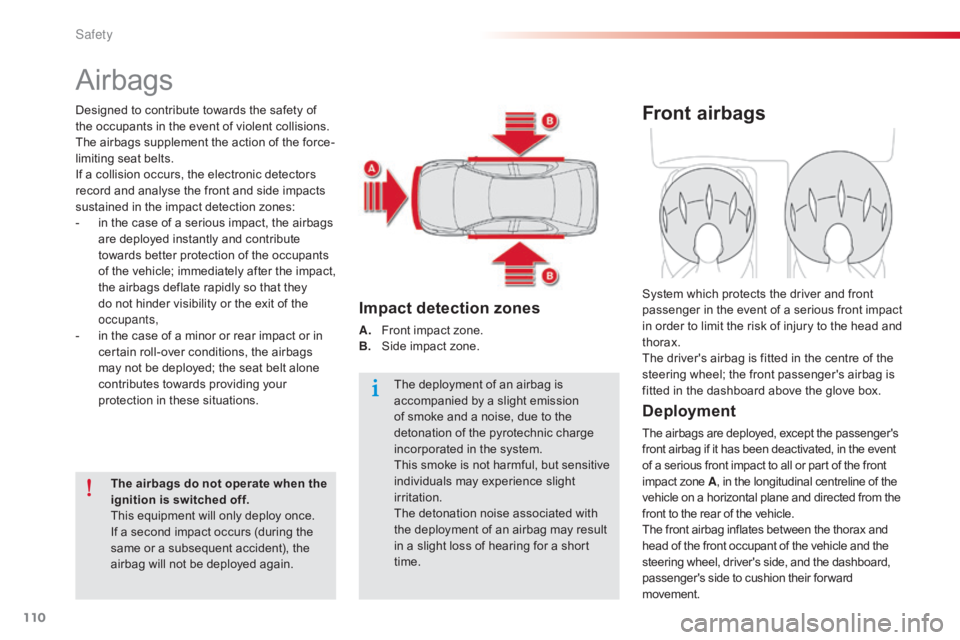
A. Front impact zone.
B. S ide impact zone.
Front airbags
Deployment
The airbags are deployed, except the passenger's front airbag if it has been deactivated, in the event o
f a serious front impact to all or part of the front
i
mpact zone A, in the longitudinal centreline of the
v
ehicle on a horizontal plane and directed from the
f
ront to the rear of the vehicle.
The
front airbag inflates between the thorax and
h
ead of the front occupant of the vehicle and the
s
teering wheel, driver's side, and the dashboard,
p
assenger's side to cushion their for ward
m
ovement.
System
which protects the driver and front
p
assenger in the event of a serious front impact
i
n order to limit the risk of injury to the head and
t
horax.
The driver's airbag is fitted in the centre of the
s
teering wheel; the front passenger's airbag is
f
itted in the dashboard above the glove box.
Safety
Page 162 of 260
160
C-elysee_en_Chap09_info-pratiques_ed01-2016
Changing a fuse
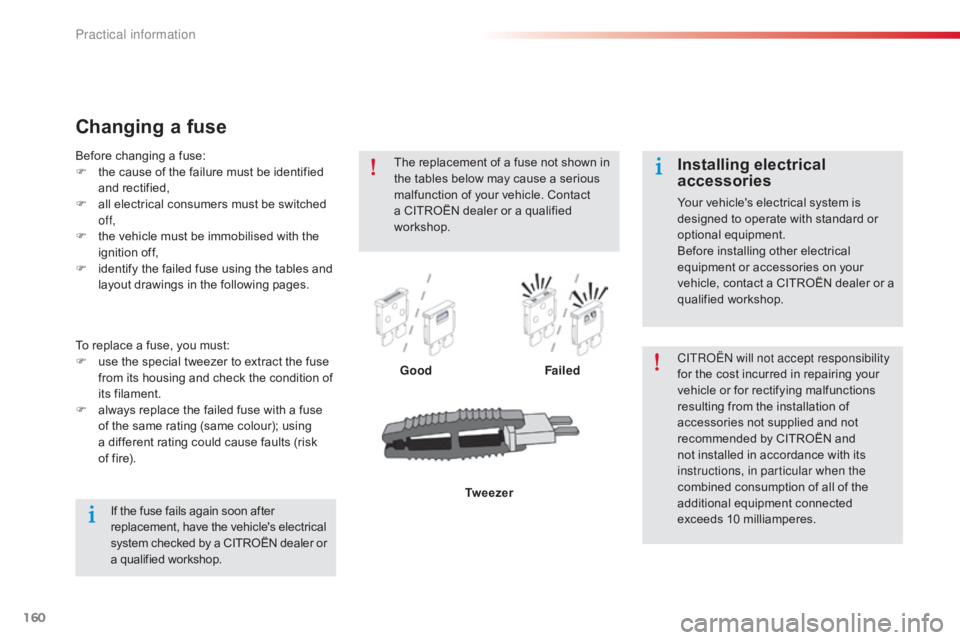
GoodFailedCITROËN will not accept responsibility
for
the cost incurred in repairing your
v
ehicle or for rectifying malfunctions
r
esulting from the installation of
a
ccessories not supplied and not
r
ecommended by CITROËN and
n
ot installed in accordance with its
in
structions, in particular when the
combined
consumption of all of the
a
dditional equipment connected
e
xceeds
1
0
mil
liamperes.
Installing electrical
accessories
Your vehicle's electrical system is designed to operate with standard or
o
ptional
e
quipment.
Before
installing other electrical
e
quipment or accessories on your
v
ehicle, contact a CITROËN dealer or a
q
ualified
w
orkshop.
Before
changing
a
fuse:
F
t
he
cause
of
the
failure
must
be
identified
a
nd r
ectified,
F
a
ll
electrical
consumers
must
be
switched
o
f f,
F
t
he
vehicle
must
be
immobilised
with
the
ig
nition
o
ff,
F
i
dentify
the
failed
fuse
using
the
tables
and
l
ayout
drawings
in
the
following
pages.
To
replace
a
fuse,
you
must:
F
u
se
the
special
tweezer
to
extract
the
fuse
f
rom
its
housing
and
check
the
condition
of
it
s
f
ilament.
F
a
lways
replace
the
failed
fuse
with
a
fuse
o
f
the
same
rating
(same
colour);
using
a
different
rating
could
cause
faults
(risk
o
f fire). Tw e e z e r
The
replacement
of
a
fuse
not
shown
in
t
he
tables
below
may
cause
a
serious
m
alfunction
of
your
vehicle.
Contact
a
CITROËN
dealer
or
a
qualified
w
orkshop.
If
the
fuse
fails
again
soon
after
r
eplacement,
have
the
vehicle's
electrical
s
ystem
checked
by
a
CITROËN
dealer
or
a
qualified
workshop.
Practical information