2016 Citroen BERLINGO Fault
[x] Cancel search: FaultPage 66 of 264

64
Berlingo-2-VU_en_Chap04_Ergonomie_ed01-2016
The speed of the vehicle responds to
the pressure of the driver's foot, up
to the the accelerator pedal's point of
resistance, which indicates that the
programmed speed has been reached.
However, pressing the pedal beyond
this point of resistance to the floor
allows the programmed speed to be
exceeded. To resume use of the limiter,
simply reduce the pressure on the
accelerator pedal gradually and return
to a speed below that programmed.
Adjustments can be carried out
when stationary, with the engine
running, or with the vehicle moving.This speed limiter shows the function
selection status in the instrument panel
and displays the programmed speed:SPEED LIMITER
"LIMIT"
Function selected,
displaying of the
"Speed Limiter"
symbol.
Function off,
last programmed
speed - OFF.
Function on.
Vehicle speed above,
the programmed
speed setting is
displayed flashing.
o
perating fault
detected,
OFF - the dashes
flash.
1.
Limiter mode On / Of
f.
2.
Reduce programmed speed
setting.
3.
Increase programmed speed
setting.
4.
Speed limiter On / Pause.
"This is the selected speed which the
driver does not wish to exceed".
This selection is made with the engine
running while stationary or with the vehicle
moving. The minimum speed which can be
programmed is 20 mph (30 km/h).
Steering mounted controls
Page 68 of 264

66
Berlingo-2-VU_en_Chap04_Ergonomie_ed01-2016
Switching the function offOperating fault
The programmed speed is cleared
then replaced by three dashes.
Contact a CITR
o Ë n dealer or a
qualified workshop to have the system
checked.
Flashing of the speed setting
Good practice
In any event, the speed limiter cannot
replace the need to observe speed
limits, nor can it replace the need for
vigilance on the part of the driver.
Always pay attention to the profile
of the road and sharp acceleration
and stay in complete control of your
vehicle.
To avoid any jamming under the
pedals:
-
ensure that the mat and its fixings
on the floor are positioned correctly
,
-
never place one mat on top of
another
.
Exceeding the programmed
speed
Pressing the accelerator pedal in order
to exceed the programmed speed
will have no effect unless you press
the pedal firmly beyond the point of
resistance.
The limiter is deactivated temporarily
and the programmed speed flashes
accompanied by an audible signal.
To return to the limiter function, reduce
your speed to below the programmed
speed.
The speed setting flashes:
-
following forcing of the accelerator
point of resistance,
-
when the limiter cannot prevent an
increase in the vehicle speed due
to the profile of the road or on a
steep descent,
-
in the event of sharp acceleration. -
Place the switch in position
0 or
switch off the ignition to switch the
system off.
The last programmed speed remains in
the memory.
Steering mounted controls
Page 86 of 264

84
Berlingo-2-VU_en_Chap04_Ergonomie_ed01-2016Berlingo-2-VU_en_Chap04_Ergonomie_ed01-2016
LOAD SPACE FITTINGS
12 volt socket (120 W max)
It is advisable to limit its use to avoid
discharging the battery.
Lashing rings
Use the lashing rings on the rear floor
to secure your loads.
Trim panels
The lower parts of the sides are fitted
with load protection trim panels.
a
s a safety precaution in case of
sharp braking, you are advised to
immobilise the load by securing
it firmly using the stowing rings and
place heavy objects as far forward as
possible (towards the cab).
The connection of an electrical
device not approved by CITR
o
Ë
n
,
such as a USB charger, may
adversely affect the operation of
vehicle electrical systems, causing
faults such as poor telephone reception
or interference with displays in the
screens.
Practical information
Page 97 of 264
95
Berlingo-2-VU_en_Chap05_Securite_ed01-2016
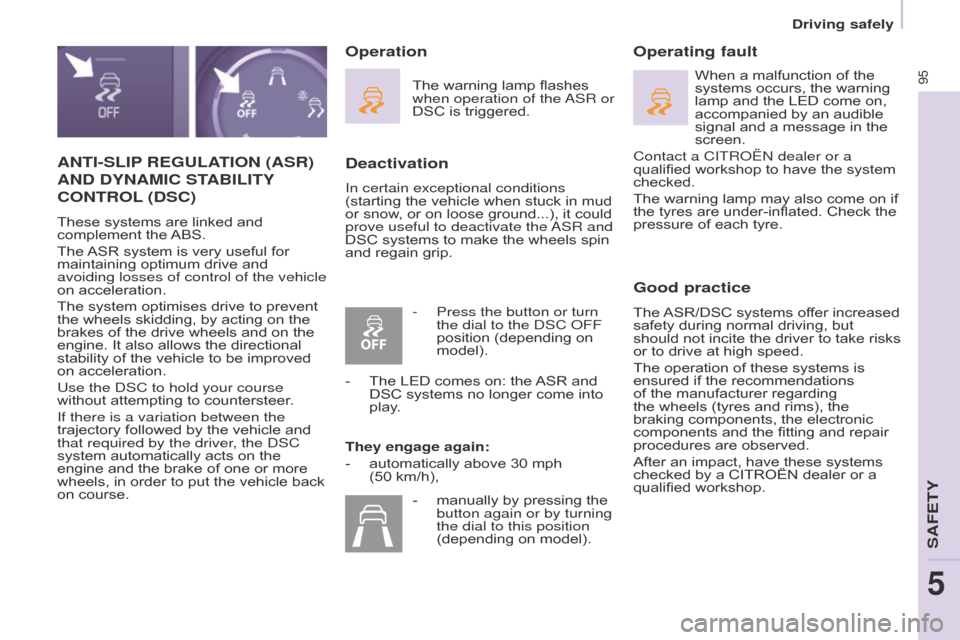
ANTI-SLIP REGULATION (ASR)
AND
DYNAMIC STABILITY
CONTROL (DSC)
These systems are linked and
complement the ABS.
The ASR system is very useful for
maintaining optimum drive and
avoiding losses of control of the vehicle
on acceleration.
The system optimises drive to prevent
the wheels skidding, by acting on the
brakes of the drive wheels and on the
engine. It also allows the directional
stability of the vehicle to be improved
on acceleration.
Use the
d SC to hold your course
without attempting to countersteer.
If there is a variation between the
trajectory followed by the vehicle and
that required by the driver, the
d SC
system automatically acts on the
engine and the brake of one or more
wheels, in order to put the vehicle back
on course.
Deactivation
In certain exceptional conditions
(starting the vehicle when stuck in mud
or snow, or on loose ground...), it could
prove useful to deactivate the
a
SR and
DSC systems to make the wheels spin
and regain grip.
Operating fault
Good practice
The ASR/DSC systems offer increased
safety during normal driving, but
should not incite the driver to take risks
or to drive at high speed.
The operation of these systems is
ensured if the recommendations
of the manufacturer regarding
the wheels (tyres and rims), the
braking components, the electronic
components and the fitting and repair
procedures are observed.
After an impact, have these systems
checked by a CITROËN dealer or a
qualified workshop.
Operation
The warning lamp flashes
when operation of the a SR or
DSC is triggered.
They engage again:
-
automatically above 30 mph
(50 km/h), When a malfunction of the
systems occurs, the warning
lamp and the LED come on,
accompanied by an audible
signal and a message in the
screen.
Contact a CITR
o Ë n dealer or a
qualified workshop to have the system
checked.
The warning lamp may also come on if
the tyres are under-inflated. Check the
pressure of each tyre.
-
Press the button or turn
the dial to the
d SC o FF
position (depending on
model).
-
The LED comes on: the
ASR and
DSC systems no longer come into
play.
-
manually by pressing the
button again or by turning
the dial to this position
(depending on model).
Driving safely
SAFETY
5
Page 100 of 264

98
Berlingo-2-VU_en_Chap05_Securite_ed01-2016
ACTIVE CITY BRAKE
Active City Brake is a driving
assistance system that aims to avoid
a frontal collision or reduce the speed
of an impact if the driver does not
react sufficiently (inadequate brake
application).
This system is designed to
improve driving safety.
It remains the driver's
responsibility to continuously
monitor the state of the traffic and
to assess the distances and relative
speeds of other vehicles.
Active City Brake can in no
circumstances replace the need for
vigilance on the part of the driver. Never look at the laser sensor
through an optical instrument
(magnifying glass, microscope...)
at a distance of less than
10
centimetres: risk of eye injury.Principle
Using a laser sensor located at the top
of the windscreen, this system detects
a vehicle running in the same direction
or stationary ahead of your vehicle.
When necessary, the vehicle's braking
system is operated automatically
to avoid a collision with the vehicle
ahead.Automatic braking occurs later
than if done by the driver, so as
to intervene only when there is a
high risk of collision.
Conditions for activation
Active City Brake only operates if the
following conditions are met:
●
ignition on,
●
the vehicle is in a forward gear
,
●
speed is between about 3 and
18 mph (5 and 30 km/h),
●
the braking assistance systems
(ABS, EBFD, emergency braking
assistance) are not faulty
,
●
the trajectory control systems
(ASR, DSC) are not deactivated
or faulty,
●
the vehicle is not in a tight corner
,
●
the system has not been triggered
during the previous 10 seconds.
Driving safely
Page 103 of 264

101
Berlingo-2-VU_en_Chap05_Securite_ed01-2016
Operating faults
Sensor fault
The operation of the laser sensor may
suffer interference from accumulations
of dirt or misting of the windscreen.
In this case you are warned by the
display of a message.
Use the windscreen demisting
and regularly clean the area of the
windscreen in front of the sensor.Do not stick or otherwise fix any
object on the windscreen in front
of the sensor. System fault
In the event of a malfunction of the
system, you are warned by an audible
signal and the display of the message
Automatic braking system fault.
Have the system checked by a
CITROËN dealer or a qualified
workshop.
In the event of an impact to
the windscreen at the sensor,
deactivate the system and contact
a CITROËN dealer or a qualified
workshop
to
have your windscreen
replaced.
Never try to remove, adjust or test
the sensor.
o
nly a CITR o Ë n dealer or a
qualified workshop is able to work
on the system.
When towing a trailer or when the
vehicle is being towed, the system
must be deactivated.
driving safely
SaFETY
5
Page 108 of 264

106
Berlingo-2-VU_en_Chap05_Securite_ed01-2016Berlingo-2-VU_en_Chap05_Securite_ed01-2016
Lateral airbags
This is a system which protects the
driver and front passenger in the event
of a serious side impact in order to limit
the risk of injury to the chest.
Each lateral airbag is fitted in the front
seat backrest frame, on the door side.
Deployment
It is deployed unilaterally in the event
of a serious side impact applied to
all or part of the side impact zone B,
perpendicular to the longitudinal
centreline of the vehicle on a horizontal
plane and directed from the outside
towards the inside of the vehicle.
The lateral airbag inflates between the
front occupant of the vehicle and the
corresponding door trim panel. Impact detection zones
A.
Front impact zone.
B.
Side impact zone.
In the event of a minor impact or
bump on the side of the vehicle or
if the vehicle rolls over
, the airbag
may not be deployed. Operating fault
If this warning lamp comes
on in the instrument panel,
accompanied by an audible
signal and a message in the
screen, contact a CITR o Ë n
dealer or a qualified workshop to have
the system checked. The airbags may
no longer be deployed in the event of a
serious impact.
airbags
Page 109 of 264

107
Berlingo-2-VU_en_Chap05_Securite_ed01-2016Berlingo-2-VU_en_Chap05_Securite_ed01-2016
Front airbags
Deployment
They are deployed, except the
passenger's front airbag if it has been
deactivated, in the event of a serious
front impact applied to all or part of the
front impact zone A in the longitudinal
centreline of the vehicle on a horizontal
plane directed from the front towards
the rear of the vehicle.
The front airbag inflates between the
front occupant of the vehicle and the
dashboard to cushion their forward
movement.Deactivating the passengers front
airbag
o
nly the passenger's front airbag can
be deactivated.
-
W
ith the ignition switched off,
insert the key into the passenger's
front airbag deactivation switch.
- T urn it to the "OFF" position.
-
Remove the key keeping the switch
in the new position.
The passenger's front airbag
warning lamp in the instrument
panel remains on while the
airbag is deactivated. If the two airbag warning lamps
are on continuously, do not install
a rearward facing child seat and
contact a CITR
o Ë n dealer or a
qualified workshop.
Front airbag fault
To ensure the safety of your child,
it is essential to deactivate the
passenger's front airbag when you
install a rearward facing child seat on
the front passenger seat. Otherwise,
the child would risk being killed or
seriously injured if the airbag were
deployed. Reactivation
In the "OFF" position, the passenger's
front airbag will not be deployed in the
event of an impact.
As soon as the child seat is removed,
turn the passenger's front airbag switch
to the "ON" position to reactivate the
airbag and thus ensure the safety
of your passenger in the event of an
impact.
If this warning lamp comes
on, accompanied by an
audible signal and a message
in the screen, consult a
CITR o Ë n dealer or a
qualified workshop to have
the system checked.
The front airbags are fitted in the
centre of the steering wheel for the
driver and in the dashboard for the
front passenger(s).
SAFETY
5
Airbags