Page 452 of 620
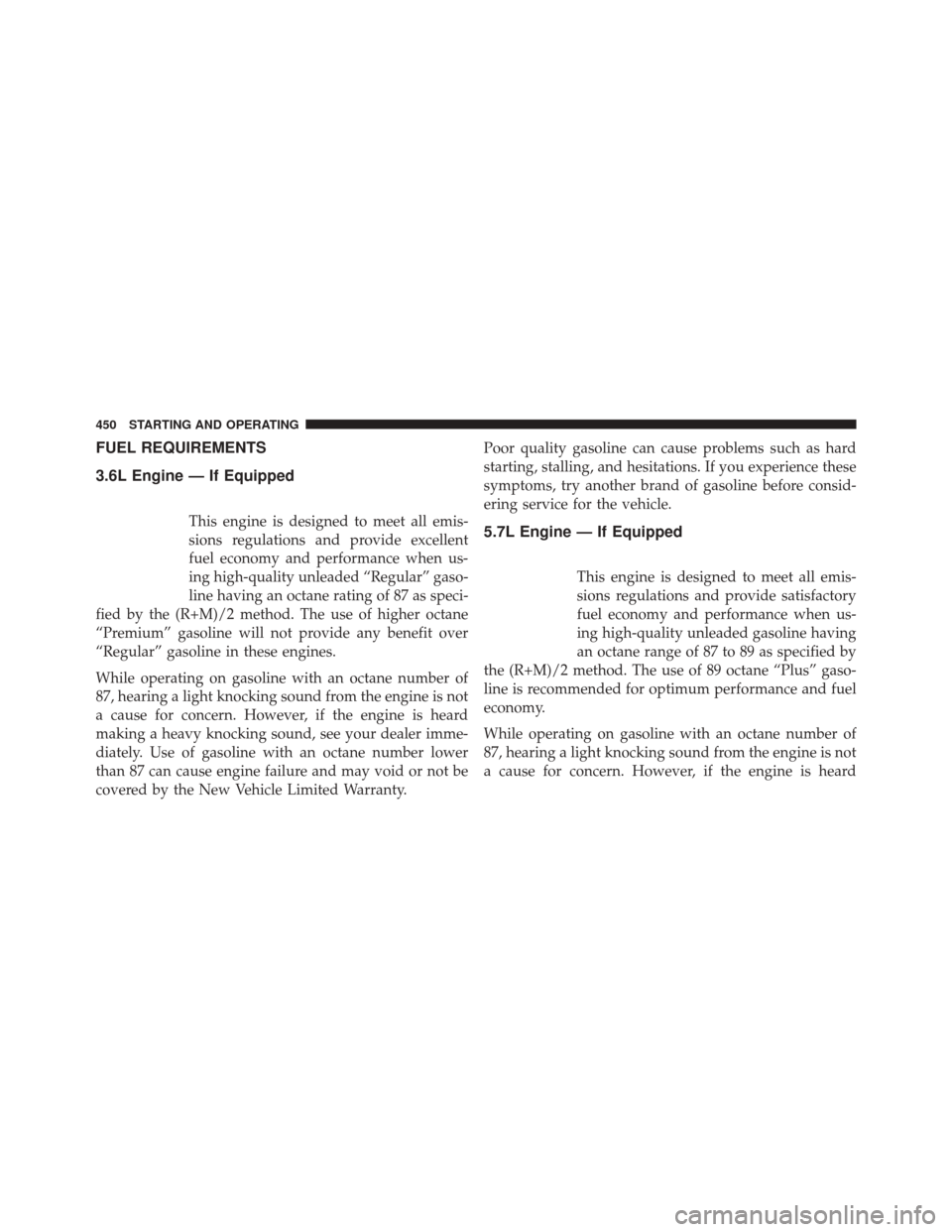
FUEL REQUIREMENTS
3.6L Engine — If Equipped
This engine is designed to meet all emis-
sions regulations and provide excellent
fuel economy and performance when us-
ing high-quality unleaded “Regular” gaso-
line having an octane rating of 87 as speci-
fied by the (R+M)/2 method. The use of higher octane
“Premium” gasoline will not provide any benefit over
“Regular” gasoline in these engines.
While operating on gasoline with an octane number of
87, hearing a light knocking sound from the engine is not
a cause for concern. However, if the engine is heard
making a heavy knocking sound, see your dealer imme-
diately. Use of gasoline with an octane number lower
than 87 can cause engine failure and may void or not be
covered by the New Vehicle Limited Warranty. Poor quality gasoline can cause problems such as hard
starting, stalling, and hesitations. If you experience these
symptoms, try another brand of gasoline before consid-
ering service for the vehicle.5.7L Engine — If Equipped
This engine is designed to meet all emis-
sions regulations and provide satisfactory
fuel economy and performance when us-
ing high-quality unleaded gasoline having
an octane range of 87 to 89 as specified by
the (R+M)/2 method. The use of 89 octane “Plus” gaso-
line is recommended for optimum performance and fuel
economy.
While operating on gasoline with an octane number of
87, hearing a light knocking sound from the engine is not
a cause for concern. However, if the engine is heard
450 STARTING AND OPERATING
Page 453 of 620
making a heavy knocking sound, see your dealer imme-
diately. Use of gasoline with an octane number lower
than 87 can cause engine failure and may void or not be
covered by the New Vehicle Limited Warranty.
Poor quality gasoline can cause problems such as hard
starting, stalling, and hesitations. If you experience these
symptoms, try another brand of gasoline before consid-
ering service for the vehicle.
Reformulated Gasoline
Many areas of the country require the use of cleaner
burning gasoline referred to as “Reformulated Gasoline”.
Reformulated gasoline contains oxygenates and are spe-
cifically blended to reduce vehicle emissions and im-
prove air quality.
The use of reformulated gasoline is recommended. Prop-
erly blended reformulated gasoline will provide im-
proved performance and durability of engine and fuel
system components.
Gasoline/Oxygenate Blends
Some fuel suppliers blend unleaded gasoline with oxy-
genates such as ethanol.
CAUTION!
DO NOT use gasoline containing methanol or gaso-
line containing more than 15% ethanol (E-15). Use of
these blends may result in starting and drivability
problems, damage critical fuel system components,
cause emissions to exceed the applicable standard,
and/or cause the “Malfunction Indicator Light” to
illuminate. Please observe pump labels as they
should clearly communicate if a fuel contains greater
than 15% ethanol (E-15).
Problems that result from using gasoline containing more
than 15% ethanol (E-15) or gasoline containing methanol
5
STARTING AND OPERATING 451
Page 454 of 620
are not the responsibility of the manufacturer and may
void or not be covered under New Vehicle Limited
Warranty.
E-85 Usage In Non-Flex Fuel Vehicles
Non-Flex Fuel Vehicles (FFV) are compatible with gaso-
line containing up to 15% ethanol (E-15). Gasoline with
higher ethanol content may void the New Vehicle Lim-
ited Warranty.
If a Non-FFV vehicle is inadvertently fueled with E-85
fuel, the engine will have some or all of these symptoms:
•Operate in a lean mode.
• OBD II “Malfunction Indicator Light” on.
• Poor engine performance.
• Poor cold start and cold drivability.
• Increased risk for fuel system component corrosion.
MMT In Gasoline
Methylcyclopentadienyl Manganese Tricarbonyl (MMT)
is a manganese-containing metallic additive that is
blended into some gasoline to increase octane. Gasoline
blended with MMT provides no performance advantage
beyond gasoline of the same octane number without
MMT. Gasoline blended with MMT reduces spark plug
life and reduces emissions system performance in some
vehicles. The manufacturer recommends that gasoline
without MMT be used in your vehicle. The MMT content
of gasoline may not be indicated on the gasoline pump,
therefore, you should ask your gasoline retailer whether
the gasoline contains MMT. MMT is prohibited in Federal
and California reformulated gasoline.
Materials Added To Fuel
Besides using unleaded gasoline with the proper octane
rating, gasolines that contain detergents, corrosion and
stability additives are recommended. Using gasolines
452 STARTING AND OPERATING
Page 456 of 620
CAUTION!(Continued)
•The use of fuel additives, which are now being
sold as octane enhancers, is not recommended.
Most of these products contain high concentrations
of methanol. Fuel system damage or vehicle perfor-
mance problems resulting from the use of such
fuels or additives is not the responsibility of the
manufacturer and may void or not be covered
under the New Vehicle Limited Warranty.
NOTE: Intentional tampering with the emissions control
system can result in civil penalties being assessed against
you.
Carbon Monoxide Warnings
WARNING!
Carbon monoxide (CO) in exhaust gases is deadly.
Follow the precautions below to prevent carbon
monoxide poisoning:
• Do not inhale exhaust gases. They contain carbon
monoxide, a colorless and odorless gas, which can
kill. Never run the engine in a closed area, such as
a garage, and never sit in a parked vehicle with the
engine running for an extended period. If the
vehicle is stopped in an open area with the engine
running for more than a short period, adjust the
ventilation system to force fresh, outside air into
the vehicle.
• Guard against carbon monoxide with proper main-
tenance. Have the exhaust system inspected every
(Continued)
454 STARTING AND OPERATING
Page 458 of 620
Fuel Requirements
If your vehicle is E-85 compatible, it will operate on
unleaded gasoline with any octane rating, or solely E-85
fuel, or any mixture of these fuels.
For best results, avoid fueling patterns alternating
between E-85 and unleaded gasoline.
When switching fuel types:
•Add 5 gallons (19 liters) or more when refueling.
• Drive the vehicle immediately after refueling for at
least 5 miles (8 km).
Observing these precautions will avoid possible hard
starting and/or driveability problems during warm up. NOTE:
•
Use seasonally adjusted E-85 fuel (ASTM D5798). With
non-seasonally adjusted E-85 fuel, hard starting and
rough idle following start up may be experienced even
if the above recommendations are followed, especially
when the ambient temperature is below 32°F (0°C).
• Some additives used in regular gasoline are not fully
compatible with E-85 and may form deposits in your
engine. To eliminate driveability issues that may be
caused by these deposits, a supplemental gasoline
additive, such as MOPAR Injector Cleanup or Techron
may be used.
Selection Of Engine Oil For Flexible Fuel Vehicles
(E-85) And Gasoline Vehicles
FFV vehicles operated on E-85 require specially formu-
lated engine oils. These special requirements are included
in MOPAR engine oils, and in equivalent oils meeting
456 STARTING AND OPERATING
Page 568 of 620
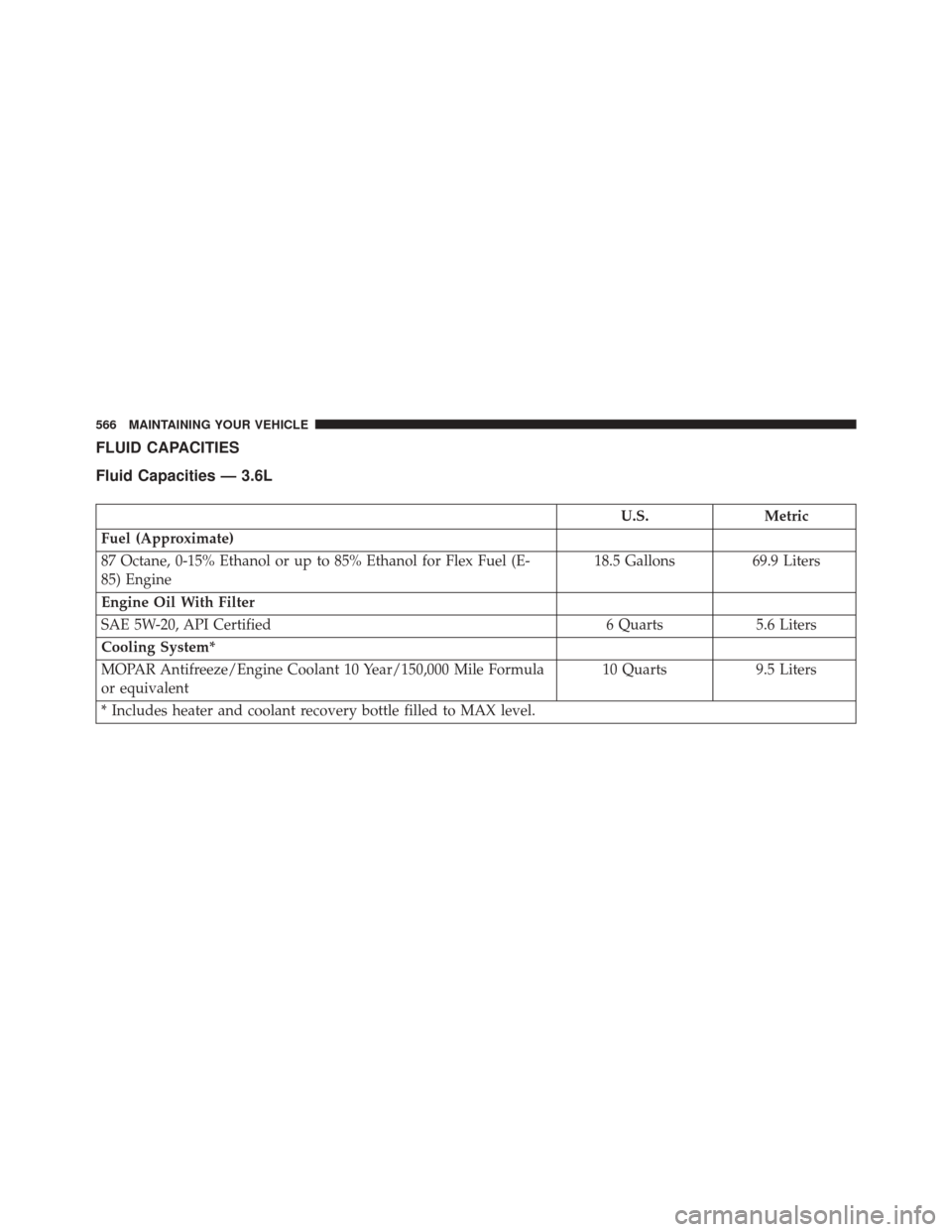
FLUID CAPACITIES
Fluid Capacities — 3.6L
U.S.Metric
Fuel (Approximate)
87 Octane, 0-15% Ethanol or up to 85% Ethanol for Flex Fuel (E-
85) Engine 18.5 Gallons
69.9 Liters
Engine Oil With Filter
SAE 5W-20, API Certified 6 Quarts5.6 Liters
Cooling System*
MOPAR Antifreeze/Engine Coolant 10 Year/150,000 Mile Formula
or equivalent 10 Quarts
9.5 Liters
* Includes heater and coolant recovery bottle filled to MAX level.
566 MAINTAINING YOUR VEHICLE
Page 569 of 620
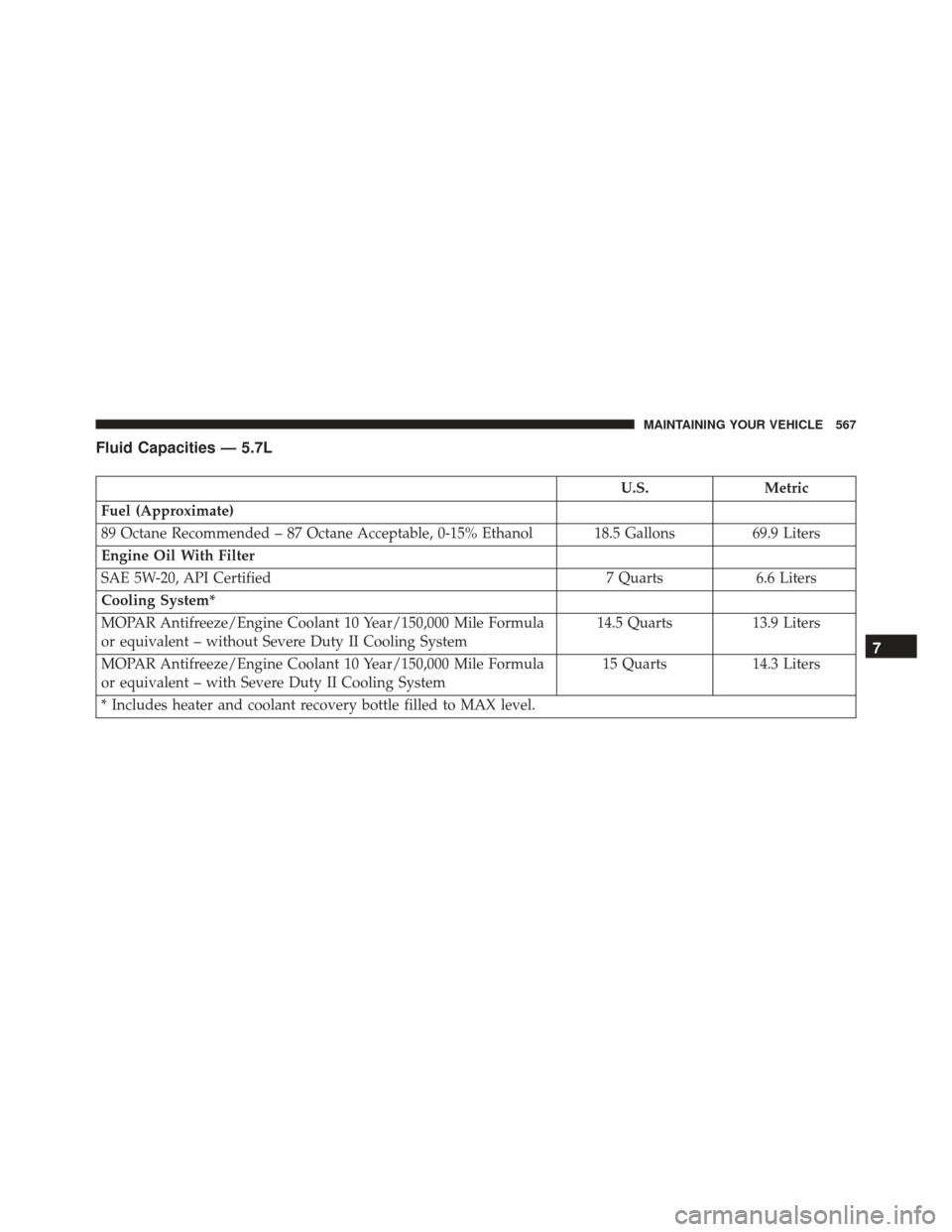
Fluid Capacities — 5.7L
U.S.Metric
Fuel (Approximate)
89 Octane Recommended – 87 Octane Acceptable, 0-15% Ethanol 18.5 Gallons 69.9 Liters
Engine Oil With Filter
SAE 5W-20, API Certified 7 Quarts6.6 Liters
Cooling System*
MOPAR Antifreeze/Engine Coolant 10 Year/150,000 Mile Formula
or equivalent – without Severe Duty II Cooling System 14.5 Quarts
13.9 Liters
MOPAR Antifreeze/Engine Coolant 10 Year/150,000 Mile Formula
or equivalent – with Severe Duty II Cooling System 15 Quarts
14.3 Liters
* Includes heater and coolant recovery bottle filled to MAX level.
7
MAINTAINING YOUR VEHICLE 567
Page 571 of 620
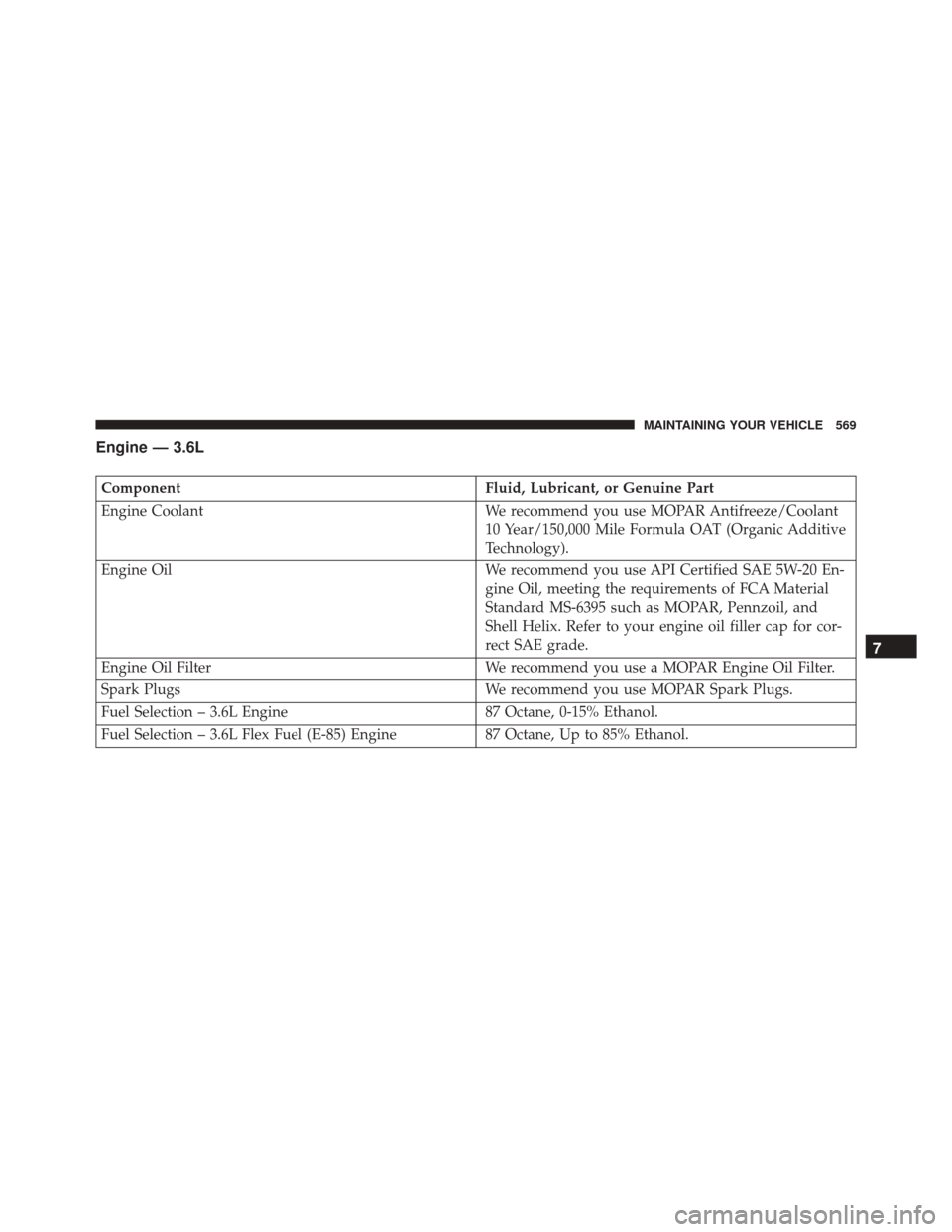
Engine — 3.6L
ComponentFluid, Lubricant, or Genuine Part
Engine Coolant We recommend you use MOPAR Antifreeze/Coolant
10 Year/150,000 Mile Formula OAT (Organic Additive
Technology).
Engine Oil We recommend you use API Certified SAE 5W-20 En-
gine Oil, meeting the requirements of FCA Material
Standard MS-6395 such as MOPAR, Pennzoil, and
Shell Helix. Refer to your engine oil filler cap for cor-
rect SAE grade.
Engine Oil Filter We recommend you use a MOPAR Engine Oil Filter.
Spark Plugs We recommend you use MOPAR Spark Plugs.
Fuel Selection – 3.6L Engine 87 Octane, 0-15% Ethanol.
Fuel Selection – 3.6L Flex Fuel (E-85) Engine 87 Octane, Up to 85% Ethanol.
7
MAINTAINING YOUR VEHICLE 569