2016 CHRYSLER 300 coolant level
[x] Cancel search: coolant levelPage 272 of 620
1. Tachometer•Indicates the engine speed in revolutions per minute
(RPM x 1000).
2. Driver Information Display (DID) Display •When the appropriate conditions exist, this display
shows the Driver Information Display (DID) mes-
sages. Refer to “Driver Information Display (DID)”
in “Understanding Your Instrument Panel” for fur-
ther information.
3. Speedometer •Indicates vehicle speed.
4. Fuel Gauge •The pointer shows the level of fuel in the fuel tank
when the Keyless Push Button Ignition is in the
ON/RUN position.
The fuel pump symbol
points to the side of the
vehicle where the fuel door is located.
5. Temperature Gauge
•The temperature gauge shows engine coolant tem-
perature. Any reading within the normal range indi-
cates that the engine cooling system is operating
satisfactorily.
• The gauge pointer will likely indicate a higher tem-
perature when driving in hot weather, up mountain
grades, or when towing a trailer. It should not be
allowed to exceed the upper limits of the normal
operating range.
CAUTION!
Driving with a hot engine cooling system could
damage your vehicle. If the temperature gauge reads
“H” pull over and stop the vehicle. Idle the vehicle
with the air conditioner turned off until the pointer
drops back into the normal range. If the pointer
(Continued)
270 UNDERSTANDING YOUR INSTRUMENT PANEL
Page 533 of 620
miles (240,000 km) before replacement. To prevent reduc-
ing this extended maintenance period, it is important that
you use the same engine coolant (OAT coolant conform-
ing to MS.90032) throughout the life of your vehicle.
Please review these recommendations for using Organic
Additive Technology (OAT) engine coolant (antifreeze)
that meets the requirements of FCA Material Standard
MS.90032. When adding engine coolant (antifreeze):
•We recommend using MOPAR Antifreeze/Coolant 10
Year/150,000 Mile Formula OAT (Organic Additive
Technology) that meets the requirements of FCA Ma-
terial Standard MS.90032.
• Mix a minimum solution of 50% OAT engine coolant
that meets the requirements of FCA Material Standard
MS.90032 and distilled water. Use higher concentra-
tions (not to exceed 70%) if temperatures below 34°F
(37°C) are anticipated. Please contact your authorized
dealer for assistance. •
Use only high purity water such as distilled or deion-
ized water when mixing the water/engine coolant
(antifreeze) solution. The use of lower quality water
will reduce the amount of corrosion protection in the
engine cooling system.
NOTE:
• It is the owner’s responsibility to maintain the proper
level of protection against freezing according to the
temperatures occurring in the area where the vehicle is
operated.
• Some vehicles require special tools to add coolant
properly. Failure to fill these systems properly could
lead to severe internal engine damage. If any coolant is
needed to be added to the system, please contact your
local authorized dealer.
• Mixing engine coolant (antifreeze) types is not recom-
mended and can result in cooling system damage. If
7
MAINTAINING YOUR VEHICLE 531
Page 535 of 620
puddles on the ground. If ingested by a child or pet, seek
emergency assistance immediately. Clean up any ground
spills immediately.
Coolant Level
The coolant bottle provides a quick visual method for
determining that the coolant level is adequate. With the
engine OFF and cold, the level of the engine coolant
(antifreeze) in the bottle should be between the ranges
indicated on the bottle.
The radiator normally remains completely full, so there is
no need to remove the radiator/coolant pressure cap
unless checking for engine coolant (antifreeze) freeze
point or replacing coolant. Advise your service attendant
of this. As long as the engine operating temperature is
satisfactory, the coolant bottle need only be checked once
a month.When additional engine coolant (antifreeze) is needed to
maintain the proper level, only OAT coolant that meets
the requirements of FCA Material Standard MS.90032
should be added to the coolant bottle. Do not overfill.Points To Remember
NOTE:
When the vehicle is stopped after a few miles/
kilometers of operation, you may observe vapor coming
from the front of the engine compartment. This is nor-
mally a result of moisture from rain, snow, or high
humidity accumulating on the radiator and being vapor-
ized when the thermostat opens, allowing hot engine
coolant (antifreeze) to enter the radiator.
If an examination of your engine compartment shows no
evidence of radiator or hose leaks, the vehicle may be
safely driven. The vapor will soon dissipate.
• Do not overfill the coolant expansion bottle.
7
MAINTAINING YOUR VEHICLE 533
Page 568 of 620
FLUID CAPACITIES
Fluid Capacities — 3.6L
U.S.Metric
Fuel (Approximate)
87 Octane, 0-15% Ethanol or up to 85% Ethanol for Flex Fuel (E-
85) Engine 18.5 Gallons
69.9 Liters
Engine Oil With Filter
SAE 5W-20, API Certified 6 Quarts5.6 Liters
Cooling System*
MOPAR Antifreeze/Engine Coolant 10 Year/150,000 Mile Formula
or equivalent 10 Quarts
9.5 Liters
* Includes heater and coolant recovery bottle filled to MAX level.
566 MAINTAINING YOUR VEHICLE
Page 569 of 620
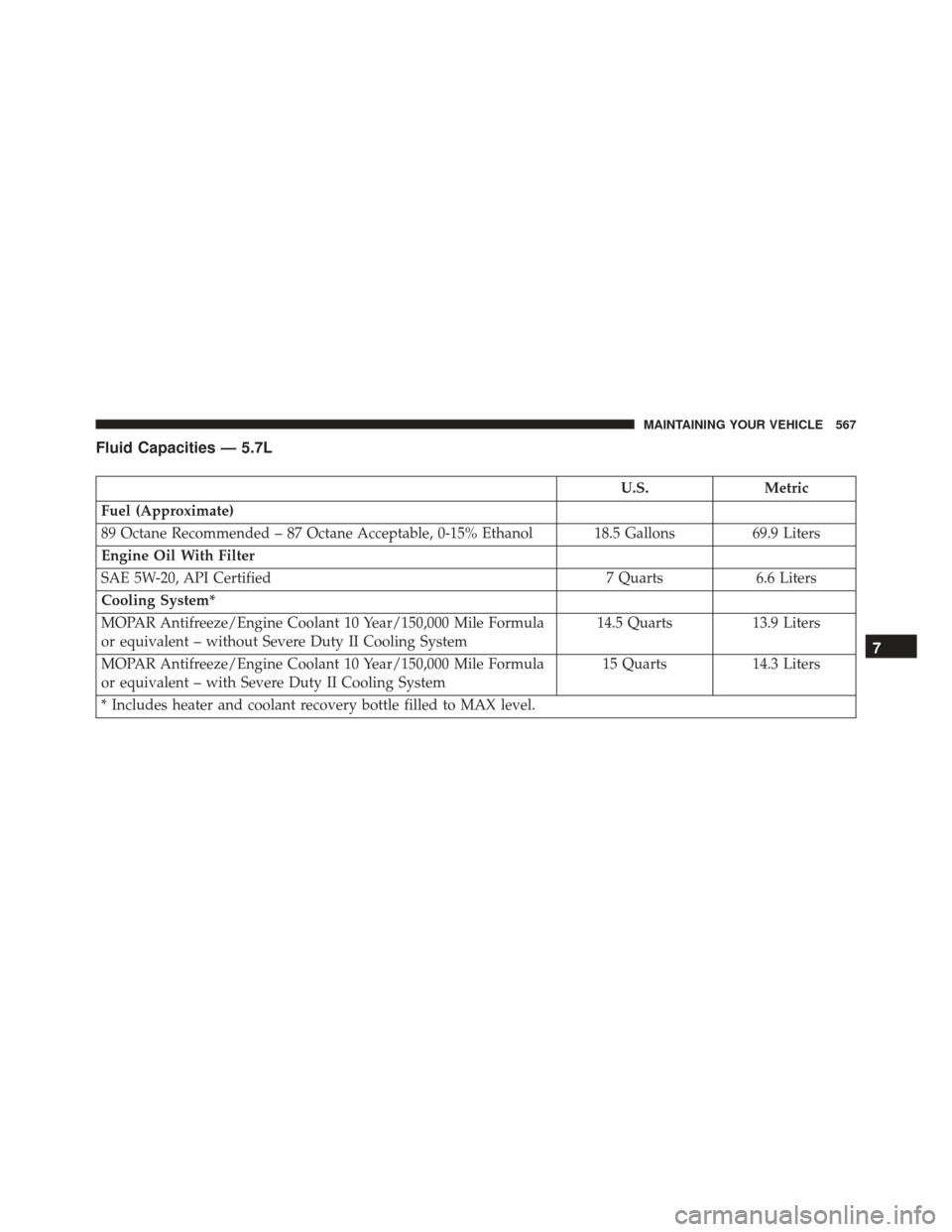
Fluid Capacities — 5.7L
U.S.Metric
Fuel (Approximate)
89 Octane Recommended – 87 Octane Acceptable, 0-15% Ethanol 18.5 Gallons 69.9 Liters
Engine Oil With Filter
SAE 5W-20, API Certified 7 Quarts6.6 Liters
Cooling System*
MOPAR Antifreeze/Engine Coolant 10 Year/150,000 Mile Formula
or equivalent – without Severe Duty II Cooling System 14.5 Quarts
13.9 Liters
MOPAR Antifreeze/Engine Coolant 10 Year/150,000 Mile Formula
or equivalent – with Severe Duty II Cooling System 15 Quarts
14.3 Liters
* Includes heater and coolant recovery bottle filled to MAX level.
7
MAINTAINING YOUR VEHICLE 567
Page 577 of 620

Severe Duty All Models
Change Engine Oil at 4,000 miles (6,500 km) if the vehicle
is operated in a dusty and off road environment or is
operated predominantly at idle or only very low engine
RPM’s. This type of vehicle use is considered Severe
Duty.
Once A Month Or Before A Long Trip:
•Check engine oil level.
• Check windshield washer fluid level.
• Check tire pressure and look for unusual wear or
damage. Rotate tires at the first sign of irregular wear,
even if it occurs before your next scheduled service.
• Check the fluid levels of the coolant reservoir, brake
master cylinder, and power steering (if equipped) and
fill as needed.
• Check function of all interior and exterior lights. Required Maintenance Intervals:
Refer to the maintenance schedules on the following
page for the required maintenance intervals.
At Every Oil Change Interval As Indicated By Oil
Change Indicator System:
•Change oil and filter
• Rotate the tires.
Rotate at the first sign of irregular
wear, even if it occurs before your next scheduled service
• Inspect battery and clean and tighten terminals as
required
• Inspect brake pads, shoes, rotors, drums, hoses
and park brake
•
Inspect engine cooling system protection and hoses
• Inspect exhaust system
• Inspect engine air cleaner if using in dusty or
off-road conditions 8
MAINTENANCE SCHEDULES 575
Page 597 of 620

AlarmArm The System ........................20
Alarm, Panic .............................24
Alarm (Security Alarm) ..................19, 276
Alarm System (Security Alarm) ................19
All Wheel Drive Towing ............................. .501
All Wheel Drive (AWD) .................394, 538
Alterations/Modifications, Vehicle ...............7
Antifreeze (Engine Coolant) ...............530, 566
Disposal ............................. .532
Anti-Lock Brake System (ABS) ................404
Anti-Lock Warning Light ....................291
Appearance Care ........................ .539
Arming System (Security Alarm) ...............19
Assist, Hill Start ......................... .407
Auto Down Power Windows ..................42
Automatic Door Locks ......................34
Automatic Headlights ..................... .153Automatic High Beams
.....................154
Automatic Temperature Control (ATC) .......338, 345
Automatic Transmission .................384, 538
Adding Fluid ...................538, 568, 571
Fluid And Filter Changes ..................538
Fluid Change ......................... .538
Fluid Level Check ...................536, 537
Fluid Type ........................ .568, 571
Gear Ranges .......................... .385
Special Additives ...................... .537
Autostick Operation ............................ .391
Auto Unlock, Doors ........................34
Auto Up Power Windows ....................43
AW D Towing ............................. .501
Axle Fluid .......................... .568, 571
Axle Lubrication ..................... .568, 571
10
INDEX 595
Page 599 of 620

Changing A Flat Tire...................... .481
Chart, Tire Sizing ........................ .418
Check Engine Light (Malfunction Indicator Light) . .511
Checking Your Vehicle For Safety ...............99
Checks, Safety ............................99
Child Restraint ............................77
Child Restraints Booster Seats ...........................82
Center Seat LATCH ......................90
Child Restraints .........................77
Child Seat Installation .....................95
How To Stow An Unused ALR Seat Belt ........91
Infants And Child Restraints ................80
Install A LATCH-Compatible Child Restraint ....90
Lower Anchors And Tethers For Children .......84
Older Children And Child Restraints ..........80
Seating Positions ........................83
Child Safety Locks .........................35
Clean Air Gasoline ....................... .451Cleaning
Wheels .............................. .542
Climate Control ......................... .338
Automatic ........................... .338
Clock ................................. .314
Coin Holder ............................ .255
Cold Weather Operation ....................379
Compact Disc (CD) Maintenance ..............337
Compact Spare Tire ....................... .435
Connector UCI................................ .334
Universal Consumer Interface (UCI) ..........334
Console, Floor .......................... .255
Contract, Service ......................... .585
Coolant Pressure Cap (Radiator Cap) ...........532
Cooling System .......................... .528
Adding Coolant (Antifreeze) ...............530
Coolant Capacity ...................... .566
Coolant Level ..................... .528, 533
10
INDEX 597