Page 629 of 702
Cavity Cartridge FuseBlade FuseDescription
F10 –20 Amp Yellow Power Transfer Unit (PTU) –
If Equipped
F11 – – Not Used
F12 –20 Amp Yellow Brake Vacuum Pump – If Equipped
F13 –10 Amp Red Engine Control Module (ECM)/VSM
(Engine Stop/Start Only)
F14 –10 Amp Red Drivetrain Control Module (DTCM)/
Power Transfer Unit (PTU) – If
Equipped/RDM/Brake System Module (BSM)/Brake Pedal Switch/EPB (Electric Park Brake)
F15 – – Not Used
F16 –20 Amp Yellow Ignition Coil
F17 – – Not Used
F18 – – Not Used
F19 40 Amp Green –Starter Solenoid
7
MAINTAINING YOUR VEHICLE 627
Page 645 of 702
5. Disconnect the bulb from the electrical connector andthen connect the replacement bulb.CAUTION!
Do not touch the new bulb with your fingers. Oil
contamination will severely shorten bulb life. If the
bulb comes in contact with any oily surface, clean the
bulb with rubbing alcohol.
Headlamp Bulb SocketHeadlamp Bulb
7
MAINTAINING YOUR VEHICLE 643
Page 650 of 702
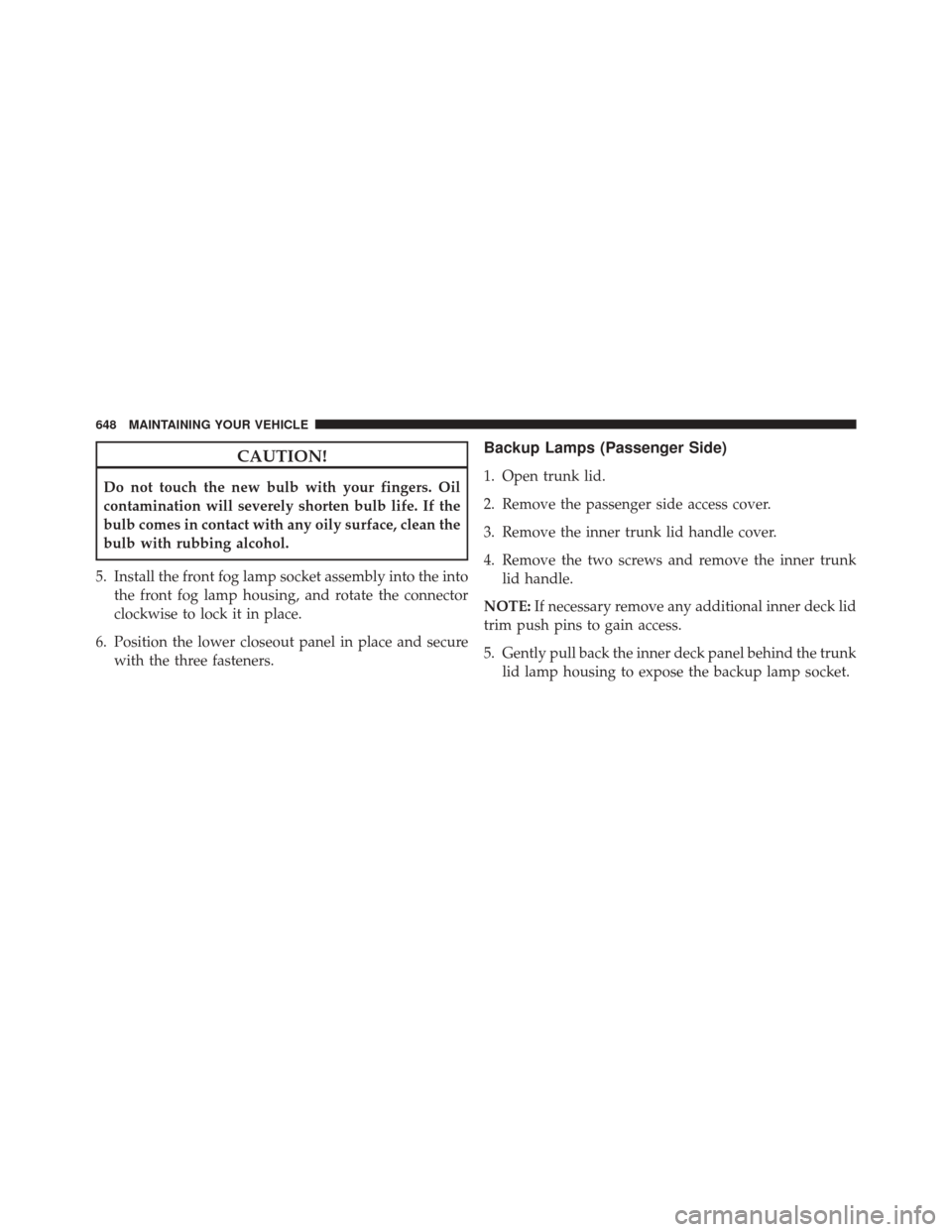
CAUTION!
Do not touch the new bulb with your fingers. Oil
contamination will severely shorten bulb life. If the
bulb comes in contact with any oily surface, clean the
bulb with rubbing alcohol.
5. Install the front fog lamp socket assembly into the into the front fog lamp housing, and rotate the connector
clockwise to lock it in place.
6. Position the lower closeout panel in place and secure with the three fasteners.
Backup Lamps (Passenger Side)
1. Open trunk lid.
2. Remove the passenger side access cover.
3. Remove the inner trunk lid handle cover.
4. Remove the two screws and remove the inner trunklid handle.
NOTE: If necessary remove any additional inner deck lid
trim push pins to gain access.
5. Gently pull back the inner deck panel behind the trunk lid lamp housing to expose the backup lamp socket.
648 MAINTAINING YOUR VEHICLE
Page 655 of 702
FLUID CAPACITIES
U.S.Metric
Fuel (Approximate)
2.4L and 3.6L Engines 15.8 Gallons60 Liters
Engine Oil With Filter
2.4 Liter Engine (SAE 0W-20, API Certified) 5.5 Quarts5.2 Liters
3.6 Liter Engine (SAE 5W-20, API Certified) 6 Quarts5.6 Liters
Cooling System*
2.4 Liter Engine (MOPAR Antifreeze/Engine Coolant
10 Year/150,000 Mile Formula) 7.2 Quarts
6.8 Liters
3.6 Liter Engine (MOPAR Antifreeze/Engine Coolant
10 Year/150,000 Mile Formula) 8.7 Quarts
8.2 Liters
* Includes heater and coolant reservoir filled to MAX level.
7
MAINTAINING YOUR VEHICLE 653
Page 656 of 702
FLUIDS, LUBRICANTS, AND GENUINE PARTS
Engine
ComponentFluid, Lubricant, or Genuine Part
Engine Coolant We recommend you use MOPAR Antifreeze/Coolant 10
Year/150,000 Mile Formula OAT (Organic Additive Tech-
nology) or equivalent meeting the requirements of FCA
Material Standard MS.90032.
Engine Oil – 2.4L Engine We recommend you use SAE 0W-20 API Certified Engine
Oil, meeting the requirements of FCA US Material Stan-
dard MS-6395 such as MOPAR, Pennzoil, and Shell Helix.
Refer to your engine oil filler cap for correct SAE grade.
Engine Oil – 3.6L Engine We recommend you use API Certified SAE 5W-20 Engine
Oil, meeting the requirements of FCA US Material Stan-
dard MS-6395 such as MOPAR, Pennzoil, and Shell Helix.
Refer to your engine oil filler cap for correct SAE grade.
654 MAINTAINING YOUR VEHICLE
Page 657 of 702
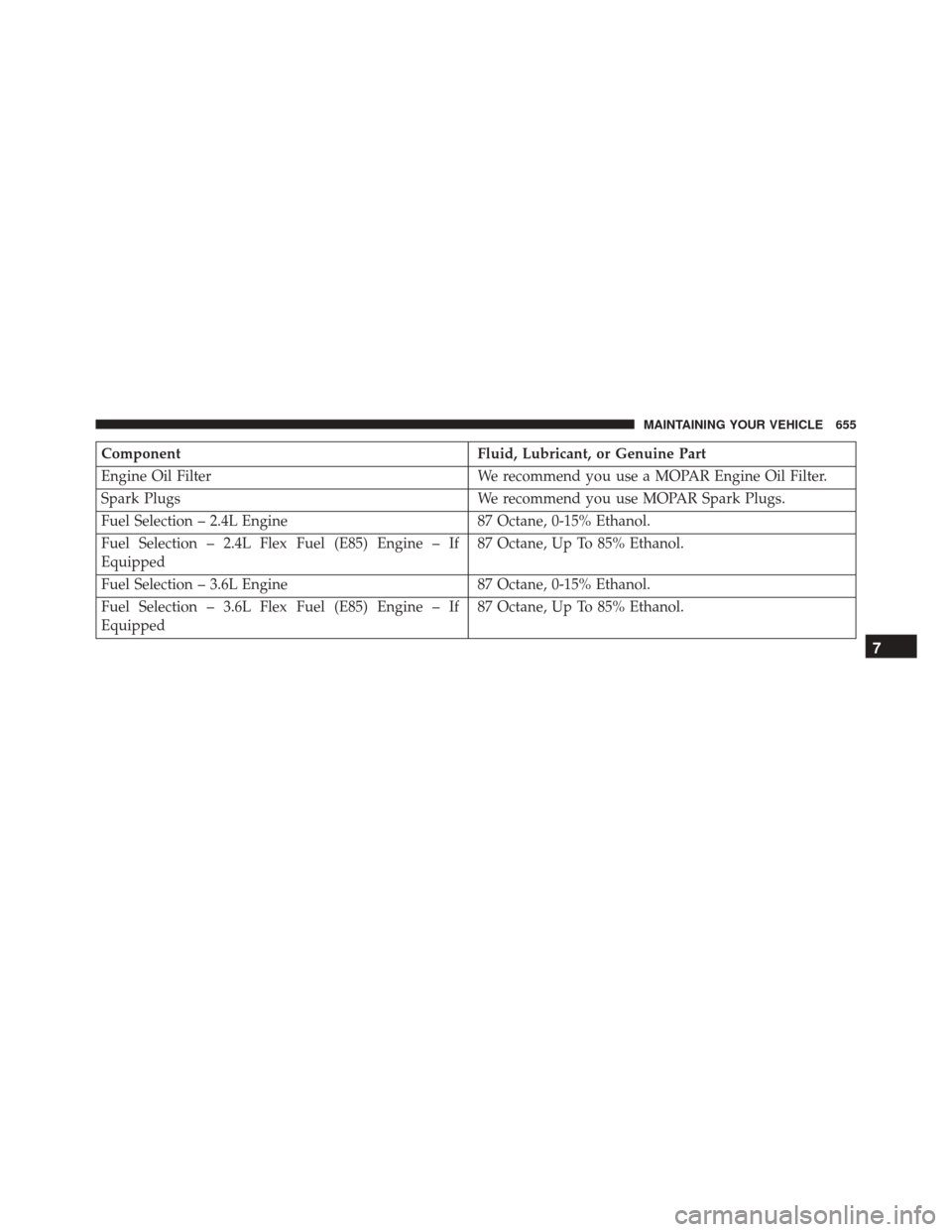
ComponentFluid, Lubricant, or Genuine Part
Engine Oil Filter We recommend you use a MOPAR Engine Oil Filter.
Spark Plugs We recommend you use MOPAR Spark Plugs.
Fuel Selection – 2.4L Engine 87 Octane, 0-15% Ethanol.
Fuel Selection – 2.4L Flex Fuel (E85) Engine – If
Equipped 87 Octane, Up To 85% Ethanol.
Fuel Selection – 3.6L Engine 87 Octane, 0-15% Ethanol.
Fuel Selection – 3.6L Flex Fuel (E85) Engine – If
Equipped 87 Octane, Up To 85% Ethanol.
7
MAINTAINING YOUR VEHICLE 655
Page 662 of 702

MAINTENANCE SCHEDULE
Your vehicle is equipped with an automatic oil change
indicator system. The oil change indicator system will
remind you that it is time to take your vehicle in for
scheduled maintenance.
Based on engine operation conditions, the oil change
indicator message will illuminate. This means that ser-
vice is required for your vehicle. Operating conditions
such as frequent short-trips, trailer tow, extremely hot or
cold ambient temperatures will influence when the “Oil
Change Required” message is displayed. Severe Operat-
ing Conditions can cause the change oil message to
illuminate as early as 3,500 miles (5,600 km) since last
reset. Have your vehicle serviced as soon as possible,
within the next 500 miles (805 km).
Your authorized dealer will reset the oil change indicator
message after completing the scheduled oil change. If a
scheduled oil change is performed by someone otherthan your authorized dealer, the message can be reset by
referring to the steps described under “Oil Change Reset”
in “Electronic Vehicle Information Center (EVIC)” or
�Driver Information Display (DID)” in “Understanding
Your Instrument Panel” for further information.
NOTE:
Under no circumstances should oil change inter-
vals exceed 10,000 miles (16,000 km), twelve months or
350 hours of engine run time, whichever comes first. The
350 hours of engine run or idle time is generally only a
concern for fleet customers.
Severe Duty All Models
Change Engine Oil at 4,000 miles (6,500 km) if the vehicle
is operated in a dusty and off road environment or is
operated predominately at idle or only very low engine
RPM’s. This type of vehicle use is considered Severe
Duty.
660 MAINTENANCE SCHEDULES
Page 663 of 702

Once A Month Or Before A Long Trip:
•Check engine oil level.
• Check windshield washer fluid level.
• Check tire pressure and look for unusual wear or
damage. Rotate tires at the first sign of irregular wear,
even if it occurs before the oil indicator system turns
on.
• Check the fluid levels of the coolant reservoir and
brake master cylinder, fill as needed.
• Check function of all interior and exterior lights.
Required Maintenance Intervals
Refer to the maintenance schedules on the following
page for the required maintenance intervals.At Every Oil Change Interval As Indicated By Oil Change Indicator System:
•Change oil and filter
• Rotate the tires. Rotate at the first sign of irregu-
lar wear, even if it occurs before the oil indicator
system turns on.
• Inspect battery and clean and tighten terminals as
required
• Inspect brake pads, shoes, rotors, drums, hoses
and park brake
• Inspect engine cooling system protection and
hoses
• Inspect exhaust system
• Inspect engine air cleaner if using in dusty or
off-road conditions 8
MAINTENANCE SCHEDULES 661