Page 75 of 702
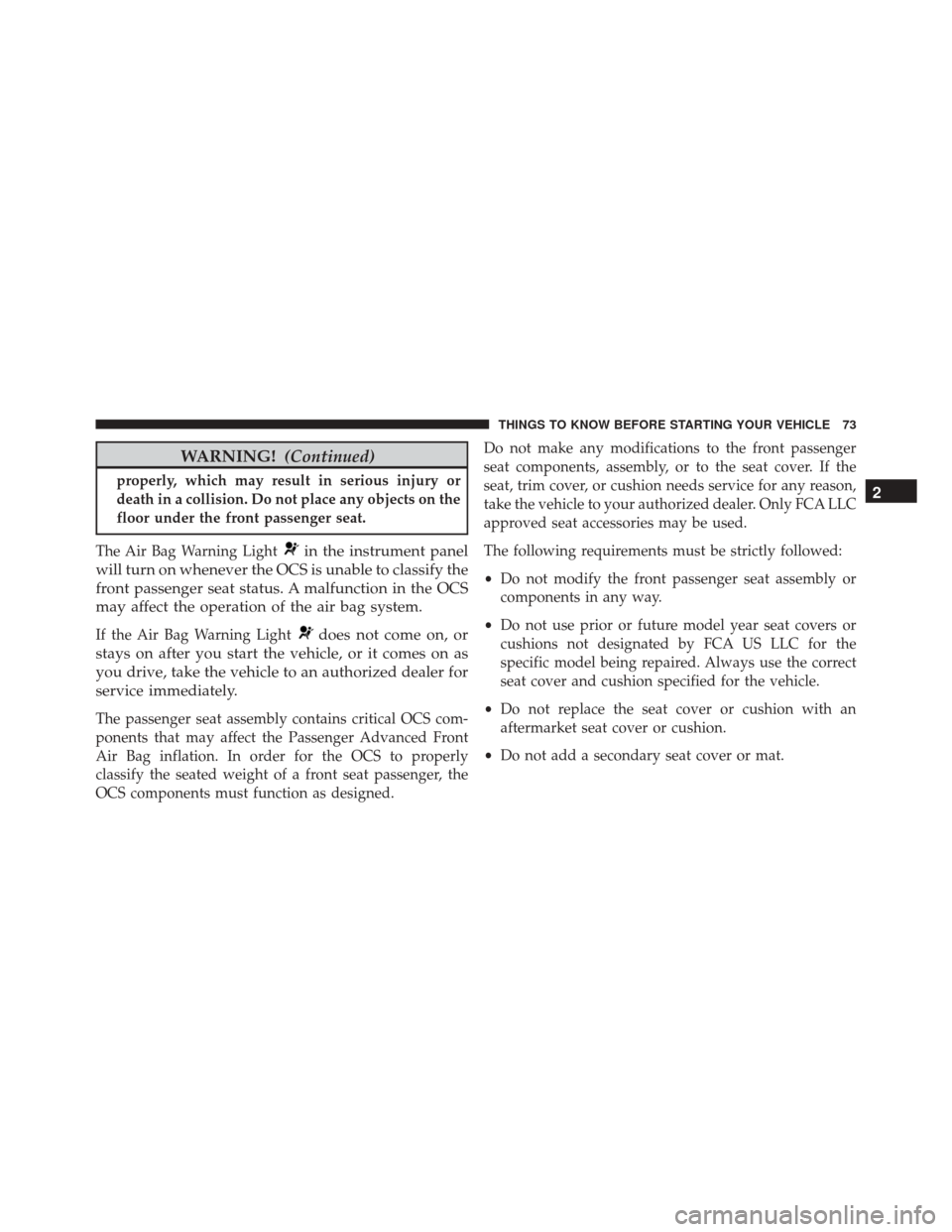
WARNING!(Continued)
properly, which may result in serious injury or
death in a collision. Do not place any objects on the
floor under the front passenger seat.
The Air Bag Warning Light
in the instrument panel
will turn on whenever the OCS is unable to classify the
front passenger seat status. A malfunction in the OCS
may affect the operation of the air bag system.
If the Air Bag Warning Lightdoes not come on, or
stays on after you start the vehicle, or it comes on as
you drive, take the vehicle to an authorized dealer for
service immediately.
The passenger seat assembly contains critical OCS com-
ponents that may affect the Passenger Advanced Front
Air Bag inflation. In order for the OCS to properly
classify the seated weight of a front seat passenger, the
OCS components must function as designed. Do not make any modifications to the front passenger
seat components, assembly, or to the seat cover. If the
seat, trim cover, or cushion needs service for any reason,
take the vehicle to your authorized dealer. Only FCA LLC
approved seat accessories may be used.
The following requirements must be strictly followed:
•
Do not modify the front passenger seat assembly or
components in any way.
• Do not use prior or future model year seat covers or
cushions not designated by FCA US LLC for the
specific model being repaired. Always use the correct
seat cover and cushion specified for the vehicle.
• Do not replace the seat cover or cushion with an
aftermarket seat cover or cushion.
• Do not add a secondary seat cover or mat.
2
THINGS TO KNOW BEFORE STARTING YOUR VEHICLE 73
Page 89 of 702
NOTE:
•
For additional information, refer to www.seatcheck.org or
call 1–866–732–8243.
•Canadian residents should refer to Transport Canada’s
website for additional information: www.tc.gc.ca/eng/
motorvehiclesafety/safedrivers-childsafety-index-53.htm
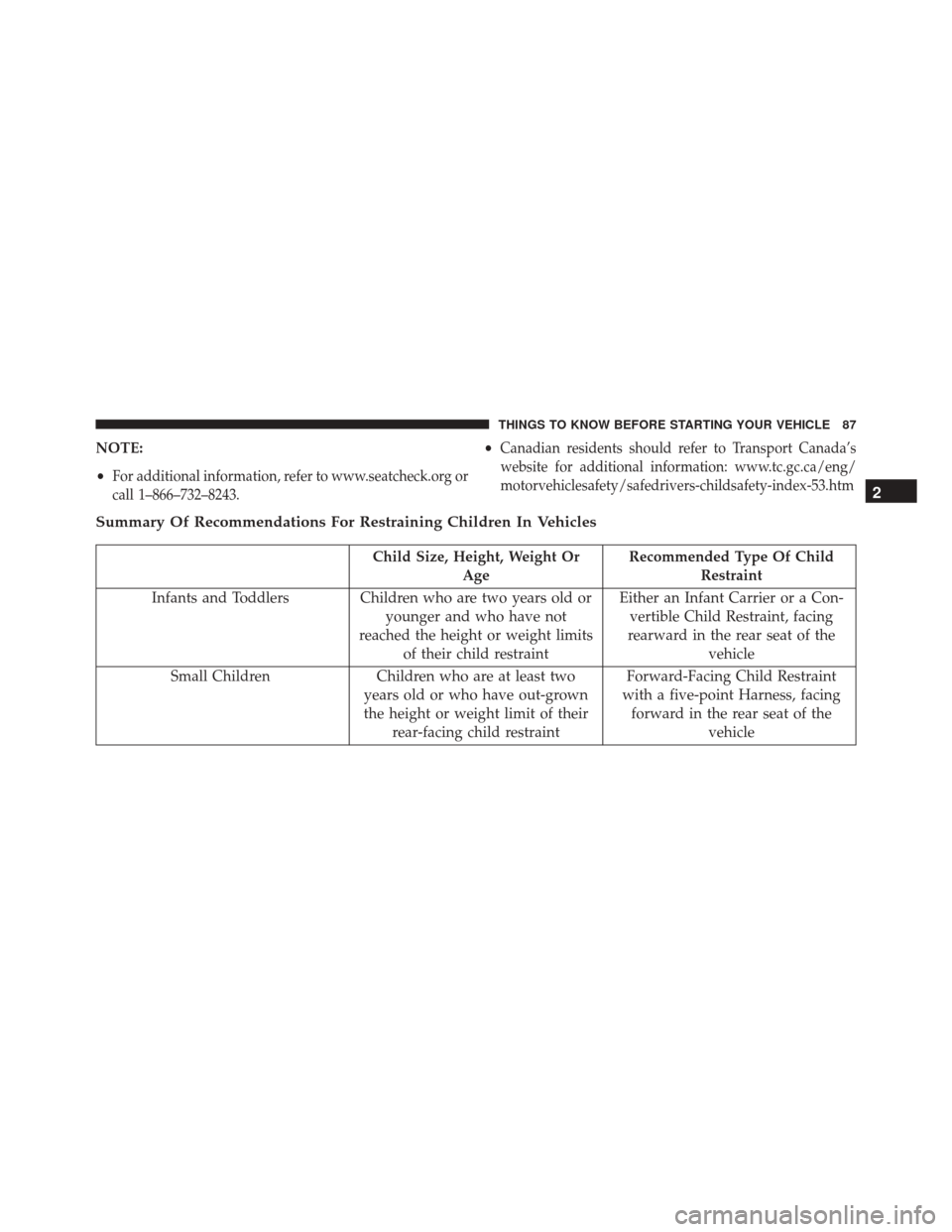
Summary Of Recommendations For Restraining Children In Vehicles
Child Size, Height, Weight Or Age Recommended Type Of Child
Restraint
Infants and Toddlers Children who are two years old or younger and who have not
reached the height or weight limits of their child restraint Either an Infant Carrier or a Con-
vertible Child Restraint, facing
rearward in the rear seat of the vehicle
Small Children Children who are at least two
years old or who have out-grown
the height or weight limit of their rear-facing child restraint Forward-Facing Child Restraint
with a five-point Harness, facing forward in the rear seat of the vehicle
2
THINGS TO KNOW BEFORE STARTING YOUR VEHICLE 87
Page 90 of 702
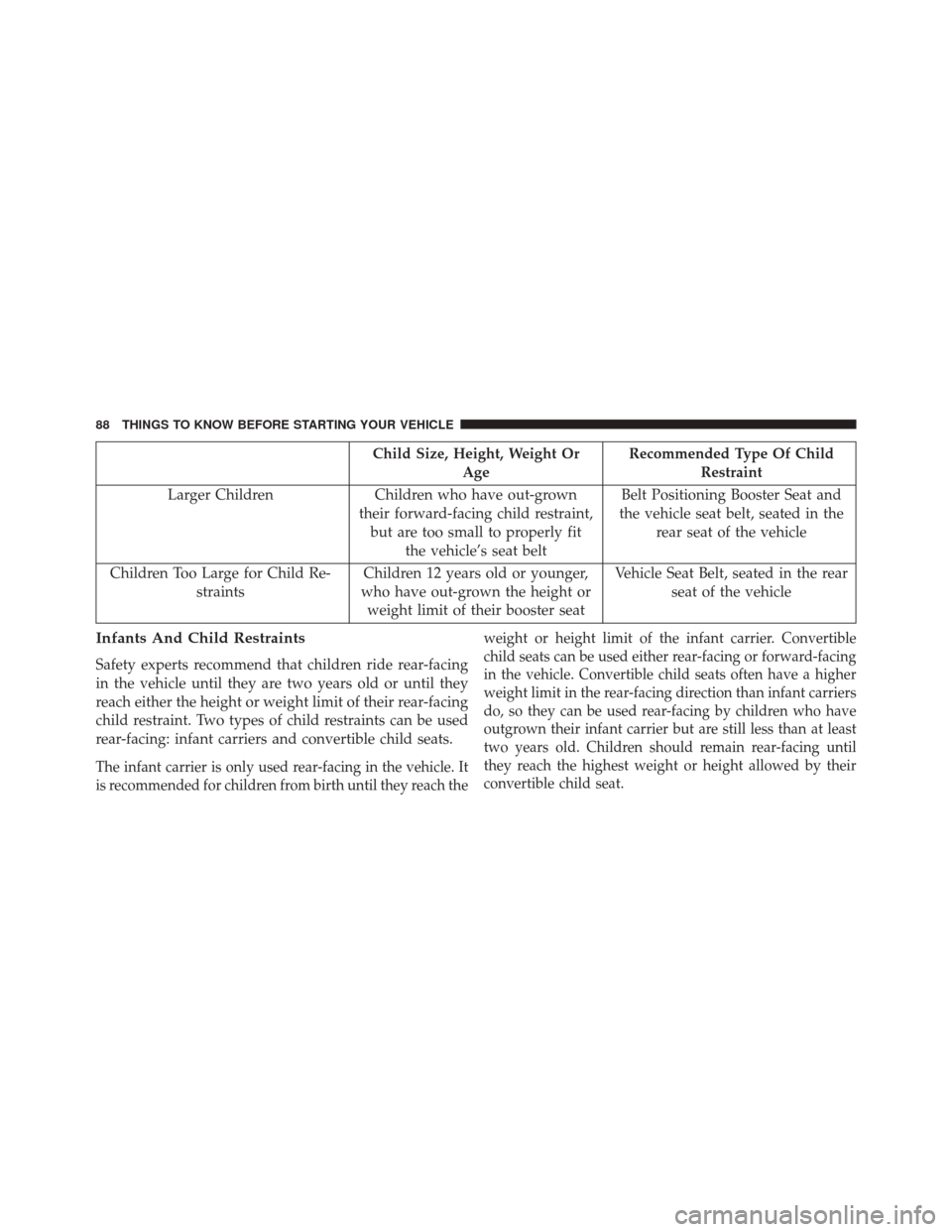
Child Size, Height, Weight OrAge Recommended Type Of Child
Restraint
Larger Children Children who have out-grown
their forward-facing child restraint, but are too small to properly fit the vehicle’s seat belt Belt Positioning Booster Seat and
the vehicle seat belt, seated in the rear seat of the vehicle
Children Too Large for Child Re- straints Children 12 years old or younger,
who have out-grown the height or weight limit of their booster seat Vehicle Seat Belt, seated in the rear
seat of the vehicle
Infants And Child Restraints
Safety experts recommend that children ride rear-facing
in the vehicle until they are two years old or until they
reach either the height or weight limit of their rear-facing
child restraint. Two types of child restraints can be used
rear-facing: infant carriers and convertible child seats.
The infant carrier is only used rear-facing in the vehicle. It
is recommended for children from birth until they reach the weight or height limit of the infant carrier. Convertible
child seats can be used either rear-facing or forward-facing
in the vehicle. Convertible child seats often have a higher
weight limit in the rear-facing direction than infant carriers
do, so they can be used rear-facing by children who have
outgrown their infant carrier but are still less than at least
two years old. Children should remain rear-facing until
they reach the highest weight or height allowed by their
convertible child seat.
88 THINGS TO KNOW BEFORE STARTING YOUR VEHICLE
Page 91 of 702
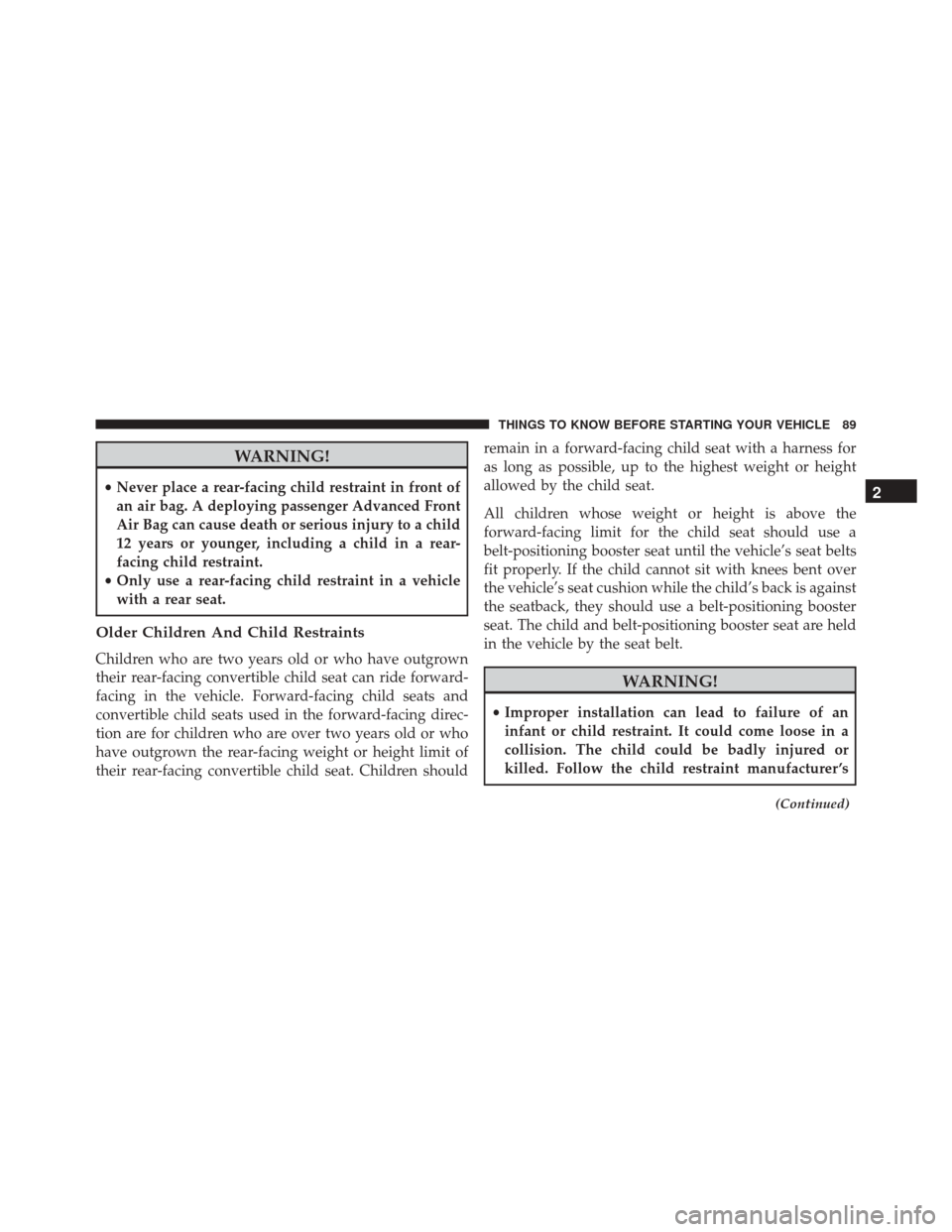
WARNING!
•Never place a rear-facing child restraint in front of
an air bag. A deploying passenger Advanced Front
Air Bag can cause death or serious injury to a child
12 years or younger, including a child in a rear-
facing child restraint.
• Only use a rear-facing child restraint in a vehicle
with a rear seat.
Older Children And Child Restraints
Children who are two years old or who have outgrown
their rear-facing convertible child seat can ride forward-
facing in the vehicle. Forward-facing child seats and
convertible child seats used in the forward-facing direc-
tion are for children who are over two years old or who
have outgrown the rear-facing weight or height limit of
their rear-facing convertible child seat. Children should remain in a forward-facing child seat with a harness for
as long as possible, up to the highest weight or height
allowed by the child seat.
All children whose weight or height is above the
forward-facing limit for the child seat should use a
belt-positioning booster seat until the vehicle’s seat belts
fit properly. If the child cannot sit with knees bent over
the vehicle’s seat cushion while the child’s back is against
the seatback, they should use a belt-positioning booster
seat. The child and belt-positioning booster seat are held
in the vehicle by the seat belt.
WARNING!
•
Improper installation can lead to failure of an
infant or child restraint. It could come loose in a
collision. The child could be badly injured or
killed. Follow the child restraint manufacturer ’s
(Continued)
2
THINGS TO KNOW BEFORE STARTING YOUR VEHICLE 89
Page 94 of 702
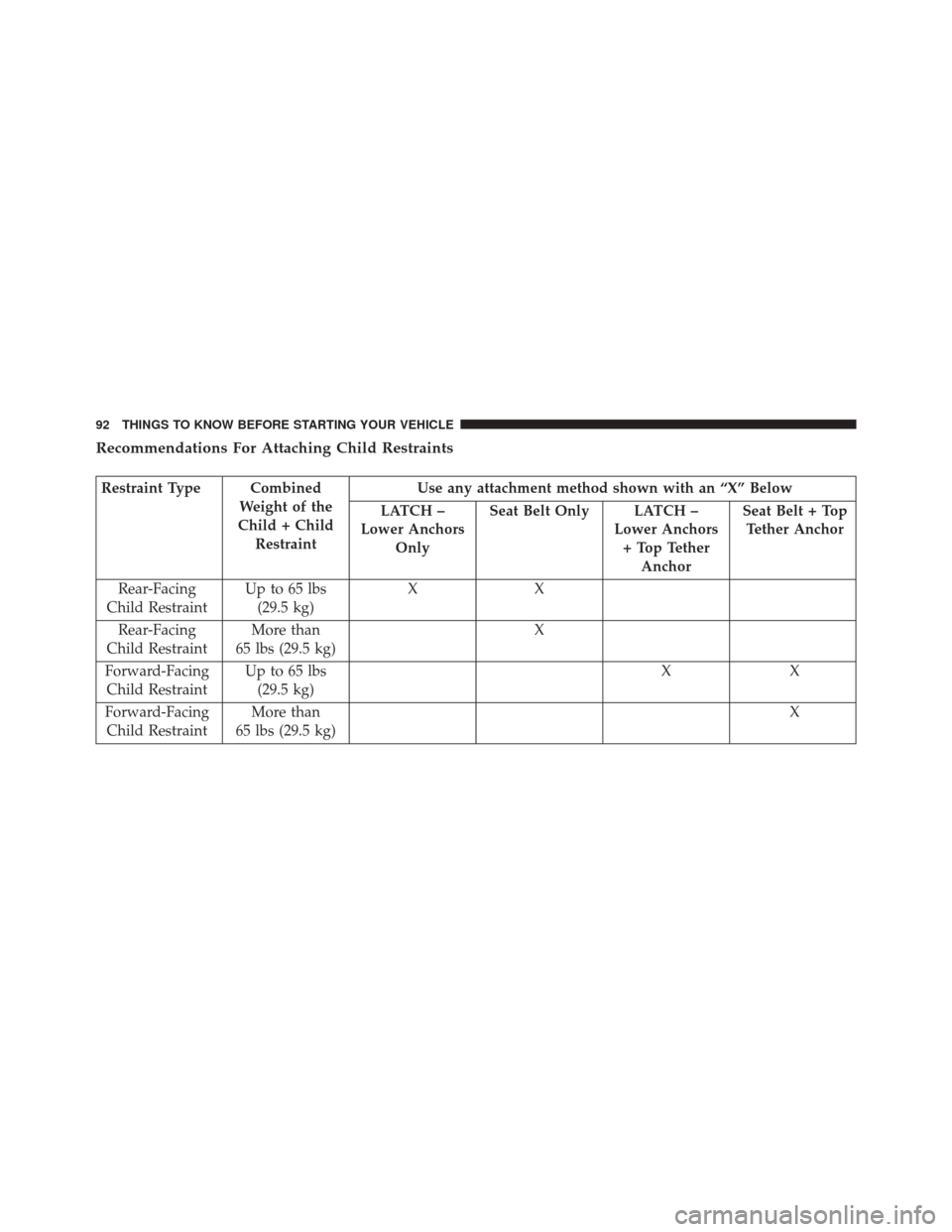
Recommendations For Attaching Child Restraints
Restraint Type CombinedWeight of the
Child + Child Restraint Use any attachment method shown with an “X” Below
LATCH –
Lower Anchors Only Seat Belt Only LATCH –
Lower Anchors+ Top Tether Anchor Seat Belt + Top
Tether Anchor
Rear-Facing
Child Restraint Up to 65 lbs
(29.5 kg) XX
Rear-Facing
Child Restraint More than
65 lbs (29.5 kg) X
Forward-Facing Child Restraint Up to 65 lbs
(29.5 kg) XX
Forward-Facing Child Restraint More than
65 lbs (29.5 kg) X
92 THINGS TO KNOW BEFORE STARTING YOUR VEHICLE
Page 97 of 702
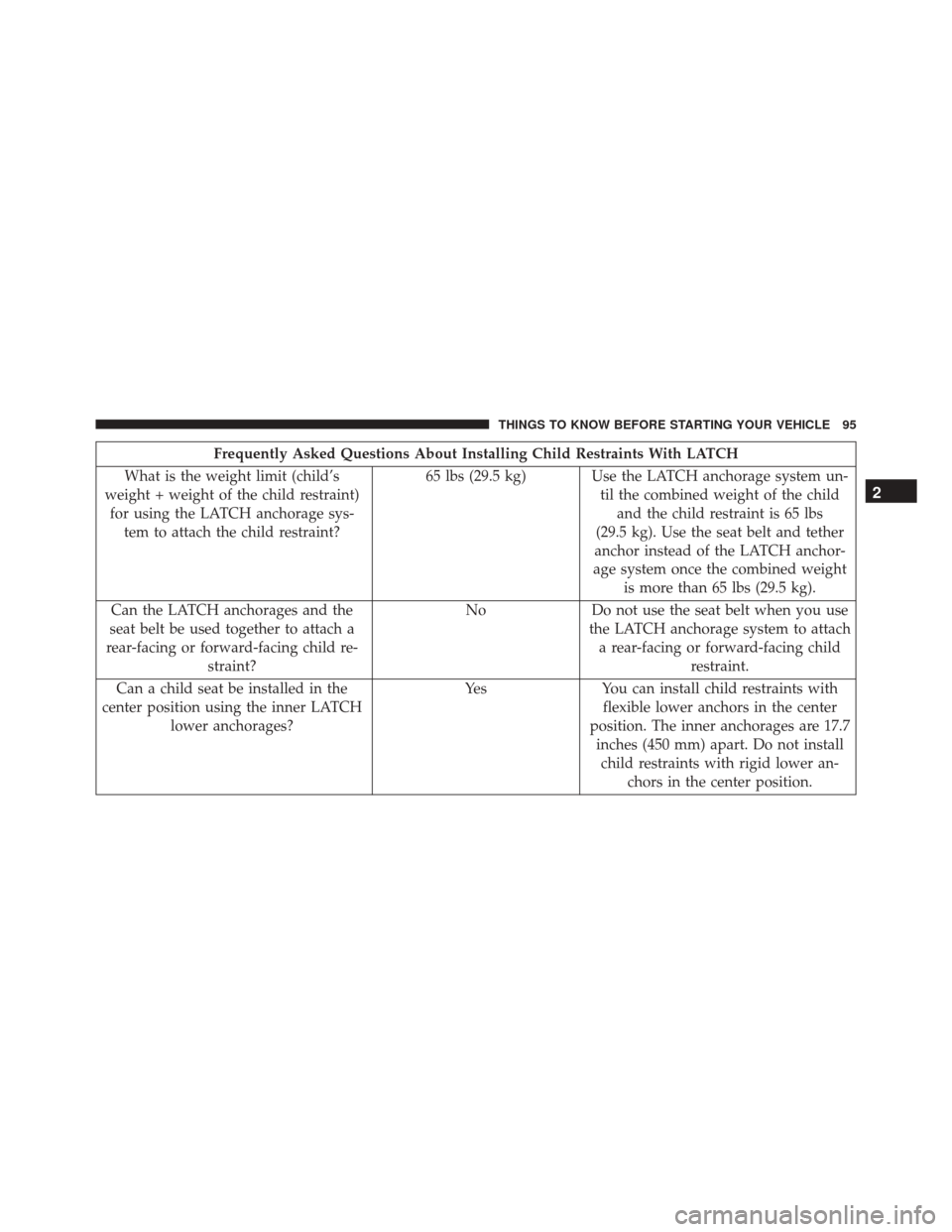
Frequently Asked Questions About Installing Child Restraints With LATCH
What is the weight limit (child’s
weight + weight of the child restraint) for using the LATCH anchorage sys- tem to attach the child restraint? 65 lbs (29.5 kg) Use the LATCH anchorage system un-
til the combined weight of the childand the child restraint is 65 lbs
(29.5 kg). Use the seat belt and tether
anchor instead of the LATCH anchor-
age system once the combined weight is more than 65 lbs (29.5 kg).
Can the LATCH anchorages and the
seat belt be used together to attach a
rear-facing or forward-facing child re- straint? No
Do not use the seat belt when you use
the LATCH anchorage system to attach a rear-facing or forward-facing child restraint.
Can a child seat be installed in the
center position using the inner LATCH lower anchorages? Yes
You can install child restraints with
flexible lower anchors in the center
position. The inner anchorages are 17.7 inches (450 mm) apart. Do not installchild restraints with rigid lower an- chors in the center position.
2
THINGS TO KNOW BEFORE STARTING YOUR VEHICLE 95
Page 105 of 702
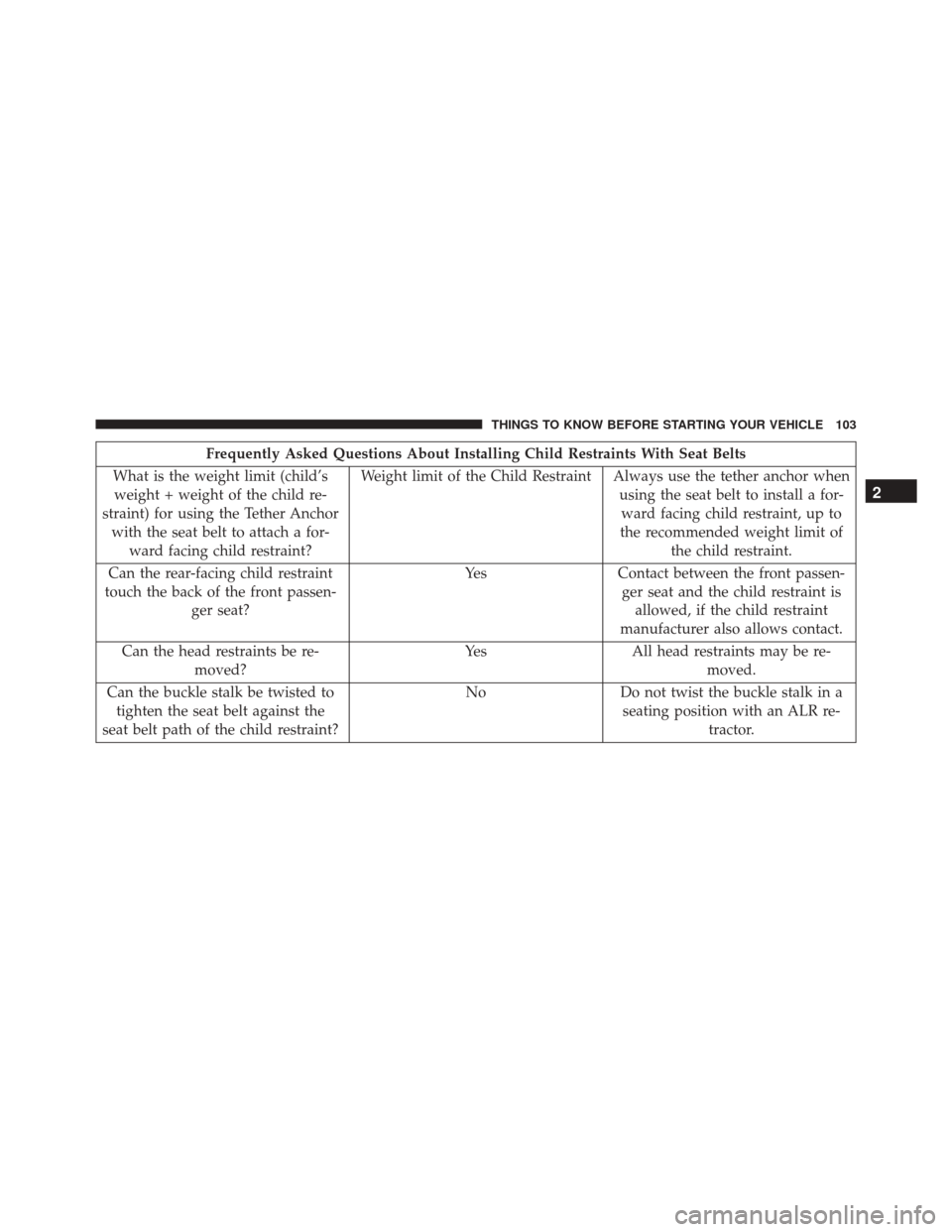
Frequently Asked Questions About Installing Child Restraints With Seat Belts
What is the weight limit (child’s weight + weight of the child re-
straint) for using the Tether Anchor with the seat belt to attach a for- ward facing child restraint? Weight limit of the Child Restraint Always use the tether anchor when
using the seat belt to install a for-ward facing child restraint, up to
the recommended weight limit of the child restraint.
Can the rear-facing child restraint
touch the back of the front passen- ger seat? Yes Contact between the front passen-
ger seat and the child restraint isallowed, if the child restraint
manufacturer also allows contact.
Can the head restraints be re- moved? Yes All head restraints may be re-
moved.
Can the buckle stalk be twisted to tighten the seat belt against the
seat belt path of the child restraint? No
Do not twist the buckle stalk in a
seating position with an ALR re- tractor.
2
THINGS TO KNOW BEFORE STARTING YOUR VEHICLE 103
Page 308 of 702
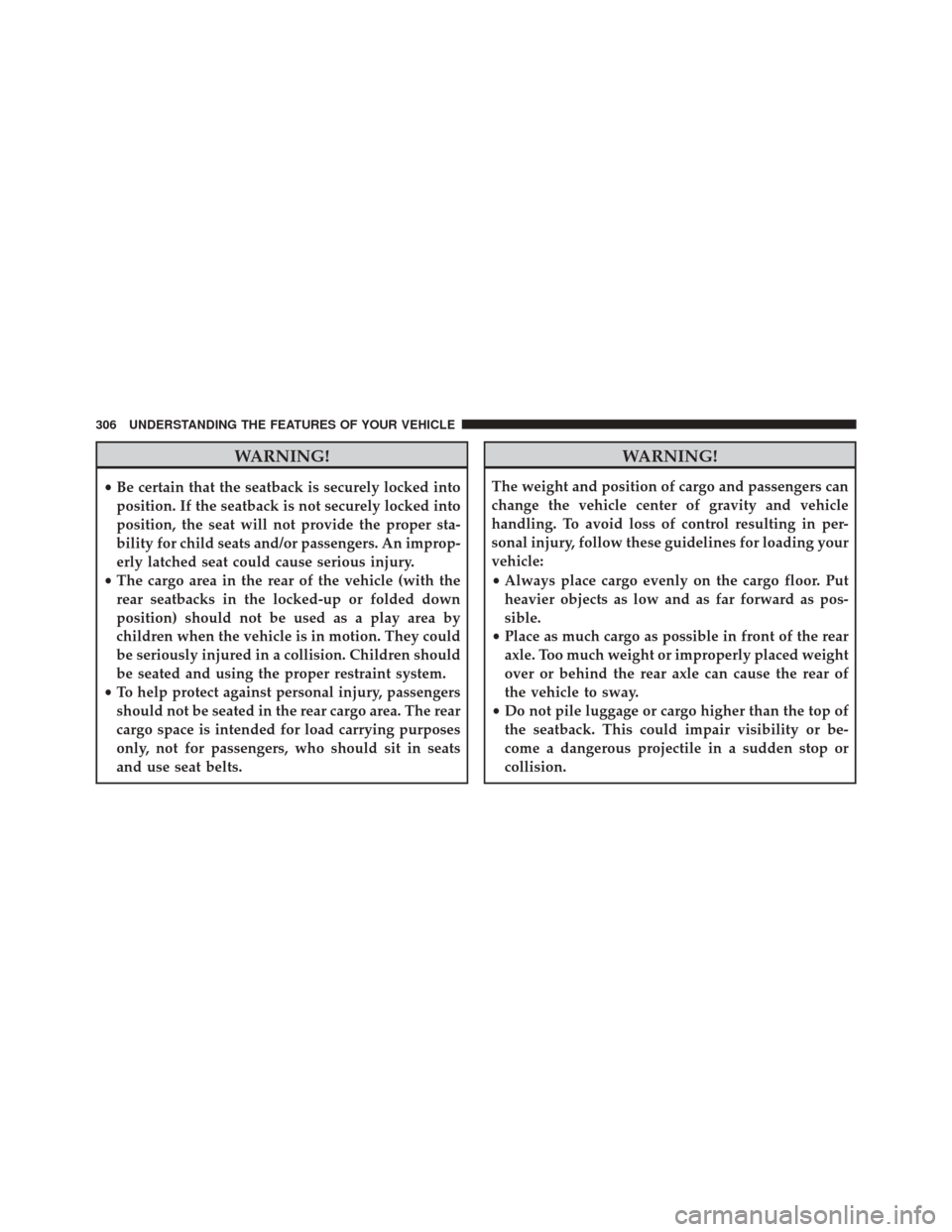
WARNING!
•Be certain that the seatback is securely locked into
position. If the seatback is not securely locked into
position, the seat will not provide the proper sta-
bility for child seats and/or passengers. An improp-
erly latched seat could cause serious injury.
• The cargo area in the rear of the vehicle (with the
rear seatbacks in the locked-up or folded down
position) should not be used as a play area by
children when the vehicle is in motion. They could
be seriously injured in a collision. Children should
be seated and using the proper restraint system.
• To help protect against personal injury, passengers
should not be seated in the rear cargo area. The rear
cargo space is intended for load carrying purposes
only, not for passengers, who should sit in seats
and use seat belts.
WARNING!
The weight and position of cargo and passengers can
change the vehicle center of gravity and vehicle
handling. To avoid loss of control resulting in per-
sonal injury, follow these guidelines for loading your
vehicle:
• Always place cargo evenly on the cargo floor. Put
heavier objects as low and as far forward as pos-
sible.
• Place as much cargo as possible in front of the rear
axle. Too much weight or improperly placed weight
over or behind the rear axle can cause the rear of
the vehicle to sway.
• Do not pile luggage or cargo higher than the top of
the seatback. This could impair visibility or be-
come a dangerous projectile in a sudden stop or
collision.
306 UNDERSTANDING THE FEATURES OF YOUR VEHICLE