2016 CHEVROLET IMPALA trailer
[x] Cancel search: trailerPage 246 of 377
Chevrolet Impala Owner Manual (GMNA-Localizing-U.S/Canada-9086448) -
2016 - CRC - 5/20/15
Driving and Operating 245
.Total weight on your vehicle's
tires.
Weight of the Trailer
How heavy can a trailer safely be?
It should never weigh more than
454 kg (1,000 lb). But even that can
be too heavy.
It depends on how the rig is used.
For example, speed, altitude, road
grades, outside temperature, and
how much the vehicle is used to pull
a trailer are all important. It can
depend on any special equipment
on the vehicle, and the amount of
tongue weight the vehicle can carry.
See “Weight of the Trailer Tongue”
following.
Maximum trailer weight is calculated
assuming only the driver is in the
tow vehicle and it has all the
required trailering equipment. The
weight of additional optional
equipment, passengers, and cargo
in the tow vehicle must be
subtracted from the maximum trailer
weight. Ask your dealer for trailering
information or advice, or write us at
our Customer Assistance Offices.
See
Customer Assistance Offices
0 343.
Weight of the Trailer Tongue
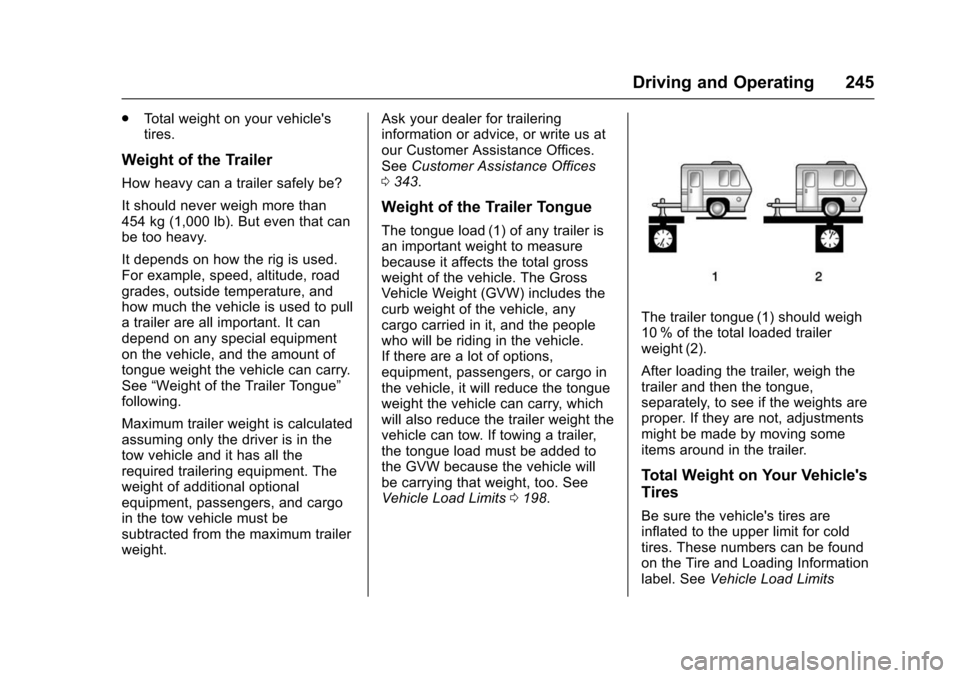
The tongue load (1) of any trailer is
an important weight to measure
because it affects the total gross
weight of the vehicle. The Gross
Vehicle Weight (GVW) includes the
curb weight of the vehicle, any
cargo carried in it, and the people
who will be riding in the vehicle.
If there are a lot of options,
equipment, passengers, or cargo in
the vehicle, it will reduce the tongue
weight the vehicle can carry, which
will also reduce the trailer weight the
vehicle can tow. If towing a trailer,
the tongue load must be added to
the GVW because the vehicle will
be carrying that weight, too. See
Vehicle Load Limits 0198.
The trailer tongue (1) should weigh
10 % of the total loaded trailer
weight (2).
After loading the trailer, weigh the
trailer and then the tongue,
separately, to see if the weights are
proper. If they are not, adjustments
might be made by moving some
items around in the trailer.
Total Weight on Your Vehicle's
Tires
Be sure the vehicle's tires are
inflated to the upper limit for cold
tires. These numbers can be found
on the Tire and Loading Information
label. See Vehicle Load Limits
Page 247 of 377

Chevrolet Impala Owner Manual (GMNA-Localizing-U.S/Canada-9086448) -
2016 - CRC - 5/20/15
246 Driving and Operating
0198. Make sure not to go over the
GVW limit for the vehicle, including
the weight of the trailer tongue.
Towing Equipment
Hitches
Use the correct hitch equipment.
See your dealer or a hitch dealer for
assistance.
. The rear bumper on the vehicle
is not intended for hitches. Do
not attach rental hitches or other
bumper-type hitches to it. Use
only a frame-mounted hitch that
does not attach to the bumper.
. Will any holes be made in the
body of the vehicle when the
trailer hitch is installed? If so,
seal the holes when the hitch is
removed. If the holes are not
sealed, dirt, water, and deadly
carbon monoxide (CO) from the
exhaust can get into the vehicle.
See Engine Exhaust 0210.
Safety Chains
Always attach chains between the
vehicle and the trailer. Cross the
safety chains under the tongue of
the trailer to help prevent the tongue
from contacting the road if it
becomes separated from the hitch.
Leave enough slack so the rig can
turn. Never allow safety chains to
drag on the ground.
Trailer Brakes
Does the trailer have its own
brakes? Be sure to read and follow
the instructions for the trailer brakes
so they are installed, adjusted, and
maintained properly.
Because the vehicle has antilock
brakes, do not tap into the vehicle's
brake system. If this is done, both
brake systems will not work well or
at all.
Conversions and
Add-Ons
Add-On Electrical
Equipment
{Warning
The Data Link Connector (DLC) is
used for vehicle service and
Emission Inspection/Maintenance
testing. See Malfunction Indicator
Lamp (Check Engine Light)
0 120. A device connected to the
Data Link Connector (DLC)—
such as an aftermarket fleet or
driver-behavior tracking device—
may interfere with vehicle
systems. This could affect vehicle
operation and cause a crash.
Such devices may also access
information stored in the vehicle’s
systems.
Page 266 of 377
Chevrolet Impala Owner Manual (GMNA-Localizing-U.S/Canada-9086448) -
2016 - CRC - 5/20/15
Vehicle Care 265
If No Steam Is Coming from
the Engine Compartment
If an engine overheat warning is
displayed but no steam can be seen
or heard, the problem might not be
too serious. Sometimes the engine
can get a little too hot when the
vehicle:
.Climbs a long hill on a hot day.
. Stops after high-speed driving.
. Idles for long periods in traffic.
. Tows a trailer.
If the overheat warning displays with
no sign of steam: 1. Turn the air conditioning off.
2. Turn the heater on to the highest temperature and to the
highest fan speed. Open the
windows as necessary.
3. When it is safe to do so, pull off the road, shift to P (Park) or
N (Neutral), and let the
engine idle.
If the coolant temperature gauge is
no longer in the overheat zone, the
vehicle can be driven. Continue to drive the vehicle slowly for about
10 minutes. Keep a safe vehicle
distance from the vehicle in front.
If the warning does not come back
on, continue to drive normally and
have the cooling system checked
for proper fill and function.
If the warning continues, pull over,
stop, and park the vehicle
right away.
If there is no sign of steam, idle the
engine for three minutes while
parked. If the warning is still
displayed, turn off the engine until it
cools down. Also, see
Overheated
Engine Protection Operating Mode
0 265.
Overheated Engine
Protection
Operating Mode
This emergency operating mode
allows the vehicle to be driven to a
safe place in an emergency
situation. If an overheated engine
condition exists, an overheat
protection mode which alternates
firing groups of cylinders helps prevent engine damage. In this
mode, there is significant loss in
power and engine performance.
The engine coolant temperature
gauge indicates if an overheat
condition exists. Driving extended
distances and/or towing a trailer in
the overheat protection mode
should be avoided.
Washer Fluid
What to Use
When windshield washer fluid is
needed, be sure to read the
manufacturer's instructions before
use. If operating the vehicle in an
area where the temperature may fall
below freezing, use a fluid that has
sufficient protection against
freezing.
Adding Washer Fluid
Page 314 of 377
Chevrolet Impala Owner Manual (GMNA-Localizing-U.S/Canada-9086448) -
2016 - CRC - 5/20/15
Vehicle Care 313
Towing the Vehicle
Caution
Incorrectly towing a disabled
vehicle may cause damage. The
damage would not be covered by
the vehicle warranty.
Do not lash or hook to
suspension components. Use the
proper straps around the tires to
secure the vehicle.
Have the vehicle towed on a wheel
lift tow truck. A flatbed car carrier
could damage the vehicle. The
wheel lift tow truck must raise the
rear of the vehicle and wheel dollies
must be used to lift the front wheels
off the ground.
Consult your dealer or a
professional towing service if the
disabled vehicle must be towed.
Recreational Vehicle
Towing
Recreational vehicle towing means
towing the vehicle behind another
vehicle –such as behind a motor
home. The two most common types
of recreational vehicle towing are
known as dinghy towing and dolly
towing. Dinghy towing is towing the
vehicle with all four wheels on the
ground. Dolly towing is towing the
vehicle with two wheels on the
ground and two wheels up on a
device known as a dolly.
Here are some important things to
consider before recreational vehicle
towing:
. What is the towing capacity of
the towing vehicle? Be sure to
read the tow vehicle
manufacturer's
recommendations.
. How far will the vehicle be
towed? Some vehicles have
restrictions on how far and how
long they can tow. .
Does the vehicle have the
proper towing equipment? See
your dealer or trailering
professional for additional advice
and equipment
recommendations.
. Is the vehicle ready to be
towed? Just as preparing the
vehicle for a long trip, make sure
the vehicle is prepared to be
towed.
Caution
Use of a shield mounted in front
of the vehicle grille could restrict
airflow and cause damage to the
transmission. The repairs would
not be covered by the vehicle
warranty. If using a shield, only
use one that attaches to the
towing vehicle.
Page 326 of 377
Chevrolet Impala Owner Manual (GMNA-Localizing-U.S/Canada-9086448) -
2016 - CRC - 5/20/15
Service and Maintenance 325
frequent checks and services. The
Additional Required Services -
Normal are for vehicles that:
.Carry passengers and cargo
within recommended limits on
the Tire and Loading Information
label. See Vehicle Load Limits
0 198.
. Are driven on reasonable road
surfaces within legal driving
limits.
. Use the recommended fuel. See
Fuel 0237.
Refer to the information in the
Maintenance Schedule Additional
Required Services - Normal chart.
The Additional Required Services -
Severe are for vehicles that are:
. Mainly driven in heavy city traffic
in hot weather.
. Mainly driven in hilly or
mountainous terrain.
. Frequently towing a trailer.
. Used for high speed or
competitive driving. .
Used for taxi, police, or delivery
service.
Refer to the information in the
Maintenance Schedule Additional
Required Services - Severe chart.
{Warning
Performing maintenance work can
be dangerous and can cause
serious injury. Perform
maintenance work only if the
required information, proper tools,
and equipment are available.
If they are not, see your dealer to
have a trained technician do the
work. See Doing Your Own
Service Work 0250.
Maintenance
Schedule
Owner Checks and Services
For CNG equipped vehicles, also
see the maintenance schedule
section in the Impala Bi-Fuel
supplement.
At Each Fuel Stop
.
Check the engine oil level. See
Engine Oil 0255.
Once a Month
. Check the tire inflation
pressures. See Tire Pressure
0 290.
. Inspect the tires for wear. See
Tire Inspection 0296.
. Check the windshield washer
fluid level. See Washer Fluid
0 265.
Engine Oil Change
When the CHANGE ENGINE OIL
SOON message displays, have the
engine oil and filter changed within
the next 1 000 km/600 mi. If driven
Page 376 of 377

Chevrolet Impala Owner Manual (GMNA-Localizing-U.S/Canada-9086448) -
2016 - CRC - 5/20/15
Index 375
Tires (cont'd)Pressure Monitor
Operation . . . . . . . . . . . . . . . . . . . 293
Pressure Monitor System . . . . . 292
Rotation . . . . . . . . . . . . . . . . . . . . . . 296
Sidewall Labeling . . . . . . . . . . . . . 285
Terminology and Definitions . . 288
Uniform Tire Quality Grading . . . . . . . . . . . . . . . . . . . . . 299
Wheel Alignment and Tire Balance . . . . . . . . . . . . . . . . . . . . . 301
Wheel Replacement . . . . . . . . . . 301
When It Is Time for New Tires . . . . . . . . . . . . . . . . . . . . . . . . 297
Winter . . . . . . . . . . . . . . . . . . . . . . . . 284
Towing Driving Characteristics . . . . . . . . 242
Equipment . . . . . . . . . . . . . . . . . . . . 246
General Information . . . . . . . . . . 242
Recreational Vehicle . . . . . . . . . . 313
Trailer . . . . . . . . . . . . . . . . . . . . . . . . 244
Vehicle . . . . . . . . . . . . . . . . . . . . . . . 313
Track Events and
Competitive Driving . . . . . . . . . . . 194
Traction Control System (TCS)/StabiliTrak
®Light . . . . . . . . . . . . 124
Off Light . . . . . . . . . . . . . . . . . . . . . . 124 Traction Control/Electronic
Stability Control . . . . . . . . . . . . . . . 216
Trademarks and License Agreements . . . . . . . . . . . . . . . . . . . 179
Trailer Towing . . . . . . . . . . . . . . . . . . . . . . . . 244
Transmission
Automatic . . . . . . . . . . . . . . . . . . . . . .211
Fluid, Automatic . . . . . . . . . . . . . . 258
Messages . . . . . . . . . . . . . . . . . . . . 137
Transportation Program,
Courtesy . . . . . . . . . . . . . . . . . . . . . . 347
Trip Odometer . . . . . . . . . . . . . . . . . . 115
Trunk . . . . . . . . . . . . . . . . . . . . . . . . . . . . 41
Turn and Lane-Change Signals . . . . . . . . . . . . . . . . . . . . . . . . 151
Turn Signal Bulb Replacement . . . . . . . . . . . . 273
U
Umbrella Storage . . . . . . . . . . . . . . . 101
Uniform Tire Quality Grading . . . 299
Universal Remote System . . . . . . 144Operation . . . . . . . . . . . . . . . . . . . . . 147
Programming . . . . . . . . . . . . . . . . . 144
Updates
Software . . . . . . . . . . . . . . . . . . . . . . 160
USB Port . . . . . . . . . . . . . . . . . . . . . . . 164
Using This Manual . . . . . . . . . . . . . . . . 2
V
Vehicle Alarm System . . . . . . . . . . . . . . . . . . 42
Canadian Owners . . . . . . . . . . . . . . . 2
Control . . . . . . . . . . . . . . . . . . . . . . . 192
Identification Number (VIN) . . . 337
Load Limits . . . . . . . . . . . . . . . . . . . 198
Messages . . . . . . . . . . . . . . . . . . . . 129
Personalization . . . . . . . . . . . . . . . 138
Reminder Messages . . . . . . . . . . 137
Remote Start . . . . . . . . . . . . . . . . . . . 35
Security . . . . . . . . . . . . . . . . . . . . . . . . 42
Speed Messages . . . . . . . . . . . . . 138
Towing . . . . . . . . . . . . . . . . . . . . . . . . 313
Vehicle Ahead Indicator . . . . . . . . 123
Vehicle Care Tire Pressure . . . . . . . . . . . . . . . . . 290
Vehicle Data Recording and Privacy . . . . . . . . . . . . . . . . . . . . . . . . 352
Ventilation, Air . . . . . . . . . . . . . . . . . . 188
Visors . . . . . . . . . . . . . . . . . . . . . . . . . . . 49
Voltage Devices and Wiring . . . . 276
W
Warning Brake System Light . . . . . . . . . . . 121
Caution and Danger . . . . . . . . . . . . . 2