2016 CHEVROLET IMPALA fuel pressure
[x] Cancel search: fuel pressurePage 5 of 29

Chevrolet Impala Bi-Fuel (Gasoline/CNG) Supplement (GMNA-Localizing-U.
S/Canada-9087624) - 2016 - CRC - 8/17/15
4 Instruments and Controls
CNG fuel gauge readings are
affected by changes in fuel
temperature and fuel pressure.
See“Fuel Gauge” in the owner
manual.
Malfunction Indicator
Lamp (Check Engine
Light)
The malfunction indicator lamp is in
the instrument cluster.
This vehicle has been specifically
designed to illuminate this indicator
when emissions exceed acceptable
levels while operating on either
gasoline or CNG fuel.
The malfunction indicator lamp
comes on to indicate that there is a
problem and service is required.
Malfunctions often will be indicated
by the system before any problem is apparent. This system is also
designed to assist the service
technician in correctly diagnosing
any malfunction.
Caution
If the vehicle is continually driven
with this light on, the emission
controls might not work as well,
the vehicle fuel economy might
not be as good, and the engine
might not run as smoothly. This
could lead to costly repairs that
might not be covered by the
vehicle warranty.
This light should come on as a
check to show you it is working
when the ignition is on and the
engine is not running.
This light comes on during a
malfunction in one of two ways:
Light Flashing
A misfire condition has been
detected. A misfire increases
vehicle emissions and could damage the emission control
system on the vehicle. Diagnosis
and service might be required.
To prevent more serious damage to
the vehicle:
.
Reduce vehicle speed.
. Avoid hard accelerations.
. Avoid steep uphill grades.
If the light continues to flash, find a
safe place to stop and park the
vehicle. Turn the vehicle off, wait at
least 10 seconds, and restart the
engine. If the light is still flashing,
follow the previous steps and see
your dealer for service as soon as
possible.
Light On Steady
An emission control system
malfunction has been detected on
the vehicle. Diagnosis and service
might be required.
See the owner manual for more
information.
Page 10 of 29

Chevrolet Impala Bi-Fuel (Gasoline/CNG) Supplement (GMNA-Localizing-U.
S/Canada-9087624) - 2016 - CRC - 8/17/15
Driving and Operating 9
standards for general marketplace
vehicle usage; however, CNG is
available at both private and public
filling stations. We recommend use
of CNG that meets or exceeds SAE
J1616 specifications for fuel
composition and cleanliness. See
Filling the Tank (CNG)09.
Caution
Using below standard CNG fuel
quality may cause damage to the
CNG fuel system. Use only CNG
fuel meeting recommended CNG
fuel standards.
The main component of CNG is
methane, a highly flammable,
colorless gas. An odorant has been
added for detection through smell.
The smell is similar to that of rotten
eggs. The CNG in the vehicle is
stored under high pressure
(maximum 24 800kPa at 21 °C/
3,600 psig at 70 °F). Gas should
never be smelled unless it occurs
briefly during refueling. If gas is
smelled or a hissing sound is heard
at any other time, park in a well ventilated outdoor open area, shut
down the vehicle, and have it
serviced.
It may be possible to hear the fuel
flowing while the engine is running if
standing close to the pipework or
various fuel system components
(regulator, filter). This is normal and
should not be confused with a
hissing sound at fittings that may
indicate a fuel leak. If you suspect a
fuel leak, follow the instructions
under
Fuel System Leak 014.
Fuel Selector Switch
The fuel selector switch is on the
instrument panel left of the steering
wheel. When the ignition is in ON/
RUN, press
0to select between
gasoline and CNG. The indicator
light in the fuel selector switch
comes on when the vehicle is
running on CNG.
Certain conditions must be met in
order to switch between gasoline
and CNG. The vehicle will start up
on the last fuel that was selected.
When the fuel selector switch is
pressed, the indicator light will flash
during a fuel transition. If the fuel
transition is unsuccessful, the DIC
will display FUEL MODE
UNAVAILABLE. See Fuel System
Messages 06.
Filling the Tank (CNG)
{Warning
CNG is flammable and highly
explosive. You could be killed or
seriously injured if leaking natural
(Continued)
Page 11 of 29

Chevrolet Impala Bi-Fuel (Gasoline/CNG) Supplement (GMNA-Localizing-U.
S/Canada-9087624) - 2016 - CRC - 8/17/15
10 Driving and Operating
Warning (Continued)
gas is ignited. If you suspect a
leak, do not start the engine or
drive the vehicle. Have the
vehicle immediately towed,
inspected, and repaired by an
authorized GM dealer.
Before filling either fuel tank, turn off
the engine.
The gasoline tank is filled through
the standard fill pipe. See “Filling
the Tank” under“Fuel” in the owner
manual.
The CNG fill receptacle is behind
the fuel door on the passenger side
above the gasoline cap.
Refueling Procedure
There are two methods of refueling:
fast fill or time fill. Fast fill is
normally used in fuel stations for
natural gas vehicles. It takes about
two to five minutes to fill up the fuel
tank. Time fill is done with a
refueling appliance, including
residential appliances, or a time-fill
post provided by the fleet operator.
Refueling time varies depending
upon the refueling system used —
consult with the refueling station
attendant or system provider.
Always observe all safety
recommendations and operating
instructions on the refueling
equipment. If a 24 800 kPa
(3,600 psig) nozzle is not available,
a 20 684 kPa (3,000 psig) nozzle
may be connected to the vehicle.
A fuel nozzle less than 7.6 cm (3 in)
long may be difficult to disengage
after dispensing CNG. During fueling, CNG needs to be
delivered to the vehicle at the
appropriate pressure in relationship
to the ambient temperature. This
can be done automatically by a
temperature compensation system
on the CNG fuel dispenser or
manually by stopping the CNG fill at
a recommended pressure related to
the ambient temperature
compensation chart. GM
recommends that customers use
CNG fueling stations that have a
temperature compensation system
whenever possible. Check with the
fuel station. If one is not available,
see the temperature compensation
chart that follows in this section to
choose the appropriate fill pressure
for the ambient temperature. In
addition, fill only to the pressure
level for the lowest ambient
temperature anticipated during
fueling.
Leaving a vehicle connected to a
time fill station can cause the tank
to be filled to a higher pressure than
recommended, especially when
outside temperatures fluctuate.
Disconnect the vehicle from the time
Page 12 of 29
Chevrolet Impala Bi-Fuel (Gasoline/CNG) Supplement (GMNA-Localizing-U.
S/Canada-9087624) - 2016 - CRC - 8/17/15
Driving and Operating 11
fill station as soon as it is full,
unless an auto shutoff feature
is used.
{Warning
If CNG tanks are filled to a higher
pressure than recommended and
then exposed to a much higher
ambient temperature
environment, expansion of the
gas caused by the temperature
change may cause pressure relief
devices on the vehicle CNG
tank(s) to release gas, as
designed. If an ignition source is
present, this could create a risk of
fire or explosion. If there is any
possibility that the tank has been
over pressurized, take steps to
relieve the excess pressure, such
as by driving or running the
vehicle in an outdoor open area
to remove some fuel.Make sure that your CNG vehicle is
properly maintained and repaired to
avoid elevated temperatures
surrounding the tank, since elevated
temperatures in the area of the tank
could also raise the CNG pressure
in the tank.
Consult materials available from
NGVAmerica - http://www.ngvc.org
and the Clean Vehicle
Education Foundation -
http://www.cleanvehicle.org on CNG
fueling stations for more information.
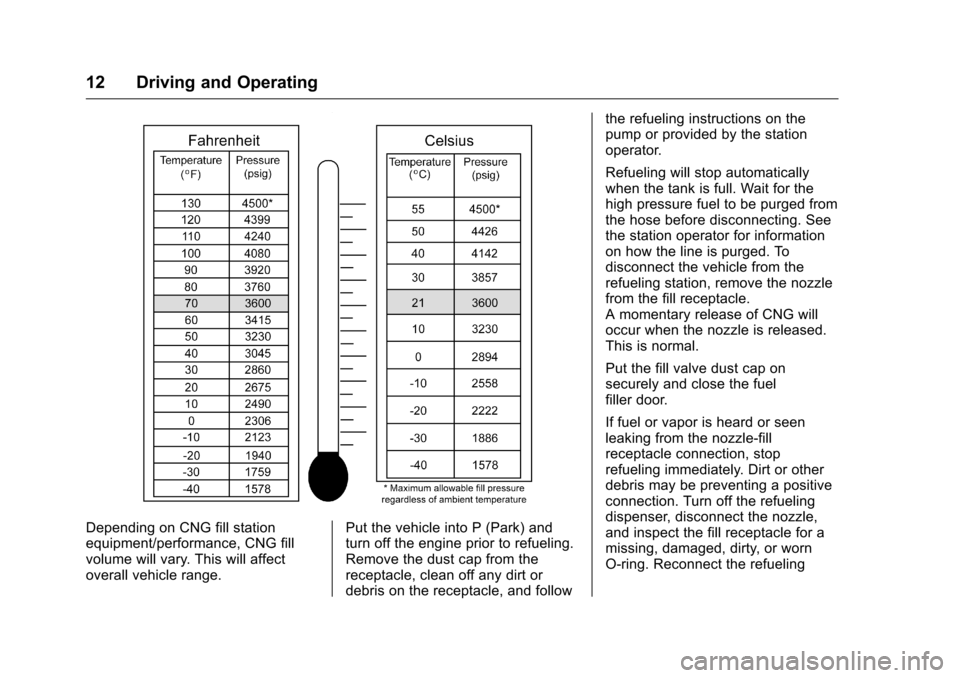
Ambient Temperature / Maximum
CNG Fill Pressure Compensation
Chart
To avoid the risk of fire or explosion
if an ignition source were present,
do not fill above the pressure level
that corresponds to the lowest
ambient temperature expected
during fueling.
Service Pressure 24 800 kPa
(3,600 psig) at 21 °C (70 °F).
Page 13 of 29
Chevrolet Impala Bi-Fuel (Gasoline/CNG) Supplement (GMNA-Localizing-U.
S/Canada-9087624) - 2016 - CRC - 8/17/15
12 Driving and Operating
Depending on CNG fill station
equipment/performance, CNG fill
volume will vary. This will affect
overall vehicle range.Put the vehicle into P (Park) and
turn off the engine prior to refueling.
Remove the dust cap from the
receptacle, clean off any dirt or
debris on the receptacle, and followthe refueling instructions on the
pump or provided by the station
operator.
Refueling will stop automatically
when the tank is full. Wait for the
high pressure fuel to be purged from
the hose before disconnecting. See
the station operator for information
on how the line is purged. To
disconnect the vehicle from the
refueling station, remove the nozzle
from the fill receptacle.
A momentary release of CNG will
occur when the nozzle is released.
This is normal.
Put the fill valve dust cap on
securely and close the fuel
filler door.
If fuel or vapor is heard or seen
leaking from the nozzle-fill
receptacle connection, stop
refueling immediately. Dirt or other
debris may be preventing a positive
connection. Turn off the refueling
dispenser, disconnect the nozzle,
and inspect the fill receptacle for a
missing, damaged, dirty, or worn
O-ring. Reconnect the refueling
Page 15 of 29
Chevrolet Impala Bi-Fuel (Gasoline/CNG) Supplement (GMNA-Localizing-U.
S/Canada-9087624) - 2016 - CRC - 8/17/15
14 Driving and Operating
Pressure Relief Devices
The CNG tank has pressure relief
devices that are designed to release
pressure if the CNG tank is
overheated or over pressurized.
If a pressure relief device releases
CNG, the CNG tank will be emptied
and will switch to gasoline,
if gasoline is available. A loud
rushing noise may be heard when
CNG is released.
In Case of a CNG Leak
If a CNG fuel leak is suspected, see
Fuel System Leak014.
Fuel System Leak
{Warning
Fuel vapors and fuel fires burn
violently and can cause injury or
death.
. Keep all smoking materials
and sources of ignition away
from the fuel system
components.
(Continued)
Warning (Continued)
.CNG is non-toxic but the
vapors are lighter than air
and can cause oxygen
depletion if they are
enclosed in a confined
space. Make sure there is
adequate ventilation and
use extreme caution if a
leak is suspected.
{Warning
If you smell a persistent natural
gas odor or hear a continual
hissing sound, there could be a
CNG leak. If the gas is
accidentally ignited, you or others
could be seriously injured or
killed. Do not start the engine or
drive the vehicle. Have the
vehicle towed to an authorized
GM dealer for service. A slight natural gas odor may be
detected for a few moments after
refueling. This is normal. You should
not be able to smell natural gas at
any other time. If you do, or if you
hear a hissing sound, the fuel
system may have a leak.
If natural gas is smelled or a hissing
sound is heard:
1. Park the vehicle in an outdoor open area and apply the
parking brake. Keep heat,
sparks, and flame away. Open
all the vehicle doors for
ventilation.
2. Turn the ignition to LOCK/OFF. Do not start the engine, refuel,
or drive the vehicle.
3. The manual shutoff is on the driver side of the vehicle in
front of the rear tire. See Fuel
System Components 017.
Page 17 of 29
Chevrolet Impala Bi-Fuel (Gasoline/CNG) Supplement (GMNA-Localizing-U.
S/Canada-9087624) - 2016 - CRC - 8/17/15
16 Vehicle Care
Vehicle Care
General Information
Accessories andModifications . . . . . . . . . . . . . . . . . 16
Vehicle Checks
Doing Your OwnService Work . . . . . . . . . . . . . . . . . 16
Fuel System Components . . . . . 17
Wheels and Tires
Tire Changing . . . . . . . . . . . . . . . . . 19
Jump Starting
Jump Starting - North America . . . . . . . . . . . . . . . . . . . . . . 19
Appearance Care
Exterior Care . . . . . . . . . . . . . . . . . . 20
General Information
Accessories and
Modifications
Adding accessories or making
modifications to the vehicle,
including to the CNG tank shields,
could cause damage and would not
be covered by the vehicle warranty.
If a CNG tank needs service or
repair, have only a qualified
technician perform the work. See
“Accessories and Modifications” in
the owner manual.
Vehicle Checks
Doing Your Own
Service Work
{Warning
Never try to do your own service
work on the Compressed Natural
Gas (CNG) fuel system. The CNG
fuel system operates under high
pressure. You can be injured and
the vehicle can be damaged if
you try to do your own service
work. Service and repair of this
system should only be performed
by a qualified dealer.
Page 18 of 29
Chevrolet Impala Bi-Fuel (Gasoline/CNG) Supplement (GMNA-Localizing-U.
S/Canada-9087624) - 2016 - CRC - 8/17/15
Vehicle Care 17
Fuel System Components
{Warning
Tampering with, or improperly
maintaining the high-pressure fuel
system can cause a dangerous
condition in which serious injury
or death may result. Never
attempt to modify the fuel system,
and always have the fuel system
repaired and maintained by a
qualified dealer.
CNG fuel system components
include the fuel tank in the trunk of
the vehicle, a fuel pressure
regulator, an in-tank fuel shutoff
valve, high pressure fuel lines,
electronically controlled multipoint
fuel injectors, and other equipment. CNG fuel system components
comply with appropriate safety
standards. Never modify or replace
any original CNG components or
parts with those specified for a
gasoline-powered vehicle. Improper
parts or components can damage
the vehicle fuel system and affect
the vehicle safety and performance.
Do not modify, tamper with,
or perforate the CNG tank shield.
Damage to the CNG fuel system
can result.
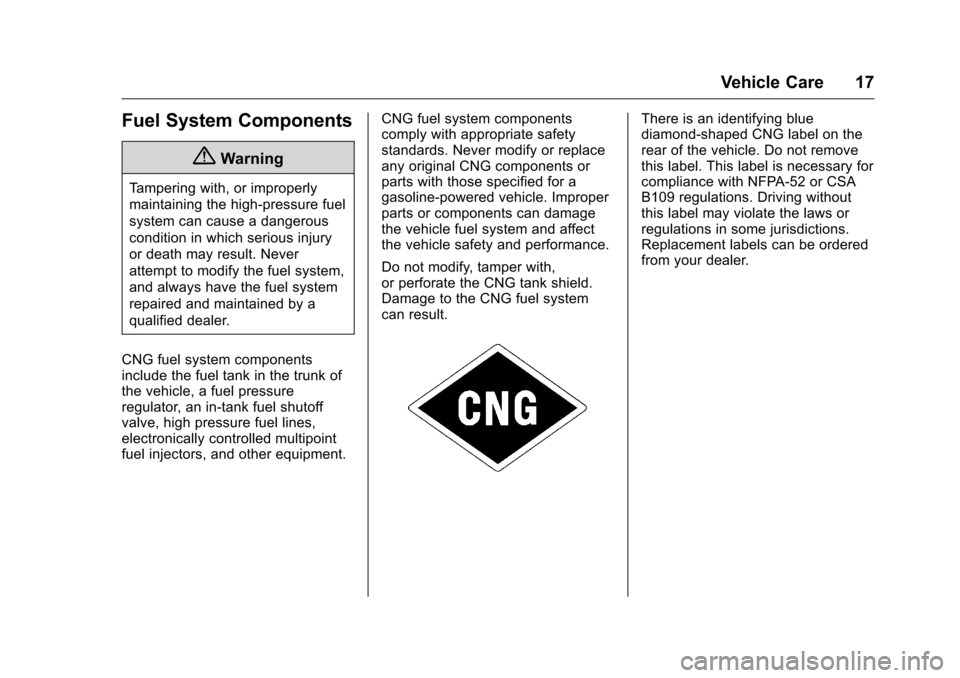
There is an identifying blue
diamond-shaped CNG label on the
rear of the vehicle. Do not remove
this label. This label is necessary for
compliance with NFPA-52 or CSA
B109 regulations. Driving without
this label may violate the laws or
regulations in some jurisdictions.
Replacement labels can be ordered
from your dealer.