2016 CHEVROLET EXPRESS CARGO VAN tow
[x] Cancel search: towPage 6 of 30
Chevrolet/GMC Express/Savana CNG Compressed Natural Gas Supplement
(GMNA-Localizing-U.S/Canada-9159237) - 2016 - crc - 6/18/15
Driving and Operating 5
Driving and
Operating
Driving Information
Vehicle Load Limits . . . . . . . . . . . . . 5
Starting and Operating
Starting the Engine . . . . . . . . . . . . . . 5
Fuel
Fuel . . . . . . . . . . . . . . . . . . . . . . . . . . . . . 6
Filling the Tank . . . . . . . . . . . . . . . . . . 7
Fuel System Leak . . . . . . . . . . . . . 10
Trailer Towing
Trailer Towing . . . . . . . . . . . . . . . . . . 13
Driving Information
Vehicle Load Limits
Caution
Loose items stored in the cargo
area may damage the fuel tank
and fuel system components.
Secure all items in the cargo area
to avoid shifting and any damage
to the fuel tank and fuel tank
components.
Starting and
Operating
Starting the Engine
Starting the engine in a CNG
vehicle is similar to starting a
gasoline engine. See“Starting the
Engine” in the owner manual.
Cold Weather Starting
If the outside temperature is below
−20 °C (−4 °F), the engine may be
harder to start, or may not start until
the temperature increases.
Using the engine heater may make
it easier to start. See “Engine
Heater” in the owner manual.
High Altitude Cold Starting
An engine is harder to start in cold
weather. The thinner air found
above 1 600 m (5,000 ft) also makes
the vehicle harder to start. The
unique properties of CNG make it
even more difficult or impossible to
start at high altitudes if
Page 8 of 30
Chevrolet/GMC Express/Savana CNG Compressed Natural Gas Supplement
(GMNA-Localizing-U.S/Canada-9159237) - 2016 - crc - 6/18/15
Driving and Operating 7
Filling the Tank
{Warning
CNG is flammable and highly
explosive. You could be killed or
seriously injured if leaking natural
gas is ignited. If you suspect a
leak, do not start the engine or
drive the vehicle. Have the
vehicle immediately towed,
inspected, and repaired by an
authorized GM dealer.
{Warning
When refueling in temperatures
below−20 °C (−4 °F), CNG may
leak from the fuel tank valve
pressure relief port if the fast fill
method is used. You or others
could be injured if leaking CNG is
ignited. Fill the vehicle with the
time fill method or refuel when the
temperature is above −20 °C
(−4 °F).
Before filling the fuel tanks, turn off
the engine.
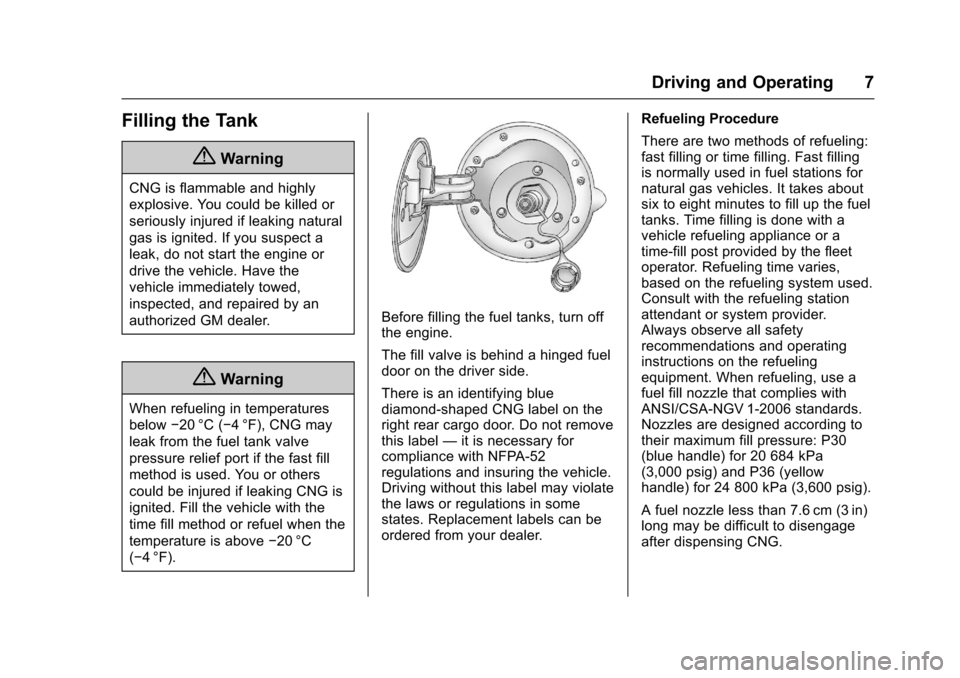
The fill valve is behind a hinged fuel
door on the driver side.
There is an identifying blue
diamond-shaped CNG label on the
right rear cargo door. Do not remove
this label —it is necessary for
compliance with NFPA-52
regulations and insuring the vehicle.
Driving without this label may violate
the laws or regulations in some
states. Replacement labels can be
ordered from your dealer. Refueling Procedure
There are two methods of refueling:
fast filling or time filling. Fast filling
is normally used in fuel stations for
natural gas vehicles. It takes about
six to eight minutes to fill up the fuel
tanks. Time filling is done with a
vehicle refueling appliance or a
time-fill post provided by the fleet
operator. Refueling time varies,
based on the refueling system used.
Consult with the refueling station
attendant or system provider.
Always observe all safety
recommendations and operating
instructions on the refueling
equipment. When refueling, use a
fuel fill nozzle that complies with
ANSI/CSA-NGV 1-2006 standards.
Nozzles are designed according to
their maximum fill pressure: P30
(blue handle) for 20 684 kPa
(3,000 psig) and P36 (yellow
handle) for 24 800 kPa (3,600 psig).
A fuel nozzle less than 7.6 cm (3 in)
long may be difficult to disengage
after dispensing CNG.
Page 11 of 30
Chevrolet/GMC Express/Savana CNG Compressed Natural Gas Supplement
(GMNA-Localizing-U.S/Canada-9159237) - 2016 - crc - 6/18/15
10 Driving and Operating
use with CNG are included with the
vehicle. See an authorized GM
dealer for additional O-rings.
{Warning
Attempting to fill a CNG fuel
system that has a missing or
damaged O‐ring is dangerous.
Natural gas can leak. If the
natural gas is ignited, you or
others could be injured. Replace
the O‐ring before filling the tank.
To replace the fill valve O-ring: 1. Carefully remove the O-ring from the groove in the fill valve.
A small flat-blade or pointed
tool can be used.
2. Make sure the groove is clean and free of dirt and debris.
3. Install the new O-ring in the groove in the fill valve. Make
sure the O-ring is properly
seated in the groove.
Refueling will stop automatically
when the tank is full. To disconnect
the vehicle from the refueling station, remove the nozzle from the
fill valve. A hissing sound may be
heard as a small amount of natural
gas escapes. This is normal.
If dirt or other debris is adhering to
the inside of the fuel fill valve, gas
may leak out after refueling. If more
fuel is needed, repeat the refueling
procedure.
Put the fill valve dust cap on
securely and close the fuel
filler door.
Pressure Relief Devices
The CNG tank has pressure relief
devices that are designed to release
pressure if the CNG tank is
overheated or over pressurized.
{Warning
If the pressure relief devices
release CNG while the vehicle is
being operated, the CNG tanks
will be emptied and it will run out
of fuel. If a release of CNG is
detected, move the vehicle to a
(Continued)
Warning (Continued)
safe stopping location. A loud
rushing noise may be heard when
the CNG is released.
If a pressure relief device
releases CNG while the vehicle is
not running, it is possible that not
all tanks will be emptied. Do not
start the vehicle.
Have the vehicle towed to an
authorized GM dealer for service.
In Case of a CNG Leak
If a CNG fuel leak is suspected, see
Fuel System Leak010.
Fuel System Leak
{Warning
Fuel vapors and fuel fires burn
violently and can cause injury or
death.
(Continued)
Page 12 of 30
Chevrolet/GMC Express/Savana CNG Compressed Natural Gas Supplement
(GMNA-Localizing-U.S/Canada-9159237) - 2016 - crc - 6/18/15
Driving and Operating 11
Warning (Continued)
.Keep all smoking materials
and sources of ignition away
from the fuel system
components.
. CNG is non-toxic but the
vapors are lighter than air
and can cause oxygen
depletion if they are
enclosed in a confined
space. Make sure there is
adequate ventilation and
use extreme caution if a
leak is suspected.
{Warning
If you smell a persistent natural
gas odor or hear a continual
hissing sound, there could be a
natural gas leak. If the natural gas
is ignited, you or others could be
injured. Do not start the engine or
drive the vehicle. Have the
vehicle towed to an authorized
GM dealer for service. A slight natural gas odor may be
detected for a few moments after
refueling. This is normal. You should
not be able to smell natural gas at
any other time. If you do, or if you
hear a hissing sound, the fuel
system may have a leak.
If natural gas is smelled or a hissing
sound is heard:
1. Park the vehicle in an outdoor open area and apply the
parking brake. Keep heat,
sparks, and flame away. Open
all the vehicle doors for
ventilation.
2. Turn the ignition to LOCK/OFF.
Page 13 of 30
Chevrolet/GMC Express/Savana CNG Compressed Natural Gas Supplement
(GMNA-Localizing-U.S/Canada-9159237) - 2016 - crc - 6/18/15
12 Driving and Operating
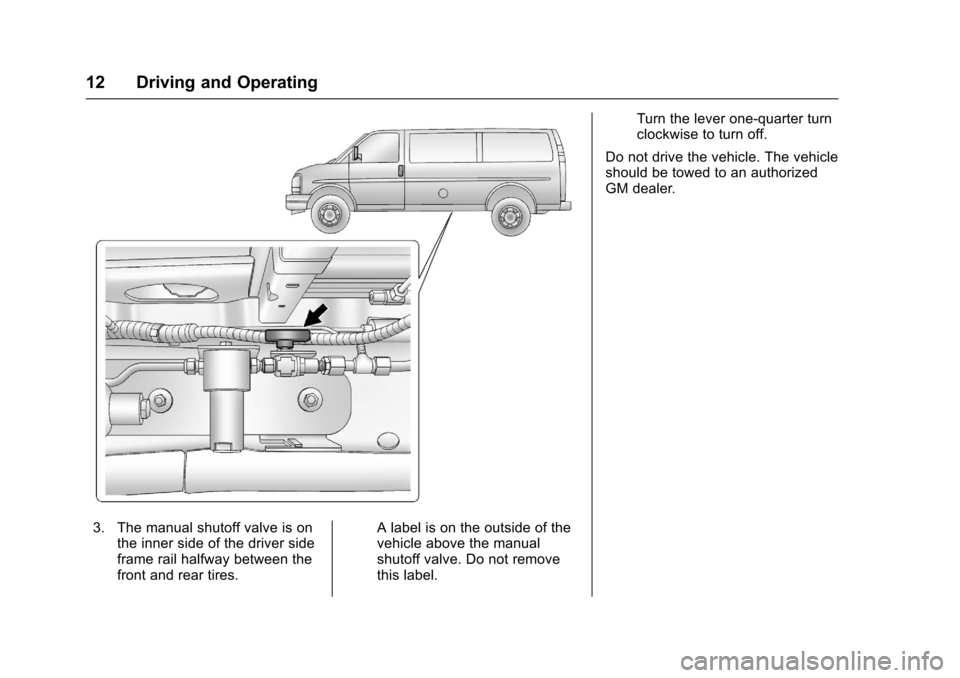
3. The manual shutoff valve is onthe inner side of the driver side
frame rail halfway between the
front and rear tires. A label is on the outside of the
vehicle above the manual
shutoff valve. Do not remove
this label.Turn the lever one-quarter turn
clockwise to turn off.
Do not drive the vehicle. The vehicle
should be towed to an authorized
GM dealer.
Page 14 of 30
Chevrolet/GMC Express/Savana CNG Compressed Natural Gas Supplement
(GMNA-Localizing-U.S/Canada-9159237) - 2016 - crc - 6/18/15
Driving and Operating 13
Trailer Towing
{Warning
The trailer hitch protects the CNG
tank in a crash and from road
hazards. Damage may result in a
rupture or explosion of the CNG
tank. You or others could be
injured or even killed. If the trailer
hitch must be removed for any
reason, e.g., tank inspection or
vehicle repair, always reinstall the
trailer hitch before operating the
vehicle.
The compressed natural gas system
adds approximately 363 kg (800 lb)
of weight to the vehicle. This must
be included when determining the
maximum load and trailer towing
capacity for the vehicle as described
in the owner manual.
Page 15 of 30
Chevrolet/GMC Express/Savana CNG Compressed Natural Gas Supplement
(GMNA-Localizing-U.S/Canada-9159237) - 2016 - crc - 6/18/15
14 Vehicle Care
Vehicle Care
General Information
Accessories andModifications . . . . . . . . . . . . . . . . . 14
Vehicle Checks
Doing Your OwnService Work . . . . . . . . . . . . . . . . . 15
Fuel System Components . . . . . 15
Wheels and Tires
Tire Changing . . . . . . . . . . . . . . . . . 17
Jump Starting
Jump Starting - North America . . . . . . . . . . . . . . . . . . . . . . 17
Towing the Vehicle
Towing the Vehicle . . . . . . . . . . . . . 18
Appearance Care
Exterior Care . . . . . . . . . . . . . . . . . . 18
General Information
Accessories and
Modifications
Do not add accessories to the CNG
or gasoline circuits. Do not cut or
splice any wire harness to add
accessories.
Adding accessories or making
modifications to the vehicle,
including to the CNG tank shields,
could cause a malfunction or
damage and would not be covered
by the vehicle warranty. The CNG
fuel tanks under the vehicle are
protected by tank shields. If the
vehicle has a CNG fuel tank in the
cargo area, it is covered with a
shield.
{Warning
To help avoid damage to the CNG
tanks and to reduce the risk of
explosion, tank shields must be
present. Do not attach
accessories, such as racks or
(Continued)
Warning (Continued)
bins, to the shield. Do not drill,
modify, or use shields as a work
surface. Do not use fire near
shields or tanks.
If a CNG tank needs service or
repair, have only a qualified
technician perform the work. See
“Accessories and Modifications” in
the owner manual.
Page 18 of 30
Chevrolet/GMC Express/Savana CNG Compressed Natural Gas Supplement
(GMNA-Localizing-U.S/Canada-9159237) - 2016 - crc - 6/18/15
Vehicle Care 17
The manual shutoff valve is on the
inner side of the driver side frame
rail halfway between the front and
rear tires.
A label is on the outside of the
vehicle above the manual shutoff
valve. Do not remove this label.
To turn off the valve, turn the lever
one-quarter turn clockwise. Turn it
counterclockwise to turn the valve
back on.
Turn off the valve if a fuel leak is
suspected or if the vehicle is
involved in an accident. This valve,
when turned, will stop CNG flow to
the engine. If the vehicle has just
been in storage and it will not start,
verify that the valve is turned to the
on position.Wheels and Tires
Tire Changing
This vehicle does not have a spare
tire. SeeTowing the Vehicle 018.
Jump Starting
Jump Starting - North
America
{Warning
If the CNG fuel system has a
leak, a spark from the jumper
cables could ignite the natural
gas, causing injury or death. Do
not jump start the vehicle if you
smell a persistent natural gas
odor or hear a continual hissing
sound. Close the manual shutoff
valve, and have the vehicle towed
to an authorized GM dealer for
service. See Fuel System
Components 015.
See “Jump Starting - North America”
in the owner manual.