2016 CHEVROLET CITY EXPRESS CARGO VAN instrument panel
[x] Cancel search: instrument panelPage 167 of 297

Black plate (26,1)Chevrolet City Express Owner Manual (GMNA-Localizing-U.S./Canada-
7707496) - 2015 - CRC - 11/26/14
9-26 Driving and Operating
.You may feel a pulsation in the
brake pedal and hear a noise or
vibration from under the hood.
This is normal and indicates that
the traction control system is
working properly.
.Adjust your speed and driving to
the road conditions.
See Traction Control System (TCS)/
Electronic Stability Control Light on
page 5-16 andElectronic Stability
Control (ESC) Off Light on
page 5-16.
If a malfunction occurs in the
systems, the
dindicator comes on
in the instrument cluster. The TCS
and Electronic Stability Control
systems automatically turn off when
the indicator light is on.
Turning the Systems Off
and On
The TCS/Electronic Stability Control
button is on the instrument panel, to
the left of the steering wheel.
{Caution
Do not repeatedly brake or
accelerate heavily when TCS is
off. The vehicle driveline could be
damaged.
To turn off TCS and Electronic
Stability Control, press and release
the
gbutton. The Electronic
Stability Control (ESC) Off Light
g
comes on and stays on in the
instrument cluster. To turn TCS and Electronic Stability
Control on again, press and release
the
gbutton. The Electronic
Stability Control (ESC) Off Light
g
displayed in the instrument cluster
will turn off.
When the TCS/Electronic Stability
Control button is used to turn off the
systems, the TCS system still
operates to prevent one drive wheel
from slipping by transferring power
to a non–slipping drive wheel. The
dindicator flashes if this occurs. All
other functions are off and the
d
indicator will not flash.
The TCS and Electronic Stability
Control systems are automatically
reset to on when the ignition is
placed in the OFF position then
back to the ON position.
The systems have a built in
diagnostic feature that test the
systems each time the engine is
started and the vehicle moved
forward or in reverse at a slow
speed. When the test occurs a clunk
Page 172 of 297

Black plate (31,1)Chevrolet City Express Owner Manual (GMNA-Localizing-U.S./Canada-
7707496) - 2015 - CRC - 11/26/14
Driving and Operating 9-31
Warning (Continued)
or bent, the sensing zone
may be altered causing
inaccurate measurement of
obstacles or false alarms.
The Rear Parking Assist (RPA)
sounds a tone to warn the driver of
obstacles near the rear bumper
when the shift lever is in
R (Reverse). The system may not
detect objects at speeds above
5 km/h (3 mph) and may not detect
certain angular or moving objects.
The RPA detects objects up to 1.8 m
(5.9 ft) from the rear bumper with a
decreased coverage area at the
outer corners of the bumper. As you
move closer to the obstacle, the rate
of the tone increases. When the
obstacle is less than 25 cm (10 in)
away, the tone will sound
continuously. If the RPA detects a
stationary or receding object further
than 25 cm (10 in) from the side of
the vehicle, the tone will sound for only three seconds. Once the
system detects an object
approaching, the tone will sound
again.
The RPA automatically turns on
when the shift lever is placed in
R (Reverse) and the ignition switch
is in ON. The RPA OFF switch on
the instrument panel allows the
driver to turn the RPA on and off. To
turn the RPA off, the ignition switch
must be placed in ON. An indicator
light on the switch will illuminate
when the system is turned off. If the
indicator light illuminates when the
RPA is not turned off, it may indicate
a malfunction in the RPA.
Keep the RPA sensors, located on
the rear bumper, free from snow,
ice, and large accumulations of dirt.
Do not clean the sensors with sharp
objects. If the sensors are covered,
it will affect the accuracy of
the RPA.
Rear Vision
Camera (RVC)
When the shift lever is shifted into
R (Reverse), the display shows the
view to the rear of the vehicle.
{Warning
.Failure to follow the warnings
and instructions for proper
use of the Rear Vision
Camera (RVC) could result in
serious injury or death.
.The RVC is a convenience
but it is not a substitute for
proper backing. Always turn
and look out the windows,
and check mirrors to be sure
that it is safe to move before
operating the vehicle. Always
back up slowly.
.The system is designed as an
aid to the driver in showing
large stationary objects
(Continued)
Page 180 of 297
Black plate (39,1)Chevrolet City Express Owner Manual (GMNA-Localizing-U.S./Canada-
7707496) - 2015 - CRC - 11/26/14
Driving and Operating 9-39
Filling the Tank
{Warning
Fuel vapors and fuel fires burn
violently and can cause injury or
death.
.To help avoid injuries to you
and others, read and follow
all the instructions on the fuel
pump island.
.Turn off the engine when
refueling.
.Keep sparks, flames, and
smoking materials away
from fuel.
.Do not leave the fuel pump
unattended.
.Do not reenter the vehicle
while pumping fuel.
.Keep children away from the
fuel pump and never let
children pump fuel.(Continued)
Warning (Continued)
.Fuel can spray out if the fuel
cap is opened too quickly.
This spray can happen if the
tank is nearly full, and is
more likely in hot weather.
Open the fuel cap slowly and
wait for any hiss noise to stop
then unscrew the cap all
the way.
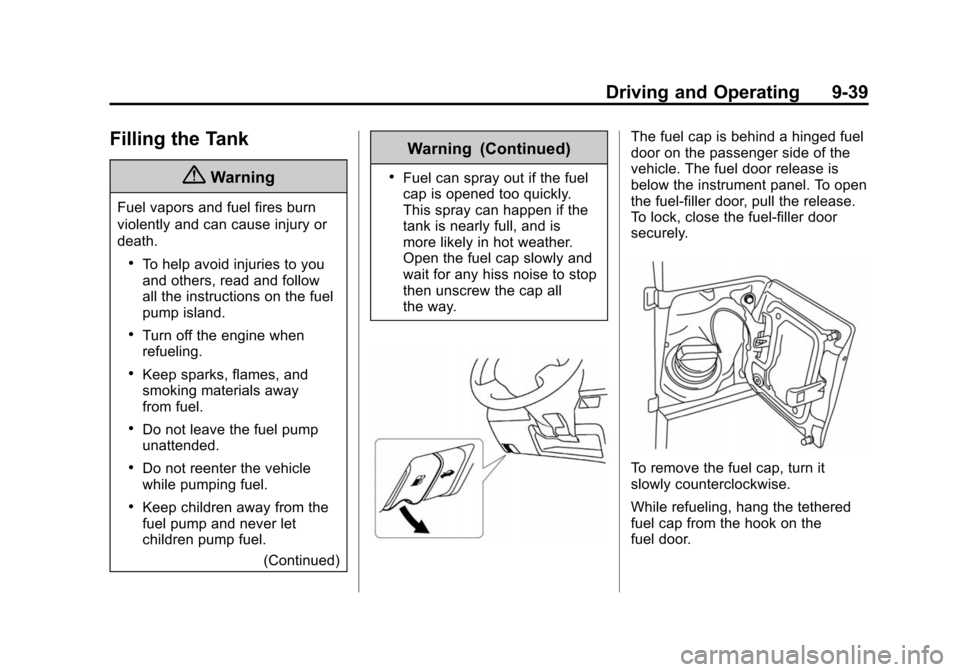
The fuel cap is behind a hinged fuel
door on the passenger side of the
vehicle. The fuel door release is
below the instrument panel. To open
the fuel-filler door, pull the release.
To lock, close the fuel-filler door
securely.
To remove the fuel cap, turn it
slowly counterclockwise.
While refueling, hang the tethered
fuel cap from the hook on the
fuel door.
Page 184 of 297

Black plate (1,1)Chevrolet City Express Owner Manual (GMNA-Localizing-U.S./Canada-
7707496) - 2015 - CRC - 11/26/14
Vehicle Care 10-1
Vehicle Care
General Information
General Information . . . . . . . . . . 10-2
California Proposition65 Warning . . . . . . . . . . . . . . . . . 10-2
California Perchlorate Materials Requirements . . . . 10-2
Accessories and Modifications . . . . . . . . . . . . . . . 10-3
Vehicle Checks
Doing Your OwnService Work . . . . . . . . . . . . . . . 10-4
Hood . . . . . . . . . . . . . . . . . . . . . . . . 10-5
Engine Compartment Overview . . . . . . . . . . . . . . . . . . . 10-7
Engine Oil . . . . . . . . . . . . . . . . . . . 10-8
Continuously Variable Transmission (CVT)
Fluid . . . . . . . . . . . . . . . . . . . . . . 10-11
Engine Air Cleaner/Filter . . . . 10-11
Cooling System . . . . . . . . . . . . 10-13
Engine Coolant . . . . . . . . . . . . . 10-13
Engine Overheating . . . . . . . . 10-16
Overheated Engine Protection
Operating Mode . . . . . . . . . . . 10-17 Washer Fluid . . . . . . . . . . . . . . . 10-18
Brakes . . . . . . . . . . . . . . . . . . . . . 10-19
Brake Fluid . . . . . . . . . . . . . . . . . 10-19
Battery . . . . . . . . . . . . . . . . . . . . . 10-21
Wiper Blade
Replacement . . . . . . . . . . . . . . 10-22
Headlamp Aiming
Headlamp Aiming . . . . . . . . . . 10-23
Bulb Replacement
Bulb Replacement . . . . . . . . . . 10-23
Halogen Bulbs . . . . . . . . . . . . . . 10-23
Headlamps, Front TurnSignal and Parking
Lamps . . . . . . . . . . . . . . . . . . . . 10-23
Replacement Bulbs . . . . . . . . . 10-23
Electrical System
Electrical System Overload . . . . . . . . . . . . . . . . . . 10-24
Fuses and Circuit Breakers . . . . . . . . . . . . . . . . . . 10-25
Engine Compartment Fuse Block . . . . . . . . . . . . . . . . . . . . . 10-25
Instrument Panel Fuse Block . . . . . . . . . . . . . . . . . . . . . 10-26
Wheels and Tires
Tires . . . . . . . . . . . . . . . . . . . . . . . . 10-26
All-Season Tires . . . . . . . . . . . . 10-27
Winter Tires . . . . . . . . . . . . . . . . 10-27
Summer Tires . . . . . . . . . . . . . . 10-28
All-Terrain Tires . . . . . . . . . . . . 10-28
Tire Sidewall Labeling . . . . . . 10-28
Tire Designations . . . . . . . . . . . 10-30
Tire Terminology andDefinitions . . . . . . . . . . . . . . . . 10-32
Tire Pressure . . . . . . . . . . . . . . . 10-35
Tire Pressure Monitor System . . . . . . . . . . . . . . . . . . . 10-36
Tire Pressure Monitor Operation . . . . . . . . . . . . . . . . . 10-37
Tire Inspection . . . . . . . . . . . . . . 10-39
Tire Rotation . . . . . . . . . . . . . . . 10-39
When It Is Time for New Tires . . . . . . . . . . . . . . . . . . . . . . 10-41
Buying New Tires . . . . . . . . . . . 10-41
Different Size Tires and Wheels . . . . . . . . . . . . . . . . . . . 10-43
Uniform Tire Quality Grading . . . . . . . . . . . . . . . . . . . 10-44
Wheel Alignment and Tire Balance . . . . . . . . . . . . . . . . . . . 10-45
Wheel Replacement . . . . . . . . 10-45
Tire Chains . . . . . . . . . . . . . . . . . 10-46
Page 188 of 297

Black plate (5,1)Chevrolet City Express Owner Manual (GMNA-Localizing-U.S./Canada-
7707496) - 2015 - CRC - 11/26/14
Vehicle Care 10-5
This vehicle has an airbag system.
Before attempting to do your own
service work, seeServicing the
Airbag-Equipped Vehicle on
page 3-28.
Keep a record with all parts receipts
and list the mileage and the date of
any service work performed. See
Maintenance Records on
page 11-13.
{Caution
Even small amounts of
contamination can cause damage
to vehicle systems. Do not allow
contaminants to contact the fluids,
reservoir caps, or dipsticks.
Hood
To open the hood:
1. Pull the hood lock release handle located below the
instrument panel on the left side
of the steering wheel.
2. Go to the front of the vehicle,locate the hood release lever in
between the hood and grille, and
push the lever sideways with
your fingertips.
3. Raise the hood.
Page 209 of 297

Black plate (26,1)Chevrolet City Express Owner Manual (GMNA-Localizing-U.S./Canada-
7707496) - 2015 - CRC - 11/26/14
10-26 Vehicle Care
Instrument Panel Fuse
Block
{Caution
Spilling liquid on any electrical
component on the vehicle may
damage it. Always keep the
covers on any electrical
component.
Pull the fuse box cover to remove.
Push the fuse box cover to install.
Wheels and Tires
Tires
Every new GM vehicle has
high-quality tires made by a
leading tire manufacturer. See
the warranty manual for
information regarding the tire
warranty and where to get
service. For additional
information refer to the tire
manufacturer.
{Warning
.Poorly maintained and
improperly used tires are
dangerous.
.Overloading the tires can
cause overheating as a
result of too much flexing.
There could be a blowout
(Continued)
Warning (Continued)
and a serious crash. See
Vehicle Load Limits on
page 9-9.
.Underinflated tires pose
the same danger as
overloaded tires. The
resulting crash could
cause serious injury.
Check all tires frequently
to maintain the
recommended pressure.
Tire pressure should be
checked when the tires
are cold.
.Overinflated tires are more
likely to be cut, punctured,
or broken by a sudden
impact —such as when
hitting a pothole. Keep
tires at the recommended
pressure.
(Continued)
Page 251 of 297

Black plate (68,1)Chevrolet City Express Owner Manual (GMNA-Localizing-U.S./Canada-
7707496) - 2015 - CRC - 11/26/14
10-68 Vehicle Care
using mild soap. Do not use bleach
or fabric softener. Rinse thoroughly
and air dry before next use.
{Caution
Do not attach a device with a
suction cup to the display. This
may cause damage and would
not be covered by the vehicle
warranty.
Use a cloth dampened only with
water to clean the meter and
gauge lens.
Instrument Panel, Leather,
Vinyl, Other Plastic Surfaces,
Low Gloss Paint Surfaces and
Natural Open Pore Wood
Surfaces
Use a soft microfiber cloth
dampened with water to remove
dust and loose dirt. For a more
thorough cleaning, use a soft
microfiber cloth dampened with a
mild soap solution.
{Caution
Soaking or saturating leather,
especially perforated leather, as
well as other interior surfaces,
may cause permanent damage.
Wipe excess moisture from these
surfaces after cleaning and allow
them to dry naturally. Never use
heat, steam, or spot removers. Do
not use cleaners that contain
silicone or wax-based products.
Cleaners containing these
solvents can permanently change
the appearance and feel of
leather or soft trim, and are not
recommended.
Do not use cleaners that increase
gloss, especially on the instrument
panel. Reflected glare can decrease
visibility through the windshield
under certain conditions.
{Caution
Use of air fresheners may cause
permanent damage to plastics
and painted surfaces. If an air
freshener comes in contact with
any plastic or painted surface in
the vehicle, blot immediately and
clean with a soft cloth dampened
with a mild soap solution.
Damage caused by air fresheners
would not be covered by the
vehicle warranty.
Care of Safety Belts
Keep belts clean and dry.
{Warning
Do not bleach or dye safety belts.
It may severely weaken them. In
a crash, they might not be able to
provide adequate protection.
Clean safety belts only with mild
soap and lukewarm water.
Page 268 of 297

Black plate (1,1)Chevrolet City Express Owner Manual (GMNA-Localizing-U.S./Canada-
7707496) - 2015 - CRC - 11/26/14
Technical Data 12-1
Technical Data
Vehicle Identification
Vehicle IdentificationNumber (VIN) . . . . . . . . . . . . . . 12-1
Vehicle Data
Capacities andSpecifications . . . . . . . . . . . . . . 12-2
Engine Drive Belt Routing . . . 12-3
Vehicle Identification
Vehicle Identification
Number (VIN)
This legal identifier is in the front
corner of the instrument panel, on
the left side of the vehicle. It can be
seen through the windshield from
outside. The VIN also appears on
the Vehicle Certification and
certificates of title and registration.
Engine Identification
The fourth character in the VIN is
the engine code. This code
identifies the vehicle's engine,
specifications, and replacement
parts. See “Engine Specifications”
under Capacities and Specifications
on page 12-2 for the vehicle's
engine code.