2016 CADILLAC ATS Heat
[x] Cancel search: HeatPage 278 of 348

Cadillac ATS/ATS-V Owner Manual (GMNA-Localizing-MidEast-9369639) -
2016 - crc - 12/9/15
Vehicle Care 277
Number Usage1 –
2 –
3 Passenger motorized
safety belt
4 –
5 –
6 Driver power seat
7 –
8 Headlamp washer relay
9 –
10 –
11 –
12 –
13 Passenger power seat
14 –
15 Passive entry/ Passive start
16 –
17 Headlamp washer Number Usage
18 –
19 ABS pump
20 ABS valve
21 –
22 Driver motorized safety belt
23 Wiper control relay
24 Wiper speed relay
25 Engine control module relay
26 –
27 –/Heated seat 2
28 –/Reverse lockout
29 AFS AHL/ Pedestrian
protection
30 –
31 Passenger window switch
32 –
33 Sunroof
34 Front wiper Number Usage
35 Steering column lock
36 Rear electrical center/Ignition
37 –/MIL/Ignition
38 –/PT fuse
39 O2 sensor
40 Ignition coils/ Injectors
41 Ignition coils/ Injectors/–
42 Engine control module
43 –
44 –
45 Washer
46 –
47 Front washer relay
48 Instrument panel body/Ignition
49 Fuel system control module/Ignition
Page 279 of 348

Cadillac ATS/ATS-V Owner Manual (GMNA-Localizing-MidEast-9369639) -
2016 - crc - 12/9/15
278 Vehicle Care
Number Usage50 Heated steering wheel
51 Engine control module/Ignition
52 Transmission control module/
Ignition
53 Coolant pump
54 Coolant pump relay
55 –
56 Transmission control module/–
57 Low-beam headlamp relay
58 High-beam headlamp relay
59 Run/Crank relay
60 Starer 2 relay
61 Vacuum pump relay
62 Starter relay
63 A/C control relay
64 Adaptive headlamp leveling Number Usage
65 Left HID headlamp
66 Right HID headlamp
67 Left/Right high-beam
headlamp
68 Aeroshutter
69 Horn
70 Horn relay
71 Cooling fan
72 Starter 2
73 Brake vacuum pump
74 Starter
75 A/C clutch
76 –
Instrument Panel Fuse
Block
The instrument panel fuse block is
in the end of the driver side of the
instrument panel.
To access the fuses, remove the
end panel by gently prying with a
plastic tool near each clip, beginning
at the point shown.
Page 281 of 348

Cadillac ATS/ATS-V Owner Manual (GMNA-Localizing-MidEast-9369639) -
2016 - crc - 12/9/15
280 Vehicle Care
ItemUsage
2 –
3 Electric steering column lock
4 –
5 HVAC control
6 Tilt and telescoping steering column
8 Data link connector
9 –
10 Shunt 11 Body control module 1
12 Body control module 5
13 Body control module 6
14 –
15 Body control module 7
16 Transmission control module
17 – Item
Usage
18 –
19 –
20 –
21 –
22 Sensing diagnostic module/Automatic
occupant sensing
23 Radio/DVD/HVAC control
24 Display
25 Heated steering wheel
26 Wireless charger
27 Steering wheel controls
28 –
29 Visor vanity lamp
30 –
31 –
32 –
33 Front HVAC blower Item
Usage
CB1 Retained accessory power/Accessory
CB7 –
K10 Retained accessory power/Accessory
K605 Logistics
K644 –
Page 283 of 348

Cadillac ATS/ATS-V Owner Manual (GMNA-Localizing-MidEast-9369639) -
2016 - crc - 12/9/15
282 Vehicle Care
Number Usage*1 Rear driver control module/DC DC
transformer
2 Left window
3 Body control module 8
*4 A/C inverter 5 Passive entry/ Passive start
battery 1
6 Body control module 4
7 Heated mirrors
8 Amplifier
9 Rear window defogger
10 Glass break
*11 Trailer connector 12 OnStar (if equipped)
13 Right window
14 Electric parking brake
15 – Number Usage
16 Trunk release
*17 Run relay
*18 Logistics relay
*19 –
20 Rear window defogger relay
21 Mirror window module
22 –
23 Canister vent
24 Body control module 2
*25 Rear vision camera
*26 Front ventilated seats
*27 SBZA/LDW/EOCM
*28 Trailer/Sunshade
*29 Rear heated seats
*30 Semi-active damping system Number Usage
*31 Transfer case control module/Rear
control drive module
32 Theft module/ Universal garage
door opener/Rain
sensor
*33 UPA
*34 Radio/DVD 35 –
*36 Trailer 37 Fuel pump/Fuel system control
module
38 –
39 –
40 –
41 –
*42 Memory seat module
43 Body control module 3
44 –
Page 284 of 348
Cadillac ATS/ATS-V Owner Manual (GMNA-Localizing-MidEast-9369639) -
2016 - crc - 12/9/15
Vehicle Care 283
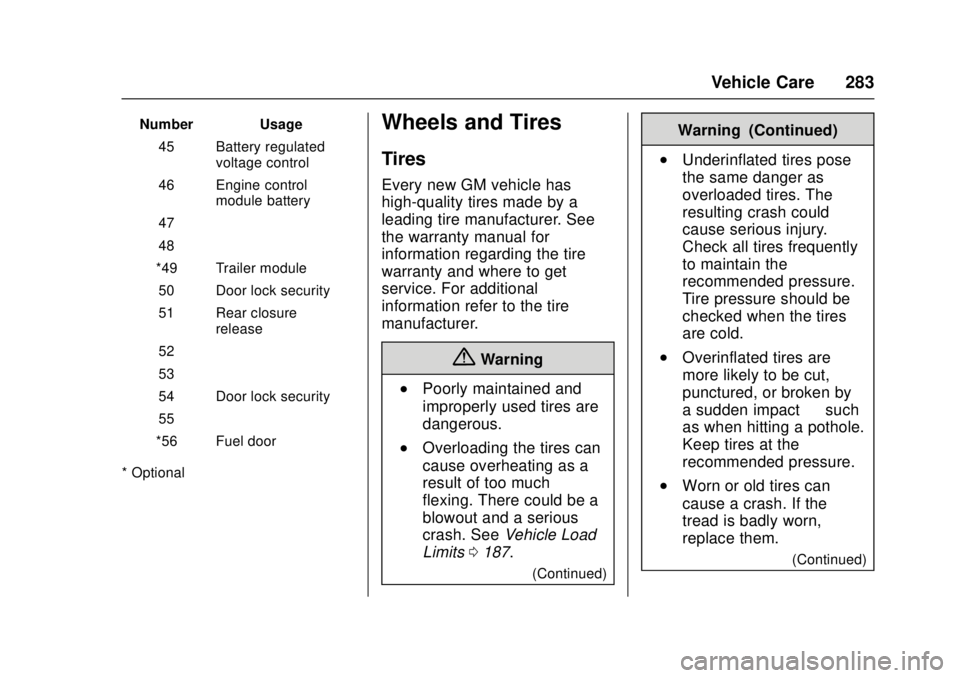
Number Usage45 Battery regulated voltage control
46 Engine control module battery
47 –
48 –
*49 Trailer module 50 Door lock security
51 Rear closure release
52 –
53 –
54 Door lock security
55 –
*56 Fuel door
* OptionalWheels and Tires
Tires
Every new GM vehicle has
high-quality tires made by a
leading tire manufacturer. See
the warranty manual for
information regarding the tire
warranty and where to get
service. For additional
information refer to the tire
manufacturer.
{Warning
.Poorly maintained and
improperly used tires are
dangerous.
.Overloading the tires can
cause overheating as a
result of too much
flexing. There could be a
blowout and a serious
crash. See Vehicle Load
Limits 0187.
(Continued)
Warning (Continued)
.Underinflated tires pose
the same danger as
overloaded tires. The
resulting crash could
cause serious injury.
Check all tires frequently
to maintain the
recommended pressure.
Tire pressure should be
checked when the tires
are cold.
.Overinflated tires are
more likely to be cut,
punctured, or broken by
a sudden impact —such
as when hitting a pothole.
Keep tires at the
recommended pressure.
.Worn or old tires can
cause a crash. If the
tread is badly worn,
replace them.
(Continued)
Page 287 of 348

Cadillac ATS/ATS-V Owner Manual (GMNA-Localizing-MidEast-9369639) -
2016 - crc - 12/9/15
286 Vehicle Care
Caution
Using liquid sealants can damage
the tire valves and tire pressure
monitor sensors in the run-flat
tires. This damage is not covered
by the vehicle warranty. Do not
use liquid sealants in run-flat
tires.
Summer Tires
This vehicle may come with high
performance summer tires. These
tires have a special tread and
compound that are optimized for
maximum dry and wet road
performance. This special tread and
compound will have decreased
performance in cold climates, and
on ice and snow. It is recommended
that winter tires be installed on the
vehicle if frequent driving at
temperatures below approximately
5 °C (40 °F) or on ice or snow
covered roads is expected. See
Winter Tires0284.
Caution
High performance summer tires
have rubber compounds that lose
flexibility and may develop
surface cracks in the tread area
at temperatures below −7 °C (20 °
F). Always store high
performance summer tires
indoors and at temperatures
above −7 °C (20 °F) when not in
use. If the tires have been
subjected to −7 °C (20 °F) or less,
let them warm up in a heated
space to at least 5 °C (40 °F) for
24 hours or more before being
installed or driving a vehicle on
which they are installed. Do not
apply heat or blow heated air
directly on the tires. Always
inspect tires before use. See Tire
Inspection 0292.
Tire Pressure
Tires need the correct amount of
air pressure to operate
effectively. Caution
Neither tire underinflation nor
overinflation is good.
Underinflated tires, or tires
that do not have enough air,
can result in:
.Tire overloading and
overheating which could
lead to a blowout.
.Premature or
irregular wear.
.Poor handling.
.Reduced fuel economy.
Overinflated tires, or tires that
have too much air, can
result in:
.Unusual wear.
.Poor handling.
.Rough ride.
.Needless damage from
road hazards.
Page 288 of 348

Cadillac ATS/ATS-V Owner Manual (GMNA-Localizing-MidEast-9369639) -
2016 - crc - 12/9/15
Vehicle Care 287
The Tire and Loading
Information label on the vehicle
indicates the original equipment
tires and the correct cold tire
inflation pressures. The
recommended pressure is the
minimum air pressure needed to
support the vehicle's maximum
load carrying capacity. See
Vehicle Load Limits0187.
How the vehicle is loaded
affects vehicle handling and ride
comfort. Never load the vehicle
with more weight than it was
designed to carry.
When to Check
Check the tires once a month
or more.
How to Check
Use a good quality pocket-type
gauge to check the tire
pressure. Proper tire inflation
cannot be determined by looking
at the tire. Check the tire
inflation pressure when the tires
are cold, meaning the vehicle has not been driven for at least
three hours or no more than
1.6 km (1 mi).
Remove the valve cap from the
tire valve stem. Press the tire
gauge firmly onto the valve to
get the pressure measurement.
If the cold tire inflation pressure
matches the recommended
pressure on the Tire and
Loading Information label, no
further adjustment is necessary.
If the inflation pressure is low,
add air until the recommended
pressure is reached. If the
inflation pressure in high, press
on the metal stem in the center
of the tire valve to release air.
Re-check the tire pressure with
the tire gauge.
Put the valve caps back on the
valve stems to keep out dirt and
moisture and prevent leaks. Use
only valve caps designed for the
vehicle by GM. TPMS sensors
could be damaged and would
not be covered by the vehicle
warranty.
Tire Pressure for
High-Speed Operation
{Warning
Driving at high speeds, 160 km/h
(100 mph) or higher, puts
additional strain on tires.
Sustained high-speed driving
causes excessive heat buildup
and can cause sudden tire failure.
This could cause a crash, and
you or others could be killed.
Some high-speed rated tires
require inflation pressure
adjustment for high-speed
operation. When speed limits and
road conditions allow the vehicle
to be driven at high speeds, make
sure the tires are rated for
high-speed operation, are in
excellent condition, and are set to
the correct cold tire inflation
pressure for the vehicle load.
Page 289 of 348

Cadillac ATS/ATS-V Owner Manual (GMNA-Localizing-MidEast-9369639) -
2016 - crc - 12/9/15
288 Vehicle Care
Vehicles with P225/45R17 90V and
225/40R18 92V size tires require
inflation pressure adjustment when
driving the vehicle at speeds of
160 km/h (100 mph) or higher. Set
the cold tire inflation pressure to
280 kPa (41 psi).
Vehicles with 225/40RF18 88W and
255/35RF18 90W or 255/35ZR18
(94Y) and 275/35ZR18 (99Y) size
tires require inflation pressure
adjustment when driving the vehicle
at speeds of 160 km/h (100 mph) or
higher. Set the cold tire inflation
pressure to 300 kPa (44 psi).
Sustained operation at speeds over
160 km/h (100 mph) requires a load
limit of the driver and one
passenger, with no additional cargo.
When loaded above this level, up to
the GVW, do not operate the vehicle
above 160 km/h (100 mph).
Return the tires to the
recommended cold tire inflation
pressure when high-speed driving
has ended. SeeVehicle Load Limits
0 187 andTire Pressure 0286.Tire Pressure Monitor
System
Caution
Modifications made to the Tire
Pressure Monitor System (TPMS)
by anyone other than an
authorized service facility may
void authorization to use the
system.
The Tire Pressure Monitor System
(TPMS) uses radio and sensor
technology to check tire pressure
levels. The TPMS sensors monitor
the air pressure in your vehicle's
tires and transmit tire pressure
readings to a receiver located in the
vehicle.
Each tire, including the spare (if
provided), should be checked
monthly when cold and inflated to
the inflation pressure recommended
by the vehicle manufacturer on the
vehicle placard or tire inflation
pressure label. (If your vehicle has
tires of a different size than the size
indicated on the vehicle placard or tire inflation pressure label, you
should determine the proper tire
inflation pressure for those tires.)
As an added safety feature, your
vehicle has been equipped with a
tire pressure monitoring system
(TPMS) that illuminates a low tire
pressure telltale when one or more
of your tires is significantly
under-inflated.
Accordingly, when the low tire
pressure telltale illuminates, you
should stop and check your tires as
soon as possible, and inflate them
to the proper pressure. Driving on a
significantly under-inflated tire
causes the tire to overheat and can
lead to tire failure. Under-inflation
also reduces fuel efficiency and tire
tread life, and may affect the
vehicle's handling and stopping
ability.
Please note that the TPMS is not a
substitute for proper tire
maintenance, and it is the driver's
responsibility to maintain correct tire
pressure, even if under-inflation has