2016 AUDI TT ROADSTER ESP
[x] Cancel search: ESPPage 255 of 306

Downloaded from www.Manualslib.com manuals search engine 0
N
,.....
N
......
0
,.....
Vl
CX) You
cannot check the service interval on a new
vehicle until it has been driven for about 500 km.
Qualified workshops reset the service interval af
ter the oil is changed. The distance to the next oil
change is initially displayed based on the driving
profile prior to the oil change. Your own personal
driving profile is used subsequently to calculate
the remaining distance. Frequent cold starts or
short trips place extra demands on the engine oil
with the result that the oil has to be changed
more often.
Resetting the display
Your qualified workshop resets the service inter
val display after each service.
It is very important that you reset the oil change
display if you change the oil yourself. The next oil
change will be due after a fixed service interval.
To reset the display, select the following on the
infotainment system: !MENU! button> Car > left
control button > Servicing & checks > Service in
tervals > Reset oil change interval.
CD CAUTION
- Do not reset the oil change interval display
unless you have changed the oil.
- Keeping to the correct service intervals is
most important for the service life and re
sidual value of the vehicle (and especially
for the life of the engine). Services must al
ways be carried out promptly, even if the
mileage is low. Checking
and topping up fluids
253
Page 256 of 306

Downloaded from www.Manualslib.com manuals search engine Wheels
Wheels
Tyres and rims
General notes
� Inspect the tyres regularly for damage (cuts,
cracks or blisters, etc.). Remove any foreign
bodies embedded in the treads.
� If you have to drive over a kerb or similar obsta
cle, drive very slowly and as near as possible at
a right angle to the kerb.
� Damaged rims or tyres must be replaced imme
diately.
� Keep grease, oil and fuel off the tyres.
� Mark
the wheels before taking them off so that
they rotate in the same direction when refitted.
� When removed, the wheels should be stored
flat in a cool, dry and preferably dark place.
CD CAUTION
- Please note that summer and winter tyres
are optimised for the prevailing road condi
tions at different times of year. We recom
mend that you use winter tyres during the
winter months. At low temperatures, sum
mer tyres lose their elasticity and grip, and
braking performance also suffers as a re
sult. Cracks can form in the tread block on
summer tyres if they are used at very cold
temperatures, and this can cause perma
nent damage to the tyres. An increase in
rolling noise and tyre imbalance may result
from this damage.
- Machined, polished or chrome-plated rims
must not be used in winter conditions. The
process used to manufacture these types of
wheel rim does not provide adequate sur
face protection against corrosion, and the
rims can be permanently damaged by road
salt or similar.
New wheels or tyres
It is best to have all servicing of wheels and tyres
performed by a qualified workshop, since they
l l
COC = Certificate of conformity
254 have
the necessary special tools and replacement
parts in addition to trained personnel.
� New tyres do not yet give maximum grip. When
driving with new tyres, drive at moderate
speeds and be especially careful during the first
500 km.
� All four wheels must be fitted with tyres of the
same type, size (rolling circumference) and
preferably the same tread pattern.
� Tyres should be replaced in pairs and not indi
vidually (i.e. both front tyres or both rear tyres
together).
� We recommend the use of Audi Genuine Tyres.
If you wish to use other tyres, please note that
the actual size can differ from the nominal size
marked on the tyre ¢ A .
� If you wish to purchase a different combination
of rims and tyres than the ones fitted on the ve
hicle during production, it is advisable to con
sult a qualified workshop beforehand ¢ A.
The sizes of the rims and tyres approved for your
vehicle are listed in the vehicle's documents (e.g.
EC Certificate of Conformity or COC document l)).
The vehicle documents vary depending on the
country in which the vehicle is registered.
If the spare wheel* is not the same type as the
tyres fitted on the car (for example if the car has
winter tyres or wide-section tyres) you should on
ly use the spare wheel* if a puncture occurs, and
then only for a short period of time. In this case,
please drive with extra care. Refit a normal road
wheel as soon as possible.
On vehicles with four-wheel drive, all four wheels
must always be fitted with tyres of the same
type, make and tread pattern, as the driveline
could otherwise be damaged by variations in the
wheel speeds. For the same reason, only use a
spare wheel* which has the same rolling circum
ference as the normal road wheels.
Manufacturing date
The manufacturing date is indicated on the tyre
sidewall (possibly only on the inner side of the
wheel): ..,.
Page 261 of 306

Downloaded from www.Manualslib.com manuals search engine 0
N
,.....
N
......
0
,.....
Vl
CX) based
on the tyre pressures you have stored. The
inflation pressures recommended for your vehicle
are given on the tyre pressure sticker
¢page 256, Fig. 222.
The rolling circumference and vibration can
change and cause a tyre pressure warning if:
- The inflation pressure in one or more tyres is
too low.
- The tyre has suffered structural damage.
- The wheels were changed or the tyre pressures
were changed and the new tyre pressures were
not stored ¢ page 259.
- You are driving with the temporary spare
wheel*.
Indicator lamps
RE- Loss of pressure on one or more tyres¢.&,.
Check and change or repair the tyre(s). Check and
adjust the inflation pressures of all four tyres
again and store the new tyre pressures on the in
fotainment system¢ page 259.
@m (Tyre Pressure Monitoring System) Tyre
pressure: fault. See owner's manual -If @m
ap
pears and the indicator lamp RE in the instru
ment cluster display flashes for approx. one mi
nute and then remains lit after you have switched
on the ignition or while you are driving, there is a
fault in the system. Try to store the correct tyre
pressures ¢ page 259. If the indicator lamp
does not go out or if it comes on again after a
short time, drive to a qualified workshop without
delay and have the fault rectified.
& WARNING
- If the tyre pressure loss indicator appears
on the display, slow down immediately and
avoid any severe braking or steering ma
noeuvres. As soon as you can do so safely,
stop and check the tyres and the tyre pres
sures.
- It is the driver's responsibility to ensure that
the tyre pressures are correct. For this rea
son you must check the tyre pressures regu
larly.
- Under certain conditions (e.g. driving at
high speeds, on ice and snow or on poor Wheels
road surfaces) the tyre pressure loss indica
tor may not appear immediately.
- The use of run-flat tyres on your vehicle is
NOT authorised! Unauthorised use can cause
an accident or damage your vehicle.
((D) Note
- If a malfunction occurs in the ESC system,
the tyre pressure loss indicator may also be
out of action.
- When driving with snow chains, a system
malfunction can occur.
- The tyre pressure loss indicator on your Audi
is specially matched to tyres with the mark
ing "AO"¢ page 254. We recommend that
you use these tyres.
Storing tyre pressure settings
Applies to: vehicles with tyre pressure loss indicator
When you change a tyre or the tyre pressure on
your vehicle, you must confirm the change on the
infotainment system.
.., Before storing the new tyre pressures, check
that the current pressures on all four wheels
correspond to the specified values and adapt
the pressures to the current load ¢ page 255.
.., Switch on the ignition.
.., Select the following on the infotainment sys
tem: I MENU I button >Car> left control button
> Servicing & checks > Tyre pressure loss indi
cator.
(D} Note
Do not store the tyre pressures if you are driv
ing with snow chains.
259
Page 262 of 306

Downloaded from www.Manualslib.com manuals search engine Wheels
Tyre pressure
monitoring system
General notes
Applies to: vehicles with tyre pressure monitoring system
The tyre pressure monitoring system keeps a
check on the tyre pressures of the four road
wheels while you are driving.
The system uses sensors to measure tempera
tures and pressures in the tyres. The sensors
transmit the data to the control unit by radio.
The tyre pressure monitoring system displays the
current pressures and temperatures of the tyres
on the infotainment system while the vehicle is
moving ¢ page 260. In addition, it compares the
current tyre pressures with the stored tyre pres
sures and warns you if it detects a discrepancy
¢page 261.
The system cannot check if the stored tyre pres
sures correspond to the recommended tyre pres
sures for your vehicle. You must store the new
tyre pressures ¢ page 261:
- after every adjustment to the tyre pressures,
e.g. after changing the laden weight of your ve
hicle,
- after changing a wheel, or
- when using wheels with new wheel sensors.
.&_ WARNING
- The tyre pressure monitoring system helps
the driver to monitor the tyre pressures.
However, it is always the driver's responsi
bility to ensure that the tyres are at the cor
rect pressure.
- Never re-adjust the tyre inflation pressure
when the tyre is hot. This can cause serious
damage to the tyre or even a blow-out,
which could result in an accident.
- Under-inflated tyres flex more than they
should. This causes them to overheat. This
can cause tread separation and tyre blow
out, which could result in an accident.
- The tyre pressure monitoring system cannot
warn you of tyre damage or defects that
could lead, for example, to a tyre blow-out.
Perform a regular visual check of your tyres.
260 (I))
Note
- The sensors and valves do not have to be de
tached or changed round when fitting new
tyres. Only the valve core needs to be re
placed, and if necessary the valve and the
electronic components in the wheel. Please
contact a qualified workshop if you have any
questions.
-After using the tyre repair kit, the tyre pres
sure monitoring system may malfunction.
Have the sensors renewed by a qualified
workshop.
Displaying tyre pressures and temperatures
Applies to: vehicles with tyre pressure monitoring system
Important: The vehicle must be moving.
.. Select the following on the infotainment sys
tem: !MENU! button> Servicing & checks >
Tyre pressure loss indicator > Display tyre
pressures.
The current tyre pressures are displayed in green,
yellow or red on the infotainment system:
- Green: The tyre pressure is roughly the same as
the reference value.
- Yellow: The tyre pressure is too low compared
with the reference value.
- Red: The tyre pressure is much too low com-
pared with the reference value.
The reference value is the last stored tyre pres
sure value ¢ page 261.
Bear in mind that the tyre inflation pressure is al
so influenced by the temperature of the tyre. The
tyre heats up while the vehicle is being driven
and the tyre pressure will rise accordingly.
.&_ WARNING
Please observe the important safety informa-
tion and notes ¢ page 260.
�
Page 263 of 306

Downloaded from www.Manualslib.com manuals search engine 0
N
,.....
N
......
0
,.....
Vl
CX) (D)
Note
The tyre pressures and temperatures are not
shown in the display when the vehicle is sta
tionary or during the initialisation phase. Hor
izontal dashes--.--will appear instead of the
pressure and temperature figures.
(1) Loss of tyre pressure
Applies to: vehicles with tyre pressure monitoring system
If the indicator lamp RE appears, the tyre pres
sure on at least one of the wheels is too low or
new sensors have not yet been initialised.
Indicator lamp [Bl lights up after switching
on the ignition
The tyre pressure is too low compared with the
reference value.
... Adjust the pressure of the relevant tyre(s) at
the next opportunity and store the pressures
¢page 261.
Indicator lamp [Bl lights up during a journey
Wheels with new sensors have not yet been ini
tialised or the tyre pressure has reached a critical
level compared with the reference value.
... Avoid unnecessary braking and steering ma
noeuvres.
... Adapt your driving style to the prevailing condi
tions.
... As soon as you can do so safely, stop and check
the tyre(s).
... If it is possible to continue driving, you should
take the vehicle to a qualified workshop and
have the defective tyre(s) repaired or replaced
immediately.
A WARNING
Please observe the important safety informa
tion and notes ¢page 260. Wheels
Storing new tyre pressures
Applies to: vehicles with tyre pressure monitoring system
To enable the tyre pressure monitoring system
to work reliably, it is important to store the cor
rect pressure settings.
You should always store the tyre pressures if new
sensors are fitted or after changing the pressures
when carrying a different amount of passengers
or luggage.
... Before storing the new tyre pressures, check
that the current pressures on all four wheels
correspond to the specified values and adapt
the pressures to the current load ¢ page 256,
Fig. 222. Only adjust and store the inflation
pressure of the tyres when they are at approxi
mately ambient temperature. If the tyre tem
peratures are higher than the ambient temper
ature, the inflation pressures should be in
creased by approx. 0.2 bar above the pressures
specified on the tyre pressure sticker.
... Switch on the ignition.
... Select the following on the infotainment sys
tem: I MENU I button > Servicing & checks >
Tyre pressure loss indicator > Store tyre pres
sures > Yes, store now. The tyre pressure moni
toring system will then measure the current
tyre pressures when you drive the vehicle and
store them as the new reference values .
... If the new tyre pressures do not appear on the
infotainment display, you will need to drive for
about 10 minutes so that the sensor signal
from the wheels can be received again .
During this initialisation phase,--.--will be
shown on the pressure and temperature display
and some functions of the tyre pressure monitor
ing system will not be available. The system will
warn you only if the pressure of one or more tyres
is below the minimum reference pressure.
If the indicator lamp RE lights up and the mes
sage Tyre pressure: wheel change detected.
Please check all tyres and store pressures in
MMI appears, the system has detected that the
sensor positions have changed because of a
wheel change or that new sensors have been fit-
ted. Store the new tyre pressures.
llll-
261
Page 265 of 306

Downloaded from www.Manualslib.com manuals search engine 0
N
,.....
N
......
0
,.....
Vl
CX) Care
of vehicle and
cleaning
General notes
Regular and careful care helps to maintain the
value of the vehicle. This may also be one of the
requirements for upholding any warranty claims
in the event of corrosion or paint defects.
Qualified workshops carry stocks of suitable car
care materials. Please follow the instructions for
use on the packaging.
A WARNING
- Cleaning products and other materials used
for car care can damage health if misused.
- Car care products can contain toxic substan
ces and must always be kept in a safe place
out of reach of children.
@ For the sake of the environment
- Please choose care products that are not
harmful to the environment.
- Surplus cleaning materials should not be
disposed of together with ordinary house
hold waste.
Washing the vehicle
The longer residues are allowed to remain on the
vehicle, the more damage they can do to the
paintwork. High temperatures (for instance in di
rect sunlight) further intensify the damage.
Before washing, soak heavy dirt with plenty of
water.
Stubborn dirt, such as bird droppings or resinous
tree sap, is best removed with plenty of water
and a micro-fibre cloth.
After the period when salt is put on the roads,
have the underside of the vehicle washed thor
oughly.
High-pressure cleaners
When cleaning the vehicle with a high-pressure
cleaner, always follow the operating instructions
for the equipment. This applies particularly to Care
of vehicle and cleaning
the operating pressure and the spraying dis
tance. Do not point the spray jet directly at the
seals on the windows, doors, bonnet or boot lid,
or at the tyres, rubber hoses, insulating material,
sensors* or camera lenses*. Maintain a distance
of at least 40 cm.
Do not use a high-pressure cleaner to remove
snow and ice.
Never use high-pressure cleaners with a round
jet nozzle or "dirt blasters".
The water must not be hotter than 60 °C.
Automatic car washes
Spray the vehicle with water before washing.
Ensure that the windows are closed and that the
windscreen wipers are switched off. Follow the
car wash operator's rules and recommendations,
especially if any accessories are attached to your
vehicle.
If possible use a brush less car wash.
Washing by hand
Clean the car with a soft sponge or brush, start
ing on the roof and working down. Use solvent
free cleaning agents.
Washing matt-painted vehicles by hand
To avoid damaging the paintwork when washing
the car, first remove any dust, sand and grit. In
sects, grease stains and fingerprints are best re
moved using a special cleaning agent for matt
painted surfaces.
Apply the product with a micro-fibre cloth. Do
not apply too much pressure to avoid damaging
the paintwork.
Rinse the car thoroughly with water. Then clean
the car with a neutral shampoo and a soft micro
fibre cloth.
Rinse the car with Lots of water again and then
let it dry in the air. Remove any water stains with
a chamois.
263
Page 267 of 306
Downloaded from www.Manualslib.com manuals search engine 0
N
,.....
N
....
0
,.....
Vl
CX) Care
of vehicle and cleaning
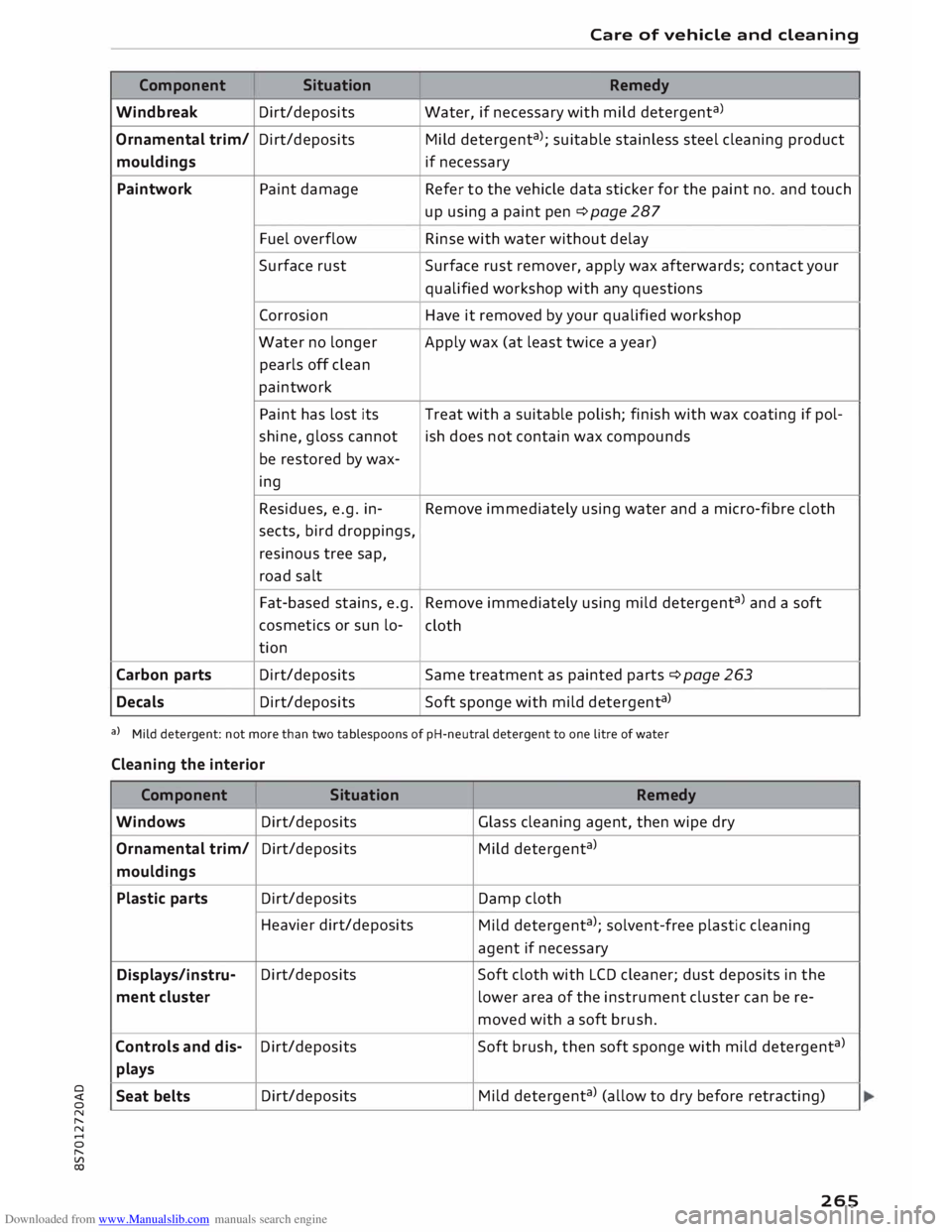
Component Situation Remedy
Windbreak Dirt/deposits Water,
if necessary with mild detergent a
>
Ornamental trim/ Dirt/deposits
Mild detergent a
>; suitable stainless steel cleaning product
mouldings if necessary
Paintwork Paint damage Refer to
the vehicle data sticker for the paint no. and touch
up using a paint pen � page 287
Fuel overflow
Rinse with water without delay
Surface rust
Surface rust remover, apply wax afterwards; contact your
qualified workshop with any questions
Corrosion Have it removed by your qualified workshop
Water no longer
Apply wax (at least twice a year)
pearls off clean
paintwork
Paint has lost its Treat
with a suitable polish; finish with wax coating if pol-
shine, gloss cannot ish does not contain wax compounds
be restored by wax-
ing
Residues, e.g. in- Remove immediately using water and a micro-fibre cloth
sects, bird droppings,
resinous tree sap,
road salt
Fat-based stains, e.g.
Remove immediately using mild detergent a
> and a soft
cosmetics or sun lo-
cloth
tion
Carbon parts Dirt/deposits
Same treatment as painted parts �page 263
Decals Dirt/deposits Soft
sponge with mild detergent a
>
al Mild detergent: not more than two tablespoons of pH-neutral detergent to one litre of water
Cleaning the interior
Component Situation Remedy
Windows Dirt/deposits Glass
cleaning agent, then wipe dry
Ornamental trim/ Dirt/deposits
Mild detergent a
>
mouldings
Plastic parts Dirt/deposits Damp
cloth
Heavier dirt/deposits
Mild detergent a
>
; solvent-free plastic cleaning
agent if necessary
Displays/instru- Dirt/deposits
Soft cloth with LCD cleaner; dust deposits in the
ment cluster lower
area of the instrument cluster can be re-
moved with a soft brush.
Controls and dis- Dirt/deposits
Soft brush, then soft sponge with mild detergent a
>
plays
Seat belts Dirt/deposits
Mild
detergent a
>
(allow to dry before retracting)
265
Page 268 of 306

Downloaded from www.Manualslib.com manuals search engine Care
of vehicle and cleaning
Component Situation I
Remedy
Fabrics, Surface
dirt Vacuum
cleaner
leatherette, Water-based stains, e.g. Absorbent cloth and mild detergent a
>
Alcantara coffee, tea, blood, etc.
Fat-based stains, e.g. oil,
Apply mild detergent a
>, dab off dissolved grease or
make-up, etc. colour particles
with absorbent cloth; if necessary
treat with water
Special dirt/stains, e.g. ball- Special stain remover (dab off with absorbent fab-
point pen, nail varnish, dis-ric);
if necessary treat with mild detergent a
>
persion paint, shoe cream,
etc.
Natural leather Fresh
dirt/stains Cotton cloth with mild detergent a
>
Water-based stains, e.g. Fresh
stains: absorbent cloth
coffee, tea, blood, etc. Dried
stains: stain remover suitable for leather
Fat-based stains, e.g. oil, Fresh stains: absorbent cloth and suitable stain re-
make-up, etc. mover for leather
Dried stains: grease removal spray
Special dirt/stains, e.g. ball- Stain remover suitable for leather
point pen, nail varnish, dis-
persion paint, shoe cream,
etc.
Care of vehicle Regularly apply leather-care cream with ultra-violet
protection and impregnating compound; if necessa-
ry use special colour leather cream
Carbon parts Dirt/deposits
Same treatment as plastic parts
al Mild detergent: not more than two tablespoons of pH-neutral detergent to one litre of water
.&_ WARNING
Do not use water-repellent coatings on the
windscreen. In bad visibility conditions such
as light rain, low sun or when driving at night
these coatings can cause increased dazzle,
which is a serious safety hazard. Such coat
ings can also cause the wiper blades to jud
der.
CD CAUTION
- Headlights/rear lights
- Never clean the headlights/rear lights
with a dry cloth or sponge.
- Do not use cleaning agents containing al
cohol. This could cause the glass to crack!
-Wheels
- Do not use paint polish or other abrasive
agents.
266 -
If the protective paint coating on the
wheel rim is scratched or damaged by
stone chips etc., the damaged
area
should
be touched up without delay.
- Sensors/camera lenses
- Never remove snow and ice from the cam-
era lens using warm or hot water -danger
of cracks appearing on the lens.
- Never clean the camera lens with cleaning
agents which are abrasive or contain alco
hol -danger of scratches and cracks ap
pearing.
- Soft top
- Remove bird droppings without delay.
- Never use petrol, stain remover, benzene,
paint thinners or other solvents to remove
stains.
-
Windows