2016 AUDI TT ROADSTER warning
[x] Cancel search: warningPage 229 of 306

Downloaded from www.Manualslib.com manuals search engine 0
N
,.....
N
......
0
,.....
Vl
CX) -
Never place objects in the driver's footwell.
Such objects could move under the pedals
and interfere with their proper function. In
the event of sudden braking or a change of
direction, you would not be able to use the
pedals. This could result in a loss of control
and possibly cause an accident.
Floor mats on the driver's side
Use only floor mats which can be securely fas
tened in the footwell and do not obstruct the
pedals.
... Make sure that floor mats are securely fastened
and cannot interfere with the pedals ¢,&. .
Use only floor mats that leave the pedal area un
obstructed and are firmly secured to prevent
them from slipping. You can obtain suitable floor
mats from your dealer or a specialist retailer.
A WARNING
Any obstructions that restrict pedal travel can
cause loss of vehicle control and increase the
risk of serious personal injury.
- Always make sure that floor mats are prop
erly secured.
- Never lay or install additional floor mats or
other floor coverings over the existing floor
mats; this would restrict the pedal area and
possibly obstruct the pedals, which could
cause an accident.
Stowing luggage safely
Luggage compartment
All luggage and other objects must be safely se
cured in the luggage compartment. To maintain
safe handling on the road, please observe the fol
lowing points:
.,.. Distribute the load evenly in the luggage com
partment.
.,.. Place heavy items as far forward as possible in
the Luggage compartment and secure them
properly. Safe
driving
... Secure the load with the luggage net* or with
non-elastic straps secured to the fastening
rings* ¢ page 228.
A WARNING
- Loose items in the luggage compartment
are a safety hazard: they can move suddenly
and impair the handling of the vehicle as a
result of the change in weight distribution.
- In an accident or a sudden manoeuvre, loose
objects in the passenger compartment can
be flung forward -risk of injury! Always
stow objects safely in the luggage compart
ment and secure them on the fastening
rings*. Use suitable securing straps, particu
larly when transporting heavy objects.
- Always stow objects in the luggage com
partment.
- Transporting heavy objects may affect the
vehicle's handling by shifting the centre of
gravity -this could cause an accident. Take
extra care when driving and adjust your
speed accordingly.
- Never exceed the maximum axle loads or
the maximum gross weight for the vehicle
¢ page 287. Exceeding the permitted axle
loads or gross weight limit can affect the ve
hicle's handling characteristics, and increase
the risk of accidents, personal injuries or
damage to the vehicle.
- Never leave your vehicle unattended when
the boot lid is open. Children could climb in
to the boot and close the boot lid from the
inside. In this case the child would be un
able to get out of the
vehicle
without help.
This could have fatal consequences.
- Never allow children to play in or around the
vehicle. Always close and lock the boot lid
and all the doors when you leave the vehi
cle.
- Never let passengers ride in the luggage
compartment. All occupants must be prop
erly restrained by the seat belts at all times
¢page 230. .,._
227
Page 230 of 306

Downloaded from www.Manualslib.com manuals search engine Safe
driving
� Note
- The tyre pressure must be adjusted accord
ing to the Load the vehicle is carrying
¢page 256.
-Air circulation in the vehicle helps reduce
fogging of the windows. Used air escapes
through ventilation slots in the rear of the
vehicle. Make sure that these ventilation
slots are not obstructed.
- Suitable belts for securing Loads to the fas
tening rings* are commercially available.
Fastening rings
Unsecured Loads are a hazard to all vehicle occu
pants.
AUDI
Fig. 186 Luggage compartment: Location of fastening
rings
� Use the fastening rings to secure items safely
in the Luggage compartment ¢.&. in Luggage
compartment on page 22 7.
During a collision or an accident, even small and
Light objects can possess so much energy that
they can cause very severe injuries. The amount
of this "kinetic energy" depends on the speed of
the vehicle and the weight of the object. The
most significant factor, however, is the speed of
the vehicle.
For example: an object weighing 4.5 kg is Lying
unsecured in the vehicle. During a frontal colli
sion at a speed of 50 km/h, this object generates
a force corresponding to 20 times its weight.
That means that the effective weight of the ob
ject increases to about 90 kg. You can imagine
the severity of the injuries which might be sus-
228 tained
if this "projectile" strikes an occupant as it
flies through the passenger compartment.
A WARNING
If items of Luggage or other objects are se
cured to the fastening rings with inappropri
ate or damaged tensioning straps, injuries
could result in the event of sudden braking or
a collision.
- To prevent pieces of Luggage or other ob
jects from flying forward, always use appro
priate tensioning straps which are properly
secured to the fastening rings.
- Never secure a child seat on the fastening
rings.
Pedestrian protection
system
Description
Applies to: vehicles with pedestrian protection system
The pedestrian protection system is automatical
ly activated in the event that the front of the ve
hicle collides with a pedestrian. The bonnet is
raised slightly to create an additional crush zone
above the engine.
The sensors of the pedestrian protection system
are Located in the front bumper. In rare cases,
the system can be triggered because the possibil
ity that a pedestrian has been hit cannot be ruled
out by the sensors, for example:
- in a collision with a signpost,
- in a collision with an animal, or
- if you drive into a pile of snow, or
- in the event of ground contact, e.g. when driv-
ing on extremely poor road surfaces.
If the system has been activated, press the bon
net back into its original position ¢.&. in Servic
ing the pedestrian protection system on
page 229 and have the system serviced by a
qualified workshop.
A WARNING
- Do not use an additional or replacement
number plate holder other than the original
one fitted at the front of the vehicle.
Page 231 of 306

Downloaded from www.Manualslib.com manuals search engine 0
N
,.....
N
......
0
,.....
Vl
CX) -
Never change or replace the bumper or bon
net as a part of tuning measures. This can
impair the effectiveness of the pedestrian
protection system and invalidate the oper
ating permit for your vehicle.
- False activation of the pedestrian protection
system is possible.
Servicing the pedestrian protection system
Applies to: vehicles with pedestrian protection system
Fig. 187 Pressing back/checking the bonnet
If the pedestrian protection system has been de
ployed, the bonnet will be slightly raised at the
end next to the windscreen. In addition, the indi
cator lamp m will be displayed along with a
message .
.,. To engage the bonnet again, press it down with
both hands on the left side of the vehicle in
area (i)¢Fig.187 ¢.&,. .
.,. To check whether the bonnet is properly engag
ed, pull the rear edge of the bonnet @ up
wards. If the bonnet can be lifted, press it
down again .
.,. When the bonnet has engaged properly, repeat
the procedure on the right side of the vehicle .
.,. Drive to the nearest qualified workshop without
delay and have the pedestrian protection sys
tem serviced ¢(D.
8_ WARNING
- Do not press back the bonnet unless both of
your hands are flat on top of the bonnet. If
you do this, you cannot catch your fingers
between the bonnet and body. Take care
when pressing back the bonnet: careless or Safe
driving
uncontrolled movements can cause injury to
yourself or others -risk of injury!
- The system can only be activated once. If
the pedestrian protection system has been
triggered, have it replaced without delay by
a qualified workshop.
CD CAUTION
- All repairs to the bumper and the pedes
trian protection system must only be carried
out by a qualified workshop working to the
specifications of the Audi factory. Improper
repairs can impair the effectiveness of the
system and invalidate the operating permit
for your vehicle.
- The relevant safety requirements must be
observed when individual components of
the system or the entire vehicle are scrap
ped. Your authorised dealer is familiar with
these regulations and will be pleased to
pass on the information to you.
229
Page 232 of 306

Downloaded from www.Manualslib.com manuals search engine Seat
belts
Seat belts
Why is it so important to
use seat belts?
Seat belts provide effective protection
The common belief that passengers can brace
their weight with their hands in a minor collision
is false.
Fig. 188 Driver with correctly positioned seat belt -good
protection if the brakes are applied suddenly
It is an established fact that seat belts provide
good protection in accidents. Therefore wearing
a seat belt is required by law in most countries.
When worn correctly, seat belts hold the occu
pants in the best position for maximum protec
tion ¢ Fig. 188. The seat belts are capable of ab
sorbing much of the kinetic energy which is gen
erated in a collision. They also help to prevent
uncontrolled movements which could lead to se
vere injuries ¢ page 230, Important safety
notes when using seat belts.
If they wear the seat belts correctly, the passen
gers benefit greatly from the ability of the belts
to reduce the kinetic energy gradually. The front
crumple zones and other passive safety features
(such as the airbag system) are also designed to
absorb the kinetic energy generated in a colli
sion. Taken together, all these features reduce
the forces acting on the occupants and conse
quently the risk of injury.
Although these examples are based on a frontal
collision, the physical principles involved are the
same in other types of accidents. This is why it is
so important to put on the seat belts before ev
ery trip -even when "just driving around the cor-
230 ner".
Please also ensure that your passenger's
seat belt is properly fastened ¢ A.
Seat belts worn correctly have been shown to be
an effective means of reducing the potential for
injury and improving the chances of survival in a
serious accident ¢ page 231, Forces acting in a
collision.
For information on how children can travel safely
in the car refer to¢ page 223, Child seats.
_& WARNING
- Seat belts must be put on before every trip -
even when driving in town. This also applies
to passengers -risk of injury!
- During pregnancy, women should always
ensure they wear a seat belt. The best way
to protect the unborn child is to protect the
mother ¢ page 233, Wearing and adjust
ing the seat belts during pregnancy.
Important safety notes when using seat
belts
There are a number of safety points concerning
the seat belts which you should remember. This
will help to reduce the risk of injury in an acci
dent.
_& WARNING
- The seat belts can only provide maximum
protection if the seats are adjusted properly
¢ page 54, Front seats.
- To ensure proper protection, it is important
to wear the seat belts in the correct position
¢ page 232, How to wear seat belts prop
erly. Ensure that the seat belts are worn ex
actly as recommended in this chapter. Belts
which are not worn properly can increase
the risk of injury in accidents considerably.
- Do not allow the seat belt to become twis
ted or jammed, or to rub on any sharp
edges.
- Never allow two passengers (even children)
to share the same seat belt. It is especially
dangerous to place a seat belt over a child
sitting on your lap.
..,.
Page 235 of 306

Downloaded from www.Manualslib.com manuals search engine 0
N
,.....
N
......
0
,.....
Vl
CX) A
WARNING
-Always make certain that the belt is posi
tioned properly ¢ Fig. 192 -risk of injury
¢ page
233, Adjusting the seat belts. -
- The latch plate of the belt must always be
engaged in the correct buckle for that seat.
Otherwise the belt will not be fully effective
and the danger of injury increases.
Adjusting the seat belts
Always position seat belts properly for maximum
safety.
Fig. 194 Adjusting shoulder/lap belt
The following equipment is available for your ve
hicle to help you position the seat belt properly
to suit your height:
- Height-adjustable seats
- Belt guide ring on backrest
A WARNING
- The shoulder section of the belt should be
fitted across the centre of the collar bone
close to the body. To fasten the belt, take
hold of the belt above the latch plate and
pull it slowly down across your chest. Wear
the lap portion of the seat belt as low as
possible over the hips so that there is no
pressure on the lower abdomen. The belt
should always be worn tightly ¢ Fig. 194.
Pull the belt tight if necessary to take up
any slack.
- Always make sure that belt is positioned
properly. Incorrectly worn seat belts can
give rise to injuries even in a minor collision. Seat
belts
- Seat belts worn too loose can result in inju
ries because they allow excessive forward
movement in a crash; the occupant will be
brought to a sudden stop by the belt web
bing.
Wearing and adjusting the seat belts
during pregnancy
To afford the best protection for the unborn
child it is important for the mother to wear the
seat belt properly at all times.
Fig. 195 Positioning seat belts during pregnancy
Women should always ensure they adjust the
seat belt correctly during pregnancy.
.., Adjust the seat correctly before putting on the
seat belt¢ page 54, Front seats.
... To fasten the belt, pull it slowly down across
your chest. Wear the lap portion of the seat
belt as low as possible over the hips so that
there is no pressure on the stomach ¢ Fig. 195,
¢ ,& .
... Insert the latch plate into the buckle for the ap
propriate seat and push it down until it is se
curely locked with an audible click¢ page 232,
Fig. 193.
... Pull the belt to check that it is now securely fas
tened.
A WARNING
During pregnancy, women should especially
make sure to wear the lap portion of the seat
belt as low as possible across the hips so that
there is no pressure on the stomach.
233
Page 236 of 306
Downloaded from www.Manualslib.com manuals search engine Seat
belts
Taking off the seat belts
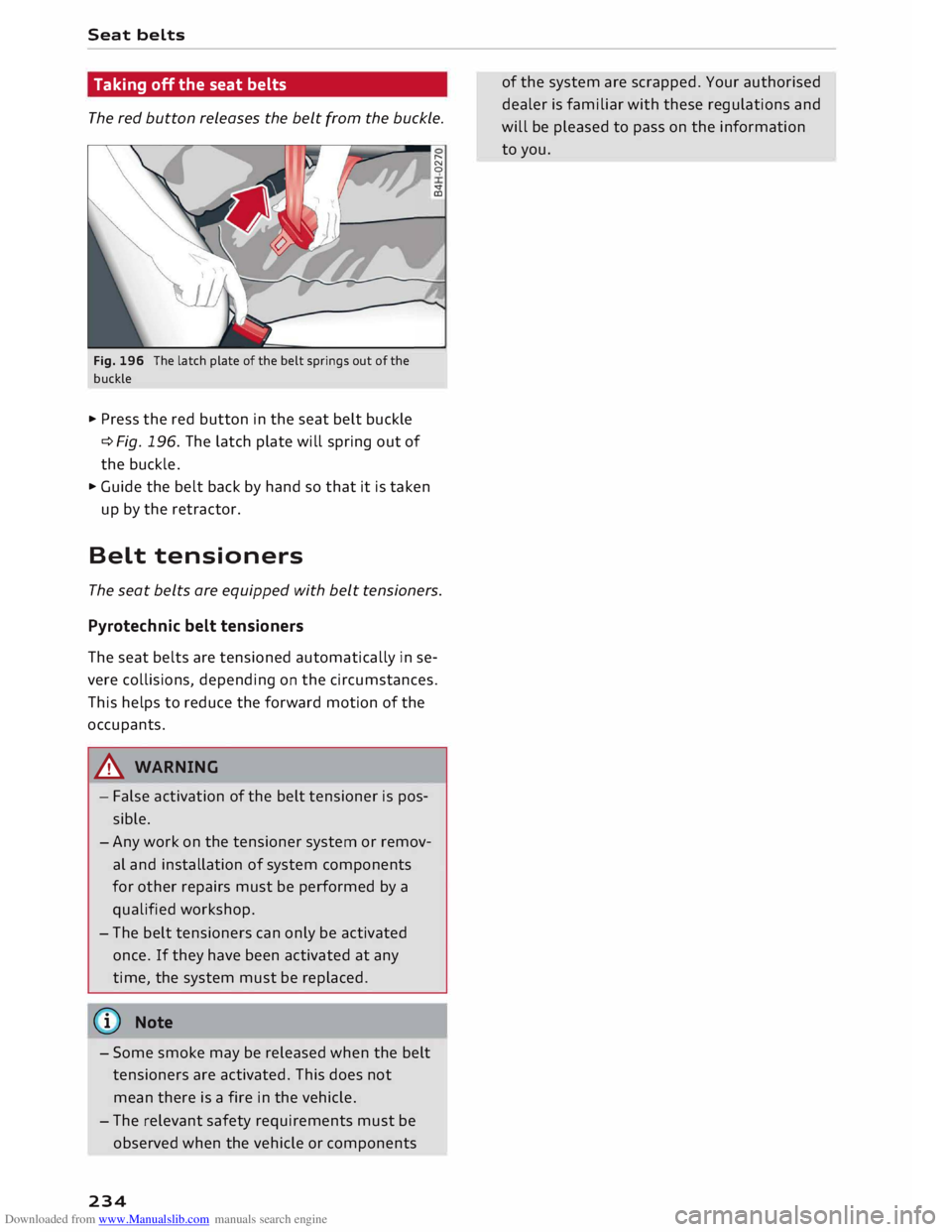
The red button releases the belt from the buckle.
Fig. 196 The latch plate of the belt springs out of the
buckle
... Press the red button in the seat belt buckle
¢ Fig. 196. The latch plate will spring out of
the buckle .
... Guide the belt back by hand so that it is taken
up by the retractor.
Belt tensioners ....
N
0
�
ID
The seat belts are equipped with belt tensioners.
Pyrotechnic belt tensioners
The seat belts are tensioned automatically in se
vere collisions, depending on the circumstances.
This helps to reduce the forward motion of the
occupants.
A WARNING
- False activation of the belt tensioner is pos
sible.
- Any work on the tensioner system or remov
al and installation of system components
for other repairs must be performed by a
qualified workshop.
- The belt tensioners can only be activated
once. If they have been activated at any
time, the system must be replaced.
Q) Note
- Some smoke may be released when the belt
tensioners are activated. This does not
mean there is a fire in the vehicle.
- The relevant safety requirements must be
observed when the vehicle or components
234 of
the system are scrapped. Your authorised
dealer is familiar with these regulations and
will be pleased to pass on the information
to you.
Page 237 of 306

Downloaded from www.Manualslib.com manuals search engine 0
N
,.....
N
......
0
,.....
Vl
CX) Airbag
system
Description of airbag
system
General notes on airbag system
The airbag is an integral part of the car's passive
safety system.
In conjunction with the seat belts, the airbag sys
tem gives the front occupants additional protec
tion for the head and chest in the event of a se
vere frontal collision.
In a severe side collision the side airbags reduce
the risk of injury to the occupants ¢,&..
In addition to their normal function of protecting
the occupants in a collision, the seat belts also
hold them in a position where the airbags can in
flate properly and provide maximum protection.
The airbag system will only work with the igni
tion on. The airbag system is monitored electron
ically; the indicator lamp m indicates whether
the system is functioning properly.
The main parts of the airbag system are:
- The electronic monitoring system (control unit
and sensors)
- The two front airbags
- The two side airbags
- The indicator lamp El in the instrument cluster
There is a fault in the airbag system if the
warning lamp
- does not come on when the ignition is switched
on.
- does not go out about 4 seconds after the igni
tion is switched on.
- goes out and then comes on again after the ig
nition is switched on.
- comes on or flickers while the car is moving.
A WARNING
- The airbags are not a substitute for the seat
belts; they are an integral part of the car's
overall passive safety system. The airbags
can only offer effective protection if the oc
cupants are wearing their seat belts. For Airbag
system
this reason it is very important to wear the
seat belts at all times ¢ page 230, Why is it
so important to use seat belts?.
- The seat belts and airbags can only provide
maximum protection if the occupants are
seated correctly ¢ page 54, Front seats.
- If you do not wear a seat belt, if you lean
forward, or are not seated correctly while
the vehicle is in motion, you are at greater
risk of injury should the airbag system be
triggered in an accident.
- Components of the airbag system are loca
ted in various parts of the vehicle. If repairs
to other vehicle components make it neces
sary to perform work on the airbag system
or to remove or install parts of the airbag
system, this may cause damage to the air
bag system. As a result, the airbags may not
inflate correctly or may not be triggered at
all in an accident situation. For this reason,
you should always have the work carried out
by a qualified workshop.
- If a fault should occur in the airbag system,
have the system checked immediately by a
qualified workshop. Otherwise the system
may fail to trigger in an accident.
- Do not attempt to modify components of
the airbag system in any way.
- Never make any alterations to the front
bumper or the body.
- Do not remove the seats.
- The airbag system can only be activated
once; if the airbag has been triggered, the
system must be replaced. Should the airbag
system or airbag modules have to be re
placed, the qualified workshop carrying out
the replacement will document all details.
- If any repair work is required or the airbag
and restraint systems have to be replaced,
have the work carried out by your authorised
Audi dealer or a qualified workshop which
adheres to the Audi factory standards. This
will minimise the risk of injury.
- If you sell the vehicle, remember to pass on
the complete Service Wallet to the new
owner. If any of the airbags have been deac
tivated, it is important that the new owner
is also given the relevant documents.
..,.
235
Page 239 of 306

Downloaded from www.Manualslib.com manuals search engine 0
N
,.....
N
....
0
,.....
Vl
CX) Deactivating
the passenger's airbag
Applies to: vehicles with key-operated switch for passenger's
airbag
If an airbag has been deactivated, it should be
reactivated as soon as possible so that it can
continue to give the required protection.
Fig. 199 Glove box: Key-operated switch for deactivating
passenger's airbag
Fig. 200 Warning lamp lights up when passenger's airbag
is deactivated
If you install a rearward-facing child seat on the
passenger's seat you must deactivate the pas
senger's airbag beforehand .
... To deactivate the passenger's airbag, use the
emergency key to turn the key-operated switch
to OFF ¢ Fig. 199 .
... The
passenger's airbag can be reactivated by
turning the key to position ON.
Monitoring of airbag system
The indicator lamp JJI ¢ page 16 will light up for
a few seconds every time the ignition is switched
on.
If the passenger's airbag has been deactivated,
the indicator lamp "PASSENGER AIR BAG OFF
or" AIR BAG OFF" will light up constantly as a
reminder¢ Fig. 200 . Airbag
system
.&_ WARNING
- Never install a rearward-facing child seat on
the passenger's seat unless the passenger's
airbag has been deactivated -this can result
in potentially fatal injuries to the child
¢page 223.
- If you have deactivated the passenger's air
bag, reactivate it as soon as the child seat is
no longer needed so that the airbag can
continue to give the required protection.
- It is the driver's responsibility to ensure that
the key-operated switch is set to the correct
position.
Description of front airbags
The airbag system is not a substitute for the seat
belts.
Fig. 201 Steering wheel: Driver's airbag
Fig. 202 Dashboard: Passenger's airbag
The front airbag for the driver is located in the
padded hub of the steering wheel¢ Fig. 201. The
front airbag for the passenger is in the dash
board above the glove box ¢Fig. 202. The loca
tions of the airbags are marked with the word
"AIRBAG". Ill--
237