2016 AUDI TT COUPE lock
[x] Cancel search: lockPage 227 of 322

Downloaded from www.Manualslib.com manuals search engine ...... N
G'. CX)
..... ID IJ' ..... ID .....
Activating the convertible locking retractor
Use the convertible locking retractor to secure a
child restraint.
Always heed the child safety seat manufacturer's
instructions when installing a child restraint in
your vehicle. To activate the convertible locking
retractor:
.. Place the child restraint on a seat, preferably
on the rear seat.
.. Slowly pull the belt all the way out.
.. Route it around or through the child restraint
belt path <:!> .&,..
"'Push the child safety seat down with your full
weight to get the safety belt really tight.
.. Insert the belt tongue into the buckle for that
seating position .
.. Guide the safety belt back into the retractor un
til
the belt lies flat and snug on the child safety
seat.
.. You should hear a "clicking" noise as the belt
winds back into the inertia reel. Test the con
vertible locking retractor by pulling on the belt.
You should no longer be able to pull the belt
out of the retractor. The convertible locking re
tractor is now activated .
.. Make sure that the red release button is facing
away from
the child restraint so that it can be
unbuckled quickly.
.. Pull on the belt to make sure the safety belt is
properly
tight and fastened so that the seat
cannot move forward and sideways more than
1 in (2.S cm).
.&_WARNING
Usi ng the wrong child restraint or an improp
erly installed child restraint can cause serious
personal injury or death in a crash.
- Always
make sure that the safety belt re
tractor is locked when installing a child
safety seat. An unlocked safety belt retrac
tor cannot hold the child safety seat in place
during
normal driving or in a crash.
- Always buckle
the child safety seat firmly in
place even if a child is not sitting in it. A
loose child safety seat can fly around during
a
sudden stop or in a crash.
Child safety
- Always make sure the seat backrest to which
the child restraint is installed is in an up
right position and securely latched into
place and cannot fold forward. Otherwise,
the seatback with the child safety seat at
tached to it could fly forward in the event of
an accident or other emergency situation.
-Always read and heed all WARNINGS when
ever using a child restrained in a vehicle is
being
used <:!>page 212. Special precautions
apply when installing a child safety seat on
the front passenger seat <:!>page 189, Child
restraints on the front seat-some impor
tant things to know.
Deactivating the convertible locking
retractor
The convertible locking retractor for child re
straints will be deactivated automatically when
the
belt is wound all the way back into the re
tractor.
.. Press the red button on the safety belt buckle.
The
belt tongue will pop out of the buckle.
.. Guide the safety belt all the way back into its
stowed position.
Always
let the safety belt retract completely into
its stowed position. The safety belt can now be
used as an ordinary safety belt without the con
vertible locking retractor for child restraints.
If the convertible locking retractor should be ac
tivated inadvertently, the safety belt must be un
fastened and guided completely back into its
stowed position to deactivate this feature. If the
convertible locking retractor is not deactivated,
the safety belt will gradually become tighter and
uncomfortable to wear.
.&. WARNING
Improperly installed child safety seats in
crease the risk of serious personal injury and
death in a collision.
----'
- Never unfasten the safety belt to deactivate
the convertible locking retractor for child re
straints while the vehicle is moving. You
225
Page 230 of 322

Downloaded from www.Manualslib.com manuals search engine Child safety
•Attach both hook-on connectors with the spring
catch release on the child safety seat onto the
LATCH lower anchorage so that the connectors
lock into place Q fig. 173.
• Pull on the connector attachments to make
sure they are properly attached to the LATCH
lower anchorage.
• Pull straps tight following the child restraint
manufacturer's instructions.
Releasing
• Loosen the tension on the straps following the
child restraint manufacturer's instructions.
• Depress the spring catches to release the an
chorage hooks from the lower anchorages.
Remember: Use tether straps to help keep the
child restraint fir m ly in place .
A WARNING
Improper use of the LATCH system can in
crease the risk of serious personal injury and
death in an accident.
- These
anchors were developed only for child
safety seats using the "LATCH" system.
-Never attach other child safety seats, belts
or other objects to these anchors.
- Always
make sure that you hear a click when
la tching
the seat in place. If you do not hear
a click the seat is not secure and could fly
forward
and hit the interior of the vehicle,
or be ejected from the vehicle.
A WARNING
Improper installation of c hild restraints will
increase
the risk of i njury in an accident.
-Always follow the child restraint system
manufacturer's instructions for proper in
stallation of the child restraint system and
proper use of tether straps as well as the
lower anchorages or safety belts in your ve
hicle.
- Always read and
heed the important infor
mation and WARNINGS about child safety
and the installation of child restraint sys
tems Q page 212, Child safety.
228
Tether anchors and tether straps
Fig. 174 Tether anchors : attachment hook locations be·
hind th e rear seatbacks
The tether anchors for the rear seating positions
are located on the backside of the rear seat·
backs.
A
tether is a straight or V-shaped strap that at
taches the top part of a child restraint to special
anchorage points in the vehicle.
The
purpose of the tether is to reduce the for
ward movement of the child restraint in a crash,
in order to help reduce the risk of head injury
that could be caused by striking the vehicle inte
rior.
Forward facing child
restraints manufactured af
ter September 1, 1999, are required by U.S. fed
eral regulations to comply with new child head
movement performance requirements. These
new
performance requirements make a tether
necessary on most new child safety seats.
A WARNING
Improper installation of child restraints will
increase
the risk of injury and death in a
crash.
-Always follow the instructions provided by
the manufacturer of the child restraint you
intend to install in your Audi.
-
Improper use of child restraint anchors (in
cluding tether anchors) can lead to injury in
a collision. The anchors are designed to
withstand only those loads imposed by cor
rectly fitted child restraints.
-Never mount two child restraint systems on
-
one LATCH lower anchor point. ..,.
Page 234 of 322

Downloaded from www.Manualslib.com manuals search engine Checking and Filling
-If you a re unable to determine whether or
not a particular fuel blend
meets the speci
fications, ask your service station or its fuel
supplier.
-
Do not use fuel for which the contents can
not be identified.
- Fuel system damage and performance prob
lems resulting from
the use of fuels differ
ent from those specified are not the respon
sibility of
Audi and are not covered under
the New Vehicle or the Emission Control
System Warranties.
- If you experience a loss of fuel economy or
driveability and performance problems due
to
the use of one of these fuel blends, we
recommend
that you switch to unblended
fuel.
Gasoline additives
A major concern among many auto manufactur
ers
is carbon deposit build-up caused by the type
of gasoline
you use .
Although gasoline grades differ from one manu
facturer
to another, they have certain things in
common. All gasoline grades contain substances
that can cause deposits to collect on vital engine
parts, such as fuel injectors and intake valves.
Al
though most gasoline brands include additives to
keep engine and fuel systems clean, they are not
equally effective .
Audi recommends using TOP TIER Detergent Gas
oline.
For more information on TOP TIER Deter
gent Gasoline, please go to the official website
(www.toptiergas .com).
After an extended period
of using inadequate
fuels, carbon deposit build-ups can rob your en
gine of peak performance.
CD Note
Damage or malfunction due to poor fuel qual
ity
is not covered by the Audi New Vehicle
Limited Warranty.
232
Refueling
Fuel filler neck
The fuel filler neck is located on the right rear
side panel behind
the fuel filler flap.
If the power locking system should fail, you can
still open
the flap manually -for detailed instruc
tions see
~page 235.
You can find the fuel tank capacity of your vehicle
in ~page 299.
The label on the inside of the fuel filler flap tells
you
the correct fuel for your vehicle. For more in
formation about fuel specifications, see
~page 231.
Your vehicle fuel tank has an on board refuelling
vapor recovery system. This feature helps to pre
vent fuel vapors from escaping from
the tank and
polluting
the environment while you refuel your
vehicle .
In order to fill the tank properly while
protecting
the environment, please follow this
refueling procedure carefully.
.&. WARNING
Under normal operating conditions, never car
ry additional fuel containers in your car. Gas
canisters and other containers used to trans
port fuel can be dangerous. Such containers,
full or empty, may leak and could cause a fire
in a collision. If you must transport fuel to
use for your lawn mower, snow blower, etc.,
be very careful and always observe local and
state laws regarding the use, transportation
and storage of such fuel containers.
Make cer
tain the container
meets industry standards
(ANSI/ASTM F8S2 -86).
{[) Note
Never drive your vehicle until the fuel tank is
completely empty. The irregular supply
of
fuel can cause misfiring. Gasoline could enter
the exhaust system and damage the catalytic
converter.
Page 235 of 322

Downloaded from www.Manualslib.com manuals search engine ..... N
G: CX)
.....
"' U"I
.....
"' .....
Fueling procedure
Fig. 177 Right re ar vehicle side: opening the fuel filler
door
Fig. 178 Engaged fuel pump nozzle
The fuel filler door is unlocked or locked by the
central locking system.
.. Press on the fuel filler door to open -arrow-
Q fig. 177. Your vehicle comes with a new tank
system without a cap.
.. Insert the fuel pump nozzle all the way into the
tankfiller neck ~fig. 178. Make sure it is cor
rectly locked
in place.
.. Begin fueling. Once the pump nozzle switches
off, the fuel tank is "full" . Do not fill the tank
more. Otherwise the expansion space in the
tank will be filled .
.. Pull the pump nozzle out of the tank filler neck
five
seconds after i t has switched off, so that
the rest of the fuel can flow out of the pump
nozzle into the filler neck.
.. Close fuel filler door until it latches.
The correct fuel type for your vehicle can be
found on a label located on the inside of the fuel
filler door. For additional information on fuel re-'
fer to ¢page231.
The fuel tank capacity of your vehicle is listed in
the Technical Data section Qpage 299.
Checking and Filling
.&. WARNING
Not paying attention when fueling or han
dling fuel incorrectly can lead to fires, explo
sions or serious injuries.
- Fuel igni
tes easily and can cause serious
burns and other injuries .
-
-If you do not switch the engine off when fu
eling and/or do not insert the fuel nozzle
completely into the tank opening, fuel can
leak
out or run over . Leaked fuel can ignite
and start a fire.
-
Do not use the telephone while fueling . The
electromagnetic rays can cause sparks,
which can ignite fuel vapors and start a fire.
-
Do not sit in your vehicle while fueling. If
you must make an exception and enter your
vehicl e again while fueling, close the door
and touch metal to discharge static electric
ity
before touching the fuel nozzle . Static
electricity can create sparks, which can ig
nite vapors when fueling.
-
Do not smoke or have an open f lame in the
area when fueling your vehicle or filling a
fuel container because this increases the
risk of an explosion .
- For
your safety, carrying fuel containers in
your vehicle is not recommended. Whether
full or empty, the container can leak and
cause a fire in the event of an accident .
-
If you must make an exception and trans
port a fuel container, note the following :
- Never fill
the fuel container with fuel
while it is in or on the vehicle . Static elec
tricity is discharged when filling which can
cause the fuel vapors to ignite and in
creases the risk of an exp losion .
-Always place a fuel container on the
ground before filling .
- Always hold
the fuel nozzle completely in
the fuel container when filling .
-
If the fuel container is made of metal, the
fuel nozzle must always be in contact with
the container when filling it with fuel. This
prevents static electricity from discharg
ing.
- Never
spill fuel in the vehicle or the lug
gage compartment. Evaporated fuel is
233
Page 237 of 322

Downloaded from www.Manualslib.com manuals search engine ..... N
G: CX)
.....
"' U"I
.....
"' .....
.. Guide the reserve canister filler tube into the
funnel and start the emergency fueling.
.. Remove the funnel after refueling and close the
fuel filler door so that it latches shut.
CD Note
Remove any overflowing fuel from the ve hicle
paint immediately.
Fuel filler door emergency release
If the fuel filler door lock is faulty, the fuel filler
door con be unlocked manually.
Fig. 181 L uggage compa rtment: cover in t he r ight side
t
rim panel
.,.. Open the luggage compartment lid.
.. L ift the cargo floor .
"'
"' 0 0
it IIl
.,.. Loosen the strap from its holde r and pull on it
carefu lly Qfig. 181.
Catalytic converter
It is very important that your emission control
system (catalytic converter) is functioning prop
erly to ensure
that your vehicle is running in on
environmentally sound manner.
.,.. Always use lead-free gasoline Q page 231, Gas
oline grade .
.. Never run the tank down all the way to empty.
.. Never put too m uch motor oil in your engine
Q page 240, Adding engine oil "t::r..
.. Never try to push-or tow-start your vehicle.
The
catal ytic converter is an efficient "clean-up"
device built into the exhaust system of the vehi
cle. The catalytic
converter burns many of the
pollutants in the exhaust gas before they are re
leased into
the atmosphere .
Checking and Filling
The exclusive use of unleaded fuel is critically im
portant for the life of the catalytic converter and
proper functioning of the engine.
A WARNING
f= - I
The temperature of the exhaust system is
high, both when driving and after stopping
the engine.
- Never
touch the exhaust tail pipes once they
have become hot. This could result in burns.
-Do not park or operate the vehicle in a reas
where the hot exhaust system may come in
contact with dry grass, brush, fuel spill or
other material which can cause a fire .
-
Do not appl y additional undercoating or
r ustproofing on or near the exhaust mani
fold, exhau
st pipes, catalytic converter or
heat shields. During driving, the substance
used for un dercoating could overheat and
cause a fire.
CD Note
-Be aware that just one tank filli ng with
leaded fuel w ill already seriously degrade
the performance of th e c atalytic converter .
-
Do not exceed the correct engine oil leve l
Qpoge240 .
-Do not drive until the fuel tank becomes
completely empty. The engi ne could mis
fire. Unbu r
ned fuel coul d also get into the
exhaust system and this could cause the
ca ta lyt ic co nver ter to overheat.
-Do not swi tch off the ignition whil e the vehi
cl e is moving .
-
Do not continue to operate your vehi cle un
der these condi tions, as o therwise fuel c a n
reach the catalytic converter. This could re
sult in over heating of the converter, requir
ing
its replacement .
- T o assu re
effic ient operatio n of the E mis
sion Contro l System:
-Have your vehicle maintained properly and
in accordance wi th the service recommen
dations in yo ur Warranty & Main tenance
bookle t.
- L ack
of proper maintenance as well as im-
p r
oper use of the veh icle w ill impair the .,..
235
Page 239 of 322

Downloaded from www.Manualslib.com manuals search engine work and do not wear clothing that can
hang down into the engine.
-Limit your exposure to exhaust and chemi
cals to as short a time as possible c::> &..
/Jj._ WARNING
California Proposition 65 Warning:
- Engine
exhaust, some of its constituents,
and certain vehicle components contain or
emit chemicals known to the State of Cali
fornia to cause cancer and birth defects and
reproductive harm. In addition, certain flu
ids
contained in vehicles and certain prod
ucts of component wear contain or emit
chemicals known to the State of California
to cause cancer and birth defects or other
reproductive harm.
-Battery posts, terminals and related acces
sories contain lead
and lead compounds,
chemicals known to the State of California
to cause cancer and reproductive harms.
Wash hands after handling.
CD Note
When filling fluids, be sure not to mix the flu
ids up.
Otherwise severe malfunctions and en
gine damage will occur.
@ For the sake of the environment
You should regularly check the ground under
your vehicle in order to detect leaks quickly. If
there are visible spots from oil or other fluids,
bring your vehicle
to an authorized Audi deal
er or authorized Audi Service Facility to be
checked.
Checking and Filling
Opening the hood
The hood is released from the interior.
Fig. 182 Driver footwell : release lever
Fig.
183 Unlocked hood: lever
Make sure the wiper arms are not raised up from
the windsh ield. Otherwise the paint could be
damaged.
... With the driver's door open, pull the lever be
low the instrument panel in the direction of the
arrowc::>fig.182 .
... Raise the hood slightly c::> ,&.
... Press the lever c::>fig. 183 in the direction of the
arrow. This releases the hooks.
.. Open the hood.
.&. WARNING
Never open the hood when you see that steam
or coolant drips from the engine compart
ment-there is a danger of burns! Wait until
no steam or coolant flows out.
Closing the hood
.. Push the hood down until you overcome the
force of the struts .
... Let the hood fall lightly into the latch. Do not
press it in. c::> ,&. ...
237
Page 245 of 322

Downloaded from www.Manualslib.com manuals search engine ...... N
> u. CX> ...... u:>
"' ...... u:> ......
Read and follow the WARNINGS before check
ing anything
in the engine compartment
Qpage236.
Checking the engine coolant level
""Park your vehicle on a level surface.
"" switch the ignition off.
.. Read the coolant level on the coolant expansion
tank
Q page 238, fig. 184. The coolant level
must be between the markings when the en
gine
in cold. When the engine is warm it can be
slightly above
the upper marking.
Adding coolant
Requirement: there must be a res idual amount of
coo l
ant in the expans io n tank c:?(i) .
""Let the engine cool down.
.. Place a cloth over the coolant expansion tank
cap and unscrew
the cap counterclockwise
c:?,8..
""Add coolant mixed in the correct ratio
i:?page 242 up to the upper marking.
""Make sure that the fluid level remains stable.
Add more coolant if necessary.
"" Close the cap securely .
A coolant loss suggests a leak. Immediately drive
your vehicle
to an authorized Audi dealer or au
thorized
Audi Service Facility and have the cool
ing system inspected.
If the cooling system is not
leaking, a loss can come from
the coolant boiling
through overheating and being pushed
out of the
cooling system.
.&. WARNING
-The cooling system is pressurized and can be-
come very hot.
To reduce the risk of burns
from hot coolant:
-
Do not open the coolant expansion tank cap
w ith
the engine hot. There is a risk of burns .
- Stop
the engine and allow it to cool.
-
Protect your face, hands and arms from es-
caping coolant and
steam by covering the
coolant tank cap with a large, thick cloth.
- Turn
the coolant tank cap counterclockwise
slowly and keep light pressure on
the cap.
-
To reduce the risk of burns, do not allow any
antifreeze or coolant to dr
ip onto the ex-
Checking and Filling
ha ust system or hot engine components.
The ethylene glycol in engine coolant can
catch fire under certain circumstances.
- The coolant additive and the coolant can be
dangerous to your health.
For this reason,
keep
the coolant in the original container
away from children. There is a
risk of poi
soning.
-When working in the engine compartment,
remember
that the radiator fan can switch
on even if
the ignition is switched off, which
increases
the risk of personal injury.
CD Note
Do not add coolant if the expans ion tank is
empty . Air could enter the cooling system and
damage
the eng ine. If this is the case, do not
continu e driving. See an authorized
Audi dea l
er or authorized
Audi Service Facility for assis
tance.
Radiator fan
The radiator fan switches on automatically by it
self.
An auxiliary electric radiator fan switches on and
off depending on coolant temperature and other
vehicle operating conditions.
After you switch
the engine off, the auxiliary fan
can continue running for
up to 10 minutes -even
with
the ignit ion off. It can even switch on again
later by itself c:? & . if
- the temperature of
the engine coolant rises due
to
the heat build-up from the engine in the en
gine compartment, or
-
the engi ne compartment heats up because the
vehicle is parked in intense sunlight.
.&. WARNING
-To reduce the risk of personal injury never
touch
the radiator fan.
- The auxiliary electric fan
is temperature
controlled and can switch on suddenly even
when
the engine is not running.
243
Page 246 of 322
Downloaded from www.Manualslib.com manuals search engine Checking and Filling
-The auxiliary radiator fan switches on auto
matically when the engine coolant reaches a
certain temperature and will continue to run
until the coolant temperature drops.
Brake fluid
Checking brake fluid level
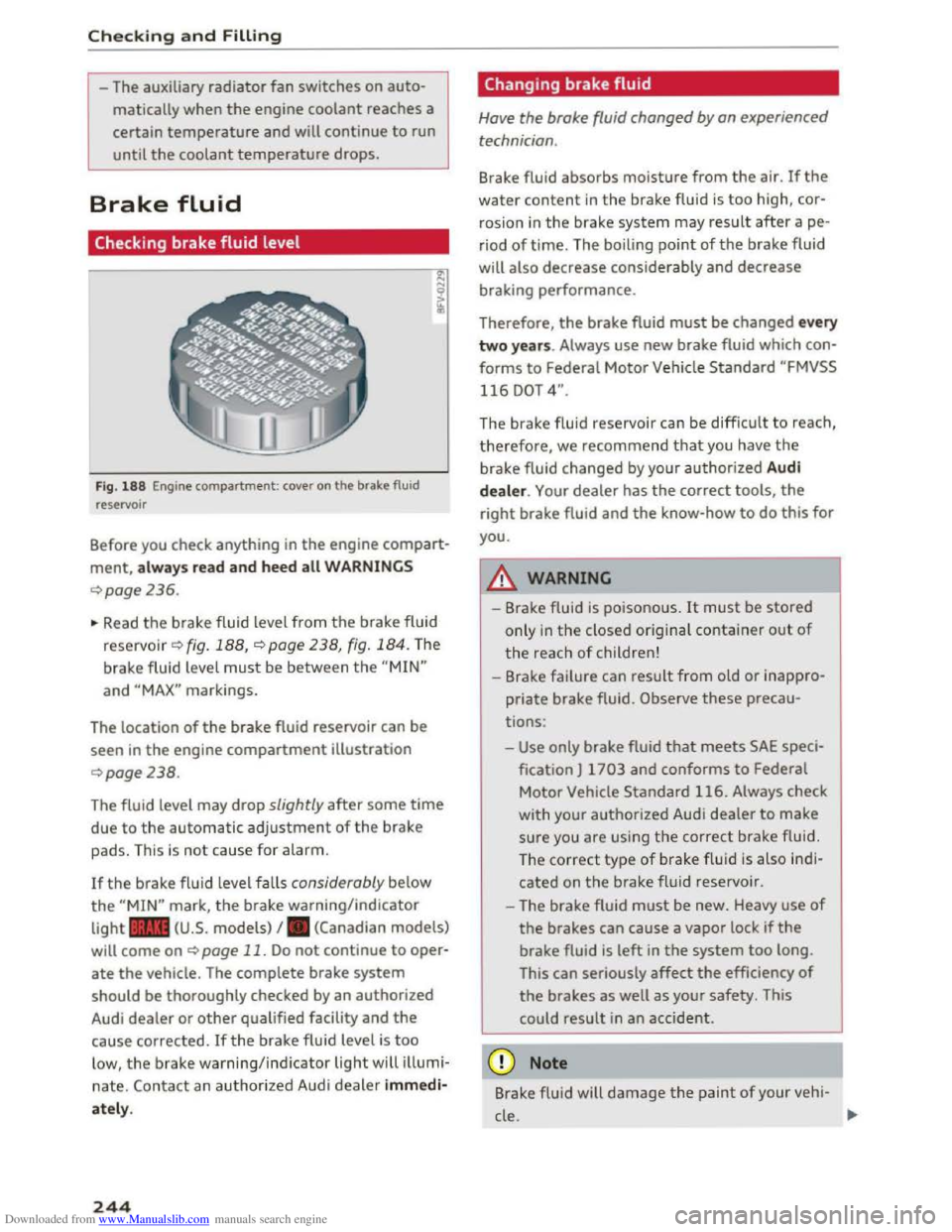
Fig. 188 Engine compartment: cover on the brake fluid
reservoir
Before you check anything in the engine compart
ment, always read and heed all WARNINGS
¢page 236.
~ Read the brake fluid level from the brake fluid
reservo ir ¢ fig. 188, ¢page 238, fig. 184. The
brake fluid level must be between the "MIN"
and "MAX" markings.
The location
of the brake fluid reservoir can be
seen in the engine compartment illustration
¢page238.
The fluid level may drop slightly after some time
due to the automatic adjustment of the brake
pads. This is not cause for alarm.
If the brake fluid level falls considerably below
the "MIN" mark, the brake warning/indicator
light .. (U.S. models) I. (Canadian models)
will come on ¢ page 11. Do not continue to oper
ate the vehicle. The complete brake system
should be thoroughly checked by an authorized
Audi dealer or other qualified facility and the
cause corrected. Ifthe brake fluid level is too
low, the brake warning/indicator light will illumi
nate. Contact an authorized Audi dealer immedi
ately.
244
Changing brake fluid
Have the brake fluid changed by an experienced
technician .
Brake fluid absorbs moisture from the air. If the
water content in the brake fluid is too high, cor
rosion in
the brake system may result after ape
riod of time. The boiling point of the brake fluid
will
also decrease considerably and decrease
braking performance.
Therefore, the brake fluid must be changed every
two years. Always use new brake fluid which con
forms to Federal Motor Vehicle Standard "FMVSS
116 DOT 4".
The brake fluid reservoir can be difficult to reach,
therefore, we recommend that you have the
brake fluid changed by your authorized Audi
dealer. Your dealer has the correct tools, the
right brake fluid and the know-how to do this for
you.
8._ WARNING
- Brake fluid is poisonous. It must be stored
only in the closed original container out of
the reach of children!
-Brake failure can result from old or inappro
priate brake fluid. Observe these precau
tions:
-Use only brake fluid that meets SAE speci
fication
J 1703 and conforms to Federal
Motor Vehicle Standard 116. Always check
with
your authorized Audi dealer to make
sure you are using the correct brake fluid.
The
correct type of brake f lui d is also ind i
cated on the brake fluid reservoir .
- The
brake fluid must be new. Heavy use of
the brakes can cause a vapor lock if the
brake fluid is left in the system too long.
This
can seriously affect the efficiency of
the brakes as well as your safety. This
could
result in an accident.
CD Note
Brake flu id will damage the paint of your veh i-
cle .
JIJ.