2016 AUDI S5 COUPE maint
[x] Cancel search: maintPage 196 of 264

Check ing and F illing
Using the proper engine oil is impo rtant for the
functionality and service life of the engine. Your engine was facto ry-filled with a h igh-quality oi l
which can usually be used throughout the entire
year.
@) Note
Your Limited New Vehicle War ranty does not
cover damage or malfunctions due to failure
to follow recommended maintenance and use
requirements as set forth in the Audi Owner's
Manual and Warran ty
& Maintenance booklet.
- Use only a high quality eng ine oil t hat ex-
p ressly complies with the Audi oil qua lity
standard specified for your vehicle's engine .
Using a ny o ther oil can cause serious engine
d am age.
- D o not mix any lubricants o r other addit ives
i nto the engine oil. Doing so ca n cause en
g ine damage.
(D Tips
I f you need to add oil and there is none availa
ble t hat meets the Audi o il quality standard
your eng ine requi res , you m ay ad d a tot al of
no more than 0.5 qu art /li ter o f a h igh-quality
"synthe tic"oil that meets t he following speci
fications.
- Vehicles w it h gasoline eng ine: AC EA A3 o r
API SM with a viscosity grade of SAE 0W-30,
SAE SW -30 or SAE SW-40.
- Fo r more information about en gine o il that
has been approve d for your ve hicle, please
contact eithe r you r a uthorized Aud i dea ler
or A udi C ustome r Relat ions at
1 (800) 822-2834 or visit our web site at
www .audiusa .com or www.aud icanada .ca .
Engine oil consumption
The engine in your vehicle depends on an ade
quate amoun t of oil to lubricate and cool all of
its moving parts .
In order to provide effective lubr ication and coo l
ing of in ternal engine components, all internal
combustion eng ines consume a certain amou nt
of oil. Oil co nsumption varies from engine to en
g ine and may change significant ly over the life of
194
th e engine. Typically, engines w ith a specified
break-in period (see
r=:> poge 177) consume more
o il dur ing the b reak-in per iod than they consume
after oil consumption has stabili zed .
U nder normal cond itions, the rate of oil con
sumption depends on the q ua lity and viscosity of
the oil, the RPM (revo lutions per m inute) at
which the engine is operated, the ambient tem perature and road condit ions. Further factors are
the amo unt of o il di lution from water condensa
t ion or fuel residue a nd the oxidation level of the
o il. As any engine is subject to wea r as mileage
builds up, the o il cons umption may increase ove r
t i me unt il repla ce m ent of wo rn components m ay
be come necessary .
With a ll these va riab les coming into p lay, no
sta ndard rate of o il cons umption can be estab
li sh ed or spec ified . T he re is no alte rn ative to reg
ul ar and frequen t checking of the oi l level, see
Note .
If the yellow engine oi l leve l wa rning symbo l Ill
in the instrument clus ter lights up , you sho uld
c h eck t he o il level as soon as possible
r=:> page 195 . Top off the oi l at your ea rliest con
venience
r=:> poge 195.
A WARNING
Before you check anyth ing in the engine com
partment, always read and heed all WARN
INGS
r=:> .&. in Working in the engine compart
ment on page 191.
@ Note
D riving wit h an insuffic ient oil level is like ly to
cause severe damage to the eng ine.
(D Tips
- The oil pressure warning display. is not
an indicator of the oil level. Do not rely on
it . Instead, check the oil level in your en
gine at regular intervals, preferably each
time you refuel, and always before going
on a long trip .
-If you have the impress io n your e ngine con
sumes excessive amou nts of oil, we recom-
mend th at yo u consult an authori zed A udi .,.
Page 198 of 264

Check ing and F illing
@ For the sake of the environment
- Under no circumstances can the oil come in
contact with the sewage network or the soil.
- Observe and fo llow legal regulations when
disposing of empty oil containers.
Changing the engine oil
We recommend that hove your oil changed by on
authorized Audi dealer or a qualified service sta
tion .
Before you che ck anything in the eng ine compart
ment,
always read and heed all WARNINGS ¢ A
in Working in the engine comportment on
page 191.
The engine oil must be changed according to the i n tervals specified in your Warranty
& Mainte
nance booklet . This is very important because the
lubricat ing propert ies of oil diminish gradually
during normal vehicle use.
Under some circ umstances the eng ine oi l sho uld
be changed more frequently. Change oil more of
ten if yo u drive most ly short distances, operate
the vehicle in dusty areas or under predominantly
stop-and-go traffic cond it ions , or have your vehi
cle where temperatures remain below freezing
for extended periods.
Detergent additives in the oil will make fresh oil
look dark after t he engine has been run ning for a
short t ime . T his is normal and is not a reason to
cha nge the oil mo re often than recommended .
Because of the prob lem of proper disposal, along
with the special tools and necessary expertise re
qu ired, we strongly recommend that you have
your oil c hanged by an aut ho rized
Audi dealer o r
a qualif ied se rvice station .
If you choose to change your o il yourself , please
note the following important informat ion:
A WARNING
To re duce the risk of pe rsonal injury if you
must c hange t he engine oil in your ve hicle
yo urs elf:
- W ear eye protection .
196
-
-To reduce the r is k of burns from hot engine
oil, let the engine cool down to the touch.
- W hen removing the oil drain plug with your
fingers, stay as far away as possible. Always
keep your forearm pa rallel to the ground to
he lp prevent hot oil from run ning down your
arm .
- Drain t he oil into a container designed for
this purpose, one large enough to hold at
leas t the tota l amou nt of oil in you r engine.
- Engi ne oil is poisonous. Keep it well out of
the reach of childre n.
- Continuous contact wit h used engine o il is
ha rmf ul to your skin. Always protect your
skin by washi ng oil
off thoroughly with soap
and wate r.
(D Note
Neve r mix oil additives with yo ur engine oil.
These additives can damage your e ngine and
adverse ly affect your A udi L imi ted New Vehi
cle Warranty .
@ For the sake of the environment
-Be fore chang ing you r oi l, first make sure
you know where you can properly dispose o f
t h e used oil.
- Always dispose of used e ngine o il pro perly .
Do not d ump it on garden so il, wooded
areas, into op en streams o r down sewage
drains.
- Recycle used e ngine o il by tak ing it to a used
eng ine oil collect io n fa cil ity in you r area, o r
c o nta ct a servi ce st ation.
Cooling system
Coolant '
The engine coolant performs two functions: it
keeps the engine from overheating and it pro
tects the engine from freezing in the winter.
The coolin g system is sealed and generally re
quires little attention .
The coo lin g sys tem h as been filled a t the fac to ry
wi th a pe rmanent coolan t which does not need to
be changed. The coo lant consists of a mixture of .,.
Page 199 of 264

.... N
0 Ico ....
er's glycol-basedcoo lant additive Gl3 antifreeze
with anticorrosion additives (50% for USA mod
e ls; 60% for Canadian models). This m ixture
both assures the necessary frost protection and
protects metal components in the engine's cool
ing system from corrosion and scaling.
It also
raises the boiling point of the coolant .
Do not reduce the concentration of the coolant in
the summer by adding plain water.
Th e propor
tion of coolant addit ive must be at l eas t 50° /4
but not more th an 60 %
to maintain antifreeze
p rotection and cooling efficiency. If the coolant
frost protec tion is too low, the coolant co uld
freeze and damage the vehicle heating and en
gine cooling system.
F or yea r-round driving, antifreeze is added at the
factory for temperatures down to:
- -31 °F (- 35 °C) USA
- -40 °F ( - 40 °C) Canada.
If you must add coolant, use a mixture of water
and coolant addit ive. Mixing the coolant additive
with distilled water is recommended.
A WARNING
Before you check anything in the engine com
partment, always read and heed all WARN
INGS
Q &. in Working in the engine compart
ment on page 191.
(D Note
- Before winter sets in, have the coolant
checked to see if the coolant additive in your
vehicle is sufficient to meet the climate con
dit ions. This is especially important if you
li ve in a reg ion where the w inte r is ext reme
l y co ld. If ne cessary, in cre ase the proport io n
of coo lant add itive to 60%.
- When addi ng coolant addit ive to you r cool
i ng system, remember:
- We recommend using only coolant addi
tive Gl2++ or Gl3 for your ve hicle. T his
coolant additive is available at authorized
Audi dea lers. Othe r types of antifreeze can
significant ly reduce cor ros ion p rotection .
Check ing and Filling
The resulting co rrosion can cause a loss of
coolant and serious engine damage.
- Do not add any type of radiator lea k sealant
to your vehicle's engine coolant. Adding ra
diator repair fluid may adversely affect the
function and performance of your cooling
system and could resu lt in damage not cov
ered by your New Veh icle Limited Warranty.
Checking the engine coolant level
The engine coolant level can be checked with a
quick glance.
F ig. 163 Engine compa rtment: Cover on the coolant ex
pans ion tank
.. Before you check anything in the engine com
partment,
al ways read and heed all WARN
INGS
q ..&. in Working in the engine compart
ment on page 191.
.. Park your ve hicle on a leve l sur face .
.. Tu rn off the ignit io n .
.. Read the eng ine coolan t level from the coo la nt
expansion tank
qfig . 163, Qpage 193,
fig. 160 .
With a cold engine, the coolant level
should be between the " MIN" and "MAX" mark
ings. When the engine is warm, the level may
be slightly above the "MAX" marking.
The location of the coolant expansion tank can be
seen in the engine compartment illustration
qpage 193.
To obtain an accurate reading, the engine must
be switched off.
T he expansion ta nk in your veh icle is eq uipped
with an electric coo lant level senso r.
When the coolant leve l is too low, the warning
light i n the Auto-Check System
Q page 17 will
197
Page 202 of 264
Check ing and F illing
The brake fluid rese rvoir is located at the rear
partition of the engine compartment on the l eft
side
c!,> pag e 193 .
The fl uid level may drop slightly after some time
due to the automatic adjustment of the brake
pads . This is not cause for alarm.
If th e b rake fl uid level fa lls considerably be low
the "M IN" mark, the b rake warning/ind icator
lig ht ( U.S. mode ls :
1111 , Canadian models:. )
will come on
c!,> page 15 . Do not contin ue to oper
ate the vehicle . T he comp lete brake system
should be thoroughly checked by an authori zed
Aud i dealer or qualified workshop and the cause
corrected . If the brake flu id level is too low, the
b rake warning/indicator light will i llum inate.
Contact a n author ized Audi dealer
immediately .
{D) Tips
The brake fluid reservoir is located under
neath the cover .
Changing brake fluid
Have the brake fluid changed by an experienced
technician .
Brake fluid absorbs mo isture from the air. If the
water content in the b rake fluid is too high, cor
rosion in the brake system may resu lt afte r ape
riod of t ime. The boiling poi nt of the brake flu id
will also decrease cons iderably and decrease
b raking perfo rman ce.
Therefore, the brake fluid must be changed
every
two year s.
Always use new brake fluid wh ic h con
forms to Fede ral Motor Veh icle Standard "FMVSS
1 16 DO T 4".
The brake fluid reservoir can be diff icult to reach,
therefore, we recommend that yo u have the
brake fl uid changed by yo ur autho rized
Audi
dealer .
Your dealer has t he corre ct tools, t he
right brake fluid and the know-how to do this for
you.
A WARNING
- Brake fluid is poisonous. It must be stored
only in the closed orig inal container out of
the reach of chi ldren!
200
- Bra ke fa ilure ca n result from old or inapp ro
priate brake fluid . Observe these precau
tions:
- Use only brake fluid t hat meets SA E speci
fi ca ti on
J 170 3 and con forms to Federa l
Motor Ve hicle Standard 116 . Always check
wi th yo ur autho rized Audi dea le r to make
s ur e yo u are using the correct brake fluid .
The correct type of brake flu id is also ind i
cated on the b rake fluid reservo ir .
- The brake fluid m ust be new . Heavy use of
the brakes can cause a vapo r lock if the
brake fluid is left in the system too long .
This can se riously affect the efficiency of
the b rakes as well as your safety . This
could resu lt in an accident .
(D Note
Brake fluid will damage the paint of your veh i
cle.
@ For the sake of the environment
Because of the problem o f proper d isposa l o f
brake fluid as well as the spec ial too ls re
q ui red a nd the necessary expertise, we rec
omme nd that you have the bra ke f luid
changed by yo ur autho rized Aud i dea le r.
Battery
, General information
U nder normal operating condit ions, the battery
i n your Audi does not need any maintenance.
With
high outside temperatures or long daily
drives we recommend that you have the elect ro
lyte level c hecked by an au thorized Aud i dealer o r
qualified workshop. The electro lyte level shou ld
a lso be che cked each time the battery is c ha rged
c:!,> page 202.
Have the batte ry chec ked when you take yo ur ve
hicle in for service. You are we ll adv ised to re
pla ce a battery tha t is older than 5 yea rs.
With certain types of airbag deployment, t he
batte ry is d iscon nected from the ve hicle electri
ca l system for safety reasons
c!,> .&. in Repair, care
and disposal of the airbags on page 1 42. .,.
Page 207 of 264

Wheels
Wheels and Tires
General information
.,.Check your tires regularly for
damage (punctures, cuts, cracks
and bulges). Remove foreign ob
jects from the tire tread.
.,. If driving over curbs or similar
obstacles, drive slowly and ap
proach the curb at an angle.
.,.Have faulty tires or rims re
placed immediately.
"'Protect your tires from oil,
grease and fuel.
.,.M ark tires before removing
them so that the same running
direction can be maintained if
they are reinstalled.
"'Lay tires flat when storing and
store them in a cool, dry location
with as little exposure to light as
possible.
(D Note
-Please note that summer and
winter tires are designed for
the conditions that are typical in those seasons. Audi recom
mends using winter tires dur
ing the winter months. Low
temperatures significantly de crease the elasticity of summ
er tires, which affects traction
Wheels
and braking ability. If summer
tires are used in very cold
temperatures, cracks can form
on the tread bars, resulting in
permanent tire damage that
can cause loud driving noise
and unbalanced tires.
-Burnished, polished or
chromed rims must not be
used in winter driving condi
tions. The surface of the rims
does not have sufficient corro
sion protection for this and
could be permanently dam aged by road salt or similar
substances.
Tire designations
Fig. 167 T ir e designations on the side -
wall Ill>
205
Page 217 of 264

_,
through curves and when braking, which increases the risk of
an accident.
Tire pressure
Fig. 169 Driver 's sid e B-pillar : tir e pres
sure label
"' -
-~-------------------,£
tM£. IIZl COLO tlllf fllllESSt.lW. PNfU Nl:4fN$IOM$ "IIISaoN OE$ PMEU$ A FROID
-AYIJff -KPA, a PSI
Fig. 170 Tire pressure label
The correct tire pressure for tires
mounted in the factory and for
the spare t ire* is indicated on a la
bel. The label is located on the B
pillar
¢ fig . 169, ¢ fig. 170.
Use the tire pressure specified for
a normal vehicle load when the
vehicle is partially loaded
¢
page 216. If driving the vehicle
ci when fully loaded, you must in-,_ CX) ... \D Ln _, \D _,
Wheels
crease the tire pressure to the
maximum specified pressure¢&.-
Checking/correcting tire
pressure
.,,.Check the tire pressure at least
once per month and also check it before every long drive .
.,,.Always check the tire pressure
when the tires are
cold. Do not
reduce the pressure if it increas
es when the tires are warm .
... check the label ¢
fig. 170 for
the correct tire pressure based on vehicle load.
.,,.Correct the tire pressure if nec
essary.
... vehicles with Tire Pressure Mon
itoring System*: store the modi
fied tire pressure in the Infotain
ment system
¢ page 224.
.,,.Check the pressure in the emer
gency tire*/spare t ire*. Always
maintain the maximum temper
ature that is specified for the
tire .
_& WARNING
Always adapt the tire pressure
to your driving style and vehicle
load.
-Overloading can lead to loss of vehicle control and increase ...
215
Page 223 of 264

.... N
0 Ico ....
damage the t ires, and t he chains will quickly b e
destroyed.
A WARNING
Using incorrect snow chains or installing snow
chains incorrect ly can result in loss of vehicle
co ntrol, which increases the risk of an acc i
dent .
Snow chains can damage the r ims/wheel cov
ers* if the chains come into d irect contact
w ith them . Remove the wheel covers* first.
Use coated snow chains .
@ Tips
When driving with snow cha ins, it may help to
switch on sport mode¢
page 171.
Low aspect ratio tires
Your Aud i is factory-equipped with low aspect ra
t io ti res. These t ires have been tho rough ly tested
a n d been se lected specifically fo r yo ur model for
t he ir superb performance, road feel and handling
under a variety o f driving conditions. Ask your au
thor ized Audi dealer for more details .
The low aspect ratio of these t ires is indicated by
a numera l of
55 or l ess in the tire 's size designa
tion . The numera l represents the rat io o f the
tire's sidewall height in relat ion to its tread width
expressed in pe rc e ntage. Conventional t ir e s hav e
a height/w idth rat io of 60 or more.
The performan ce of low- aspect- ratio tire s is par
ticularl y sensiti ve to imp roper inflat ion pres
sure . It is therefore import ant that low a spect
ratio tires are infl ated to the specified pressure
and that the inflation pre ssure is regularl y
checked and mainta ined . Tire pre ssure s shoul d
be checked at least once a month and alwa ys
befor e a long t rip
¢ page 215.
What you can do to avoid tire and rim
damag e
Low aspect rat io tires can be damaged more easi
ly by impact with potho les, curbs, gull ies or
Wh eel s
ridges on the road, particular ly if the tire is un
deri nflated.
In orde r to min imi ze the occurrence of imp act
damage to the tires of yo ur vehicle , we recom
mend that you observe the following preca u
tions:
- Always ma intain recommended inflat io n pres
sures. Check yo ur ti re pressure every 2,000
miles (3,000 km) and add air if necessary .
- Dr ive ca refully on roads w ith po tholes, deep
gullies or ridges . The impac t from dr iving
through or over such obstacles can damage
your tires. Impact with a curb may a lso cause
damage to your tires.
- After any impact, immediate ly inspect your
tires or have th em inspected by th e nearest au
thorized Audi dealer. Replace a damaged tire as
soon as possible.
- Inspect you r tires every 2,000 m iles (3,000 km)
for damage and wear. Damage is not a lways
easy to see . Damage can lead to loss of air and
underinflation, wh ic h could eventually cause
tire fa ilure. If you believe that a tire may have
been damaged , replace the tire as soon as pos
sib le.
- These tires may wear more quickly than others .
- Please also remember that, while these tires
delive r responsive ha ndling, they may ride less
comfortably a nd make more noise than other
choi ces.
Reduced perfo rmance in winter /cold se ason
conditions
All tires are des igned for certai n purposes. The
low aspect ratio, ultra high performance tires
o rigi na lly installed o n your veh icle are intended
f or maximum dry and wet road per formance and
handling . They are not suitable for co ld, snowy or
icy weather conditions . If you drive under those
c ircumstances, you should equip your vehicle
with all-season or winter tires, which offer better
tract ion under those condi tions. We suggest you
use the recommended snow or all-season tires
spec ified for your veh icle, or their equiva lent .
Refer to¢
page 220 for more detailed informa
t ion regarding winter tires .
221
Page 225 of 264
.... N
0 Ico ....
them to the proper pressure. Driving on a signifi
cantly under-inflated tire causes the tire to over
heat and can lead to t ire failure. Under-inflation
a lso reduces fuel efficiency and tire tread life,
and may affect the vehicle 's handling and stop
p ing ability .
Please note that the TPMS is not a substitute for
proper tire maintenance, and it is the driver's re
sponsib ility to ma intain correct tire pressure,
even if under-inflation has not reached the level
to tr igger illum inat ion of the TPMS low tire p res
sure telltale.
Your veh icle has also bee n eq uipped w ith a TPMS
malfunct ion indicator to indicate when the sys
tem is not operat ing properly . The TPMS ma l
function ind icator is combined w ith the low tire
p ressure tellta le. Whe n the system detects a
malfunct ion, the te lltale will flash fo r approx i
mately one mi nute and then remain continuo usly
illuminated. This sequence will continue upon
subseq uent veh icle start-ups as long as the ma l
function ex ists .
When t he malfunction indicator is ill uminated,
the system may not be ab le to detect or signal
l ow tire press ure as intended. TPMS ma lf u nctions
may occur for a var iety of reasons, including the
installation of replacement or alternate t ires or
wheels on the vehicle that prevent the TPMS
from functioning properly . Always c heck the
TPMS malfunction telltale afte r rep lacing one o r
mo re t ires o r whee ls on your ve hicl e to e nsur e
th at t he replacement or al tern ate tir es and
wheels a llow the TPMS to con tinue to function
p roperly .
Wheel s
If the Tire Pressure Monitoring System
indicator appears
Applies to vehicles: with tire pressure monitor ing system
The tire pressure indicator in th e instrument
cluster informs you if the tire pressure is too low
or if there is a sys tem malfunction.
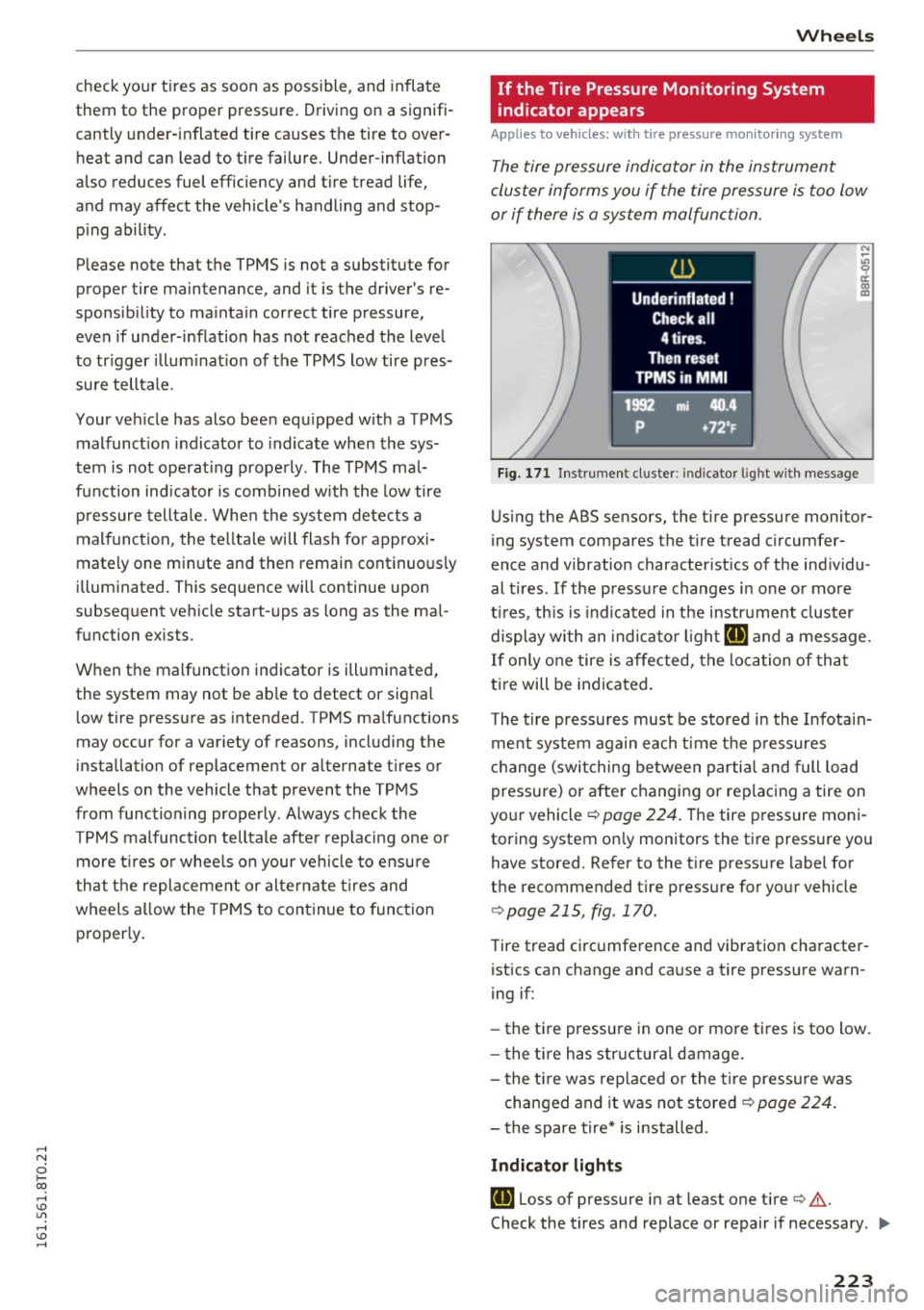
Fi g. 17 1 Instrumen t cl uster: indicator lig ht w ith mess age
U sing the ABS sensors, the t ire pressure monito r
ing system compares the tire tread c ircumfer
ence and v ibration characterist ics of the ind iv idu
al tires. If the press ure changes in one or more
t ir es, th is is indicated in the instrument cluster
display with an indica to r li ght
HE and a message.
If only one tire is affected, the loc ation of tha t
t ir e will be indicated.
T he t ire press ures mus t be stored in the Infota in
me nt system again each time t he pr essures
c h ange (switching between parti al and full load
pressure) or afte r changing or replac ing a tire on
yo ur vehicle ¢
page 224 . The tire p ressure moni
toring system on ly monitors the tire pressure you
have stored. Re fer to the t ire pressure label for
the recommended t ire pressure for yo ur vehicle
r=> page 215, fig . 170.
T ire tread c irc umference and vibration character
istics can change and ca use a tire press ure warn
ing if :
- the tire pressure in one or more tires is too low.
- t he t ire h as str uctural damage.
- t he t ire w as re pla ce d or the t ire pressu re was
ch anged and it was no t stored ¢
page 224 .
- the spare tire* is i nstalled .
Indicator lights
HE Loss of pressure in at least one tire¢.& .
Check the tires and replace or repair if necessary .
IJJ,,
223