2016 AUDI Q3 brake
[x] Cancel search: brakePage 197 of 252

... N 0 ::,
~
...
'° V, N
'° ...
(a) Curb weight
(b) Accessory weight
(c) Vehicle capacity weigh t, and
(d) Production options we ight
Ma ximum (permissible)
inflation pressure
means the maximum cold infla
tion pressure to which a t ire may
be inflated. Also called "maxi
mum inflation pressure."
Normal occupant weight
means 150 lbs. (68 kilograms)
times the number of occupants
seated in the veh icle up to the to
tal seating capacity of your vehi c le.
Occupant distribution
means distribution of occupants
in a vehicle.
Outer diameter
means the overall diameter of an
inflated new tire.
Overall width
means the linear distance be
tween the exteriors of the side
walls of an inflated tire, including
elevations due to labeling, deco
rations, or protective bands or
ribs .
Wheels
Ply
means a layer of rubber-coated
parallel cords .
Production options weight
means the combined weight of
those installed regular production
options weighing over 5 lbs. (2.3 kg) in excess of those standard
items which they replace, not pre
viously considered in curb weight
or accessory weight, including
heavy duty brakes, ride levelers,
roof rack, heavy duty battery, and
special trim .
Radial ply tire
means a pneumatic tire in which
the ply cords that extend to the beads are laid at substantially 90
degrees to the centerline of the
tread.
Recommended inflation
pressure
see ~ page 194, Cold tire infla
tion pressure .
Reinforced tire
means a tire designed to operate
at higher loads and at higher in
flation pressures than the corre sponding standard tire. Rein
forced tires may be identified as .,.
195
Page 201 of 252

different tire speeds. For this reason, in case of emergency, only
use a spare tire that has the same
circumference as the regular
tires.
&_ WARNING -
-Only use tire/rim combina tions and suitable wheel bolts
that have been approved by
Audi. Otherwise, damage to
the vehicle and an accident could result.
-For technical reasons, it is not
possible to use tires from oth
er vehicles - in some cases,
you cannot even use tires from
the same vehicle model.
-Make sure that the tires you
select have enough clearance
to the vehicle . Replacement
tires should not be chosen
simply based on the nominal
size, because tires with a dif
ferent construction can differ
greatly even if they are the
same size. If there is not
enough clearance, the tires or
the vehicle can be damaged and this can reduce driving
safety and increase the risk of
an accident.
Wheels
-Only use tires that are more
than 6 years old when abso lutely necessary and drive
carefully when doing so.
-Do not use run-flat tires on
your vehicle. Using them when
not permitted can lead to ve
hicle damage or accidents.
- If you install wheel covers on
the vehicle, make sure they al low enough air circulation to
cool the brake system. If they
do not, this could increase the
risk of an accident.
Tire wear/damage
Fig. 157 Ti re profi le: tread wear indica
tor
Tire wear
Check the tires regularly for wear .
-Inflation pressure that is too low
or high can increase tire wear
considerably.
-Driving quickly through curves,
rapid acceleration and heavy
braking increase tire wear. ..
199
Page 206 of 252

Wheels
position and the total weight of
any luggage in the vehicle. If you
tow a trailer, the weight of the trailer hitch and the tongue
weight of the loaded trailer must be included as part of the vehicle
load.
The
Gross Axle Weight Rating
("GAWR") is the maximum load
that can be applied at each of the
vehicle's two axles.
The fact that there is an upper
limit to your vehicle's Gross Vehi
cle Weight Rating means that the
total weight of whatever is being
carried in the vehicle (including
the weight of a trailer hitch and
the tongue weight of the loaded
trailer) is limited. The more pas
sengers in the vehicle or passen
gers who are heavier than the
standard weights assumed mean
that less weight can be carried as luggage.
The Gross Vehicle Weight Rating
and the Gross Axle Weight Rating
are listed on the safety compli
ance sticker label located on the
driver's side B-pillar
~ page 201,
fig . 158 .
204
_& WARNING
Overloading a vehicle can cause
loss of vehicle control, a crash
or other accident, serious per
sonal injury, and even death.
-Carrying more weight than
your vehicle was designed to carry will prevent the vehicle
from handling properly and
increase the risk of the loss of
vehicle control.
-The brakes on a vehicle that has been overloaded may not
be able to stop the vehicle
within a safe distance.
-Tires on a vehicle that has
been overloaded can fail sud
denly, including a blowout and
sudden deflation, causing loss of control and a crash.
-Always make sure that the to
tal load being transported -
including the weight of a trail
er hitch and the tongue
weight of a loaded trailer -
does not make the vehicle
heavier than the vehicle's
Gross Vehicle Weight Rating.
Page 213 of 252

.... N
c:i ::J CX)
.... I.Cl U"I
N I.Cl ......
Emergency assistance
General information
.. Park the vehicle as far as poss ible from moving
traffic in the event of a flat tire. In the event of
a flat tire, park the vehicle on a level surface. It
you are on a steep incline, be especially careful.
.. Set the parking brake .
.. Switch the emergency flashe rs on .
.. Put on a reflective vest, if available .
.. Set up the warn ing triang le, if available .
.. Have the passengers exi t the veh icle. They
sho uld move to a safe place, for example be
hind a guard rail.
_& WARNING
Pay attention to the steps above . They are for
your protection and the for the safety of other drivers.
_& WARNING
Improper use of the vehicle jack can cause se
rious personal injuries.
- Never use the screw driver hex head to
t ighten whee l bolts, since the bolts cannot
attain the necessary tighten ing torque if you
use the hex head, potentially causing an ac
c ident.
- The factory-supplied jack is intended only
for your vehicle model. Under no circum
stances should it be used to lift heavy
vehicles o r other loads; yo u ris k inju ring
yo urself.
- Never start the engine when the vehicle is
ra ised, which could cause a n accident.
- Support the veh icle secure ly with app ropr i
a te s tan ds if wor k is to be performed under
neath t he vehicle; otherwise, the re is a po
tent ial ris k for i njur y.
- Never use the jack s upplied with yo ur Audi
on another vehicle, pa rtic ularly o n a heav ie r
one. The jack is only suitable for u se on the
vehicle it came wit h.
Emergen cy a ssis tanc e
Vehicle tool kit
Fig. 161 Lu ggage compa rtment: cargo floor cover fo lded
u pwa rd
The vehicle tool kit is stored under the cargo
floor cover behind the seat backrest
q fig. 161.
The veh icle tool k it includes :
- Hook for remov ing wheel covers
- Alig nment pin for changing the w heel
- Screwdr iver with reversible blade
- Reversible bit
- Jack
- Auxiliary tool for selector lever emergency re -
lease
- Lug wrench
- Towing eye
Some of the vehicle items listed above are pro
vided on certa in models on ly or are optional ex
t ras.
Befo re returning the jack to its place, retract the
jack arm fully .
_& WARNING
---= -
-Never use the screw driver hex head to
tighten wheel bo lts, since the bolts cannot
at tain t he necess ary tightening to rque if yo u
use the hex head, po ten tially causing an ac
cident.
- T he factory-su pplied jac k is in tended only
for your ve hicle mode l. Under no circum
stances shou ld it be used to lift heavy
ve hicles or othe r loads; you risk injuring
yourse lf .
- Never start the engine when the ve hicle is
raised, which cou ld cause an accident .
211
Page 215 of 252

The spare tire is intended for short-term use on
ly. Have the damaged tire checked and replaced,
if necessary, by an author ized Audi dealer or au
thor ized Audi Service Facility as soon as possib le.
There are some restrictions on the use of the
compact spare tire . The compact spare tire has
been designed specif ically for your type of veh i
cle . Do not replace it with the spare tire from an
other type of vehicle.
R emo ving th e spar e tire
... Remove the cargo floor .
... Remove the wing bolt and then remove the re-
tainer underneath it.
... Remove the subwoofer*
¢ page 212.
... Remove the spare tire.
Snow cha in s
For technical reasons, the use of snow chains on
the compact spare tire is not permitted.
If you have to drive with snow chains and a front
tire fails, mount the spare wheel in place of a
rear tire. Install the snow chains on the rear tire
that you removed, and install that in p lace of the
front tire that failed.
A WARNING
- Never use the spare t ire if it is damaged or if
it is worn down to the tread wear indicators.
- If the spare tire is more than 6 years o ld,
use it only in an emergency and with ex
treme caution and carefu l dr iving.
- The spare tire is intended on ly for tempora
ry and short-term use. It shou ld be replaced
as soon as possible with the normal wheel
and t ire.
- After mounting the compact spare t ire, the
t ire pressure must be checked as soon as
poss ible. The t ire pressure of the compact
spare tire must be 4.2 bar; otherwise, yo u
risk having an accident.
- Do not d rive faster than 50 mph (80 km/h).
Yo u risk hav ing an accident.
- Avoid full-throttle accelerat ion, heavy b rak
ing, and fast cornering. You risk having an
acc ident.
Em ergenc y ass is tanc e
-Never drive using more than one spare
wheel and tire. You r isk having an accident.
- Normal summer or winter tires must not be
mounted on the compact spare wheel rim.
- For technical reasons, the use of tire chains
on the spare tire is not permitted. If it is
necessary to drive w ith tire chains, the spare
wheel must be mounted on the front axle in
the event of a flat in a rear t ire. The newly
ava ilable front wheel must then be installed
in place of the rear wheel with the flat tire.
I nstalling the tire chain befo re mounting
the wheel and tire is recommended .
- Loose items in the passenger compartment
can cause se rious personal injury during
ha rd bra king or i n an accident. Never store
the spare tire or jack and tools in the pas
senger compartment.
Replacing wheels
Before changing a wheel
Observe the following precautions for your own
and your passenger's safety when changing a
wheel.
... After you experience a tire failure, pull the car
well away from moving traffic and try to reach
lev el ground before you stop¢ page 211,
¢ .&_.
... All passengers should le av e the car and move
to a safe location (for instance, behind the
gua rdrail)
c:::> .lll ·
... Engage the parking brake to prevent your veh i
cle from rolling unintentiona lly
c:::> .&_ .
... Move the selector le ver to the P po sit ion .
... If you are towing a trai ler: unhitch the trailer
from your vehicle.
... Take the
jack ¢ page 211 and the spa re ti re
¢page 212 out of the luggage compartment.
A WARNING
You or your passengers could be injured while
changing a whee l if you do not follow these
safety pre caut ions:
- If you have a flat tire, move a safe distance
off the road. Turn off the eng ine, turn the
213
Page 216 of 252

Emerg enc y assis ta nc e
emergency flashers on and use other
warning dev ices to alert other motorists.
- Make sure that passengers wait in a safe
place away from the vehicle and well away
from the road and traffic.
- To help prevent the vehicle from moving
sudden ly and possibly slipp ing off the jack,
always fully set the parking brake and block
the wheel diagonally oppos ite the wheel be
ing changed with the folding chocks or oth
er objects. When one front wheel is lifted
off t he g ro u nd, plac ing the Automatic
T ransmission in "P" (Park) will
not prevent
the vehicle from moving.
- Before you change a wheel, be su re the
ground is level and firm. If necessary, use a
stu rdy board under the jack.
- Always store the veh icle tool k it, the jack
and the replaced tire in the luggage com
partment
r=> page 100.
(D Note
If you are cha nging the wheel on a steep in
cline, use the folding choc k
r=> page 212 to
block the oppos ite wheel to preven t the vehi
cle from moving .
(D Tips
Obey all laws.
Changing a wheel
When you change a wheel, follow the sequence
described below step-by-step and in exactly that
order.
1. Remove the dec orati ve w heel co ver* or the
wh eel bolt cap s*. For more deta ils see also
r=> page 215.
2. Loosen the wh eel b olt s r=> page 215 .
3. Locate the proper mounting point for the
jack and align the jack below that point
r=> page 216.
4. Lift the car with the jack r=> page 216.
S. Remove the wheel with th e fla t ti re and then
i nstall the
s p are t ire r=> page 217.
6. Tighten all wheel bo lts lightly .
7 .
Lower the veh icle w ith the jack.
214
8 . Use the whee l bolt wrench and firml y tighten
all wheel bo lts in a crisscross pattern
r=> page 215.
9. Replace the deco rative whee l co ver* or the
wheel bolt c aps* .
A WARNING
Always read and follow all WARNINGS and in
formation
r=> .&. in Raising the vehicle on
page 216
and r=> page 218.
After changing a wheel
A wheel change is not complete without the do
ing the following .
.,. Always store the vehicle too l kit, the jack* and
the replaced tire in the luggage compartment
¢ page 100 .
.,. Check the tire pres su re of the spare t ire as soon
as poss ible .
.,. As soon as possib le, have the
tigh tening tor
que s
on a ll wheel bolts checked with a torque
wrench. The correct tightening torque is
105 ft
lbs.
(140 Nm) .
.,. Have the flat tire
re pl ac ed as soon as poss ib le .
(D Tips
- If you notice that the wheel bo lts a re cor
roded and difficult to turn while changing a
t ire, they shou ld be replaced before you
check the t ightening torque.
- Drive at reduced speed until you have the
t ightening torques checked .
Page 218 of 252

Emerg ency assis ta nce
Raising the vehicle
The vehicle must be li~ed with the jack first be
fore the wheel can be removed .
Fig. 168 Sill panels : mark in gs
Fig. 169 Sill : pos itio nin g th e ve hicle jack
The location of the jack point is indicated by an
indentation on the underside of the vehicle
¢ fig. 168 .
,.. Activate the parking brake to prevent the vehi
cle from rolling unintentionally .
,.. Move the selector lever to the P position.
,.. Find the
m arki ng (imprint) on the sill that is
nearest the wheel that will be changed
c> fig . 168. Behind the marking, there is a li ft
i ng po int
on the sill for the vehicle jack.
,.. Turn the
veh icl e jack located under the lifting
point on the s ill to ra ise the jack until the jaw
c> fig . 169 @cove rs the no tch on the vehicle
c> ,&. ¢0.
,.. Align the vehicle jack so the jaw @covers the
notch and the base plate @ is flat on the floor .
The base plate @ must be
vertical under the
lifting point @.
,.. Install the rod on the vehicle jack : Insert the
rod into the opening on the handwheel. Turn
the rod left or right to secure it .
216
,.. Continue raising the jack with the rod until the
wheel lifts off the ground slight ly.
Position the vehicle jack
only under the designat
ed lifting points on the sill
c> fig. 168. T here is ex
actly
one l ocation fo r each wheel. The jack must
not be positioned at any other location
c> ,1. ¢(D .
So ft gr ound under the jack can cause the ve hicle
to slip off the jack . Always p lace the jack on firm
ground. Use a flat, stab le support if necessary .
Use a non-slip surface such as a rubber mat on a
s lipp ery s urface such as tile.
A WARNING -
-You or your passengers could be injured
while changing a wheel if you do not follow
these safety precautions:
- Position the vehicle jack only at the des ig
nated lifting points and align the jack .
Otherwise, the vehicle jack could slip and
cause an injury if it does not have suffi
cient hold on the vehicle.
- Use only the jack* supplied w ith your veh i
cle to raise the vehicle . If you use a jack
from a different vehicle, your vehicle may
slip off the jack - risk of injury!
- Do not use the jack* supplied with your ve
hicle to raise other vehicles, as these may
slip off the jack - risk of injury!
- A soft or unstab le surface under the jack
may cause the vehicle to slip off the jack.
Always provide a firm base for the jack on
the gro und .
If necessary, use a sturdy
board unde r the jack.
- On hard, slippery surface (such as t iles)
use a rubber mat or similar to prevent the
jac k from slipp ing .
- To help prevent injury to yourself and your
passengers:
- Do not raise the vehicle until you are sure
the jack is securely engaged.
- Passengers must not rema in in the vehicle
when it is jacked up.
- Make sure that passengers wait in a safe
place away from the vehicle and well away
from the road and traffic . .,_
Page 219 of 252
.... N
c:i ::J CX)
.... I.Cl U"I
N I.Cl ......
-Make sure jack posit ion is correct , adjust
as necessary and then cont inue to raise
the jack.
- If work has to be done under the vehicle,
ensure that it is safely supported on su ita
ble stands -risk of injury!
- Never start the engine when the vehicle is
on the jack -risk of accident!
CD Note
Do not lift the vehicle by the sill. Position the
vehicle jack on ly at the designated lifting
points on the sill. Otherwise, your vehicle will
be damaged.
Taking the wheel off/installing the spare
tire
F ollow these instructions step-by-step for chang
ing the wheel .
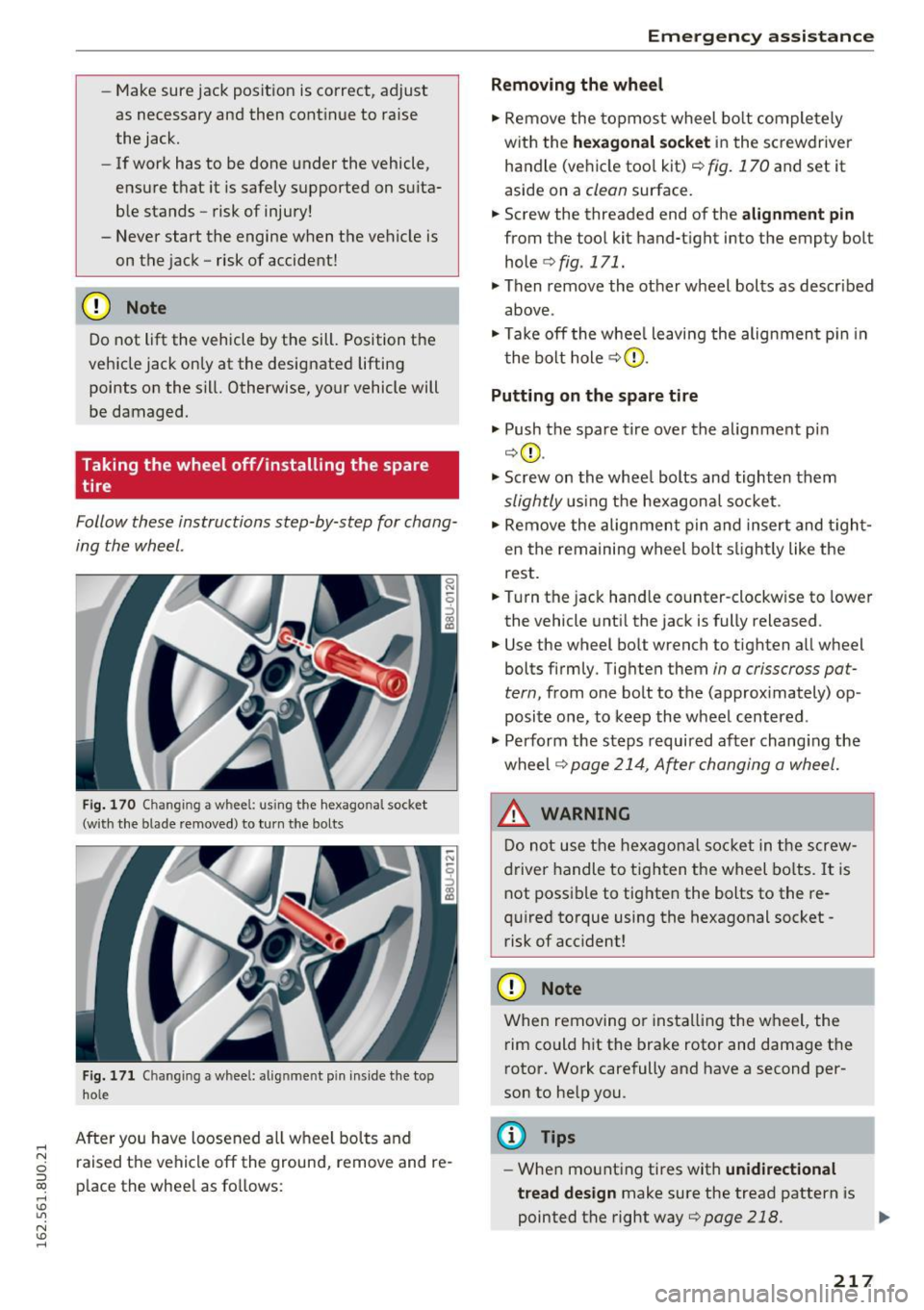
Fig. 170 C hangin g a w heel: using th e hexagonal s oc ket
(w it h the blade removed ) to turn t he bolt s
Fig. 171 Chan gin g a w hee l: a lig nm ent pin in side the to p
h ol e
After you have loosened all wheel bolts and
raised the vehicle off the ground, remove and re
p lace the whee l as follows:
Em ergen cy a ssis tanc e
Removing the whe el
"' Remove the topmost wheel bolt completely
with the
he xagona l s oc ket in the screwdriver
handle (vehicle too l kit)
c::> fig. 170 and set it
aside on a
clean surface.
.. Screw the threaded end of the
alignment pin
from the tool kit hand-tight into the empty bolt
hole
c::> fig . 171.
"' Then remove the other wheel bolts as described
above .
"' Take off the whee l leaving the alignment p in in
the bolt hole
c::> G) .
Putting on the spare tire
"' Push the spare tire over the alignment pi n
c::>(D .
"' Screw on the whee l bolts and tighten them
slightly u sing the hexagona l socket .
"' Remove the alignment pin and insert and t ight
en the remaining wheel bo lt s lightly like the
rest .
.. Turn the jack hand le count er-clockw ise to lower
the vehicle unti l the jack is fully released .
.. Use the wheel bo lt wrench to tighten all wheel
bolts firmly . Tighten them
in a crisscross pa t
tern,
from one bolt to the (approx imately) op
posite one, to keep the wheel centered .
"' Perform the steps required after chang ing the
wheel
c::> page 214, A~er changing a wheel.
_& WARNING
Do not use the hexagon al soc ket in the screw
driver handle to tighten the wheel bo lts. It is
not possible to tighten the bolts to the re
qu ired torque using the hexagonal socket -
risk of acc ident!
CD Note
When removing or installing the wheel, the
rim could h it the brake rotor and damage t he
rotor. Work carefully and have a second per
son to he lp you.
@ Tips
- When mounting tires with un idirectional
tread de sign
make sure the tread pattern is
pointed the right way
c::> page 218 . 1JJ,,
217