2016 AUDI Q3 tires
[x] Cancel search: tiresPage 208 of 252

Wheels
and a special procedure. You must not repair or
disassemble them¢&. .
A WARNING
Wheel bolts that are tightened or repaired in
correctly can become loose and result in loss
of vehicle control, which increases the risk of
an accident. For the correct t ightening specifi
cation, refer to ¢
page 214, After changing a
wheel .
- Always keep the wheel bolts and the
threads in the wheel hub clean and free of grease.
- Only use wheel bolts that fit the rim .
- Always have damaged rims repaired by an
authorized Audi dealer or authorized Aud i
Service Facility . Never repair or disassemble
rims yourself, because this inc reases the risk
of an accident.
Winter tires
Winter tires s ignificantly improve the vehicle's
handling when driving in winter conditions . Be
cause of their construction (width, compound,
tread pattern), summer tires provide l ess trac
tion on ice and snow.
.,. Use winter tires on all four wheels.
.,. Only use winter tires that are approved for your
vehicle.
.,. Please note that the maximum permitted
speed may be lower with winter tires
q .&,. . An
authori zed Audi dealer or authori zed Audi Serv
ice Facility can inform you about the maximum
permitted speed for your tires .
.,. Check the tire pressure after install ing wheels
q page 201.
The effectiveness of winter tires is reduced great
ly when the tread is worn down to a depth of
0 .157 inch (4 mm). The character istics of winter
tires also decrease greatly as the tire ages, re
gardless of the remaining tread.
A WARNING
- Never drive faster than the maximum per
mitted speed for your tires. This cou ld cause
the tires to heat up too much. This increases
206
-
the risk of an accident because it can cause
the tire to burst.
- Always adapt your driving to the road and
traffic conditions . Drive carefully and reduce
your speed on icy or slippery roads . Even
winter tires can lose traction on black ice .
@ For the sake of the environment
Reinstall summer tires at the appropriate
time, because they prov ide better handling
when roads are free of snow and ice. Summer
tires cause less road noise, tire wear and fuel
consumpt ion .
(D Tips
You can also use all season tires instead of
winter tires. Please note that in some coun
tries where winter tires are required, only
winter tires w ith the ~ symbol may be per
mitted.
Snow chains
Snow chains improve traction in the snow .
.,. Only install snow chains on the front wheels.
This applies also to vehicles with all wheel
drive* .
.,. Check and correct the seating of the snow
chains if necessary after driving a few feet. Fol
low the instructions from the manufacturer.
.,. Note the maximum permitted speed when dr iv
ing with snow chains. Do not exceed 30 mph (SO km/h).
Snow cha ins not only improve the
driving in win
ter road conditions, but also the
braking .
Use of snow chains is only permitted with certain
rim/tire combinat ions due to technical reasons .
Check with an author ized Audi dealer or author
ized Audi Service Facility to see if you may use
snow chains.
The snow chains must have
low-profile links and
must not be thicker than 0.53 inch (13.5 mm),
including the lock.
You must remove the chains when driving on
roads that are
free of snow . When roads are free ..,.
Page 209 of 252

of snow, snow chain s can imp air handling and
damage the t ires, and t he chains will quickly be
destroyed.
A WARNING
Using incorrect snow chains or installing snow
chains incorrect ly can result in loss of vehicle
co ntrol, which increases the risk of an acc i
dent .
Snow chains can damage the r ims/wheel cov
ers* if the chains come into d irect contact
w ith them. Remove the wheel covers* first.
Use coated snow chains .
Low aspect ratio tires
Your Audi is facto ry-equipped with low aspect ra
tio ti res. These t ires have been tho rough ly tested
and been se lected specifically for yo ur model fo r
thei r superb per formance, road feel and handling
under a variety of driving conditions. Ask your au
thorized Audi dealer for more details .
The low aspect ratio of these t ires is indica ted by
a numera l of
55 or les s in the tire's size designa
tion. The numeral represents the ratio of the
tire's sidewall height i n relation to its tread width
expressed in percentage. Conventional tires have
a height/w idth ratio of 60 or more.
Th e performance of low-aspect- ratio tire s is par
ticularly sensit ive to improper inflation pre s·
sure . It is therefore important that low aspect
ratio tires are inflated to the specified pressure
and that the inflation pre ssure is regul arly
ch ecked and ma intained . Tire pre ssure s should
be checked at least once a month and a lways
before a long tr ip
c> page 201.
What you can do to avoid tire and rim
damage
L ow aspect rat io tires can be damaged more easi
ly by impact wi th pot holes, c urbs, gull ies or
r idges on the ro ad, p articul arly if the tire is un
de rinflated.
I n o rder to minimize the occurrence of impact
damage to the t ires of your ve hicl e, we recom-
Wh eel s
mend that you observe the following preca u
tions:
- Always ma in tain recommended inflat io n pres
sures. Check yo ur tire pressure every 2,0 00
m iles (3,000 km) and add air if necessary .
- Dr ive c arefully on roads w it h potholes, deep
gullies or ridges . The impac t from dr iving
through or over such obstacles can damage
your tires. Impact with a curb may a lso cause
damage to your tires.
- After any impact, immediate ly inspect your
tires or have them inspected by the nearest au
thorized Audi dealer. Replace a damaged tire as
soon as possible.
- Inspect your tires every 2,000 m iles (3,000 km)
for damage and wear. Damage is not always
easy to see . Damage can lead to loss of air and
underinflation, wh ich could even tually cause
tire fa ilure. If yo u believe that a tire may have
been damaged, replace the tire as soon as pos
sib le.
- These tires may wear more quickly tha n others .
- Please also remember that, while these tires
delive r responsive ha nd ling, they may ride less
comfortably a nd make mo re noise than other
choi ces.
Reduced performance in winter /cold se ason
conditions
All t ires are des igned for certai n purposes. The
low aspect ratio, ultra high performance tires
o rigi na lly installed on your veh icle are intended
f or maximum dry and wet road performance and
handling . They are not suitable for co ld, snowy or
icy weather conditions . If you drive under those
c ircumstances, you should equip yo ur vehicle
with all-season or winter tires, which offer better
tract ion under those conditions. We suggest you
u se the recommended snow or all-season tires
spec ified for your veh icle, or their equiva lent .
Refer to
c> page 206 for more detailed informa
t ion regarding winter tires.
Uniform tire quality grading
- Tread wear
- Traction AA ABC
- Temperature ABC
207
Page 210 of 252

Wheels
Quality grades can be found where applicable on
the tire side wall between tread shoulder and maximum section width
¢ page 191, fig. 156.
For example: Tread wear 200, Traction AA, Tem
perature
A.
All passenger car tires must conform to Federal
Safety Requirements in addition to these grades.
Tread wear
The tread wear grade is a comparative rating
based on the wear rate of the tire when tested
under controlled conditions on a specified gov
ernment test course.
For example, a tire graded 150 would wear one
and one half (1 1/2) times as well on the govern
ment course as a tire graded 100.
The relative performance of tires depends upon
the actual conditions of their use, however, and may depart significantly from the norm due to
variations in driving habits, service practices and differences in road characteristics and climate.
Traction
The traction grades, from highest to lowest, are
AA, A, Band
C. Those grades represent the tire 's
ability to stop on wet pavement as measured un
der controlled conditions on specified govern ment test surfaces of asphalt and concrete. A tire
marked C may have poor traction performance
¢&_ .
Temperature
The temperature grades are A (the highest), B,
and C, representing the tire's resistance to the
generation of heat and its ability to dissipate heat when tested under controlled conditions on
a specified indoor laboratory test wheel.
Sustained high temperature can cause the mate rial of the tire to degenerate and reduce tire life,
and excessive temperature can lead to sudden
tire failure ¢&. .
The grade C corresponds to a level of perform
ance which all passenger car tires must meet un
der the Federal Motor Vehicle Safety Standard
No. 109 . Grades Band A represent higher levels
208
of performance on the laboratory test wheel than
the minimum required by law.
A WARNING -
The traction grade assigned to this tire is
based on straight-ahead braking traction
tests, and does not include acceleration, cor nering, hydroplaning or peak traction charac
teristics .
A WARNING
The temperature grade for this tire is estab
lished for a tire that is properly inflated and
not overloaded. Excessive speed, underinfla
tion, or excessive loading, either separately or
in combination, can cause heat buildup and
possible tire failure.
A WARNING
Temperature grades apply to tires that are properly inflated and not over or underinflat
ed.
Tire pressure monitoring system
(l) General notes
Appl ies to vehicles: with tire pressure mon itoring system
-
Each tire, including the spare (if provided),
should be checked monthly when cold and inflat
ed to the inflation pressure recommended by the
vehicle manufacturer on the vehicle placard or
tire inflation pressure label. (If your vehicle has
tires of a different size than the size indicated on
the vehicle placard or tire inflation pressure la
bel, you should determine the proper tire infla
tion pressure for those tires).
As an added safety feature, your vehicle has been
equipped with a tire pressure monitor ing system
(TPMS) that illuminates a low tire pressure tell
tale when one or more of your tires is significant-
ly under-inflated. Accordingly, when the low tire
pressure telltale illuminates, you should stop and
check your tires as soon as possible, and inflate
them to the proper pressure . Driving on a signifi
cantly under-inflated tire causes the tire to over
heat and can lead to tire failure . Under-inflation ..,.
Page 211 of 252

.... N
c:i :::J CX)
.... I.Cl U"I
N I.Cl ......
also reduces fuel efficiency and tire tread life,
and may affect the vehicle's handling and stop
ping ability.
Please note that the TPMS is not a substitute for
proper tire maintenance, and it is the driver's re
sponsibility to maintain correct tire pressure,
even if under-inflation has not reached the level
to trigger illumination of the TPMS low tire pres
sure telltale.
Your vehicle has also been equipped with a TPMS
malfunction indicator to indicate when the sys
tem is not operating properly. The TPMS mal
function indicator is combined with the low tire
pressure telltale. When the system detects a
malfunct ion, the telltale will flash for approxi
mately one minute and then remain continuous ly
illuminated. This sequence will continue upon
subsequent vehicle start-ups as long as the mal
function exists.
When the malfunction indicator is illuminated,
the system may not be ab le to detect or signal
low tire pressure as intended . TPM S malfunctions
may occur for a variety of reasons, including the
installation of replacement or alternate tires or
wheels on the vehicle that prevent the TPMS
from functioning properly . Always check the
TPMS malfunction telltale after replacing one or
more tires or wheels on your vehicle to ensure
that the replacement or alternate tires and
wheels allow the TPMS to continue to function
properly.
Wheels
If the Tire Pressure Monitoring System
indicator appears
Applies to vehicles : wi th tire pressure mo nito rin g sys te m
The tire pressure indicator in the instrument
cluster informs you if the tire pressure is too low
or if there is a system malfunction.
Fig. 160 Instrument cluster : indicator lig ht with message
Using the ABS sensors, the tire pressure monitor
ing system compares the tire tread circumfer
ence and vibration characterist ics of the ind ividu
al tires. If the pressure changes in one or more
t ire s, this is indicated in the instrument cluster
display with an indicator light
[I] and a message.
If only one tire is affected, the location of that
ti re will be indicated.
The tire pressures must be stored in the Infotain
ment system again each time the pressures
change (switching between partial and full load
pressure) or after changing or replacing a tire on
your vehicle ~
page 210. The tire pressure moni
toring system on ly monitors the tire pressure you
have stored. Refer to the tire pressure label for
the recommended tire pressure for your vehicle
¢ page 201, fig . 159.
Tire tread c ircumference and vibration character
istics can change and cause a tire pressure warn
ing if :
- the tire pressure in one or more tires is too low.
- the tir e has str uctural damage.
- the tir e was replaced or the tire pressure was
changed and it was not stored¢
page 210.
-the spare tire* is installed .
Indicator lights
[I] Loss of pressure in at least one tire¢,& .
Check the tires and replace or repair if necessary . ..,
209
Page 212 of 252

Wheels
Chec k/co rrec t the p ress ures o f all four tires and
sto re the pressure a gain in the Infotainment sys
tem
¢ page 210.
mm (Ti re Pressure Moni to ring System) Tire
pressure: S ystem malfunction !.
Ifm:im appears
after switc hing the ignition on or whi le driving
and the
RI] i ndicator light in the instrument cl us
ter blinks for approximate ly one minute and then
stays on, there is system malfunction. Try to
store the correct tire pressures¢
page 210 . If
the ind icator light does tur n off or turns on again
after a short period of t ime, dr ive to you r auth or
ized A udi dealer o r autho riz ed Aud i Service Faci li
ty immedia tely to have the malfunct ion corre ct
ed .
A WARNING
- If the ti re pressu re indicator appears in the
display, reduce your speed immediate ly and
avoid any hard steering or braking maneu
vers. Stop as soon as possib le and check the
t ires and t heir pressu re.
- The driver is responsib le for maintaining the
correct tire pressure. You must check the
t ire pressure regu larly .
- Under certain conditions (such as a sporty
dr iv ing style, winter cond itions o r unpaved
roads), the tire pressure mo nitoring system
indicator may be delayed.
- Do not use r un-flat tires on your vehicle. Us
ing them when not permitted can lead to
vehicle damage or accidents.
(D Tips
- The t ire pressure monitoring system can al
so stop work ing when there is an ESC mal
funct io n.
- Using snow chains may result in a system
malfunction.
- The t ires with the identification "AO" or
"RO" ¢
page 198 have been matched with
your Audi tire pressure monitoring system .
W e recommend that you use these t ires.
210
· Storing tire pressures
Applies to vehicles: with tire pressure mo nitoring system
If the tire pressure changes or a tire is replaced,
it must be confirmed in the Infotainment sys
tem .
.,. Make sure before stor ing that the t ire pressures
of all four tires mee t the specified values and
are adap ted to the load ¢
page 201 .
.,. Sw itch the ignit io n on .
.,. Sele ct: the
I CARI f u nct ion bu tton > (Car) sys
tems *
control b utt on > Servicing & c heck s >
Tire pressure monitoring .
(D Tips
Do not s to re t he tire pressures if snow ch ains
a re ins talled .
Page 215 of 252

The spare tire is intended for short-term use on
ly. Have the damaged tire checked and replaced,
if necessary, by an author ized Audi dealer or au
thor ized Audi Service Facility as soon as possib le.
There are some restrictions on the use of the
compact spare tire . The compact spare tire has
been designed specif ically for your type of veh i
cle . Do not replace it with the spare tire from an
other type of vehicle.
R emo ving th e spar e tire
... Remove the cargo floor .
... Remove the wing bolt and then remove the re-
tainer underneath it.
... Remove the subwoofer*
¢ page 212.
... Remove the spare tire.
Snow cha in s
For technical reasons, the use of snow chains on
the compact spare tire is not permitted.
If you have to drive with snow chains and a front
tire fails, mount the spare wheel in place of a
rear tire. Install the snow chains on the rear tire
that you removed, and install that in p lace of the
front tire that failed.
A WARNING
- Never use the spare t ire if it is damaged or if
it is worn down to the tread wear indicators.
- If the spare tire is more than 6 years o ld,
use it only in an emergency and with ex
treme caution and carefu l dr iving.
- The spare tire is intended on ly for tempora
ry and short-term use. It shou ld be replaced
as soon as possible with the normal wheel
and t ire.
- After mounting the compact spare t ire, the
t ire pressure must be checked as soon as
poss ible. The t ire pressure of the compact
spare tire must be 4.2 bar; otherwise, yo u
risk having an accident.
- Do not d rive faster than 50 mph (80 km/h).
Yo u risk hav ing an accident.
- Avoid full-throttle accelerat ion, heavy b rak
ing, and fast cornering. You risk having an
acc ident.
Em ergenc y ass is tanc e
-Never drive using more than one spare
wheel and tire. You r isk having an accident.
- Normal summer or winter tires must not be
mounted on the compact spare wheel rim.
- For technical reasons, the use of tire chains
on the spare tire is not permitted. If it is
necessary to drive w ith tire chains, the spare
wheel must be mounted on the front axle in
the event of a flat in a rear t ire. The newly
ava ilable front wheel must then be installed
in place of the rear wheel with the flat tire.
I nstalling the tire chain befo re mounting
the wheel and tire is recommended .
- Loose items in the passenger compartment
can cause se rious personal injury during
ha rd bra king or i n an accident. Never store
the spare tire or jack and tools in the pas
senger compartment.
Replacing wheels
Before changing a wheel
Observe the following precautions for your own
and your passenger's safety when changing a
wheel.
... After you experience a tire failure, pull the car
well away from moving traffic and try to reach
lev el ground before you stop¢ page 211,
¢ .&_.
... All passengers should le av e the car and move
to a safe location (for instance, behind the
gua rdrail)
c:::> .lll ·
... Engage the parking brake to prevent your veh i
cle from rolling unintentiona lly
c:::> .&_ .
... Move the selector le ver to the P po sit ion .
... If you are towing a trai ler: unhitch the trailer
from your vehicle.
... Take the
jack ¢ page 211 and the spa re ti re
¢page 212 out of the luggage compartment.
A WARNING
You or your passengers could be injured while
changing a whee l if you do not follow these
safety pre caut ions:
- If you have a flat tire, move a safe distance
off the road. Turn off the eng ine, turn the
213
Page 219 of 252
.... N
c:i ::J CX)
.... I.Cl U"I
N I.Cl ......
-Make sure jack posit ion is correct , adjust
as necessary and then cont inue to raise
the jack.
- If work has to be done under the vehicle,
ensure that it is safely supported on su ita
ble stands -risk of injury!
- Never start the engine when the vehicle is
on the jack -risk of accident!
CD Note
Do not lift the vehicle by the sill. Position the
vehicle jack on ly at the designated lifting
points on the sill. Otherwise, your vehicle will
be damaged.
Taking the wheel off/installing the spare
tire
F ollow these instructions step-by-step for chang
ing the wheel .
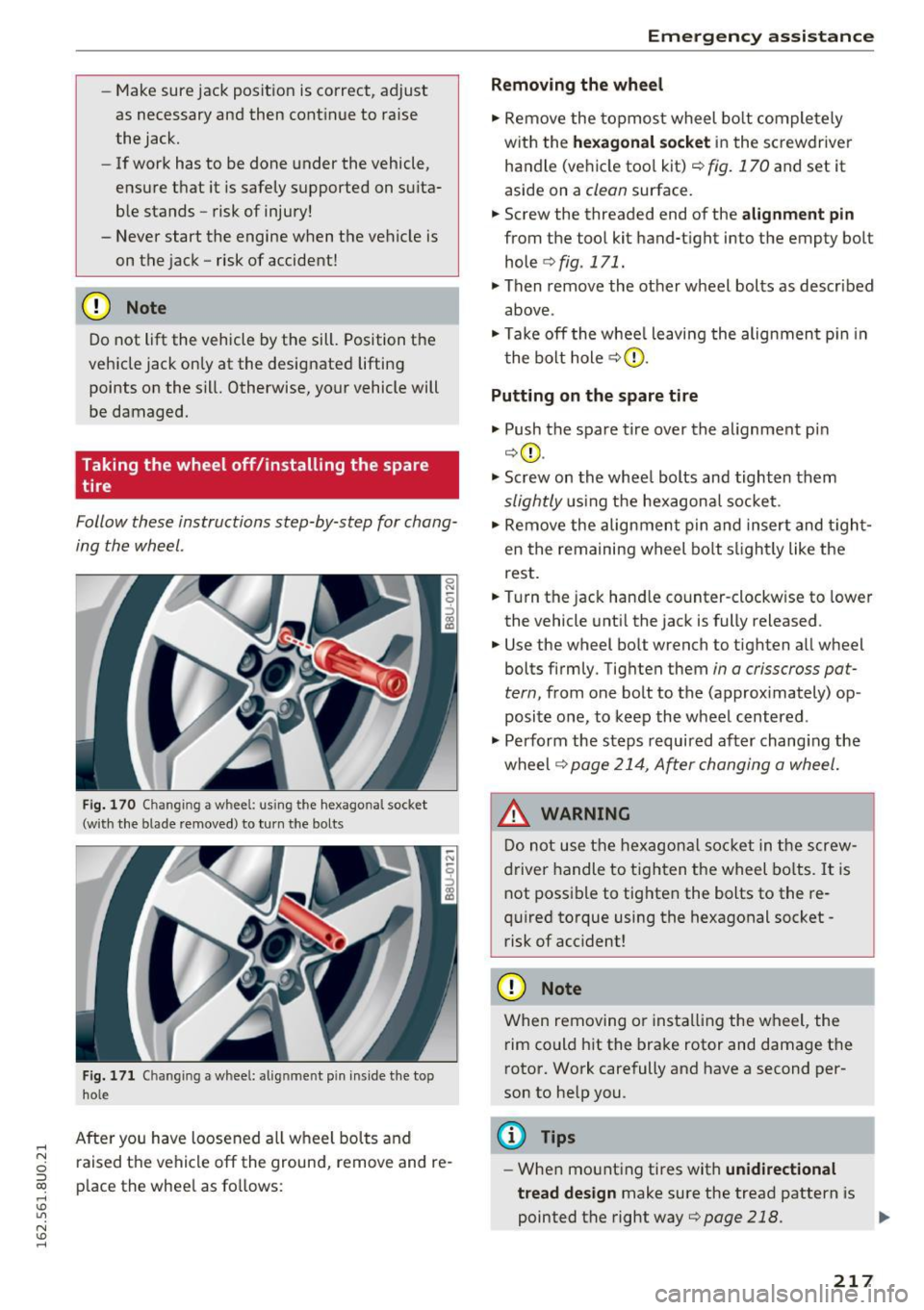
Fig. 170 C hangin g a w heel: using th e hexagonal s oc ket
(w it h the blade removed ) to turn t he bolt s
Fig. 171 Chan gin g a w hee l: a lig nm ent pin in side the to p
h ol e
After you have loosened all wheel bolts and
raised the vehicle off the ground, remove and re
p lace the whee l as follows:
Em ergen cy a ssis tanc e
Removing the whe el
"' Remove the topmost wheel bolt completely
with the
he xagona l s oc ket in the screwdriver
handle (vehicle too l kit)
c::> fig. 170 and set it
aside on a
clean surface.
.. Screw the threaded end of the
alignment pin
from the tool kit hand-tight into the empty bolt
hole
c::> fig . 171.
"' Then remove the other wheel bolts as described
above .
"' Take off the whee l leaving the alignment p in in
the bolt hole
c::> G) .
Putting on the spare tire
"' Push the spare tire over the alignment pi n
c::>(D .
"' Screw on the whee l bolts and tighten them
slightly u sing the hexagona l socket .
"' Remove the alignment pin and insert and t ight
en the remaining wheel bo lt s lightly like the
rest .
.. Turn the jack hand le count er-clockw ise to lower
the vehicle unti l the jack is fully released .
.. Use the wheel bo lt wrench to tighten all wheel
bolts firmly . Tighten them
in a crisscross pa t
tern,
from one bolt to the (approx imately) op
posite one, to keep the wheel centered .
"' Perform the steps required after chang ing the
wheel
c::> page 214, A~er changing a wheel.
_& WARNING
Do not use the hexagon al soc ket in the screw
driver handle to tighten the wheel bo lts. It is
not possible to tighten the bolts to the re
qu ired torque using the hexagonal socket -
risk of acc ident!
CD Note
When removing or installing the wheel, the
rim could h it the brake rotor and damage t he
rotor. Work carefully and have a second per
son to he lp you.
@ Tips
- When mounting tires with un idirectional
tread de sign
make sure the tread pattern is
pointed the right way
c::> page 218 . 1JJ,,
217
Page 220 of 252

Emergency assistance
- The wheel bolts should be clean and easy to
turn. Check for di rt and cor ros ion on the
mating s urfaces o f both the whee l an d the
h ub. Remove all dirt from t hese surfaces be
fo re remo unt ing t he wheel.
Tires with unidirectional tread design
Tires with unidirectional tread design must be
mounted with their tread pattern pointed in the
right direction.
Using a spare tire with a tread pattern intended for use in a specific direction
W hen us ing a spare ti re with a tread patte rn in
tended for use in a specific d irection, please note
the following:
- The direct ion o f rotat ion is marked by an
arrow
on the s ide of the t ire .
-If the spare tire has to be installed in the incor
rect d irection, use the spare tire only tempora
rily s ince the tire w ill not be ab le to achieve its
optimum pe rformance c haracter istics with re
gard to aq uaplaning, noise and wear .
- We recommend that you pay particular atten
tion to this fact during wet weathe r and that
yo u ad just yo ur speed to match road condi
t ions.
- Replace t he flat t ire with a new one and have it
i ns ta lled on yo ur vehicle as soon as possible to
r esto re t he handling advantages of a unidi re c
t ion al ti re.
Notes on wheel changing
Please read the info rm ation ¢ page 198, New
tires or wheels
i f you are goin g to use a s pare tire
which is d ifferent from the tires on yo ur vehicle.
Afte r you change a tire:
-Check the tire pressure on the spare immedi
ately after installation .
- Have the wheel bolt tightening torque
checked with a torque wrench as soon as pos
sible by your authorized Audi dealer or quali
fied workshop .
218
-With steel and alloy wheel rims, the wheel
bolts are cor rectly tightened at a torque of
105 ft lbs. (140 Nm).
- If you notice that the wheel bolts are corroded
and difficult to turn while changing a tire,
they should be replaced before you check the
t ightening torque.
- Replace the flat tire with a new one and have
it installed on your vehicle as soon as poss i
ble. Remount the wheel cover.
Until then , drive with extra care and at reduced
speeds.
A WARNING
- If you are going to equip yo ur vehicle with
tires or r ims which diffe r from those which
we re facto ry insta lled, the n be su re to read
t he informa tion ¢
page 198, New tires or
wheels.
-Always make sure the damag ed wheel or
eve n a flat tire and t he jack and tool kit ar e
prope rly se cured in t he lu ggage comp art
me nt an d ar e no t loose in the passenge r
compa rtment.
- In an accide nt or sudde n maneuver they
co uld fly forw ard, i njuring an yon e in t he ve
h icle.
- Always s to re d amaged w hee l, jack a nd to ols
secure ly i n t he lug gage co m pa rtm ent. O th
erwise, in an a cci den t or sudden maneuve r
they cou ld fly forwar d, causing injury to pas
senge rs in the ve hicle.
(D Note
D o no t use co mm ercia lly availabl e tire se al
a nts . Ot herwise, t he e lectr ic al components of
the tire p ress ure monitor ing system * will no
l onge r wor k properly and t he sensor for t he
tire pressure monitoring system * w ill have to
be replaced by qualifie d wo rks hop.
-