2016 AUDI Q3 roof
[x] Cancel search: roofPage 145 of 252

-Always move the passenger seat into its
rearmost position in the seat's fore and a ft
adjustment range , as fa r away from the air
bag as possible before installing the for
ward-facing child r estra int. T he backrest
must be adjusted to an upright posit io n.
- Make sure tha t th e
PA SSEN GER AIR BAG
OFF
light comes on and stays on all the tim e
w henever the ignition is switched on.
A WARNING
Rearwa rd-facing child restra ints:
- A ch ild in a rearward-facing child safety seat
installed on the front passenger seat wi ll be
seriously injured and can be killed if the
front airbag inflates - even with an Ad
vanced Airbag System .
- The inflating a irbag w ill hit the child safety
seat or infant carrier with great force and
will smash the chi ld safety seat and chi ld
against the backrest, center armrest, door
or roof.
- Always be especially careful if you must in
stall a rearward facing child safety seat on
the front passenger seat in exceptional c ir
cumstances.
- A tight tether strap on a rearward-facing
child restraint attached to the front passen
ger seat can put too much pressure on the
we ight-mat in the seat and register a heavi
er we ight in the Advanced Airbag System.
The heavier we ight registered can make the
system work as though an adult were on the
seat and deploy the Advanced Airbag when
it m ust be suppressed c ausing serious or
even fatal injury to the child.
- Make sure tha t the
PASSENGER AIR BAG
OFF
light comes on and stays on all the time
whenever the ignition is switched on .
-If the PASSENGER AIR BAG OFF light does
not come on and stay on, immedia tely in
stall the rear-facing child safety seat in a
rear seating position and have the airbag
system inspected by your Aud i dealer .
Child safety
Activating the convertible locking retractor
Use the convertible locking retractor to secure a
child restraint .
Always heed the ch ild safety seat manufacturer 's
instruct ions when installing a child restraint in
your vehicle. To activate the convertible locking retractor:
.. Place the child restraint on a seat, preferably
on the rear seat .
.. Slowly pull the belt
all the w ay out .
.. Route it around or through the child restra int
be lt path
¢ & .
.. Push the ch ild safety sea t down with you r full
weigh t to ge t the safety belt really tight.
.. Insert the belt tong ue into the b uck le for that
seating position .
.. Guide the safety belt back into the retractor un
til the belt lies flat and snug on the child safety
seat .
.. You should hear a ''cl icking" noise as the belt
w inds back into the inertia reel. Test the con
vert ib le lock ing retractor by pull ing on the belt .
You shou ld no longer be able to pull the belt
out of the re tractor. The convertib le loc kin g re
t ractor is now activated.
.. Make sure that the red release button is facing
away from the c hild rest raint so that it can be
unbuckled quickly .
.. Pull on the belt to make sure the safety belt is
properly tight and fastened so that the seat
cannot move forward or sideways more than
one inch (2 .5 cm) .
A WARNING
Using the wrong ch ild rest raint o r an improp
e rly inst alled child restra int can cause se rious
person al injury or death in a crash.
- Always make sure that the safety be lt re
tr actor is locked when installing a child
safety seat . An un locked safety be lt retrac
tor cannot hold the ch ild safety seat in p lace
during normal driving or in a crash.
- Always buckle the child safety seat fi rm ly in
p lace even if a child is not sitting in it. A
loose child safety seat can fly a round during
a sudden stop or in a c rash. .,.
143
Page 162 of 252

Driving and th e en vironm ent
A WARNING
-The temperature of the exhaust system is
high, both when driving and after stopping
the engine.
- Never touch the exha ust tail pipes once they
have become hot . This could result in burns.
- Do no t park or operate the vehi cle in areas
where the hot exha ust system may come in
contact with dry grass, br ush, fue l spill or
other mater ial which can cause a fire.
- Do not apply additional undercoating or
rustproofing on or near the exhaust mani
fold, exhaust p ipes, catalytic converter or
heat sh ields. During dr iv ing, the substance
used for undercoating could ove rheat and
ca use a fire .
(D Note
-Be aware that just one tank filling with
leaded fuel will a lready ser iously degrade
the performance of the catalytic converter .
- Do not exceed the correct eng ine oi l level
¢ page 181.
-Do not drive until the fuel tank becomes
complete ly empty. The engine cou ld mis
fire. Unburned fuel could also get into the
exhaust system and this could cause t he
catalytic converte r to overheat.
- Do not turn off the ignition whi le the vehicle
i s mov ing.
- Do not continue to operate your veh icle un
der these cond itions, as otherwise fue l can
r each the catalytic converte r. This cou ld re
su lt in ove rheating of t he converte r, req uir
i ng its re placement.
- T o assure efficient operation of the Emis
s ion Control System:
- Have your ve hicle maintained properly and
in accordance with the se rvice recommen
dations in your Wa rranty
& Maintenance
book let .
- Lack of proper maintenance as well as im
proper use of the vehicle will impair the
function of the em ission cont rol system
and co uld lead to damage.
160
-
® For the sake of the environment
Even when the Emiss ion Control System is op
e rating properly, the exhaust gas can have a
su lfu r-li ke exhaust gas sme ll under some op
erating states. T his depends on the sulfur
content of the fuel being used. Us ing a d iffer
ent brand of fuel may help, or fi lling the tank
with lead-free super g rade gasoline.
Shutting down vehicle
If you would like your vehicle to remain inopera
tive for a longer pe riod of time, contact an Audi
o r othe r spec ia liz ed dealer. They ca n adv ise you
o n necessa ry p recautions e.g. corros io n preven
tion, m aintenance and storage . Pay attention to
additional in formation concer ning the battery .
Refer to¢
page 187 .
Economical and environ
mentally-friendly driving
General
Your personal style of driving will determine the
economy of your vehicle, a s well as exhau st and
noise levels .
Fu el economy, env ironmenta l impact, and wear
o n your e ngine, brakes and tires large ly depend
o n t hree fa ctors:
- your personal d riving style
- operat ing cond itions
- technical limitat ions
If you anticipate what you need to do next and
drive economically, you can easily cut your f uel
consumption by 10-lS percent. Th is sect ion wi ll
give you some tips on how you can help the envi
ronment and your pocketbook .
{l) Tips
The consumption estimates as published by
ENVIRONMENTAL PROTECTIO N AGENCY
(EPA) and T ransport Canada may not corre
spond to your actual consump tion on the
r oad, which wi ll vary depending upon vehicle
l oad and speed, road a nd wea ther conditions,
tri p l engt h, etc.
Page 170 of 252

Care and cleaning
Care and cleaning
General information
Regular, prope r care helps to maintain your vehi
cle's value.
It can a lso be a requirement when
submitting war ranty claims for cor rosion damage
and pa int defects on the body.
The necessary care prod ucts can be obtained
from your authorized Audi dealer o r authorized
Aud i Service Facility. Read and follow the instruc
tions for use on the packaging.
A WARNING
- Using cleaning and care products incorrectly
can be dangero us to your hea lth .
- Always store clean ing and care products out
of reach of children to reduce the r isk of po i
so ning .
@ For the sake of the environment
- Preferab ly use environmentally-friendly
products when buying cleaning agents.
- Do not dispose of leftove r clean ing and care
products wit h household t rash.
Car washes
The longer that deposits remain on the veh icle,
the more the surface may be damaged. High
temperatures such as those caused by sunlight
increase the damaging effect.
Before washing, rinse
off heavy deposits with
p lenty of water.
Stubborn deposits s uch as bird droppings or tree
sap are best removed with plenty of water and a mic rofibe r cloth.
A lso, wash the underside of yo ur vehicle once
road sa lt stops being used for the season .
Pressure washers
When washing your veh icles with a pressure
washer, always follow t he ope ra ti ng inst ructions
p rovided w ith the pressure washer. This is espe
cially important in regard to the pressure and
spraying distance . Do not a im the spray directly
at seals on side windows, doors, the hood, the
168
rear lid or the sunroo f* or at tires rubber hoses I I
insulating material, sensors* or camera lenses* .
Keep a distance of at least 16 inches (40 cm) .
Do no t remove snow and ice with a pressure
washe r.
Neve r use rota ry no zzles or high pressure noz
z les.
The water temperatu re must not be above 140 °F
(60 °().
Automatic car washes
Spray
off the vehicle before washing.
Make su re that the windows and roof * are closed
and t he windshie ld wipers are
off . Follow instruc
tions from the car wash operato r, especially if
there are accessories attached to your vehicle.
If possible, use car washes that do not have
brushes.
Washing
by hand
Clean the vehicl e starting from the top and work
in g down using a soft sponge or cleaning br ush .
Use solvent-free cleaning products.
Washing vehicles with matte finish paint
by
hand
To avo id damaging the paint w hen washing, fi rst
remove dust and large pa rt icl es from your vehi
cle. Insects, grease spots and fingerprints are
best removed with a special cleane r for matte
finish paint .
Apply the p rodu ct using a microfiber cloth. To
avoid damaging the paint surface, do not use too
much pressure.
Rinse the vehicle thorough ly w ith wate r. Then
clean using a neutra l shampoo and a soft m icr o
fiber cloth .
R inse the ve hicle thorough ly again a nd let it air
dry. Remove any water residue using a leather
cloth.
A WARNING
- Only wash the vehicle when the ignition is
off and follow the instr uctions from the car
-
Page 197 of 252

... N 0 ::,
~
...
'° V, N
'° ...
(a) Curb weight
(b) Accessory weight
(c) Vehicle capacity weigh t, and
(d) Production options we ight
Ma ximum (permissible)
inflation pressure
means the maximum cold infla
tion pressure to which a t ire may
be inflated. Also called "maxi
mum inflation pressure."
Normal occupant weight
means 150 lbs. (68 kilograms)
times the number of occupants
seated in the veh icle up to the to
tal seating capacity of your vehi c le.
Occupant distribution
means distribution of occupants
in a vehicle.
Outer diameter
means the overall diameter of an
inflated new tire.
Overall width
means the linear distance be
tween the exteriors of the side
walls of an inflated tire, including
elevations due to labeling, deco
rations, or protective bands or
ribs .
Wheels
Ply
means a layer of rubber-coated
parallel cords .
Production options weight
means the combined weight of
those installed regular production
options weighing over 5 lbs. (2.3 kg) in excess of those standard
items which they replace, not pre
viously considered in curb weight
or accessory weight, including
heavy duty brakes, ride levelers,
roof rack, heavy duty battery, and
special trim .
Radial ply tire
means a pneumatic tire in which
the ply cords that extend to the beads are laid at substantially 90
degrees to the centerline of the
tread.
Recommended inflation
pressure
see ~ page 194, Cold tire infla
tion pressure .
Reinforced tire
means a tire designed to operate
at higher loads and at higher in
flation pressures than the corre sponding standard tire. Rein
forced tires may be identified as .,.
195
Page 222 of 252

Fuses and bulbs
(D Tips
- The following table does not list fuse loca
tions that are not used.
- Some of the equipment listed in the follow
ing tables applies only to certain model ver
sions or certain optional equipment.
Cockpit fuse assignment
The fuse number is stamped into the plastic be
low or above each fuse.
No. Equipment
1 LED headlight (left)
2 LED headlight ( right)
5 LED headlight (left)
6 LED headlight (right)
7 Steering lock
8 Convenience access
9
Airbag control module, AIRBAG OFF indi-
cator light
12 Transmission control module
Air quality sensor for climate contro l sys-
tern, heated w indow washer nozzles,~
button, reverse light button<®>, oil level
13 sensor, climate control system, seat occu-
pant detection system, seat heating , but-
tons in the center console, automatic dim-
ming mirror
Engine control module, transmission con-
trol module, quattro control module,
14
brake lights, electromechanica l steering,
Gateway cont rol module, trailer hitch con-
trol module, ESC contro l module, light
switch, damping control module
Headlight range control module, instru-
ment illuminat ion, headl ights (left, right),
15 diagnostic connector, headlight range con-
trol module, crankcase housing heater, air
flow sensor, socket relay, DC/DC converter
16 Park ing system
17 Parking system rearview camera
18 TV tuner
19 E ngine starter control, DC/DC converter
220
No . Equipment
20
ESC contro l module, climate/heating con-
tro l, special functions interface
21 Selecto r mechanism power supply
22 Interior monitoring
© button, front interior lighting buttons,
23 diagnostic connector, light switch, light/
rain sensor, humidity sensor
25 Headlight power supply
26 Rear window wiper
27 Starter system
28 Infotainment
29
Supply for the park ing system rearv iew
camera and TV tuner
30 Infotainment
31 Infotainment
32 Instrument cluster
33 A utomat ic dimming rearview mirror
36
Cigarette lighter, cockpit/ luggage com-
partment socket
37 Cockpit/rear socket
38 Transmission control module
40 Trailer hitch control module
41 Trailer hitch control module
42 Trailer hitch control module
44 Rear window defogger
45
Electromechanical parking brake control
module
46 Trailer hitch control module
47 quattro control module
48 Aut omat ic lu ggage compartment lid con-
tro l module
so Fan
51
Electromechanical parking brake control
module
52 BCM
53 Fr ont seat heating
54 Panorama roof
55 Sun shade on the panorama roof
56 Adaptive dampers control module
Page 232 of 252

Tech nical data
Gross Axle Weight Rating
The G ross Ax le We ight Rating is the max imum
load that can b e applied at each axle of the vehi
cle ¢& .
Vehicle capacity weight The vehicle capacity we ight (max . load) is l isted
on the d river's side 8-p illar.
Roof weight
The max imum perm issible roof weight is
1 65 lb
(75 kg ). The roof weight is the total of the
weight of the roof rack, the attachments and the cargo you are carrying.
.8, WARNING
- T he ac tual Gross Axle Weight Rating a t the
front and rear axles shou ld not exceed t he
permissible weights, and their comb ination
must not excee d the Gross Ve hicle Weight
Rating .
- Exceeding pe rm issible weight ratings can
result in ve hicle damage, accidents and per
sonal in jury.
(D Note
- T he vehicle capacity weight figures app ly
when the loa d is distrib uted even ly in the
vehicle (passengers and luggage) . When
transporting a heavy load in the luggage
compartment, carry t he load as near to the
rear axle as possible so that the vehicle's
handling is not impaired.
- Do not exceed the maximum permissible
axle loads o r the maximum gross vehicle
weight . Always remember tha t the vehicle 's
handling w ill be affected by the extra load.
T herefo re, adjust yo ur speed accordingly .
- Always obse rve local reg ulations .
Dimensions
Length in (mm) 172.8 (4388)
Width in (mm) 72
.0 (1831)
230
Width (across mir- i
n (mm) 79.4 (2019)
ro rs)
H eight (u nloa ded)a )
in (mm)
62 .5 (1590)
a) The he ig ht of th e vehicl e depend s on t he tire s an d the sus
p en sion .
When dr iving up steep ramps, on rough roads,
over curbs, etc. it is important to remember that
some parts of your veh icle, s uch as spoilers o r ex
haust system components, may be close to the
ground. Be c arefu l not to d amage them.
Capacities
Fue lta nk:totalca- gal (liters) 16.9 (64 .0)
pacity
Windshield washer q
uarts (lit-
4 .8 (4 .5)
fluid container ers)
Page 235 of 252

today's automobiles, have steadily reduced the
scope of maintenance and repairs which can be
carried out by vehicle owners.
Also, safety and
environmental
concerns place very strict limits
on the nature of repairs and adjustments to en
gine and transmission parts which an owner can perform .
Maintenance, adjustments and repairs usually re
quire special tools, testing devices and other
equipment available to specially trained work
shop personnel in order to assure proper per
formance, reliability and safety of the vehicle and
its many systems.
Improper maintenance, adjustments and repairs
can impair the operation and reliability of your
vehicle and even void your vehicle warranty .
Therefore, proof of servicing in accordance with
the maintenance schedule may be a condition for upholding a possible warranty claim made within
the warranty period.
Above all , operational safety can be adversely af
fected, creating unnecessary risks for you and
your passengers.
If in doubt about any servicing, have it done by
your authorized Audi dealer or any other properly equipped and qualified workshop. We strongly urge you to give your authorized Audi dealer the
opportunity to perform all scheduled mainte nance and necessary repairs. Your dealer has the
facilities, original parts and trained specialists to keep your vehicle running properly .
Performing limited maintenance yourself
The following pages describe a limited number of
procedures which can be performed on your vehi
cle with ordinary tools, should the need arise and
trained personnel be unavailable. Before per
forming any of these procedures, always thor
oughly read all of the applicable text and careful ly follow the instructions given . Always rigorously
observe the
WARNINGS provided .
Before you check anything in the engine com
partment, always read and heed all WARNINGS
c::> .&. and c::> .&. in Working in the engine compart
ment on page 177. Consumer information
A WARNING
-
Serious personal injury may occur as a result
of improperly performed maintenance, ad
justments or repairs .
- Always be extremely careful when working
on the vehicle. Always follow commonly ac
cepted safety practices and general com
mon sense. Never risk personal injury.
- Do not attempt any of the maintenance,
checks or repairs described on the following pages if you are not fully familiar with these
or other procedures with respect to the ve hicle, or are uncertain how to proceed.
- Do not do any work without the proper tools
and equipment. Have the necessary work
done by your authorized Audi dealer or an
other properly equipped and qualified work
shop.
- The engine compartment of any motor vehi cle is a potentially hazardous area. Never
reach into the area around or touch the radi
ator fan.
It is temperature controlled and
can switch on suddenly - even when the en
gine is off and the ignition key has been re
moved. The radiator fan switches on auto
matically when the coolant reaches a certain
temperature and will continue to run until
the coolant temperature drops.
- Always remove the ignition key before any
one gets under the vehicle.
- Always support your vehicle with safety
stands if it is necessary to work underneath
the vehicle. The jack* supplied with the vehi
cle is not adequate for this purpose and
could collapse causing serious personal in
jury.
- If you must work underneath the vehicle
with the wheels on the ground, always make
sure the vehicle is on level ground, that the
wheels are always securely blocked and that the engine cannot be started.
- Always make sure the transmission selector
lever (automatic transmission) is in P (Park
position) and the park brake is applied.
233
Page 239 of 252
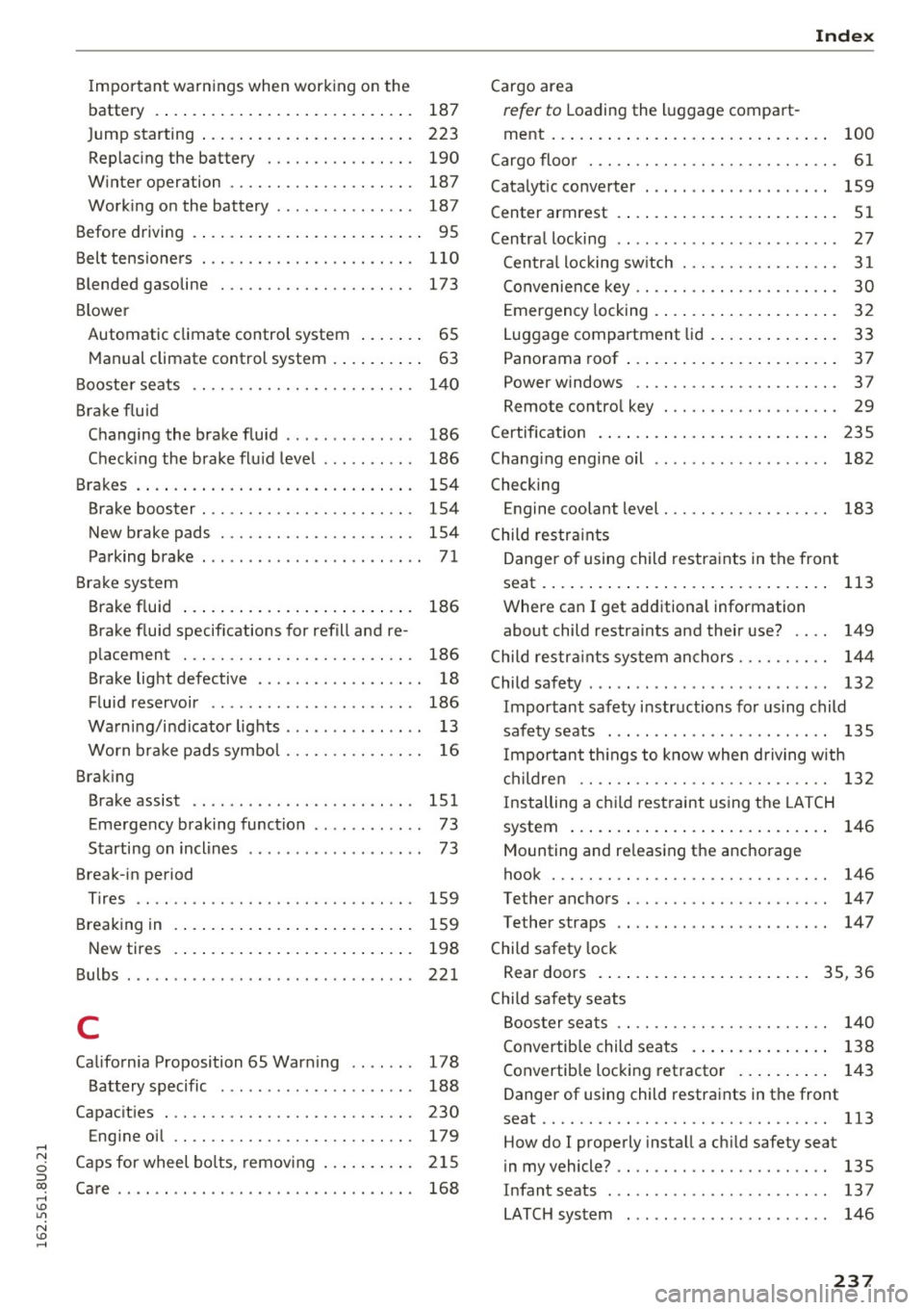
Important warnings when working on the
battery . . . . . . . . . . . . . . . . . . . . . . . . . . . .
187
Jump starting . . . . . . . . . . . . . . . . . . . . . . . 223
Replacing the battery . . . . . . . . . . . . . . . . 190
Winter operation . . . . . . . . . . . . . . . . . . . . 187
Working on the battery . . . . . . . . . . . . . . . 187
Before driving . . . . . . . . . . . . . . . . . . . . . . . . . 95
Belt tensioners . . . . . . . . . . . . . . . . . . . . . . . 110
Blended gasoline . . . . . . . . . . . . . . . . . . . . . 173
Blower
Automatic climate control system . . . . . . .
65
Manual climate control system . . . . . . . . . . 63
Booster seats . . . . . . . . . . . . . . . . . . . . . . . . 140
Brake fluid
Changing the brake fluid . . . . . . . . . . . . . .
186
Checking the brake fluid level . . . . . . . . . . 186
Brakes . . . . . . . . . . . . . . . . . . . . . . . . . . . . . . 154
Brake booster . . . . . . . . . . . . . . . . . . . . . . . 154
New brake pads . . . . . . . . . . . . . . . . . . . . . 154
Parking brake . . . . . . . . . . . . . . . . . . . . . . . . 71
Brake system
Brake fluid . . . . . . . . . . . . . . . . . . . . . . . . .
186
Brake fluid specifications for refill and re
placement . . . . . . . . . . . . . . . . . . . . . . . . . 186
Brake light defective . . . . . . . . . . . . . . . . . .
18
Fluid reservoir . . . . . . . . . . . . . . . . . . . . . . 186
Warning/indicator lights . . . . . . . . . . . . . . . 13
Worn brake pads symbol . . . . . . . . . . . . . . . 16
Braking
Brake assist . . . . . . . . . . . . . . . . . . . . . . . .
151
Emergency braking funct ion . . . . . . . . . . . . 73
Starting on inclines . . . . . . . . . . . . . . . . . . . 73
Break-in period
Tires . . . . . . . . . . . . . . . . . . . . . . . . . . . . . .
159
Breaking in . . . . . . . . . . . . . . . . . . . . . . . . . . 159
New tires . . . . . . . . . . . . . . . . . . . . . . . . . . 198
Bulbs . . . . . . . . . . . . . . . . . . . . . . . . . . . . . . . 221
C
California Proposition 65 Warning . . . . . . . 178
Battery specific . . . . . . . . . . . . . . . . . . . . . 188
Capacities . . . . . . . . . . . . . . . . . . . . . . . . . . . 230
Engine oil . . . . . . . . . . . . . . . . . . . . . . . . . . 179
Caps for wheel bolts , removing . . . . . . . . . . 215
Care . . . . . . . . . . . . . . . . . . . . . . . . . . . . . . . . 168
Index
Cargo area
refer to Loading the luggage compart-
ment...... ... .. .. .................
100
Cargo floor . . . . . . . . . . . . . . . . . . . . . . . . . . . 61
Catalytic converter . . . . . . . . . . . . . . . . . . . . 159
Center armrest . . . . . . . . . . . . . . . . . . . . . . . . 51
Centra l locking . . . . . . . . . . . . . . . . . . . . . . . . 27
Central locking sw itch . . . . . . . . . . . . . . . . . 31
Convenience key . . . . . . . . . . . . . . . . . . . . . . 30
Emergency locking . . . . . . . . . . . . . . . . . . . . 32
Luggage compartment lid . . . . . . . . . . . . . . 33
Panorama roof . . . . . . . . . . . . . . . . . . . . . . . 37
Powe r windows . . . . . . . . . . . . . . . . . . . . . . 3 7
Remote control key . . . . . . . . . . . . . . . . . . .
29
Certification . . . . . . . . . . . . . . . . . . . . . . . . . 235
Changing engine oil . . . . . . . . . . . . . . . . . . . 182
Checking
Engine coolant level . . . . . . . . . . . . . . . . . .
183
Child restraints
Danger of using child restraints in the front
seat....... ... .. .. ................ .
113
Where can I get additional information
about child restraints and their use? . . . .
149
Child restraints system anchors. . . . . . . . . . 144
Child safety . . . . . . . . . . . . . . . . . . . . . . . . . .
132
Important safety instructions for using child
safety seats . . . . . . . . . . . . . . . . . . . . . . . .
135
Important th ings to know when driving with
children . . . . . . . . . . . . . . . . . . . . . . . . . . .
132
Installing a child restraint using the LATCH
system . . . . . . . . . . . . . . . . . . . . . . . . . . . .
146
Mounting and re leasing the anchorage
hook . . . . . . . . . . . . . . . . . . . . . . . . . . . . . .
146
Tether anchors . . . . . . . . . . . . . . . . . . . . . . 147
Tether s traps . . . . . . . . . . . . . . . . . . . . . . . 147
Child safety lock
Rear doors . . . . . . . . . . . . . . . . . . . . . . .
35, 36
Child safety seats
Booster seats . . . . . . . . . . . . . . . . . . . . . . .
140
Convertible child seats . . . . . . . . . . . . . . . 138
Convertible locking retractor . . . . . . . . . . 143
Danger of using child restraints in the front
seat...... .... .. .. ............... ..
113
How do I properly install a child safety seat
in my vehicle? . . . . . . . . . . . . . . . . . . . . . . .
135
Infant seats . . . . . . . . . . . . . . . . . . . . . . . . 137
LATCH system . . . . . . . . . . . . . . . . . . . . . . 146
237