2016 AUDI A3 sport mode
[x] Cancel search: sport modePage 151 of 328

.... N
0 > CX)
rl
"' U"I
rl
"' ....
@ Tips
In some models, the maximum vehicle speed
can only be reached in the auto and dynamic
modes.
Selecting the driving mode
Appl ies to vehicles: with Audi d rive select
You con choose between comfort, auto, dynamic
and individual* .
Fig. 134 Cente r console : dr ive select button
F ig. 135 MMI: drive select (example)
Adjusting the Individual mode Assist
.,.
To set the mode, press the r:/tc'i button
~ fig. 134 repeatedly until the desired mode is
displayed in the instrument cluster. Or
.,. In the MMI, select: the
I MENU I button > Car >
Systems"
control button > Comfort, Auto, Dy
namic or Individual *.
You can change the driving mode when the vehi
cle is stationary or while driving. If traff ic per
mits, after changing modes, briefly take your
foot off the accelerator pedal so that the recently
selected mode is also activated for the engine .
Comfort -provides a comfort-or iented vehicle
setup and is suited for long drives o n highways.
Auto -provides an overall comfortab le yet dy
namic driving feel and is suited for everyday use .
Dynamic -gives the driver a sporty driving fee l
and is suited to a sporty driving style.
Individual* -~ page 149.
A WARNING
Pay attention to traffic when operating the
drive select to prevent potential risk of an ac
cident .
You can adjust the vehicle settings to your personal preferences .
.,. Select : the IMENU ! button> Car> Systems*
control button > Set individual control button.
Once you select the menu, you will automat i
cally drive in the
Individual * mode.
After you have closed the sett ings, you will auto
matically drive in the
Individual * mode.
Systems comfort
Engine
and Transmission comfortable
Steering comfortable
Cornering light* comfortable The equipment
in your vehicle will determine
which sett ings you can adjust. The follow ing ta
ble g ives an overview of the characteristics .
auto dynamic
balanced sporty
balanced sporty
balanced sporty
149
Page 152 of 328
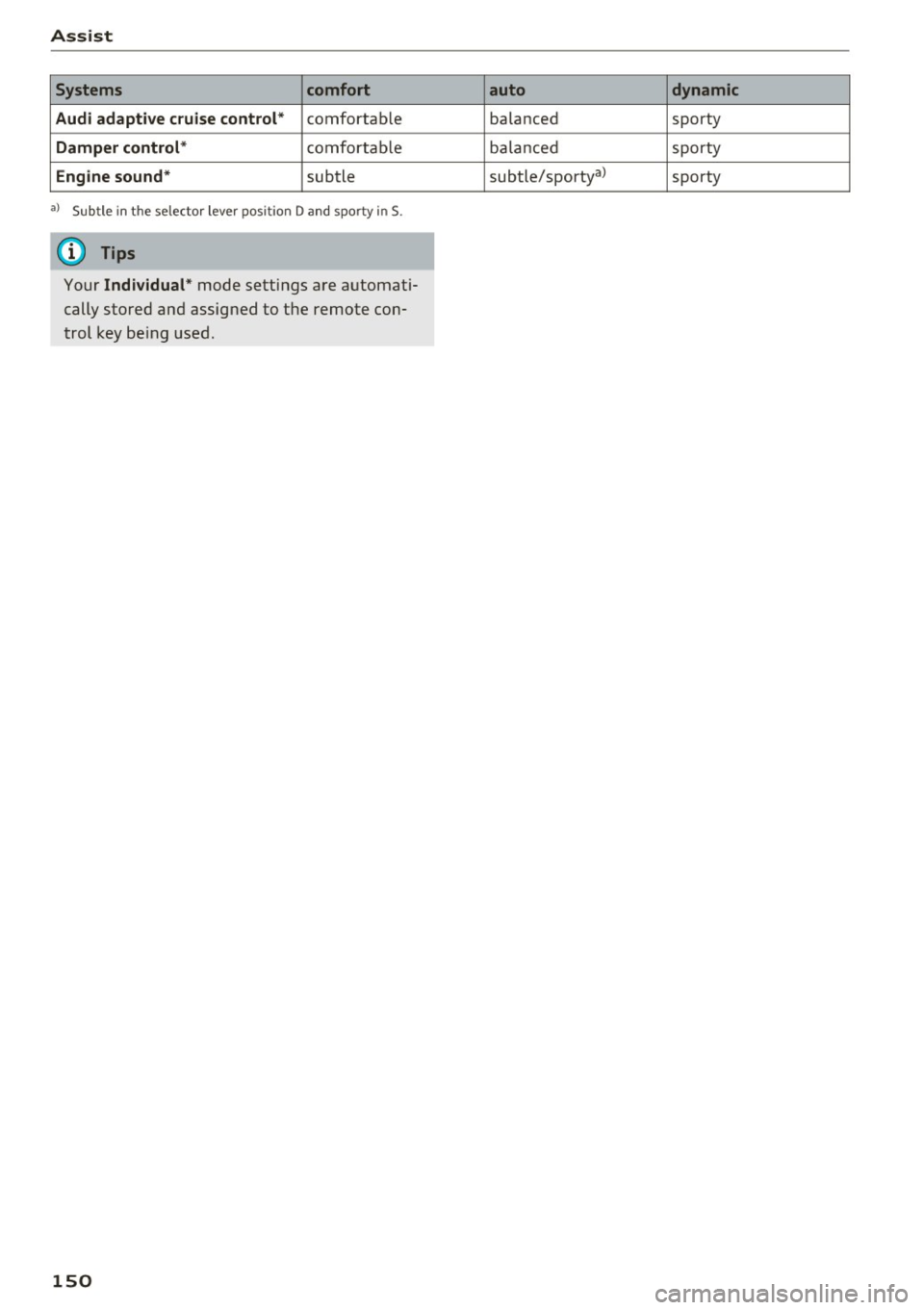
Assist Systems comfort
Audi adaptive c ru ise control*
comfortab le
Damper control * comfortable
Engine sound* subtle
al Sub tle in t he se lecto r lever position D a nd s porty in S.
(D Tips
Your Individual * mode settings are a utomat i
cally stored and assigned to the remote con
trol key be ing used.
150
auto dynamic
balanced sporty
ba la nced sporty
subtle/sporty al sporty
Page 162 of 328

Inte llig ent Techn olo gy
tak ing risks . This could increase your risk of
a collision.
- Please note the risk of a collision increases
when driving fast, especially through curves
and on slippery or wet roads, and when driv
ing too close to objects ahead. The ESC and
its integrated systems cannot always pre
vent collisions - there is still a r isk of acci
dents!
- Press the accelerator pedal carefully when
accelerating on even, s lippery surfaces such
as ice and snow. The drive wheels can spin
Switching on/off
even when these control systems are instal
led and this can affect dr iving stability and
increase the risk of a collision.
@ Tips
- ABS and ASR only function correctly when
all four wheels are equipped with identical
tires . Different tire sizes can lead to a reduc
t ion in engine power.
- You may hear noises when the systems de
scribed are working.
ESC turns on automatically when you start the engine .
Fig . 1 47 Upper center conso le: ESC butto n
function of the ESC is limited or switched off. The
amount of stabilization contro l will differ de
pending on the level.
In the follow ing unusual situations it may make
sense to switch the ESC sport mode on to allow
the wheels to spin:
- Rocking the vehicle to free it when it is stuck
- Dr iving in deep snow or on loose g ro und
The ESC is des igned to function in levels. Depend
ing on the level that is selected, the stabilization
Sport mode on ESC/ASR off Sport mode off or
ESC /ASR on
Beh avio r
The ESC and ASR stabiliza-
The stabilization function is The full stabilization tune-
tion functions are limited not available
¢ &.
. ESC and
tion of the ESC and ASR is
¢&_ . ASR are switched off. avai lable again.
Operati on Press the I~ OFF I button P ress and hold the I~ OFFI Press the I~ OFFI button
briefly . button longer than 3 sec -again.
onds .
Indicat or II turns on. II and lf11f•lH * turn on . II turns off or II and
lights lf111,n~ · turn off .
Driv e r mes- Stab ilization cont rol (E S C): Stabilization control (ESC ):
Stabilizat ion cont rol
sa ge s s port. Warning ! Re st ric ted off . Warning ! Re stri cted (E
SC ): On
st ability stability
160
Page 163 of 328

,....,
N
0 > co ,....,
You should only switch sport mode on or switch ESC/ASR off if your driving abilities
and road conditions permi t.
- The stabilization function is limited when
sport mode is sw itched on . T he driving
w heels could spi n and the veh icle cou ld
swerve, espec ially on s lick o r sli ppery road
s u rf aces.
- T here is no veh icle stabilization when ESC/
ASR a re swi tched off.
(D Tips
- ESC/ASR cannot be switched off or sport
mode cannot be sw itched on if t he cru ise
contro l system* or the adaptive c ruise con
tro l* is sw itched on .
- Mal functions in the Audi magnet ic r ide may
make it imposs ible to sw itch the ESC/ASR
off or to switc h sport mode on .
Brakes
New brake pads
New brake pads do not ac hieve the ir full braking
effect during the first 250 mi (400 km) . They
must be "b roken in " fi rs t . However, you can com
pensate for the slightly reduced bra king fo rce by
p ressing firmly o n the brake pedal. Avoid heavy
b raking during the break -in period .
Wear
Brake pad
wear depends largely on the way th e
ve hicl e is driven a nd on operat ing cond itions.
This is especially true if you are d riving frequently
in the c ity and on c urves o r wi th a sporty driving
style.
Operating noise
Noises may occur when bra kin g depend ing on the
speed , braking force and ou ts ide cond it ions s uch
as tempe rature and humidity .
Effect of water and road salt
In certain situations, for example after dr iving
through water, in heavy ra in, after ove rnig ht con
densat ion or after washing your car, the b raking
Intellig ent Technology
effect ca n be reduced by moist ure o r ice on the
bra ke rotors and brake pads . The brakes must be
"d ried" first with a few caref ul brake applica
tions.
At h igher speeds and w ith the wi ndshield wipe rs
tu rned on, the brake pads press against the brake
roto rs fo r a short amount of time. This action
wh ich is not felt by the dr iver happens at reg ular
interva ls and facilit ates a be tter reaction t ime for
the brakes in wet weather .
The braking effect can a lso be reduced if yo u are
driv ing on salted roads and yo u do not app ly the
brakes for long per iods of time . The layer of salt
o n the brake rotors and pads must be wor n off
first whe n the bra kes are applied .
Corrosion
Leaving the vehicle pa rked for long periods of
time, low mileage and avoiding heavy braking
can contribute to corros ion on the brake rotors
and dirty brake pads .
If you usua lly avoid heavy brak ing or if there is
corrosion present, occasiona l heavy brak ing at
high speeds is recommended to clean the b rake
roto rs and pads<=>,& .
Brake system malfunction
if you notice that t he b rake pedal travel has sud
denly gotten larger, t hen a b rake c ircuit may have
failed. Drive to an author iz ed Audi dealer or au
thorized Audi Serv ice Facility immediately to have
t h e problem corrected. On the way there, drive
with red uced speed and keep in mind that a long
bra king d ista nce and increased pressu re on the
br ak e pedal w ill be necessary.
Low brake fluid level
When the brake fluid level is low, malfunctions in
the brake system may occur . The b rake fluid level
i s elec tronica lly monito red .
Brake booster
The brake booster amp lifies the press ure you ap
ply to the brake pedal. It on ly operates wh ile the
engine is run ning o r when the ignition is switched
on (p lug-i n hyb rid dr ive*) . .,.
161
Page 214 of 328

Child safet y
sold in the past or will be sold ove r the course of
the useful life of your vehicle.
F or this reason, the U nited States National High
way Traffic Safety Adm inis tration has p ublished a
list of specific type, makes and models of child
restraints that must be used to certify compli
ance of the Advanced Airbag System in your vehi
cle with the suppression requ irements of Federal
Motor Vehicle Safety Standard 208. These child
restraints are:
Subpart A - Car bed child re straint s
Model Manufactured on or
after
Angel Guard Angel September 25, 2007
Ride AA2403FOF
Subp art B -Rear-facing child restr aint s
Model Manufactured on or
after
Century SmartFit 4543 December 1, 1999
Cosco Arriva September 25, 2007
22-013PAW and base
22-999WHO
E venflo Discovery Ad- December 1, 1999
jus t Right 21 2
Evenflo First Cho ice December 1, 1999
204
Graco Infant 8457
December 1, 1999
Graco Snug ride September 25, 2007
Peg Perego Primo V iag- September 25, 2007
gio SIP IMUNOOUS
Subpart C - Forward -facing and convertib le
child restraint s
Model Manufactured on or
after
Britax Roundabout September 25, 2007
E9L02xx
Cosco Touriva 02519 December 1, 1999
Cosco S umm it Deluxe September 25, 2007
High Back Booste r
2 2-262
Cosco High Back Boos- September 25, 2007
ter 22-209
212
Model Manufactured on or
after
Evenflo Tribute V September 25, 2007
379xxxx
E venflo Meda llion 254 December 1, 1999
Evenflo Generat ions September 25, 2007
352xxxx
Graco ComfortSport September 25, 2007
Graco Toddler Safety September 25, 2007
Seat Step 2
Graco Plat inum Cargo September 25, 2007
A WARNING
To reduce the risk of serious injury, make sure
that the
PASSENGER AIR BAG OFF light
comes on and stays on whenever a ch ild re
stra int is installed on the front passenger seat
and the ign ition is swi tched on.
- Take the child restra int off the front passen
ge r seat and install it prope rly at one of the
rear sea t positions i f the
PASSENGER AIR
BAG
OFF light does no t stay on .
-Have the ai rbag system in spec ted by y our
author ized Audi dealer immed iate ly.
(D Tips
The child seats listed in categor ies A to C have
been statically tested by Audi only for the Ad
van ced A irbag fun ction.
Important safety instructions for using
child safety seats
Correct use of child safety sea ts substantially re
duces the risk of injury in an accident!
As the dr iver, yo u are responsib le for the safety
of eve rybody in the veh icle, e speci ally childre n:
.,. Always use the right c hild safety seat for each
child and always use it properly
~ page 215.
.,. Always carefully follow t he chi ld safety seat
man ufac turer's ins truc tions on how to route
t he sa fety belt properly th ro ugh the ch ild safe
ty seat.
.,. When using the vehicle safety belt to install a
child sa fety seat, yo u must first activate the
convertib le locking retracto r on the safety belt
Ill-
Page 268 of 328

Tires and wheels Model/ Tire designation
Tire pressure
Engine Normal load
Maximum load
(up to 3 people)a>
front rear front rear
PSI kPA PSI kPA PSI kPA PSI kPA
A3 Sportb 225/45 Rl 7 91 Y ack: High Performance
30 210 28 190 36 250 36 250
2.0L
225/40 Rl8 92Y XL
4 cylinders High Performance
35 240 32 220 36 250 36 250
(Diesel en-
225/45 Rl7 91H
gine) All Season
33 230 30
210 41 280 41 280
225/40 Rl8 92H XL
All Season
36 250 33 230 41
280 41
280
A3 Sportb 205/55 Rl6 91 V
ack e-tron: High Performance
35 240 35 240 36 250 39 270
1.4 liters
225/40 Rl8 92Y XL
4 cylinders High Performance
33 230
33 230
36 250 39 270
(Gasoline/
225/45 Rl 7 91H
electric en- All Season
33 230 33 230 38 260 38 260
gine)
225/40 Rl8 92H XL
All Season
33 250 33 250 41 280 41 280
XL= reinforced or extra load tire. It may also appear as xi, EXTRA LOAD, or RF on the tire sidewall.
a) 2 people in the front, 1 person in the rear
A WARNING
Please note the important safe
ty precautions regarding tire pressure ¢
page 263 and load
limits ¢
page 266.
Tires and vehicle load limits
There are limits to the amount of
load or weight that any vehicle
and any tire can carry. A vehicle
that is overloaded will not handle
well and is more difficult to stop. Overloading can not only lead to
loss of vehicle control, but can al-
266
so damage important parts of the
vehicle and can lead to sudden
tire failure, including a blowout
and sudden deflation that can
cause the vehicle to crash.
Your safety and that of your pas sengers also depends on making
sure that load limits are not ex
ceeded. Vehicle load includes ev
erybody and everything in and on
the vehicle. These load limits are
technically referred to as the vehi cle's
Gross Vehicle Weight Rat-
ing
("GVWR"). ..,
Page 304 of 328

Tech nical data
Gross Axle Weight Rating
The G ross Ax le We ight Rating is the max imum
load that can be applied at each axle of the vehi
cle¢ &.
Vehicle capacity weight
The vehicle capacity we ight (max. load) is l isted
eithe r on the dr iver's side 8-pilla r or inside the
fue l filler f lap.
A WARNING
- The ac tual Gross Axle Weight Rating at the
front and rear axles shou ld not exceed the
permissible weights, and their comb inat ion
must not exceed the Gross Veh icle Weight
Rating.
Dimensions
The dimens ions can vary depending on the model
and eq uipment.
When driving on poor roads, by curbs and on
steep ramps, make su re that low-lying compo-
A3 Sed an
Leng th
Width
Wid th (across m irrors)
He ight (un loaded)al
•> T h e he ight of the veh icle depends on the tires and suspe nsion.
53 Sedan
Length
Width
Width (across mirrors)
He ight (un loaded)al
•> The he ight of the vehicle depends on the tires and suspe nsion.
A3 Sportback / A3 Sportback e-tron
Length
Width
302
- Exceed ing permissible weight ratings can
result in vehicle damage, accidents and per
sonal injury.
(D Note
- The vehicle capacity weight figures apply
when the load is d istr ibuted evenly in the
vehicle (passengers and luggage). When
t ransporting a heavy load in the luggage
compartment, carry the load as near to the
rea r axle as possib le so that the vehicle's
hand ling is not impaired.
- Do not exceed the max imum perm iss ible
axle loads or the maxim um gross vehicle
we ight. Always remember that the ve hicle's
han dling will be affe cted by the extra load.
T herefore, a djust your spee d ac co rd ingly.
- Always observe lo cal regulations.
nents such as the spoiler and exhaust system do
not come into contact w ith these o r they co uld be
d am aged. This applies especially when the vehi
cl e is f ully loaded.
i n (mm)
175.3 (4 456)
in (mm) 70.7 (1796)
in (mm) 77.1 (1960)
in (mm) 55 .7 (1416)
in (mm) 1 75.8 (4469)
in (mm) 70 .7 (1796)
in (mm) 77.1 (1960)
i n (mm) 54.8 (1392)
in (mm) 169.6 (4312)1)
in (mm) 70.2 (1785)1
)
Page 316 of 328

Index
Dimming the rearview mirror . . . . . . . . . . . . 51
Distance . . . . . . . . . . . . . . . . . . . . . . . . . . . . . 29
Door/luggage compartment lid warning . . . 28
Door contact switch . . . . . . . . . . . . . . . . . . . . 49
Doors Child safety lock (mechanical) . . . . . . . . . . . 42
Driver information system . . . . . . . . . . . . . . . 28
Boost . . . . . . . . . . . . . . . . . . . . . . . . . . . . . . 30
CO/radio display. . . . . . . . . . . . . . . . . . . . . . 28
Door/luggage compartment lid warning . . 28
Efficiency program. .... ... .... .. .. .. .. 31
Engine oil temperature indicator . . . . . . . . 32
Indicator lights . . . . . . . . . . . . . . . . . . 13 , 101
La p timer . . . . . . . . . . . . . . . . . . . . . . . . . . . 32
Messages . . . . . . . . . . . . . . . . . . . . . . . 13, 101
On-board computer . . . . . . . . . . . . . . . . . . . 29
Outside temperature display. . . . . . . . . . . . 28
Service interval display . . . . . . . . . . . . . . . 252
Using the multifunction steering wheel . . . 28
Driver seating position . . . . . . . . . . . . . . . . . 167
Drive select . . . . . . . . . . . . . . . . . . . . . . . . . . 148
Indicator light . . . . . . . . . . . . . . . . . . . . . . . 26
Driving economically . . . . . . . . . . . . . . . . . . . 77
Driving safely . . . . . . . . . . . . . . . . . . . . . . . . 166
Driving through water . . . . . . . . . . . . . . . . . . 77
Driving time . . . . . . . . . . . . . . . . . . . . . . . . . . 29
Dust filter
refer to Pollutant filter . . . . . . . . . . . . . . . . 70
E
e-tron . . . . . . . . . . . . . . . . . . . . . . . . . . . . . . . 98
Stat istics . . . . . . . . . . . . . . . . . . . . . . . . . . 107
ECO mode (automatic climate control
system) . . . . . . . . . . . . . . . . . . . . . . . . . . . . . . 72
Efficiency program . . . . . . . . . . . . . . . . . . . . . 31
Description . . . . . . . . . . . . . . . . . . . . . . . . . . 31
Fuel economy messages . . . . . . . . . . . . . . . 31
Other equipment . . . . . . . . . . . . . . . . . . . . . 31
Electrical accessories
refer to Socket . . . . . . . . . . . . . . . . . . . . . . . 62
Electric drive . . . . . . . . . . . . . . . . . . . . . . . . . . 98
E lectromechanical parking brake
refer to Parking brake . . . . . . . . . . . . . . . . . 85
Electromechanical steering . . . . . . . . . . . . . 162
Indicator lights . . . . . . . . . . . . . . . . . . . . . 162
314
Electronic differential lock . . . . . . . . . . . . . . 159
Indicator light . . . . . . . . . . . . . . . . . . . . . . . 22
Electronic immobilizer . . . . . . . . . . . . . . . . . . 40
also refer to Immobilizer . . . . . . . . . . . . . . 35
Electronic speed limiter . . . . . . . . . . . . . . . . 130
Electronic stabilization control (ESC) Indicator light . . . . . . . . . . . . . . . . . . . . . . . 22
Sport mode . . . . . . . . . . . . . . . . . . . . . . . . 160
Electronic Stabil iz at ion Control (ESC) . . . . . 159
E mergency assistance . . . . . . . . . . . . . . . . . 280
Emergency flasher . . . . . . . . . . . . . . . . . . . . . 47
Emergency flashers
Indicator light . . . . . . . . . . . . . . . . . . . . . . . 26
Emergency operation Emergency braking function . . . . . . . . . . . . 87
Front passenger 's door/rear doors . . . . . . . 41
Luggage compartment lid . . . . . . . . . . . . . . 42
Panorama sunroof . . . . . . . . . . . . . . . . . . . . 45
with convenience key . . . . . . . . . . . . . . . . . . 84
Emergency release Fuel filler door . . . . . . . . . . . . . . . . . . . . . . 232
Selector lever . . . . . . . . . . . . . . . . . . . . . . . . 96
Emergency starting . . . . . . . . . . . . . . . . . . . 29S
Energy management . . . . . . . . . . . . . . . . . . 164
Indicator light . . . . . . . . . . . . . . . . . . . . . . . 20
Engine Coolant . . . . . . . . . . . . . . . . . . . . . . . . . . . . 244
Jump starting . . . . . . . . . . . . . . . . . . . . . . . 108
Preheater . . . . . . . . . . . . . . . . . . . . . . . . . . . 75
Preheating (button) . . . . . . . . . . . . . . . . . . . 82
Preheating (key) . . . . . . . . . . . . . . . . . . . . . . 80
Starting . . . . . . . . . . . . . . . . . . . . . . . . . . . 100
Starting with jumper cables . . . . . . . . . . . 29S
Starting (button) . . . . . . . . . . . . . . . . . . . . . 82
Starting (key) . . . . . . . . . . . . . . . . . . . . . . . . 80
Starting (messages with convenience key) . 84
Stopping . . . . . . . . . . . . . . . . . . . . . . . . . . . 100
stopp ing (button) . . . . . . . . . . . . . . . . . . . . 83
stopp ing (key) . . . . . . . . . . . . . . . . . . . . . . . 81
E ngine compartment
Closing the hood . . . . . . . . . . . . . . . . . . . . 238
Opening the hood . . . . . . . . . . . . . . . . . . . 237
Overv iew . . . . . . . . . . . . . . . . . . . . . . . 239, 240
Safety precautions . . . . . . . . . . . . . . . . . . . 236
Engine control (indicator light) . . . . . . . . . . . 23
Engine coolant . . . . . . . . . . . . . . . . . . . . . . . 244
Radiator fan . . . . . . . . . . . . . . . . . . . . . . . . 246