Page 164 of 280
PUDDLE LIGHT
To change the bulb, proceed as follows:
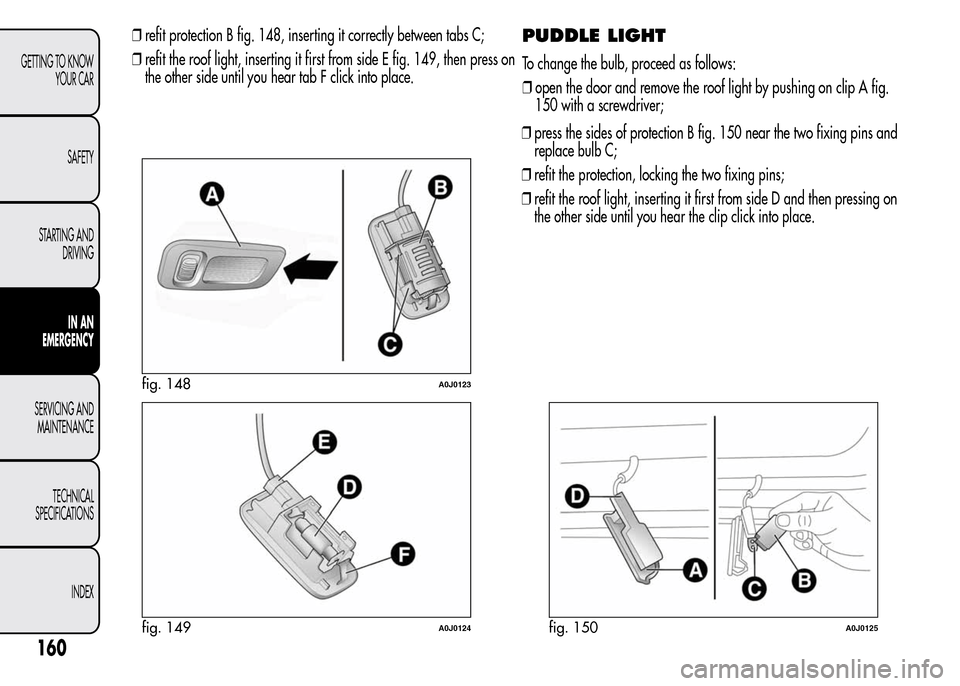
❒open the door and remove the roof light by pushing on clip A fig.
150 with a screwdriver;
❒press the sides of protection B fig. 150 near the two fixing pins and
replace bulb C;
❒refit the protection, locking the two fixing pins;
❒refit the roof light, inserting it first from side D and then pressing on
the other side until you hear the clip click into place.
fig. 148A0J0123
fig. 149A0J0124fig. 150A0J0125
160
GETTING TO KNOW
YOUR CAR
SAFETY
STARTING AND
DRIVING
IN AN
EMERGENCY
SERVICING AND
MAINTENANCE
TECHNICAL
SPECIFICATIONS
INDEX
❒refit protection B fig. 148, inserting it correctly between tabs C;
❒refit the roof light, inserting it first from side E fig. 149, then press on
the other side until you hear tab F click into place.
Page 171 of 280
LUGGAGE COMPARTMENT JUNCTIONUNIT
fig. 157
DEVICE PROTECTEDFUSE AMPS
Electric roof opening systemF1 20
Luggage compartment power socket F3 15
Front seat heaterF6 15
167
GETTING TO KNOW
YOUR CAR
SAFETY
STARTING AND
DRIVING
IN AN
EMERGENCY
SERVICING AND
MAINTENANCE
TECHNICAL
SPECIFICATIONS
INDEX
Page 190 of 280
AIR CLEANER/POLLEN
FILTER/DIESEL FILTER
Contact Alfa Romeo Authorized Services to replace the filters.
BATTERY
Battery F (see previous pages) does not require the electrolyte to be
topped up with distilled water. A periodic check carried out at Alfa
Romeo Authorized Services is, however, necessary to check efficiency.
REPLACING THE BATTERY
If necessary, replace the battery with another genuine battery with the
same specifications. Follow the battery manufacturer's instructions
for maintenance.
USEFUL ADVICE FOR EXTENDING THE
LIFE OF YOUR BATTERY
To avoid draining your battery rapidly and maintain its efficiency over
time, carefully observe the following instructions:
❒when you park the car, ensure that the doors, bonnet and flaps are
closed correctly, to prevent any roof lights from remaining on inside
the passenger compartment;
❒switch off all roof lights inside the car: the car is however equipped
with a system which switches all internal lights off automatically;
❒do not keep accessories (e.g. sound system, hazard lights, etc.)
switched on for a long time when the engine is not running;
❒before performing any operation on the electrical system, disconnect
the negative battery pole;
IMPORTANT If the charge level remains under 50% for a long time, the
battery is damaged by sulphation, reducing its capacity and
efficiency at start-up.
186
GETTING TO KNOW
YOUR CAR
SAFETY
STARTING AND
DRIVING
IN AN EMERGENCY
SERVICING AND
MAINTENANCE
TECHNICAL
SPECIFICATIONS
INDEX
The battery will also be more at risk of freezing (this can happen as
early as –10°C). Refer to “Storing the car” in “Starting and driving” if
the car is left parked for a long time.
If after having purchased your car you decide to add accessories
requiring permanent electrical power (alarm etc.) or accessories that
require large amounts of power, contact Alfa Romeo Authorized
Services. They can calculate the overall electrical requirement.
Page 197 of 280
BODY AND UNDERBODY WARRANTY
Your car is covered by warranty against perforation due to rust of any
original element of the structure or bodywork. For the general terms
of this warranty, refer to the Warranty Booklet.
PRESERVING THE BODYWORK
Paintwork
Touch up abrasions and scratches immediately to prevent the formation
of rust.
Maintenance of paintwork consists of washing the car: the frequency
depends on the conditions and environment where the car is used. For
example, it is advisable to wash the car more often in areas with
high levels of atmospheric pollution or salted roads.
On some versions the car may be equipped, on request, with an
exclusive opaque paint on the roof which, in order to be maintained
intact, requires special care: see the instructions below.
Avoid washing with rollers and/or brushes in washing
stations. Wash the car only by hand using neutral pH
detergents; dry it with a wet chamois leather. Abrasive
products and/or polishes should not be used for cleaning the car. Bird
droppings must be washed off immediately and thoroughly as the acid
they contain is particularly aggressive. Avoid (if at all possible)
parking the car under trees; remove vegetable resins immediately as,
when dried, it may only be possible to remove them with abrasive
products and/or polishes, which is highly inadvisable as they could
alter the typical opacity of the paint. Do not use pure screen washer
fluid for cleaning the front windscreen and rear window; dilute it min.
50% with water. Only use pure screen washer fluid when strictly
necessary due to outside temperature conditions.
To correctly wash the car, follow these instructions:
❒remove the aerial from the roof when using a carwash;
❒if high pressure jets or cleaners are used to wash the car, keep a
distance of at least 40 cm from the bodywork to avoid damage
or alteration. Bear in mind that a build up of water could cause
damage to the car in the long term;
❒wash the bodywork using a low pressure jet of water;
❒wipe a sponge with a slightly soapy solution over the bodywork,
frequently rinsing the sponge;
❒rinse well with water and dry with a jet of air or a chamois leather.
Dry the less visible parts (e.g. door frames, bonnet, headlight frames,
etc.) with special care, as water may stagnate more easily in these
areas. Do not wash the car after it has been left in the sun or with the
bonnet hot: this may alter the shine of the paintwork.
Exterior plastic parts must be cleaned in the same way as the rest of
the car.
Detergents pollute the environment. Only wash your car in
areas equipped to collect and treat wastewater from this
type of activity.
In order to preserve the aesthetic properties of the
paintwork, abrasive products and/or polishes should not
be used to clean the car.
193
GETTING TO KNOW
YOUR CAR
SAFETY
STARTING AND
DRIVING
IN AN EMERGENCY
SERVICING AND
MAINTENANCE
TECHNICAL
SPECIFICATIONS
INDEX
Page 222 of 280

WEIGHTS
Weights (kg)Turbo TwinAir 1.4 petrol
4-seater 5-seater 4-seater 5-seater
Unladen weight (with all fluids, fuel tank 90%
full and without optional equipment):1130 1130 1080 1080
Payload including the driver:
(***)480 560 480 560
Maximum permitted loads
(****)
– front axle: 950 950 850 850
– rear axle: 850 850 850 850
– total: 1610 1690 1560 1640
Towable loads
– trailer with brakes: 500 500 500 500
– trailer without brakes: 400 400 400 400
Maximum load on roof: 40 40 40 40
Maximum load on ball (trailer with brakes): 60 60 60 60
(***) If special equipment is fitted (sunroof, tow hitch, etc.) the unladen car weight increases, thus reducing the effective payload with respect tothe maximum permitted
load.
(****) Loads not to be exceeded. The user is responsible for arranging goods in the luggage compartment and/or load platform within the maximum permitted loads.
218
GETTING TO KNOW
YOUR CAR
SAFETY
STARTING AND
DRIVING
IN AN EMERGENCY
SERVICING AND
MAINTENANCE
TECHNICAL
SPECIFICATIONS
INDEX
Page 223 of 280
Weights (kg)1.4 Turbo MultiAir
4-seater 5-seater
Unladen weight (with all fluids, fuel tank 90% full and
without optional equipment):1135 / 1145
(*)1135 / 1145(*)
Payload including the driver:(**)480 560
Maximum permitted loads
(***)
– front axle: 950 950
– rear axle: 850 850
– total: 1625 1705
Towable loads
– trailer with brakes: 500 500
– trailer without brakes: 400 400
Maximum load on roof: 40 40
Maximum load on ball (trailer with brakes): 60 60
(*) 1.4 Turbo MultiAir 170 HP version
(**) If special equipment is fitted (sunroof, tow hitch, etc.) the unladen car weight increases, thus reducing the effective payload with respect to the maximum permitted
load.
(***) Loads not to be exceeded. The user is responsible for arranging goods in the luggage compartment and/or load platform within the maximum permitted loads.
219
GETTING TO KNOW
YOUR CAR
SAFETY
STARTING AND
DRIVING
IN AN EMERGENCY
SERVICING AND
MAINTENANCE
TECHNICAL
SPECIFICATIONS
INDEX
Page 224 of 280

Weights (kg)1.3 JTDM-21.6 JTDM
4-seater 5-seater 4-seater 5-seater
Unladen weight (with all fluids, fuel tank 90%
full and without optional equipment):1150 1150 1205 1205
Payload including the driver:
(*)480 560 480 560
Maximum permitted loads
(**)
– front axle: 950 950 1000 1000
– rear axle: 850 850 850 850
– total: 1630 1710 1685 1765
Towable loads
– trailer with brakes: 1000 1000 1000 1000
– trailer without brakes: 400 400 400 400
Maximum load on roof: 40 40 40 40
Maximum load on ball (trailer with brakes): 60 60 60 60
(*) If special equipment is fitted (sunroof, tow hitch, etc.) the unladen car weight increases, thus reducing the effective payload with respect to the maximum permitted
load.
(**) Loads not to be exceeded. The user is responsible for arranging goods in the luggage compartment and/or load platform within the maximum permitted loads.
220
GETTING TO KNOW
YOUR CAR
SAFETY
STARTING AND
DRIVING
IN AN EMERGENCY
SERVICING AND
MAINTENANCE
TECHNICAL
SPECIFICATIONS
INDEX
Page 231 of 280
FUEL CONSUMPTION
The fuel consumption figures given in the table below are determined on the basis of the type-approval tests laid down by specific European
Directives.
The procedures below are followed for measuring consumption:
❒urban cycle: cold starting followed by driving that simulates urban use of the car;
❒extra-urban cycle: frequent accelerating in all gears, simulating extra-urban use of the car: speed varies between 0 and 120 km/h;
❒combined fuel consumption: calculated with a weighting of approximately 37% of the urban cycle and 63% of the extra-urban cycle.
IMPORTANT The type of route, traffic conditions, weather conditions, driving style, general condition of the car, trim level/equipment/accessories,
use of the climate control, car load, presence of roof racks and other situations that adversely affect the aerodynamics or wind resistance lead to
different fuel consumption figures than those measured.
IMPORTANT The fuel consumption will get more regular only after having driven the first 3000 km.
227
GETTING TO KNOW
YOUR CAR
SAFETY
STARTING AND
DRIVING
IN AN EMERGENCY
SERVICING AND
MAINTENANCE
TECHNICAL
SPECIFICATIONS
INDEX