2016 Alfa Romeo MiTo ABS
[x] Cancel search: ABSPage 107 of 280

OPERATION WITH TRAILER
Parking sensor operation is deactivated automatically when the trailer
electric cable plug is fitted into the car tow hook socket. The sensors
are automatically enabled again when the trailer's cable plug is
removed.
The sensor must be free of mud, dirt, snow or ice in order
for the system to work. Be careful not to scratch or damage
the sensors while cleaning them. Avoid using dry, rough
or hard cloths. The sensors should be washed using clean water with
the addition of car shampoo if necessary. When using special washing
equipment such as high pressure jets or steam cleaning, clean the
sensors very quickly keeping the jet more than 10 cm away.
When repainting the bumpers or touching up paint in
the sensor area, contact Alfa Romeo Authorized
Services only. Incorrect paint application could affect
the operation of the parking sensors.
Parking manoeuvres however are always the driver’s
responsibility. When carrying out such manoeuvres,
always ensure that the manoeuvring area is free of
people (particularly children) and animals. The parking sensor is
designed to assist drivers, who must still never allow their
attention to lapse during potentially dangerous manoeuvres even
if performed at low speed.
GENERAL WARNINGS
During parking manoeuvres, pay the utmost attention to any obstacles
that could be located above or below the sensors.
Objects located near the rear of the car are not detected under certain
circumstances and could therefore cause damage to the car or be
damaged.
The following conditions may influence the performance of the parking
sensor system:
❒reduced sensor sensitivity and a reduction in the parking assistance
system performance could be due to the presence on the surface of
the sensor of: ice, snow, mud, thick paint
❒the sensors may detect a non-existent obstacle (echo interference)
due to mechanical interference, for example when washing the
car, in rain (strong wind), hail;
❒The signals sent by the sensors can also be altered by the presence
of ultrasonic systems (e.g. pneumatic brake systems or pneumatic
drills) near the vehicle.
❒sensor performance can also be influenced by the position of the
sensors. For example by a change in the ride setting (caused by
the wear of the shock absorbers, suspension), overloading the
vehicle and carrying out specific tuning operations that require the
vehicle to be lowered;
❒The detection of obstacles at the top part of the car may not be
guaranteed because the system detects obstacles that could cause an
impact with the car in the bottom part.
103
GETTING TO
KNOW YOUR CAR
SAFETY
STARTING AND
DRIVING
IN AN EMERGENCY
SERVICING AND
MAINTENANCE
TECHNICAL
SPECIFICATIONS
INDEX
Page 111 of 280

REFUELLING THE CAR
Stop the engine before refuelling.
PETROL ENGINES
Only use unleaded petrol. The petrol octane rating (RON) must not be
lower than 95. In order to prevent damage to the catalytic converter
never introduce even the smallest amount of leaded petrol, even in the
event of an emergency.
DIESEL ENGINES
Use only diesel fuel compliant with European specification EN590. The
use of other products or mixtures may damage the engine beyond
repair and consequently invalidate the warranty, due to the damage
caused.
Operation at low temperatures
If the outside temperature is very low, the diesel thickens due to the
formation of paraffin clots with consequent defective operation of the
fuel supply system.
In order to avoid these problems, different types of diesel fuel are
distributed according to the season: summer type, winter type and
arctic type (cold/mountain areas). If refuelling with diesel fuel whose
features are not suitable for the temperature of use, it is advisable
to mix TUTELA DIESEL ART additive with the fuel, in the proportions
shown on the container. Pour the additive into the tank before the fuel.
When using or parking the vehicle for a long time in the mountains
or cold areas, it is advisable to refuel using locally available fuel.
In this case, it is also advisable to keep the tank over 50% full.
FUEL TANK CAP
Opening
Open flap A fig. 88, pulling it outwards, hold cap B still, insert the
ignition key in the lock and turn it anticlockwise. Then turn the cap
anticlockwise and remove it.
The plug is provided with a loss prevention device C which secures it to
the flap, so it cannot be lost. Attach the cap to device D during
refuelling.
Closure
Fit the cap (complete with key) and turn it clockwise until it clicks once
or more. Then turn the key clockwise and extract it, then close the flap.
The sealing may cause a slight pressure increase in the tank. A little
breathing off, while slackening the cap is absolutely normal.
Do not place naked flames or lit cigarettes near to the
fuel filler: fire risk. Also, keep your face away from
this fuel inlet to avoid inhaling harmful fumes.
fig. 88A0J0327
107
GETTING TO
KNOW YOUR CAR
SAFETY
STARTING AND
DRIVING
IN AN EMERGENCY
SERVICING AND
MAINTENANCE
TECHNICAL
SPECIFICATIONS
INDEX
Page 136 of 280

WARMING UP THE ENGINE JUST
AFTER IT HAS STARTED
Proceed as follows:
❒drive off slowly, letting the engine turn at medium revs and without
accelerating abruptly;
❒do not demand maximum performance for the first few kilometres. It
is advisable to wait until the engine coolant temperature indicator
starts moving.
STOPPING THE ENGINE
Turn the ignition key to STOP while the engine is idling.
IMPORTANT After a demanding drive, before turning the engine off
you should allow it to idle to allow the temperature in the engine
compartment to decrease.
A quick burst on the accelerator before stopping the engine
serves absolutely no practical purpose. It wastes fuel and
is especially damaging to turbocharged engines.
PARKING
Switch off the engine and pull up the handbrake. Engage a gear (1stif
the car is facing uphill or reverse if it is facing downhill) and leave
the wheels steered to one side.
If the car is parked on a steep slope block the wheels with a wedge or
stone. Always remove the ignition key when leaving the car.
Never leave children unattended in the car. Always
remove the key from the ignition when leaving the car
and take it with you.
132
GETTING TO KNOW
YOUR CAR
SAFETY
STARTING AND
DRIVING
IN AN EMERGENCY
SERVICING AND
MAINTENANCE
TECHNICAL
SPECIFICATIONS
INDEX
Page 141 of 280

INSTALLING A TOW HOOK
Contact Alfa Romeo Authorised Services to install a tow hook.
The ABS with which the car is equipped will not control
the braking system of the trailer. Particular caution is
therefore required on slippery roads.
Do not, under any circumstances, modify the vehicle's
braking system to control the trailer breaking system.
The towing breaking system must be completely
independent of the vehicle's hydraulic system.
SNOW TYRES
Use snow tyres of the same size as the normal tyres provided with the
car: Alfa Romeo Authorized Services will be able to advise you on
the most appropriate tyre to use.
Only use these tyres in the event of ice or snow on the roads.
For the type of snow tyre to be used, inflation pressures and the
specifications, strictly follow the instructions given in the "Wheels"
paragraph in the "Technical specifications" section.
The winter performance of these tyres is considerably reduced when
the tread thickness is less than 4 mm. Replace them in this case.
Due to their specific features, the performance of snow tyres is much
lower than that of normal types in normal conditions or long motorway
stretches. Their usage should therefore be restricted in accordance
with their type approval.
All four tyres should be the same (brand and track) to ensure greater
safety when driving and braking and good driveability. Remember
that it is inadvisable to change the rotation direction of tyres.
The maximum speed for snow tyres marked “Q” is
160 km/h, while it is 190 km/h for “T” tyres and 210
km/h for "H" tyres. The highway code speed limits
must however always be complied with.
137
GETTING TO KNOW
YOUR CAR
SAFETY
STARTING AND
DRIVING
IN AN EMERGENCY
SERVICING AND
MAINTENANCE
TECHNICAL
SPECIFICATIONS
INDEX
Page 163 of 280
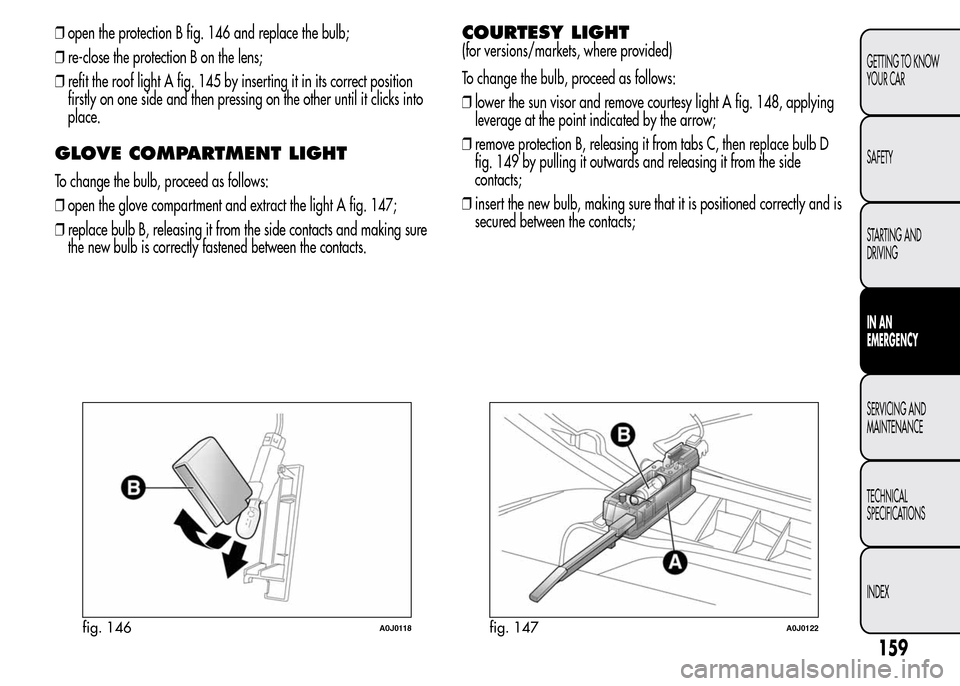
❒open the protection B fig. 146 and replace the bulb;
❒re-close the protection B on the lens;
❒refit the roof light A fig. 145 by inserting it in its correct position
firstly on one side and then pressing on the other until it clicks into
place.
GLOVE COMPARTMENT LIGHT
To change the bulb, proceed as follows:
❒open the glove compartment and extract the light A fig. 147;
❒replace bulb B, releasing it from the side contacts and making sure
the new bulb is correctly fastened between the contacts.
COURTESY LIGHT
(for versions/markets, where provided)
To change the bulb, proceed as follows:
❒lower the sun visor and remove courtesy light A fig. 148, applying
leverage at the point indicated by the arrow;
❒remove protection B, releasing it from tabs C, then replace bulb D
fig. 149 by pulling it outwards and releasing it from the side
contacts;
❒insert the new bulb, making sure that it is positioned correctly and is
secured between the contacts;
fig. 146A0J0118fig. 147A0J0122
159
GETTING TO KNOW
YOUR CAR
SAFETY
STARTING AND
DRIVING
IN AN
EMERGENCY
SERVICING AND
MAINTENANCE
TECHNICAL
SPECIFICATIONS
INDEX
Page 164 of 280
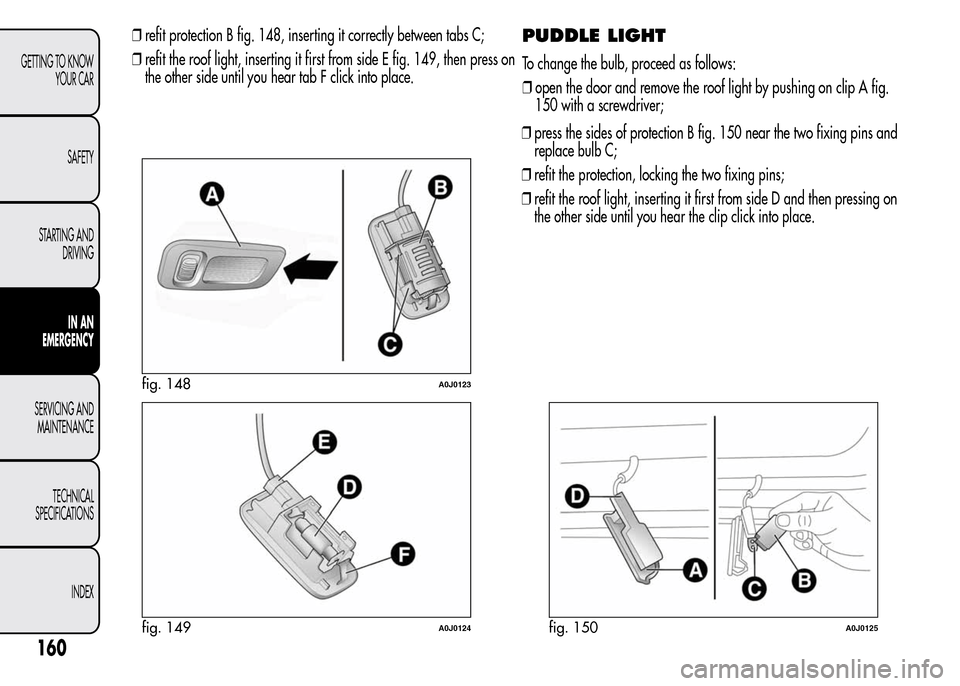
PUDDLE LIGHT
To change the bulb, proceed as follows:
❒open the door and remove the roof light by pushing on clip A fig.
150 with a screwdriver;
❒press the sides of protection B fig. 150 near the two fixing pins and
replace bulb C;
❒refit the protection, locking the two fixing pins;
❒refit the roof light, inserting it first from side D and then pressing on
the other side until you hear the clip click into place.
fig. 148A0J0123
fig. 149A0J0124fig. 150A0J0125
160
GETTING TO KNOW
YOUR CAR
SAFETY
STARTING AND
DRIVING
IN AN
EMERGENCY
SERVICING AND
MAINTENANCE
TECHNICAL
SPECIFICATIONS
INDEX
❒refit protection B fig. 148, inserting it correctly between tabs C;
❒refit the roof light, inserting it first from side E fig. 149, then press on
the other side until you hear tab F click into place.
Page 167 of 280

Dashboard fuse box
To access the fuses fig. 155, lower lid A fig. 154, grip cover B with one
hand in the area shown in the figure and remove it in the direction
shown by the arrow, in order to release first the inner retainers C and
then the tabs D.
fig. 154A0J0334fig. 155A0J0205
163
GETTING TO KNOW
YOUR CAR
SAFETY
STARTING AND
DRIVING
IN AN
EMERGENCY
SERVICING AND
MAINTENANCE
TECHNICAL
SPECIFICATIONS
INDEX
Page 199 of 280

LEATHER SEATS
(for versions/markets, where provided)
Remove the dry dirt with a buckskin or slightly damp cloth, without
exercising too much pressure. Remove liquid or oil stains using a dry
absorbent cloth, without rubbing. Then clean with a soft cloth or
buckskin cloth dampened with water and neutral soap. If the stain
persists, use specific products and observe the instructions carefully.
IMPORTANT Never use alcohol. Make sure that the cleaning products
used contain no alcohol or alcohol derivatives, even in small quantities.
PLASTIC AND COATED PARTS
Clean interior plastic parts with a damp cloth (if possible made from
microfibre), and a solution of water and neutral, non-abrasive
detergent. To clean oily or persistent stains, use specific products free
from solvents and designed to maintain the original appearance
and colour of the components.Remove any dust using a microfibre cloth, if necessary moistened with
water. The use of paper tissues is not recommended as these may
leave residues.
Never use alcohol, petrols and derivatives to clean the
dashboard and instrument panel lens.
LEATHER PARTS
(for versions/markets, where provided)
Use only water and neutral soap to clean these parts. Never use
alcohol or alcohol-based products. Before using a specific product for
cleaning interiors, make sure that it does not contain alcohol and/or
alcohol based substances.
195
GETTING TO KNOW
YOUR CAR
SAFETY
STARTING AND
DRIVING
IN AN EMERGENCY
SERVICING AND
MAINTENANCE
TECHNICAL
SPECIFICATIONS
INDEX