2016 Alfa Romeo Giulia lights
[x] Cancel search: lightsPage 77 of 204
the system and must not be regarded as
faults.
The system has been designed for
road use only. If the vehicle is driven on a
track, the system must be deactivated to
avoid unnecessary warnings. Automatic
deactivation is signalled by the dedicated
warning light/symbol switching on in the
instrument panel (see the instructions in
the "Warning lights and messages"
paragraph, "Knowing the instrument
panel" chapter).
TPMS (Tyre Pressure Monitoring
System)
60) 61) 62) 63) 64) 65) 66)
28)
The car is equipped with Tyre Pressure
Monitoring System (TPMS), which can
advise the driver in the event of
insufficient tyre pressure on the basis of
the pressure when cold indicated in the
"Technical specifications" chapter.
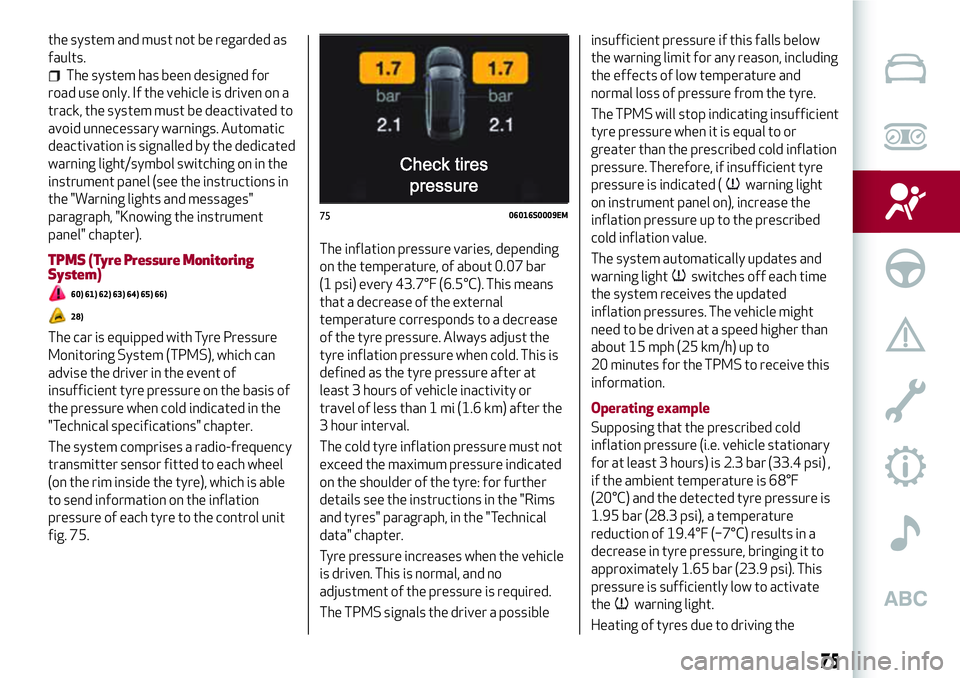
The system comprises a radio-frequency
transmitter sensor fitted to each wheel
(on the rim inside the tyre), which is able
to send information on the inflation
pressure of each tyre to the control unit
fig. 75.The inflation pressure varies, depending
on the temperature, of about 0.07 bar
(1 psi) every 43.7°F (6.5°C). This means
that a decrease of the external
temperature corresponds to a decrease
of the tyre pressure. Always adjust the
tyre inflation pressure when cold. This is
defined as the tyre pressure after at
least 3 hours of vehicle inactivity or
travel of less than 1 mi (1.6 km) after the
3 hour interval.
The cold tyre inflation pressure must not
exceed the maximum pressure indicated
on the shoulder of the tyre: for further
details see the instructions in the "Rims
and tyres" paragraph, in the "Technical
data" chapter.
Tyre pressure increases when the vehicle
is driven. This is normal, and no
adjustment of the pressure is required.
The TPMS signals the driver a possibleinsufficient pressure if this falls below
the warning limit for any reason, including
the effects of low temperature and
normal loss of pressure from the tyre.
The TPMS will stop indicating insufficient
tyre pressure when it is equal to or
greater than the prescribed cold inflation
pressure. Therefore, if insufficient tyre
pressure is indicated (
warning light
on instrument panel on), increase the
inflation pressure up to the prescribed
cold inflation value.
The system automatically updates and
warning light
switches off each time
the system receives the updated
inflation pressures. The vehicle might
need to be driven at a speed higher than
about 15 mph (25 km/h) up to
20 minutes for the TPMS to receive this
information.
Operating example
Supposing that the prescribed cold
inflation pressure (i.e. vehicle stationary
for at least 3 hours) is 2.3 bar (33.4 psi) ,
if the ambient temperature is 68°F
(20°C) and the detected tyre pressure is
1.95 bar (28.3 psi), a temperature
reduction of 19.4°F (−7°C) results in a
decrease in tyre pressure, bringing it to
approximately 1.65 bar (23.9 psi). This
pressure is sufficiently low to activate
the
warning light.
Heating of tyres due to driving the
7506016S0009EM
75
Page 78 of 204

vehicle may increase tyre pressure up to
approximately 1.95 bar (28.3 psi), but
the
warning light will stay on. In this
situation, the warning light will switch off
only after the tyres are inflated to the
prescribed cold pressure value for the
car.
IMPORTANT The TPMS is designed for
original tyres and wheels. The prescribed
pressures and consequent alarm
thresholds set in the TPMS are based on
the dimensions of the tyres fitted on the
vehicle. Using spare wheels of a size, type
and/or design different from the original
ones may cause an irregular operation of
the system and damage the sensors.
Aftermarket fitted wheels may damage
the sensors. Using aftermarket tyre
sealants may damage the Tyre Pressure
Monitoring System (TPMS) sensor. If
aftermarket tyre sealant is used it is
recommended to go to an Alfa Romeo
Dealership to have the sensors checked.
After checking or adjusting the tyre
pressure, always refit the valve cap to
prevent humidity and dirt from entering,
these may damage the Tyre Pressure
Monitoring System sensor.
INSUFFICIENT TYRE PRESSURE
INDICATION
If an insufficient pressure value is
detected on one or more tyres, the
warning light on the instrument panelswitches on and the dedicated messages
are shown on the display. The system also
highlights the tyre or tyres with
insufficient pressure graphically. An
acoustic signal is also emitted.
In this case, stop the car, check the
inflation pressure of each tyre and inflate
them to the correct cold inflation
pressure value, shown on the display or in
the dedicated TPMS menu.
TPMS TEMPORARILY DISABLED
TPMS check message
If a system failure is present, the
warning light flashes for about
75 seconds and then stays on solid. An
acoustic signal is also emitted.
A dedicated message and dashes "– –"
instead of the pressure value are shown
on the display, to indicate that detection
is impossible.
When the ignition device is set to STOP
and then back to ON, the indication
sequence repeats provided that the
failure is still resent.
The
warning light switches off when
the failure condition disappears and the
pressure value is displayed again in place
of the dashes.
A fault in the system could occur in the
following cases:
strong radio-frequency noises could
hinder the regular operation of the TPMS.This condition will be indicated by a
dedicated message on the display. The
message will disappear automatically as
soon as the radio-frequency interference
ceases to affect the system;
aftermarket application of coloured
films on the windows that interfere with
the radio waves emitted by the TPMS;
accumulation of layers of snow or ice
on the wheels or the wheel arches;
using snow chains;
use of rim/tyre assemblies without
sensors for TPMS;
After the punctured tyre has been
repaired with the original tyre sealant
contained in the TireKit, the previous
condition must be restored, so that the
warning light is off during normal
driving.
TPMS deactivation
The TPMS can be deactivated by
replacing the wheels equipped with
TPMS with others that are not (e.g. upon
replacement of the wheel assemblies in
winter) and if compatible with the
country of purchase that makes this
possibility available. Then drive for at
least 20 minutes at a speed higher than
about 15 mph (25 km/h).
The TPMS will emit an acoustic warning,
the
warning light will flash for about
75 seconds, then will stay on constantly
and the instrument panel will display the
76
SAFETY
Page 79 of 204

"TPMS check" message with some
dashes (– –) instead of the pressure
values.
From the following ignition cycle, the
TPMS will not emit any acoustic signal
and the display will not show the
message "TPMS check", but the dashes
will be still displayed instead of the
pressure value.
WARNING
54)The system is an aid for vehicle driving,
it DOES NOT warn the driver about incoming
vehicles outside of the detection areas. The
driver must always maintain a sufficient
level of attention to the traffic and road
conditions and for controlling the trajectory
of the vehicle.
55)The Forward Collision Warning (FCW)
system is automatically deactivated when
RACE mode is selected.
56)The system is an aid for the driver, who
must always pay full attention while driving.
The responsibility always rests with the
driver, who must take into account the
traffic conditions in order to drive in
complete safety. The driver must always
maintain a safe distance from the vehicle in
front.
57)If the driver depresses the brake pedal
fully or carries out a fast steering during
system operation, the automatic braking
function may stop (e.g. to allow a possible
manoeuvre to avoid the obstacle).58)The system intervenes on vehicles
travelling in the same lane. People, animals
and things (e.g. pushchairs) are not taken
into consideration.
59)If the car must be placed on a roller
bench for maintenance interventions or if it
is washed in an automatic roller washing
tunnel with an obstacle in the front part (e.g.
another car, a wall or another obstacle), the
system may detect its presence and
activate. In this case the system must be
deactivated through the settings of the
Connect system.
60)The presence of the TPMS does not
permit the driver to neglect regular checks
of the tyre pressure, including for the spare
tyre, and correct maintenance: the system is
not used to signalling a possible tyre fault.
61)Tyre pressure must be checked with
tyres rested and cold. Should it become
necessary for whatever reason to check
pressure with warm tyres, do not reduce
pressure even though it is higher than the
prescribed value. Repeat the check when the
tyres are cold.
62)Should one or more wheels be fitted
without sensors, the system will no longer be
available and a warning message will be
shown on the display, until wheels with
sensors are fitted again.
63)The TPMS cannot indicate sudden tyre
pressure drops (e.g. if a tyre bursts). In this
case, stop the vehicle, braking with caution
and avoiding abrupt steering.
64)Changes in outside temperature may
cause tyre pressures to vary. The system
may temporarily indicate insufficient
pressure. In this case, check the tyre
pressure when cold and, if necessary,
restore the inflation values.65)Replacing standard tyres with winter
tyres and vice versa requires TPMS system
adjustment that must only be performed by
Alfa Romeo Dealerships.
66)When a tyre is removed, it is advisable
to replace the rubber valve seal as well:
contact an Alfa Romeo Dealership. The
fitting/removal of the tyres and/or rims
require special care. To avoid damaging or
fitting the sensors incorrectly, tyre and/or
rim fitting/removal operations should only
be carried out by specialised staff. Contact
an Alfa Romeo Dealership.IMPORTANT
19)The system may have limited or absent
operation due to weather conditions such as:
heavy rain, hail, thick fog, heavy snow.
20)The section of the bumper before the
sensor must not be covered with adhesives,
auxiliary headlights or any other object.
21)System intervention might be
unexpected or delayed when other vehicles
transport loads projecting from the side,
above or from the rear, with respect to the
normal size of the vehicle.
22)Operation can be adversely affected by
any structural change made to the vehicle,
such as a modification to the front geometry,
tyre change, or a heavier load than the
standard load of the vehicle.
23)Incorrect repairs made on the front part
of the vehicle (e.g. bumper, chassis) may alter
the position of the radar sensor, and
adversely affect its operation. Go to an Alfa
Romeo Dealership for any operation of this
type.
77
Page 82 of 204
SBA (Seat Belt Alert)SYSTEM
The SBA system warns the passengers of
the front and rear (where provided) seats
if their seat belt is not fastened.
The system signals unfastened seat belts
with visual warnings (warning lights on in
the instrument panel and icons on the
display) and an acoustic signal (see the
following paragraphs).
NOTE Contact an Alfa Romeo Dealership
to deactivate the acoustic warning. The
acoustic warning can be reactivated at
any time through the Connect system.
FRONT SEAT BELT WARNING LIGHT
BEHAVIOUR
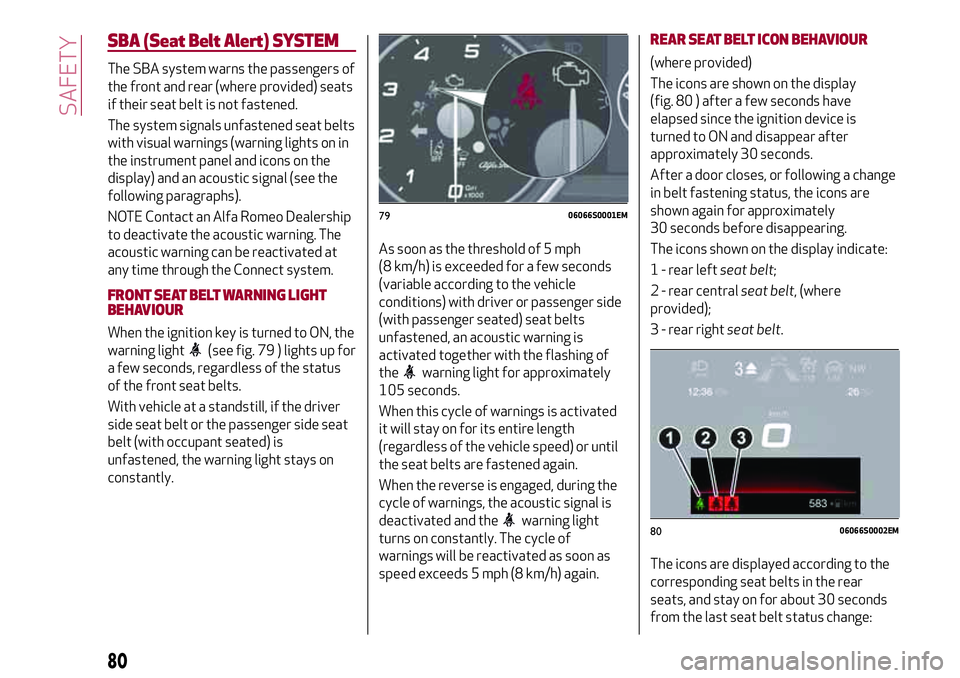
When the ignition key is turned to ON, the
warning light
(see fig. 79 ) lights up for
a few seconds, regardless of the status
of the front seat belts.
With vehicle at a standstill, if the driver
side seat belt or the passenger side seat
belt (with occupant seated) is
unfastened, the warning light stays on
constantly.As soon as the threshold of 5 mph
(8 km/h) is exceeded for a few seconds
(variable according to the vehicle
conditions) with driver or passenger side
(with passenger seated) seat belts
unfastened, an acoustic warning is
activated together with the flashing of
the
warning light for approximately
105 seconds.
When this cycle of warnings is activated
it will stay on for its entire length
(regardless of the vehicle speed) or until
the seat belts are fastened again.
When the reverse is engaged, during the
cycle of warnings, the acoustic signal is
deactivated and the
warning light
turns on constantly. The cycle of
warnings will be reactivated as soon as
speed exceeds 5 mph (8 km/h) again.
REAR SEAT BELT ICON BEHAVIOUR
(where provided)
The icons are shown on the display
(fig. 80 ) after a few seconds have
elapsed since the ignition device is
turned to ON and disappear after
approximately 30 seconds.
After a door closes, or following a change
in belt fastening status, the icons are
shown again for approximately
30 seconds before disappearing.
The icons shown on the display indicate:
1 - rear leftseat belt;
2 - rear centralseat belt, (where
provided);
3 - rear rightseat belt.
The icons are displayed according to the
corresponding seat belts in the rear
seats, and stay on for about 30 seconds
from the last seat belt status change:
7906066S0001EM
8006066S0002EM
80
SAFETY
Page 83 of 204

if the seat belt is fastenedthe
corresponding icon will be green;
if the seat belt is unfastenedthe
corresponding icon will be red.
If a rear seat belt is unfastened, an
acoustic warning (3 "beeps") will be
activated along with the relevant icon
lighting up in the display.
Furthermore the icons will light up again
for 30 seconds each time one of the rear
doors is closed.
The visual indication (flashing red) will
start and stop independently for each
warning light if several seat belts are
unfastened.
The icon will turn green after the
corresponding seat belt has been
fastened.
The rear seat icons will go out, regardless
of the state of the belt (red icon or green
icon), approximately 30 seconds after
the last signal.
IMPORTANT NOTES
As far as the rear seats are concerned,
the SBR system will only indicate
whether the seat belts are unfastened
(red icon) or fastened (green icon), not
the presence of any passengers.
The warning lights/icons all stay off if all
seat belts (front and rear) are fastened
when the ignition device is set to ON.
For the rear seats, the icons will activatea few seconds after the ignition device
has been turned to ON, regardless of the
status of the seat belts (even if the seat
belts are all fastened).
All the warning lights/icons will come on
when at least one belt changes from
fastened to unfastened status or vice
versa.
PRETENSIONERS
The vehicle is equipped with front and
rear lateral seat belt pretensioners,
which draw back the seat belts by several
centimetres in the event of a strong
frontal impact. This guarantees the
perfect adherence of the seat belts to
the occupant's bodies before the
retention action begins.
It is evident that the pretensioners have
been activated when the belt withdraws
toward the retractor.
This car is also equipped with a second
pretensioner on the front seat belts
(fitted in the kick plate area). Its
activation is signalled by the shortening
of the metal cable.
A slight discharge of smoke may be
produced during the activation of the
pretensioner which is not harmful and
does not involve any fire hazard.
The pretensioner does not require any
maintenance or lubrication: any changes
to its original conditions will invalidate its
efficiency.
If, due to unusual natural events (floods,
sea storms, etc.), the device has been
affected by water and/or mud, contact an
Alfa Romeo Dealership to have it
replaced.
IMPORTANT To obtain the highest
degree of protection from the action of
81
Page 106 of 204

may be detected when engaging the
electric parking brake with the brake
pedal pressed.
With the electric parking brake engaged,
the warning light
on the instrument
panel and the LED on the switch
fig. 101 turn on.
IMPORTANTWith the Electronic Parking
Brake failure warning light on, some
functions of the electric parking brake are
deactivated. In this case the driver is
responsible for brake activation and vehicle
parking in complete safety conditions.
If, under exceptional circumstances, the
use of the brake is required with the
vehicle in motion, keep the switch on the
central tunnel pulled as long as the brake
action is necessary.
The
warning light may switch on with
the hydraulic system temporarily
unavailable; in this case braking is
controlled by the motors.
The brake lights (stop) will also
automatically switch on in the same way
as for normal braking with the use of the
brake pedal.
Release the switch on the central tunnel
to stop the braking action with the
vehicle in motion.
If, through this procedure, the vehicle is
braked until a speed below 2 mph (3 km/h)is reached and the switch is kept pulled, the
parking brake will definitively engage.
IMPORTANTDriving the vehicle with the
electric parking brake engaged, or using it
several times to slow down the vehicle, may
cause severe damage to the braking system.
Disengaging the electric parking brake
manually
In order to manually release the parking
brake, the ignition device should be at ON
position. Moreover, you need to press the
brake pedal, then press the switch on the
central tunnel briefly.
Noise may be heard from the rear of the
vehicle and a slight movement of the
brake pedal may be detected during
disengagement.
After disengaging the electric parking
brake, the
warning light on the
instrument panel and the LED on the
fig. 101 switch turn off.
If the
warning light on the instrument
panel remains on with the electric parking
brake disengaged, this indicates a fault:
in this case contact an Alfa Romeo
Dealership.
IMPORTANT Never use gear position P
(Park) instead of the electric parking
brake. Always engage the electric
parking brake when parking the vehicle to
prevent injury or damage caused by the
unexpected movement of the vehicle.ELECTRIC PARKING BRAKE OPERATING
MODES
The electric parking brake may operate
as follows:
"Dynamic operating mode": this mode
is activated by pulling the switch
repeatedly whilst driving;
"Static engagement and release
mode": with the vehicle stationary, the
electric parking brake can be activated
by pulling the switch on the central tunnel
once. On the other hand, press the switch
and the brake pedal at the same time to
disengage the brake;
"Drive Away Release": (where
provided) the electric parking brake will
automatically disengage with the driver
side seat belt fastened and the detection
of an action performed by the driver to
move the vehicle (forward gear or
reverse gear);
"Safe Hold": if the vehicle speed is
lower than 2 mph (3 km/h), on vehicles
with automatic transmission, the gear
lever is not in P (Park) position and the
driver's intention of leaving the vehicle is
detected, the electric parking brake will
automatically engage to hold the vehicle
in safety conditions;
"Auto Park Brake": if the vehicle speed
is below 2 mph (3 km/h), the electric
parking break will automatically engage
when the gear lever is in P (Park) position.
The LED on the switch located on the
104
STARTING AND DRIVING
Page 108 of 204
for at least 2 seconds with the clutch
pedal fully pressed before engaging
reverse to prevent damage to the gears
and grating.
IMPORTANT The clutch pedal should be
used only for gear changes. Do not drive
with your foot resting on the clutch pedal,
however lightly. In some circumstances,
the electronic clutch control could cut in
by interpreting the incorrect driving style
as a fault.
WARNING
106)Depress the clutch pedal fully to
change gear correctly. It is therefore
essential that there is nothing under the
pedals: make sure the mats are lying flat and
do not get in the way of the pedals.
IMPORTANT
34)Do not drive with your hand resting on
the gear lever as the force exerted, even if
slight, could lead over time to premature
wear of the gearbox internal components.
AUTOMATIC TRANSMISSION
The vehicle can be equipped with a
8-speed automatic transmission.
The gearbox/transmission can function in
two operating modes: "Automatic" or
"Sequential".
GEAR LEVER
107) 108) 109)
35) 36)
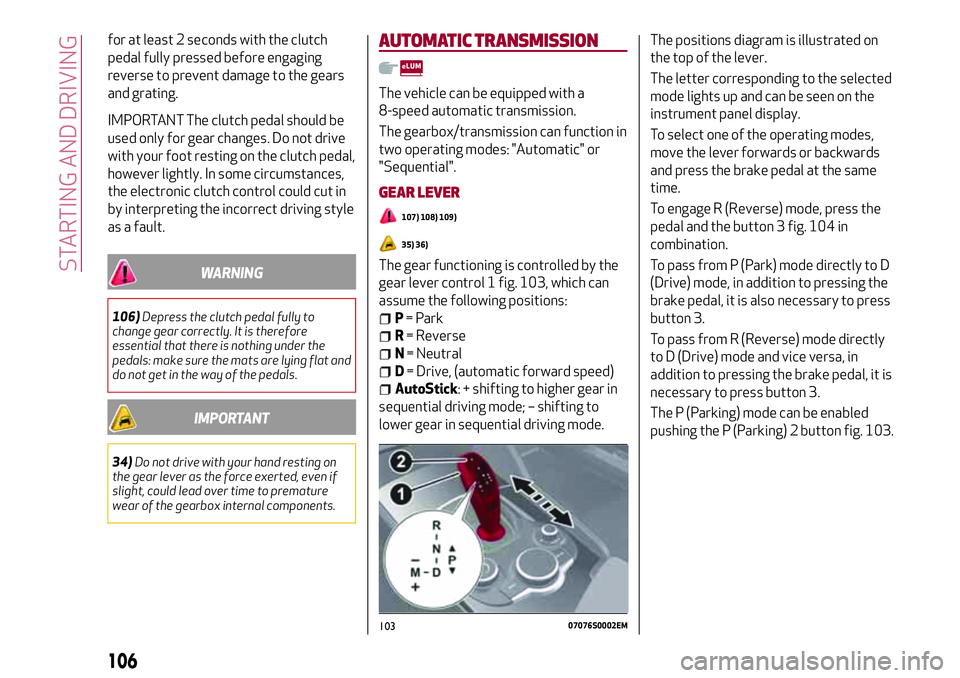
The gear functioning is controlled by the
gear lever control 1 fig. 103, which can
assume the following positions:
P= Park
R= Reverse
N= Neutral
D= Drive, (automatic forward speed)
AutoStick: + shifting to higher gear in
sequential driving mode; – shifting to
lower gear in sequential driving mode.The positions diagram is illustrated on
the top of the lever.
The letter corresponding to the selected
mode lights up and can be seen on the
instrument panel display.
To select one of the operating modes,
move the lever forwards or backwards
and press the brake pedal at the same
time.
To engage R (Reverse) mode, press the
pedal and the button 3 fig. 104 in
combination.
To pass from P (Park) mode directly to D
(Drive) mode, in addition to pressing the
brake pedal, it is also necessary to press
button 3.
To pass from R (Reverse) mode directly
to D (Drive) mode and vice versa, in
addition to pressing the brake pedal, it is
necessary to press button 3.
The P (Parking) mode can be enabled
pushing the P (Parking) 2 button fig. 103.
10307076S0002EM
106
STARTING AND DRIVING
Page 123 of 204

A punctured tyre or a burnt-out bulb?
At times, a problem may interfere with our journey.
The pages on emergencies can help you to deal with critical
situations independently and with calm.
In an emergency we recommend that you call the freephone
number found in the Warranty Booklet.
It is also possible to call the national or international universal
freephone number to search for the nearest Alfa Romeo
Dealership.
IN AN EMERGENCY
HAZARD WARNING LIGHTS.......................122
REPLACING A BULB............................122
REPLACING FUSES . ...........................127
TIRE REPAIR KIT . .............................132
EMERGENCY STARTING.........................134
FUEL CUT-OFF SYSTEM.........................137
BROKEN-DOWN VEHICLE TOWING . . ................138
TOWING THE VEHICLE ..........................138