2016 Alfa Romeo Giulia ESP
[x] Cancel search: ESPPage 120 of 204
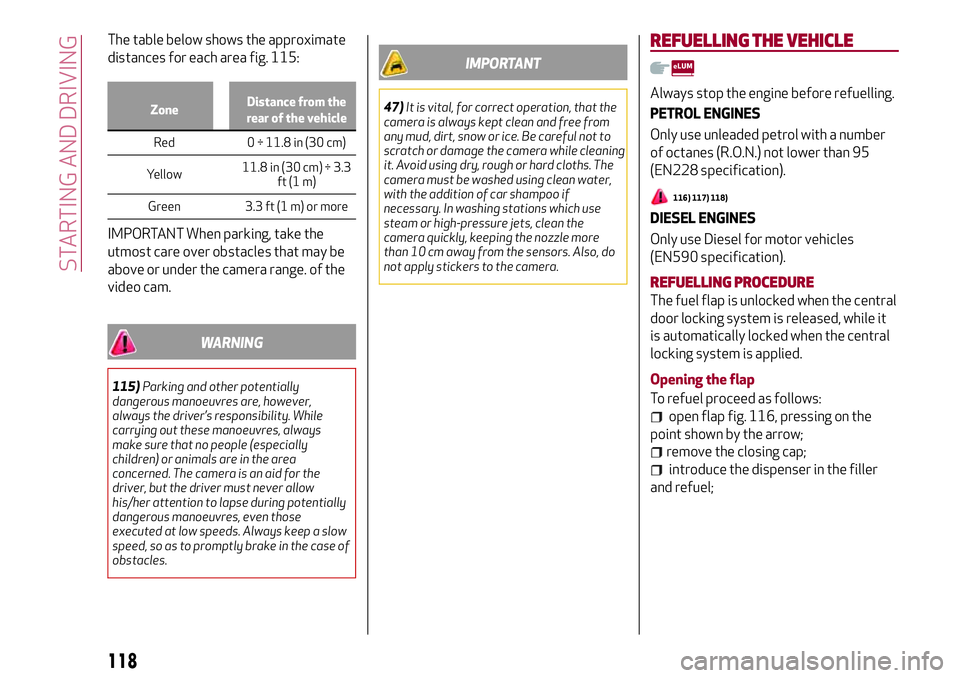
The table below shows the approximate
distances for each area fig. 115:
ZoneDistance from the
rear of the vehicle
Red 0 ÷ 11.8 in (30 cm)
Yellow11.8 in
(30 cm) ÷ 3.3
ft (1 m)
Green 3.3 ft (1 m) or more
IMPORTANT When parking, take the
utmost care over obstacles that may be
above or under the camera range. of the
video cam.
WARNING
115)Parking and other potentially
dangerous manoeuvres are, however,
always the driver’s responsibility. While
carrying out these manoeuvres, always
make sure that no people (especially
children) or animals are in the area
concerned. The camera is an aid for the
driver, but the driver must never allow
his/her attention to lapse during potentially
dangerous manoeuvres, even those
executed at low speeds. Always keep a slow
speed, so as to promptly brake in the case of
obstacles.
IMPORTANT
47)It is vital, for correct operation, that the
camera is always kept clean and free from
any mud, dirt, snow or ice. Be careful not to
scratch or damage the camera while cleaning
it. Avoid using dry, rough or hard cloths. The
camera must be washed using clean water,
with the addition of car shampoo if
necessary. In washing stations which use
steam or high-pressure jets, clean the
camera quickly, keeping the nozzle more
than 10 cm away from the sensors. Also, do
not apply stickers to the camera.
REFUELLING THE VEHICLE
Always stop the engine before refuelling.
PETROL ENGINES
Only use unleaded petrol with a number
of octanes (R.O.N.) not lower than 95
(EN228 specification).
116) 117) 118)
DIESEL ENGINES
Only use Diesel for motor vehicles
(EN590 specification).
REFUELLING PROCEDURE
The fuel flap is unlocked when the central
door locking system is released, while it
is automatically locked when the central
locking system is applied.
Opening the flap
To refuel proceed as follows:
open flap fig. 116, pressing on the
point shown by the arrow;
remove the closing cap;
introduce the dispenser in the filler
and refuel;
118
STARTING AND DRIVING
Page 124 of 204

HAZARD WARNING LIGHTS
CONTROL
48)
Press the fig. 118 button to switch the
hazard warning lights on/off.
When the hazard warning lights are on,
the
andwarning lights flash.
When you need to move away from the
vehicle to look for help, the hazard
warning lights will continue flashing even
if the ignition device is in the STOP
position.
IMPORTANT The use of hazard warning
lights is governed by the highway code of
the country you are driving in: comply
with legal requirements.
Emergency braking
The hazard lights are switched on and
warning lights
andappear on the
instrument panel in case of emergency
braking and according to the mode
selected by the “Alfa DNA™” selector.
When the "Alfa DNA™" selector is in
position "n" or "a", the activation
threshold of the hazard warning lights is
higher; on the other hand, in position "d"
the sensitivity of the activation is lower
than that in the "n" and "a" modes.
The lights switch off automatically when
emergency braking ceases.
IMPORTANT
48)A prolonged use of the hazard warning
lights may discharge the battery.
REPLACING A BULB
119) 120) 121)
49)
GENERAL INSTRUCTIONSBefore replacing a bulb check the
contacts for oxidation;
replace blown bulbs with others of the
same type and power;
after replacing a headlight bulb,
always check its alignment;
when a light is not working, check that
the corresponding fuse is intact before
changing the bulb. For the location of
fuses, refer to the paragraph "If a fuse
blows" in this chapter.
IMPORTANT In some particular climate
conditions such as low temperature,
humidity or after washing the car, a thin
condensation layer may form on the
internal surfaces of the front and rear
headlights. This phenomenon will
disappear after switching on the
headlights
11808016S0001EM
122
IN AN EMERGENCY
Page 129 of 204

pull out the bulb-bulb holder unit from
the headlight body by turning it
anticlockwise fig. 129;
remove the bulb by sliding it off the
bulb holder
install the new bulb, making sure it is
correctly inserted in the bulb holder;
then insert the bulb, bulb holder and
connector assembly in the housing on the
headlight body and turn it clockwise,
making sure that it is locked correctly;
refit the cover by tightening the two
fixing screws.
Front light cluster with main
beam/dipped beam Xenon gas
discharge headlights
To replace the bulbs of the main beam
headlights/dipped headlights contact an
Alfa Romeo Dealership
WARNING
119)Before replacing the bulb, wait for the
exhaust ducts to cool down: DANGER OF
SCALDING!
120)Modifications or repairs to the electric
system that are not carried out properly or
do not take the system technical
specifications into account can cause
malfunctions leading to the risk of fire.
121)Halogen bulbs contain pressurised gas,
in the case of breakage they may burst
causing glass fragments to be projected
outwards.
IMPORTANT
49)Halogen bulbs must be handled holding
the metallic part only. Touching the
transparent part of the bulb with your
fingers may reduce the intensity of the
emitted light and even reduce the lifespan of
the bulb. In the event of accidental contact,
wipe the bulb with a cloth moistened with
alcohol and let the bulb dry.
REPLACING FUSES
INTRODUCTION
122) 123) 124) 125) 126)
50) 51)
Fuses protect the electrical system: they
intervene (blow) in the event of a failure
or improper action on the system.
Fuse extracting pliers
To replace a fuse, use the pliers hooked
to the boot fusebox cover fig. 130.
Grab the pliers from the upper tabs,
press them and extract the pliers pulling
upwards.
The pliers fig. 131 have two different
ends, specifically designed to remove the
different types of fuses present in the
vehicle.
1: MINI fuse;
2: J-CASE fuse.
12808026S0021EM
12908026S0022EM
13008036S0053EM
127
Page 130 of 204

After use, refit the pliers in position,
proceeding as follows:
grasp the pliers from the upper tabs;
press the pliers in their housing,
pushing downwards, until they click into
place.
FUSE LOCATION
The fuses, which can be replaced by the
user, are grouped in two boxes below the
passenger side foot board and inside the
boot.
CONTROL UNIT UNDER PASSENGER
SIDE FOOTBOARD
To access the fuses, proceed as follows:
lift the upper end of the footboard 1
fig. 132 on the passenger side, pulling it
to release the 2 buttons;
remove the panel 2 fig. 133,
extracting it downward, after unscrewing
the two fixing hooks;
the fuses are freely accessible on the
control unit.
The number identifying the electrical
component corresponding to each fuse is
shown on the control unit cover.
LUGGAGE COMPARTMENT FUSE BOX
To access the fuses, proceed as follows:
lift the load carrying plane;
remove the control unit cover fig. 134;
The number identifying the electrical
component corresponding to each fuse is
shown on the cover.
After replacing a fuse, make sure that
you have closed cover correctly.
13108036S0005EM13208036S0010EM
13308036S0011EM
13408036S0014EM
128
IN AN EMERGENCY
Page 136 of 204
131)Repairs are not possible in the case of
damage to the wheel rim (bad groove
distortion causing air loss). Do not remove
foreign bodies (screws or nails) from the
tyre.
132)Never operate the compressor for
longer than 20 consecutive minutes. Risk of
overheating. The Tire Repair Kit is not
suitable for definitive repairs, so the
repaired tyres may only be used temporarily.
133)As required by current regulations, the
information on chemical substances for the
protection of human health and the
environment and on the safe use of the
sealing fluid are on the packaging label.
Compliance with the indications on the label
is an essential condition to ensure the safety
and the effectiveness of the product.
Remember to carefully read the label before
use; the user of the product is responsible
for any damages caused by improper use.
The sealing fluid has an expiry date. Replace
the bottle if the sealant has expired.
134)If the pressure falls below 1.8 bar, do
not drive any further: the Tire Repair Kit
cannot guarantee proper seal because the
tyre is too damaged. Contact an Alfa Romeo
Dealership.
135)The Tire Repair Kit provide a
temporary repair, therefore the tyre must be
examined and repaired by a specialist as
soon as possible. The sealant is suitable for
use at temperatures in the range from −40°C
to +50°C.IMPORTANT
52)In the event of a puncture caused by
foreign bodies, the kit may be used to repair
tyres showing damage on the tyre tread up
to max. 6mm diameter.
IMPORTANT
3)Dispose of the bottle and the sealant
liquid properly. Have them disposed of in
compliance with national and local
regulations.
EMERGENCY STARTING
If the battery is flat, a jump starting can
be performed using the battery and the
cables of another vehicle, or using an
auxiliary battery. In all cases, the battery
used must have a capacity equal to or a
little higher than the flat one.
Jump starting may be dangerous if
carried out incorrectly: carefully follow
the procedures described below.
53)
IMPORTANT NOTES
Do not use an auxiliary battery or any
other source of external supply with a
voltage above 12 V: the battery, the
starter, the alternator and the electrical
system of the vehicle could be damaged.
Do not attempt jump starting if the
battery is frozen. The battery could break
and explode!
REMOTE BATTERY CONNECTION
POLES
To facilitate the operation, the remote
poles of the battery for the jump starting
can be found in the engine compartment:
the battery, on the other hand, is placed
in the luggage compartment.
The negative terminal (-) fig. 141 fig. 8 is
positioned next to the right bonnet lock.
134
IN AN EMERGENCY
Page 147 of 204

Thousands of miles12 24 36 48 60 72 84 96 108 120
Thousands of kilometres20 40 60 80 100 120 140 160 180 200
Years12345678910
Replace air cleaner cartridge (5)●●●
Replace fuel filter cartridge (7)●●●
Change the brake fluid(6)
Replace the passenger compartment cleaner
●●●●●●●●●●
(5) If the vehicle is used in dusty areas, this cleaner must be replaced every 12,000 mi (20,000 km).
(7) If the vehicle runs on fuel with quality below the relevant European specification, this filter must be replaced every 12,000 mi (20,000 km)
(6) The brake fluid replacement has to be done every two years, irrespective of the mileage.
(●) Mandatory operations
145
Page 154 of 204

WARNING
154)The air intake system (air cleaner,
rubber hoses, etc.) can be a protection in the
case of blowbacks from the engine. DO NOT
REMOVE this system unless you need to
carry out repair or servicing operations.
Before starting the engine, ensure that the
system has not been removed: failure to
observe this precaution may result in serious
injury.
155)Exhaust emissions are very dangerous,
and may be lethal. They contain carbon
monoxide, a colourless, odourless gas which
can cause fainting and poisoning if inhaled.
156)The exhaust system may reach high
temperatures and may cause a fire if the
vehicle is parked on flammable material. Dry
grass or leaves can also catch fire if they
come into contact with the exhaust system.
Do not park or use the vehicle in a place in
which the exhaust system might come into
contact with flammable material.
IMPORTANT
61)Incorrect servicing of the vehicle or
failure to carry out operations or repairs
(when necessary) may lead to more
expensive repairs, damage to other
components or have a negative impact on
the vehicle performance. Have any
malfunction inspected immediately by an
Alfa Romeo Dealership.62)The vehicle is equipped with fluids which
are optimised or protecting its performance
and life and extending service intervals. Do
not use chemicals for washing these
components since they may damage the
engine, the gearbox or the climate control
system. This damage is not covered by the
vehicle’s warranty. If any component needs
to be washed due to malfunctioning, use only
the specific liquid for that procedure.
63)An excessive or insufficient amount of
oil inside the base is extremely damaging to
the engine. Make sure it is always at an
adequate level.
64)Vehicles equipped with catalytic
converter must be fuelled only with unleaded
petrol. Leaded petrol would permanently
damage the catalytic converter and
eliminate its ability to reduce polluting
emissions, seriously compromising the
engine performance, which would be
irreparably damaged. If the engine does not
work correctly, especially if it starts
irregularly or if there is a reduction of its
performance, immediately go to an Alfa
Romeo Dealership. Prolonged and faulty
operation of the engine may cause
overheating of the converter and, as a
consequence, possible damage to the
converter and the vehicle.
65)Using a gearbox fluid different from that
approved may compromise gearshifting
quality and/or cause vibration of the
gearbox itself.66)It is recommended to have the vehicle
serviced by an Alfa Romeo Dealership. When
carrying out normal periodic operations and
small servicing interventions personally on
the vehicle, it is recommended to use
suitable equipment, genuine spare parts and
the necessary fluids. Do not carry out any
interventions if you don't have the necessary
experience.
67)When you need to disconnect or remove
the battery, do not close the boot. In order to
avoid possible accidental closure, it is
recommended to place an obstacle (e.g. a
cloth) on the lock that would physically avoid
closure.
68)Always require the use of only
compressor coolants and lubricants
approved and suitable for the specific air
conditioning system fitted on the vehicle.
Some non-approved coolants are flammable
and may explode, with the risk of injuries. The
use of non-approved coolants or lubricants
may adversely affect system efficiency,
leading to expensive repairs.
69)The air conditioner system contains
coolant under high pressure: to avoid injuries
to people or damage to the system, any
coolant addition or repair that requires to
disconnect the cables must be carried out by
an Alfa Romeo Dealership.
152
SERVICING AND CARE
Page 161 of 204

ENGINE
2.2 JTD engine 136 HP 150 HP 180 HP
CycleDiesel Diesel Diesel
Number and position of cylinders 4 in line 4 in line 4 in line
Piston bore and stroke (mm) 83 / 99 83 / 99 83 / 99
Total displacement (cm³) 2143 2143 2143
Compression ratio 15.5 15.5 15.5
Maximum power (ECE) (kW) 100 110 132
Maximum power (ECE) (HP) 136 150 180
Corresponding engine speed (rpm) 4000 4250 3750
Maximum torque (ECE) (Nm) manual transmission 380 380 380
Maximum torque (ECE) (kgm) manual transmission 38.75 38.75 38.75
Corresponding engine speed (rpm) 1500 1500 1500
Maximum torque (ECE) (Nm) automatic transmission 450 450 450
Maximum torque (ECE) (kgm) automatic transmission 45.89 45.89 45.89
Corresponding engine speed (rpm) 1750 1750 1750
FuelDiesel for motor vehicles (EN590 Specification)
159