2016 Alfa Romeo Giulia steering
[x] Cancel search: steeringPage 79 of 204

"TPMS check" message with some
dashes (– –) instead of the pressure
values.
From the following ignition cycle, the
TPMS will not emit any acoustic signal
and the display will not show the
message "TPMS check", but the dashes
will be still displayed instead of the
pressure value.
WARNING
54)The system is an aid for vehicle driving,
it DOES NOT warn the driver about incoming
vehicles outside of the detection areas. The
driver must always maintain a sufficient
level of attention to the traffic and road
conditions and for controlling the trajectory
of the vehicle.
55)The Forward Collision Warning (FCW)
system is automatically deactivated when
RACE mode is selected.
56)The system is an aid for the driver, who
must always pay full attention while driving.
The responsibility always rests with the
driver, who must take into account the
traffic conditions in order to drive in
complete safety. The driver must always
maintain a safe distance from the vehicle in
front.
57)If the driver depresses the brake pedal
fully or carries out a fast steering during
system operation, the automatic braking
function may stop (e.g. to allow a possible
manoeuvre to avoid the obstacle).58)The system intervenes on vehicles
travelling in the same lane. People, animals
and things (e.g. pushchairs) are not taken
into consideration.
59)If the car must be placed on a roller
bench for maintenance interventions or if it
is washed in an automatic roller washing
tunnel with an obstacle in the front part (e.g.
another car, a wall or another obstacle), the
system may detect its presence and
activate. In this case the system must be
deactivated through the settings of the
Connect system.
60)The presence of the TPMS does not
permit the driver to neglect regular checks
of the tyre pressure, including for the spare
tyre, and correct maintenance: the system is
not used to signalling a possible tyre fault.
61)Tyre pressure must be checked with
tyres rested and cold. Should it become
necessary for whatever reason to check
pressure with warm tyres, do not reduce
pressure even though it is higher than the
prescribed value. Repeat the check when the
tyres are cold.
62)Should one or more wheels be fitted
without sensors, the system will no longer be
available and a warning message will be
shown on the display, until wheels with
sensors are fitted again.
63)The TPMS cannot indicate sudden tyre
pressure drops (e.g. if a tyre bursts). In this
case, stop the vehicle, braking with caution
and avoiding abrupt steering.
64)Changes in outside temperature may
cause tyre pressures to vary. The system
may temporarily indicate insufficient
pressure. In this case, check the tyre
pressure when cold and, if necessary,
restore the inflation values.65)Replacing standard tyres with winter
tyres and vice versa requires TPMS system
adjustment that must only be performed by
Alfa Romeo Dealerships.
66)When a tyre is removed, it is advisable
to replace the rubber valve seal as well:
contact an Alfa Romeo Dealership. The
fitting/removal of the tyres and/or rims
require special care. To avoid damaging or
fitting the sensors incorrectly, tyre and/or
rim fitting/removal operations should only
be carried out by specialised staff. Contact
an Alfa Romeo Dealership.IMPORTANT
19)The system may have limited or absent
operation due to weather conditions such as:
heavy rain, hail, thick fog, heavy snow.
20)The section of the bumper before the
sensor must not be covered with adhesives,
auxiliary headlights or any other object.
21)System intervention might be
unexpected or delayed when other vehicles
transport loads projecting from the side,
above or from the rear, with respect to the
normal size of the vehicle.
22)Operation can be adversely affected by
any structural change made to the vehicle,
such as a modification to the front geometry,
tyre change, or a heavier load than the
standard load of the vehicle.
23)Incorrect repairs made on the front part
of the vehicle (e.g. bumper, chassis) may alter
the position of the radar sensor, and
adversely affect its operation. Go to an Alfa
Romeo Dealership for any operation of this
type.
77
Page 84 of 204
the pretensioner, wear the seat belt tight
to the torso and pelvis.
LOAD LIMITERS
69)
29)
To increase safety in the event of an
accident, the front and rear lateral seat
belt retractors contain a load limiter
which controls the force acting on the
chest and shoulders during the belt
restraining action in the event of a
head-on collision.
GENERAL INSTRUCTIONS FOR USING
THE SEAT BELTS
70) 71) 72)
Respect and ensure that all the other
occupants of the vehicle comply with the
local laws in force regarding the use of
seat belts. Always fasten the seat belts
before setting off.
Seat belts must also be worn by pregnant
women: the risk of injury in the event of
an accident is reduced for them and the
unborn child if they are wearing a seat
belt.
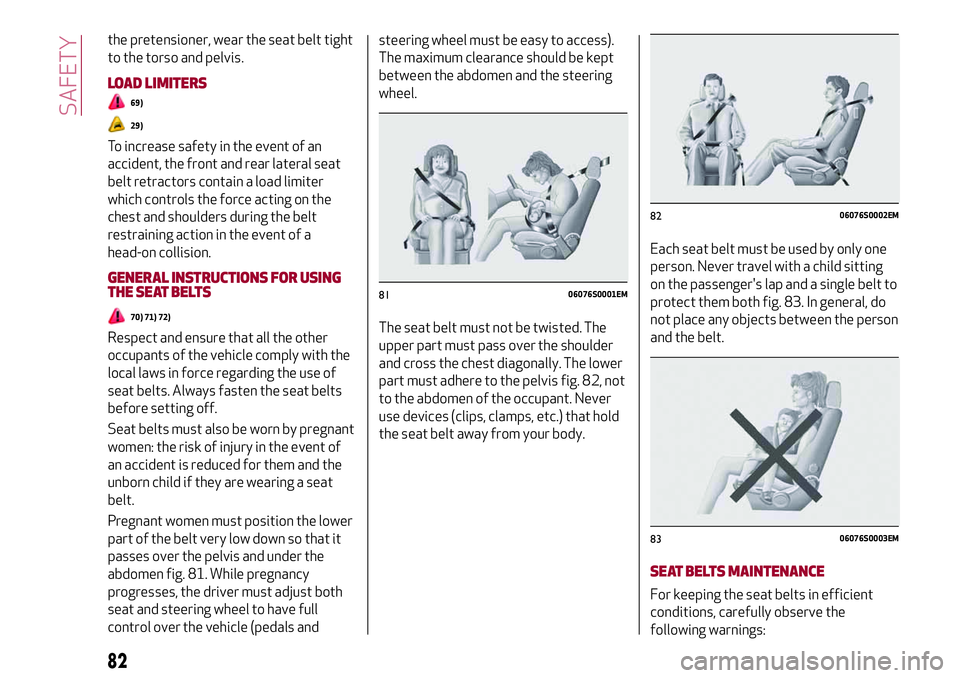
Pregnant women must position the lower
part of the belt very low down so that it
passes over the pelvis and under the
abdomen fig. 81. While pregnancy
progresses, the driver must adjust both
seat and steering wheel to have full
control over the vehicle (pedals andsteering wheel must be easy to access).
The maximum clearance should be kept
between the abdomen and the steering
wheel.
The seat belt must not be twisted. The
upper part must pass over the shoulder
and cross the chest diagonally. The lower
part must adhere to the pelvis fig. 82, not
to the abdomen of the occupant. Never
use devices (clips, clamps, etc.) that hold
the seat belt away from your body.Each seat belt must be used by only one
person. Never travel with a child sitting
on the passenger's lap and a single belt to
protect them both fig. 83. In general, do
not place any objects between the person
and the belt.
SEAT BELTS MAINTENANCE
For keeping the seat belts in efficient
conditions, carefully observe the
following warnings:
8106076S0001EM
8206076S0002EM
8306076S0003EM
82
SAFETY
Page 97 of 204

80)Always make sure that the chest section
of the seat belt does not pass under the
arms or behind the back of the child. In the
event of an accident the seat belt will not be
able to secure the child, with the risk of
injury, including fatal injury. Therefore the
child must always wear the seat belt
correctly.
81)Do not use the same lower anchorage to
install more than one child restraint system.
82)If a Universal ISOFIX child restraint
system is not fixed to all three anchorages, it
will not be able to protect the child correctly.
In a crash, the child could be seriously or
fatally injured.
83)Fit the child restraint system when the
car is stationary. The child restraint system
is correctly fixed to the brackets when you
hear the click. Follow the instructions for
assembly, disassembly and positioning that
the Manufacturer must supply with the child
restraint system.
84)If the vehicle was involved in an accident
of a certain severity, have the ISOFIX
anchorages and the child restraint system
replaced.
85)If the vehicle was involved in an accident
of a certain severity, have both the child
restraint system and the seat belt it was
attached to replaced.SUPPLEMENTARY RESTRAINT
SYSTEM (SRS) - AIRBAG
The vehicle is equipped with:
front driver airbag;
front passenger airbag;
driver and passenger front side bags
for pelvis, chest and shoulder protection
(Side bags);
side bags for head protection of front
seat passengers and rear side seat
passengers (window bag).
The location of the airbags on the vehicle
is marked by the word "AIRBAG" in the
middle of the steering wheel below the
Alfa Romeo emblem, on the dashboard,
on the side trim or on a label placed next
to the airbag deployment area.
FRONT AIRBAGS
The front (driver and passenger) airbags
protect the front seat occupants in the
event of head-on crashes of medium-high
severity, by placing the cushion between
the occupant and the steering wheel or
dashboard.
Therefore non-activation of airbags in
other types of collisions (side impacts,
rear shunts, roll-overs, etc.) does not
indicate a system malfunction.
Driver and passenger front airbags are
not a replacement of but complementary
to the seat belts, which should always beworn, as specified by law in Europe and
most non-European countries.
In the event of impact, those not wearing
a seat belt are projected forwards and
may come into contact with the bag
which is still inflating. The protection
offered by the bag is compromised in
these circumstances.
Front airbags may not activate in the
following situations:
frontal impacts against highly
deformable objects not involving the
front surface of the vehicle (e.g. wing
collision against guard rail, etc.);
vehicle wedging under other vehicles
or protective barriers (e.g. trucks or
guard rails).
Failure to activate in the conditions
described above is due to the fact that
they may not provide any additional
protection compared with seat belts, so
their activation would be inappropriate.
In these cases, non-deployment does not
indicate a system malfunction.
Driver's side front airbag
This consists of an instantly inflating bag
contained in a special compartment in the
centre of the steering wheel fig. 93.
95
Page 101 of 204

SIDE AIRBAGS
To help increase occupants protection in
the event of side impact collisions, the
vehicle is equipped with front side bags
and window bags.
Side bag
These consist of two bags located in the
front seat backrests fig. 99 that protect
the occupants’ pelvis, chest and shoulder
area in the event of a side impact of
medium/high severity.
They are marked by the "AIRBAG" label
sewn on the outer side of the front seats.
Window bag
This consists of a "curtain" bag housed
behind the roof side linings and covered
by special trims fig. 100.
They are designed to protect the head of
front and rear occupants in the event of a
side collision, thanks to the wide cushion
inflation surface.The deployment of side bags in the event
of side impacts of low severity is not
required.
In the event of a side impact, the system
provides best protection if the passenger
sits on the seat in a correct position,
allowing the window bag to inflate
correctly.
86) 87) 88) 89) 90) 91) 92) 93) 94) 95) 96) 97) 98) 99)
Important notes
Do not wash the seats with water or
pressurised steam (wash by hand or at
automatic seat washing stations).
The front and/or side airbags may
activate in the event of sharp impacts to
the underbody of the vehicle (e.g. impact
with steps, pavements, potholes or road
bumps etc.).
When the airbag deploys it emits a small
amount of dust: the dust is harmless and
does not indicate the beginning of a fire.The dust may irritate the skin and eyes
however: in this case, wash with neutral
soap and water.
Airbag checking, repair and replacement
must be carried out at an Alfa Romeo
Dealership.
If the car is scrapped, have the airbag
system deactivated at an Alfa Romeo
Dealership.
Pretensioners and airbags are deployed
in different ways on the basis of the type
of collision. Failure to activate one or
more of the devices does not indicate a
system malfunction.
WARNING
86)Do not apply stickers or other objects on
the steering wheel, on the dashboard in the
passenger side airbag area, on side
upholstery on the roof or on the seats. Never
put objects (e.g. mobile phones) on the
passenger side of the dashboard since they
could interfere with correct inflation of the
passenger airbag and also cause serious
injury to the passengers.
87)Always drive with your hands on the rim
of the steering wheel so that the airbag can
inflate freely if required. Do not drive with
your body bent forward. Keep your back
straight against the backrest.
88)The passenger airbag can be
deactivated on the Connect system by
selecting the following functions in sequence
on the main menu: “Settings”; “Safety” and
“Deactivation”.
9906106S0004EM
10006106S0005EM
99
Page 109 of 204

It is not possible to select N (Neutral)
mode from P (Park) mode.
P (Park) mode is automatically activated
if the following conditions are met
simultaneously:
D (Drive) or R (Reverse) mode is active;
the car’s speed is close to 0;
the brake pedal is released;
the driver’s seat belt is not fastened;
the driver’s door is open.
If using the gear shift in "sequential"
mode. you can activate it by moving the
lever from D (Drive) to the left and then
forward towards the - symbol or back
towards the + symbol and the gear is
shifted.
To exit position P (Park), or to pass from
position N (Neutral) to position D (Drive)
or R (Reverse) when the vehicle is
stopped or is moving at a low speed, the
brake pedal must also be pressed.
IMPORTANT DO NOT accelerate while
shifting from position P (or N) to another
position.
IMPORTANT After selecting a gear, wait
a few seconds before accelerating. This
precaution is particularly important with
a cold engine.
AutoStick - Manual (sequential)
shifting mode
In the case of frequent gearshifting (e.g.
for sport driving, when the vehicle is
driven with a heavy load, on slopes, with
strong headwind or when towing heavy
trailers), it is recommended to use the
Autostick (sequential shifting) mode to
select and keep a lower fixed ratio.
In this condition, using the lowest gear
improves the car performance,
preventing overheating.
It is possible to shift from position D
(Drive) to the sequential mode regardless
of vehicle speed.
Activation
Starting from D (Drive) mode, to activate
the sequential drive mode, move the
lever to the left (– and + indication of the
trim). The gear engaged will be shown on
the display.
Gearshifting is made by moving the gear
lever forwards, towards symbol – or
backwards, towards symbol +.Steering wheel stalks
(where provided)
The gear can be manually shifted also by
using the levers behind the steering
wheel, pull the right gear lever (+)
towards the steering wheel and release it
to engage a higher gear; perform the
same operation with the left lever (-) to
engage a lower gear fig. 105.
To engage N (Neutral): pull
simultaneously both levers.
To activate D (Drive) mode, from N
(Neutral), P (Parking) and R (Reverse):
push the brake pedal and the right lever
(+).
IMPORTANT When only one manual shift
is performed, the letter D will remain on
the display with the engaged gear next to
it.
10407076S0005EM
10507076S0006EM
107
Page 112 of 204

START & STOP EVO
The Start & Stop Evo system
automatically stops the engine each time
the vehicle is stationary and starts it
again when the driver wants to move off.
In this way, the vehicle efficiency is
increased, by reducing consumption,
dangerous gas emissions and sound
pollution.
OPERATING MODE
Stopping the engine
Versions with mechanical gearbox
With the vehicle stopped, the engine
stops with gearbox in neutral and clutch
pedal released.
Versions with automatic transmission
With vehicle at a standstill and brake
pedal pressed, the engine switches off if
the gear lever is in a position other than
R.
The system does not operate when the
gear lever is in R, for making parking
manoeuvres easier.
In the event of stops uphill, engine
switching off is disabled to make the "Hill
Start Assist" function available (works
only with running engine).
NOTE The engine can only be
automatically stopped after having run atabout 6 mph (10 km/h). After an
automatic restart, to stop the engine you
only need to move the vehicle (exceed a
speed of 0.3 mph (0.5 km/h)).
Engine stopping is signalled by the
symbol lighting up on the instrument
panel display.
Restarting the engine
Versions with mechanical gearbox
To restart the engine, press the clutch
pedal.
If the vehicle does not start when the
clutch is pressed, place the gear lever in
neutral and repeat the procedure. If the
problem persists, contact an Alfa Romeo
Dealership.
Versions with automatic transmission
To restart the engine, release the brake
pedal.
With brake pressed, if the gear lever is in
automatic mode - D (Drive) - the engine
can be restarted by moving the lever to R
(Reverse) or N (Neutral) or "AutoStick".
With brake pressed, if the gear lever is in
"AutoStick" mode, the engine can be
restarted by moving the lever to "+" or
"–", or R (Reverse) or N (Neutral).
When the engine has been stopped
automatically, keeping the brake pedal
pressed, the brake can be releasedkeeping the engine off by quickly shifting
the gear lever to P (Park).
To restart the engine, just move the lever
out of a position other than P.SYSTEM MANUAL ACTIVATION/
DEACTIVATION
110)
37)
To manually activate/deactivate the
system, press the button inserted in the
control panel on the left of the steering
wheel, fig. 107
LED off: system activated;
LED on: system deactivated.
10707126S0001EM
110
STARTING AND DRIVING
Page 119 of 204

46)Camera operation may also be
compromised by the presence of dust,
condensation, dirt or ice on the windscreen,
by traffic conditions (e.g. vehicles that are
driving not aligned with yours, vehicle driving
in a transverse or opposite way on the same
lane, bend with a small radius of curvature),
by road surface conditions and by driving
conditions (e.g. off-road driving). Make sure
the windscreen is always clean. Use specific
detergents and clean cloths to avoid
scratching the windscreen. The camera
operation may also be limited or absent in
some driving, traffic and road surface
conditions.REAR BACK-UP CAMERA /
DYNAMIC GRIDLINES
DESCRIPTION
The Rear Back-up Camera is located on
the boot, near the opening button,
fig. 114.
115)
47)
Camera activation/deactivation
The function can be activated/
deactivated on the Connect system.
Activating the device
To access the function, on the main menu
select the following items in sequence:
"Settings", "Driver assistance" and "Rear
Back-up Camera". The following
sub-menu appears:
Active
Switch-off delay;
Grille.
Select "Activate" to activate the camera
view on the Connect system display.
Every time reverse is engaged, the
display of the Connect system, fig. 115,
shows the area around the vehicle, as
seen by the Rear Back-up Camera.
SYMBOLS AND MESSAGES ON THE
DISPLAY
If activated, the grid is positioned on the
image to highlight the width of the
vehicle and the expected reversing path
in accordance with the steering wheel
position.
A superimposed central broken line
indicates the centre of the vehicle to
facilitate parking manoeuvres or tow
hook alignment. The various coloured
areas indicate the distance from the rear
of the vehicle.
11407186S0001EM11507186S0002EM
117
Page 134 of 204

WARNING
122)Never replace a fuse with another with
a higher amp rating; DANGER OF FIRE.
123)Before replacing a fuse, make sure
that the ignition device is at STOP and that
all devices are switched off and/or
disconnected.
124)Contact an Alfa Romeo Dealership if a
safety system (airbags, brakes),
transmission system (engine, gearbox) or
steering system general protection fuse
blows.
125)If a fuse blows again, contact an Alfa
Romeo Dealership.
126)If a general protective fuse
(MAXI-FUSE, MEGA-FUSE, MIDI-FUSE)
blows, contact an Alfa Romeo Dealership.
IMPORTANT
50)Never replace a fuse with metal wires or
anything else.
51)If it is necessary to wash the engine
compartment, take care not to directly hit
the fuse box and the window wiper motors
with the water jet.
TIRE REPAIR KIT
DESCRIPTION
127) 128) 129) 130) 131) 132) 133) 134) 135)
52)
3)
The Tire Repair Kit is located in the boot,
inside a specific container.
To access the Tire Repair Kit, open the
boot, lift the load platform.
The Tire Repair Kit includes also:
one tank 1 fig. 137 containing the
sealing fluid, provided with: filler tube
2 and adhesive label 3 with the writing
"Max. 50 mph (80 km/h)”, to be attached
in a position easily visible to the driver
(eg. on the dashboard) after repairing the
tyre;
compressor 4 complete with pressure
gauge and connectors;
an instruction leaflet, to refer to for
prompt and correct use of the Tire Repair
Kit and that must be then given to the
personnel dealing with the tyre treated
with sealant;
a pair of protective gloves;
some adaptors, for inflating different
elements.
IMPORTANT The sealing fluid is effective
with external temperatures of between
-40°F (-40°C) and 122°F (+50°C). The
sealing fluid has an expiry date.
INFLATION PROCEDURE
127) 128) 130) 131) 132) 133) 134) 135)
Proceed as follows:
engage the electric parking brake.
Insert the tank 1 fig. 138 containing the
sealing liquid in the proper compressor
holder, pressing down hard. Unscrew the
tyre valve cap, take out the filler hose
2 and tighten the ring nut on the tyre
valve;
13708066S0002EM
132
IN AN EMERGENCY