2015 YAMAHA WR 250F ECU
[x] Cancel search: ECUPage 136 of 430

CHASSIS
3-32
3. Tighten:
• Air bleed screw
EAS2GB2117ADJUSTING THE FRONT FORK LEGSEWA
WARNING
• Always adjust the left and right front forks
evenly. If this is not done, the vehicle may
have poor stability.
• Securely support the vehicle so that there
is no danger of it falling over.
Rebound damping force
ECA
NOTICE
Do not turn the adjuster forcibly beyond its
adjusting range.
1. Adjust:
• Rebound damping force
▼▼▼▼▼▼▼▼▼▼▼▼▼▼▼▼▼▼▼▼▼▼▼▼▼▼▼▼▼▼▼▼
a. Turn the adjuster “1” in the direction of “a” or
“b” to make an adjustment.
▲▲▲▲▲▲▲▲▲▲▲▲▲▲▲▲▲▲▲▲▲▲▲▲▲▲▲▲▲▲▲▲
Compression damping forceECA
NOTICE
Do not turn the adjuster forcibly beyond its
adjusting range.
1. Adjust:
• Compression damping force
▼▼▼▼▼▼▼▼▼▼▼▼▼▼▼▼▼▼▼▼▼▼▼▼▼▼▼▼▼▼▼▼
a. Turn the adjuster “1” in the direction of “a” or
“b” to make an adjustment.
▲▲▲▲▲▲▲▲▲▲▲▲▲▲▲▲▲▲▲▲▲▲▲▲▲▲▲▲▲▲▲▲
Air bleed screw
1.3 Nm (0.13 m·kgf, 0.94 ft·lbf)
Direction “a”
Rebound damping force is increased
(suspension is harder).
Direction “b”
Rebound damping force is decreased
(suspension is softer).
Rebound damping force
Maximum
Turn it in finger-tight.
STD
Turn it out by 10 clicks.*
Minimum
Turn it out by 20 clicks.*
* With the adjuster fully turned in
T R..
1
Direction “a”
Compression damping force is in-
creased (suspension is harder).
Direction “b”
Compression damping force is de-
creased (suspension is softer).
Compression damping force
Maximum
Turn it in finger-tight.
STD
Turn it out by 11 clicks.*
Minimum
Turn it out by 20 clicks.*
* With the adjuster fully turned in
1
a
b
a b
1
Page 137 of 430

CHASSIS
3-33
EAS2GB2118CHECKING THE SWINGARM OPERATION
1. Check:
• Swingarm smooth action
• Swingarm free play
Refer to “SWINGARM” on page 5-64.
EAS2GB2119CHECKING THE REAR SUSPENSION
1. Stand the vehicle upright on a level surface.
EWA
WARNING
Securely support the vehicle so that there is
no danger of it falling over.
2. Check:
• Rear shock absorber assembly
Gas leaks/oil leaks Replace the rear
shock absorber assembly.
Refer to “REAR SHOCK ABSORBER AS-
SEMBLY” on page 5-57.
3. Check:
• Rear shock absorber assembly smooth ac-
tion
• Rear suspension link smooth action
Sit astride the seat and shake your body up
and down several times to check whether
the rear shock absorber assembly operates
smoothly.
Unsmooth operation Correct or replace.
Refer to “REAR SHOCK ABSORBER AS-
SEMBLY” on page 5-57.
EAS2GB2120ADJUSTING THE REAR SHOCK ABSORB-
ER ASSEMBLY
Use a suitable stand to raise the rear wheel off
the ground.
EWA
WARNING
Securely support the vehicle so that there is
no danger of it falling over.Spring preload
ECA
NOTICE
Do not turn the adjuster forcibly beyond its
adjusting range.
1. Remove:
• Rear frame
Refer to “REAR SHOCK ABSORBER AS-
SEMBLY” on page 5-57.
2. Adjust:
• Spring preload
▼▼▼▼▼▼▼▼▼▼▼▼▼▼▼▼▼▼▼▼▼▼▼▼▼▼▼▼▼▼▼▼
a. Loosen the locknut “1”.
b. Loosen the adjuster “2” until there is some
clearance between the spring and the ad-
juster.
c. Measure the spring free length “a”.
d. Turn the adjuster in the direction of “b” or “c”
to make an adjustment.
Direction “b”
Spring preload is increased (suspen-
sion is harder).
Direction “c”
Spring preload is decreased (suspen-
sion is softer).
Spring installed length “d”
Minimum
Position in which the spring is
turned in 1.5 mm (0.06 in) from
its free length.
STD
Position in which the spring is
turned in 10 mm (0.39 in) from its
free length.
Maximum
Position in which the spring is
turned in 18 mm (0.71 in) from its
free length.
Page 140 of 430

CHASSIS
3-36
2. Tighten:
• Spokes
Use a spoke nipple wrench “1” for tighten-
ing.
TIP
• Do not give a half turn (180 °) or more for one
tightening.
• Make sure that tightening after a break-in is
done until the initial looseness in nipples dis-
appears.
• Make sure that tightening is done in stages,
not at a time.
EAS2GB2123CHECKING THE WHEELS
1. Check:
• Wheel(s)
Damage/out-of-round Replace.
EWA
WARNING
Never attempt to make any repairs to the
wheel.
TIP
After replacing a tire or a wheel, always bal-
ance the wheel.
EAS2GB2124CHECKING THE WHEEL BEARINGS
1. Check:
• Wheel bearings
Refer to “CHECKING THE FRONT WHEEL”
on page 5-5 and “CHECKING THE REAR
WHEEL” on page 5-10.
EAS2GB2125
CHECKING AND ADJUSTING THE STEER-
ING HEAD
1. Use a suitable stand to raise the front wheel
off the ground.
EWA
WARNING
Securely support the vehicle so that there is
no danger of it falling over.
2. Check:
• Steering head
Grasp the bottom of the front fork legs and
gently rock the front fork.
Blinding/looseness Adjust the steering
head.
3. Remove:
• Handlebar
Refer to “HANDLEBAR” on page 5-33.
• Upper bracket
Refer to “STEERING HEAD” on page 5-53.
4. Adjust:
• Steering head
▼▼▼▼▼▼▼▼▼▼▼▼▼▼▼▼▼▼▼▼▼▼▼▼▼▼▼▼▼▼▼▼
a. Remove the washer “1”.
b. After loosening the ring nut “2” with a steer-
ing nut wrench “3”, tighten it to the specified
torque.
TIP
• Set the torque wrench at a right angle to the
steering nut wrench.
• Move the steering to the left and right a couple
of times to check that it moves smoothly. Spoke nipple wrench (6–7)
90890-01521
Spoke nipple wrench (6–7)
YM-01521
Spokes
2.5 Nm (0.25 m·kgf, 1.8 ft·lbf)
1
T R..
1
3
2
Page 163 of 430

FRONT WHEEL
5-5
EAS2GB2157REMOVING THE FRONT WHEEL
1. Use a suitable stand to raise the front wheel
off the ground.
EWA
WARNING
Securely support the vehicle so that there is
no danger of it falling over.
2. Remove:
• Front wheel
EAS2GB2158CHECKING THE FRONT WHEEL
1. Check:
• Front wheel axle
Roll the front wheel axle on a flat surface.
Bends Replace.
EWA
WARNING
Do not attempt to straighten a bent wheel
axle.
2. Check:
•Tire(s)
• Front wheel
Damage/wear Replace.
Refer to “CHECKING THE TIRES” on page
3-35 and “CHECKING THE WHEELS” on
page 3-36.
3. Check:
• Spokes
Bend/damage Replace.
Loose Tighten.
Tap the spokes with a screwdriver.
TIP
A tight spoke will emit a clear, ringing tone; a
loose spoke will sound flat.
4. Tighten:
• Spokes
Refer to “CHECKING AND TIGHTENING
THE SPOKES” on page 3-35.
TIP
After tightening the spokes, measure the wheel
runout.
5. Measure:
• Wheel radial runout “a”
• Wheel lateral runout “b”
Out of specification Repair/replace.
6. Check:
•Collars
Damage/wear Replace.
7. Check:
• Bearing
Front wheel turns roughly or is loose Re-
place the wheel bearings.
• Oil seals
Damage/wear Replace.
Spokes
2.5 Nm (0.25 m·kgf, 1.8 ft·lbf)
Radial wheel runout limit
2.0 mm (0.08 in)
Lateral wheel runout limit
2.0 mm (0.08 in)
T R..
ab
Page 168 of 430

REAR WHEEL
5-10
EAS2GB2163REMOVING THE REAR WHEEL
1. Use a suitable stand to raise the rear wheel
off the ground.
EWA
WARNING
Securely support the vehicle so that there is
no danger of it falling over.
2. Remove:
• Rear wheel axle nut “1”
3. Loosen:
• Locknut “2”
4. Tighten:
• Adjusting bolt “3”
5. Remove:
• Rear wheel axle
• Rear wheel
TIP
• Push the rear wheel forward and remove the
drive chain from the rear wheel sprocket.
• Do not depress the brake pedal with the rear
wheel removed.
EAS2GB2164CHECKING THE REAR WHEEL
1. Check:
• Rear wheel axle
• Rear wheel
• Bearing
• Oil seals
Refer to “CHECKING THE FRONT WHEEL”
on page 5-5.
2. Check:
•Tire(s)
• Rear wheel
Damage/wear Replace.
Refer to “CHECKING THE TIRES” on page
3-35 and “CHECKING THE WHEELS” on
page 3-36.
3. Check:
• Spokes
Refer to “CHECKING THE FRONT WHEEL”
on page 5-5.4. Measure:
• Radial wheel runout
• Lateral wheel runout
Refer to “CHECKING THE FRONT WHEEL”
on page 5-5.
EAS2GB2165DISASSEMBLING THE REAR WHEEL
1. Remove:
• Oil seals
• Bearing
Refer to “DISASSEMBLING THE FRONT
WHEEL” on page 5-6.
EAS2GB2166CHECKING AND REPLACING THE REAR
WHEEL SPROCKET
1. Check:
• Rear wheel sprocket
More than 1/4 tooth wear “a” Replace the
rear wheel sprocket and the drive sprocket
as a set.
Bent tooth Replace the rear wheel
sprocket and the drive sprocket as a set.
2. Replace:
• Rear wheel sprocket
▼▼▼▼▼▼▼▼▼▼▼▼▼▼▼▼▼▼▼▼▼▼▼▼▼▼▼▼▼▼▼▼
a. Remove the self-locking nuts and the rear
wheel sprocket.
b. Clean the rear wheel drive hub with a clean
cloth, especially the surfaces that contact
the sprocket.
c. Install the new rear wheel sprocket.
3
12
Radial wheel runout limit
2.0 mm (0.08 in)
Lateral wheel runout limit
2.0 mm (0.08 in)
b. Correct
1. Drive chain roller
2. Rear wheel sprocket
Rear wheel sprocket self-locking
nut
50 Nm (5.0 m·kgf, 36 ft·lbf)
T R..
Page 193 of 430

HANDLEBAR
5-35
EAS2GB2196REMOVING THE HANDLEBAR
1. Stand the vehicle on a level surface.
EWA
WARNING
Securely support the vehicle so that there is
no danger of it falling over.
2. Remove:
•Clutch switch “1”
TIP
Press the projection, and remove it from the
clutch lever assembly.
3. Remove:
• Handlebar grip “1”
TIP
Blow compressed air between the left handle-
bar and the handlebar grip, and gradually push
the grip off the handlebar.
4. Remove:
• Throttle cable housings “1”
• Throttle grip “2”
TIP
While removing the throttle cable housing, pull
back the rubber cover “3”.
EAS2GB2197CHECKING THE HANDLEBAR
1. Check:
• Handlebar
Bends/cracks/damage Replace.
EWA
WARNING
Do not attempt to straighten a bent handle-
bar as this may dangerously weaken it.
EAS2GB2198INSTALLING THE HANDLEBAR
1. Stand the vehicle upright on a level surface.
EWA
WARNING
Securely support the vehicle so that there is
no danger of it falling over.
2. Install:
• Damper “1”
• Lower handlebar holders“2” (temporarily)
• Handlebar “3”
• Upper handlebar holders “4”
TIP
• Install the lower handlebar holders with them
side having the greater distance “a” from the
mounting bolt center facing forward.
• Installing the lower handlebar holders in the
reverse direction allow the front-to-rear offset
amount of the handlebar position to be
changed.
• The upper handlebar holders should be in-
stalled with the punch marks “b” facing for-
ward.
• When installing the handlebar, make sure that
right and left marks “c” are in place identically
on both sides.
• Install the handlebar so that the projection “d”
of the upper handlebar holders is positioned
at the mark on the handlebar as shown.
ECA
Upper handlebar holder bolt
28 Nm (2.8 m·kgf, 20 ft·lbf)
T R..
Page 194 of 430

HANDLEBAR
5-36
NOTICE
• First, tighten the bolts on the front side of
the upper handlebar holder, and then on
the rear side.
• Turn the handlebar all the way to the left
and right. If there is any contact with the
fuel tank, adjust the handlebar position.
3. Tighten:
• Lower handlebar holder nut
4. Install:
• Handlebar grip “1”
▼▼▼▼▼▼▼▼▼▼▼▼▼▼▼▼▼▼▼▼▼▼▼▼▼▼▼▼▼▼▼▼
a. Slightly coat the handlebar left end with a
rubber adhesive.
b. Install the handlebar grip on the handlebar
by pressing the grip from the left side.
c. Wipe off any excess adhesive with a clean
cloth.
EWA
WARNING
Securely support the vehicle so that there is
no danger of it falling over.
TIP
Install the handlebar grip to the handlebar so
that the line “a” between the two arrow marks
faces straight upward.
▲▲▲▲▲▲▲▲▲▲▲▲▲▲▲▲▲▲▲▲▲▲▲▲▲▲▲▲▲▲▲▲
2
1
1
a
3
4
Lower handlebar holder nut
40 Nm (4.0 m·kgf, 29 ft·lbf)
T R..
Page 200 of 430
FRONT FORK
5-42
EAS2GB2200REMOVING THE FRONT FORK LEGS
1. Use a suitable stand to raise the front wheel
off the ground.
EWA
WARNING
Securely support the vehicle so that there is
no danger of it falling over.
TIP
Record the adjusting screw setting position be-
fore loosening the adjuster and the base valve.
2. Loosen:
• Upper bracket pinch bolts
• Damper assembly
• Lower bracket pinch bolts
EWA
WARNING
Before loosening the upper and lower
bracket pinch bolts, support the front fork
leg.
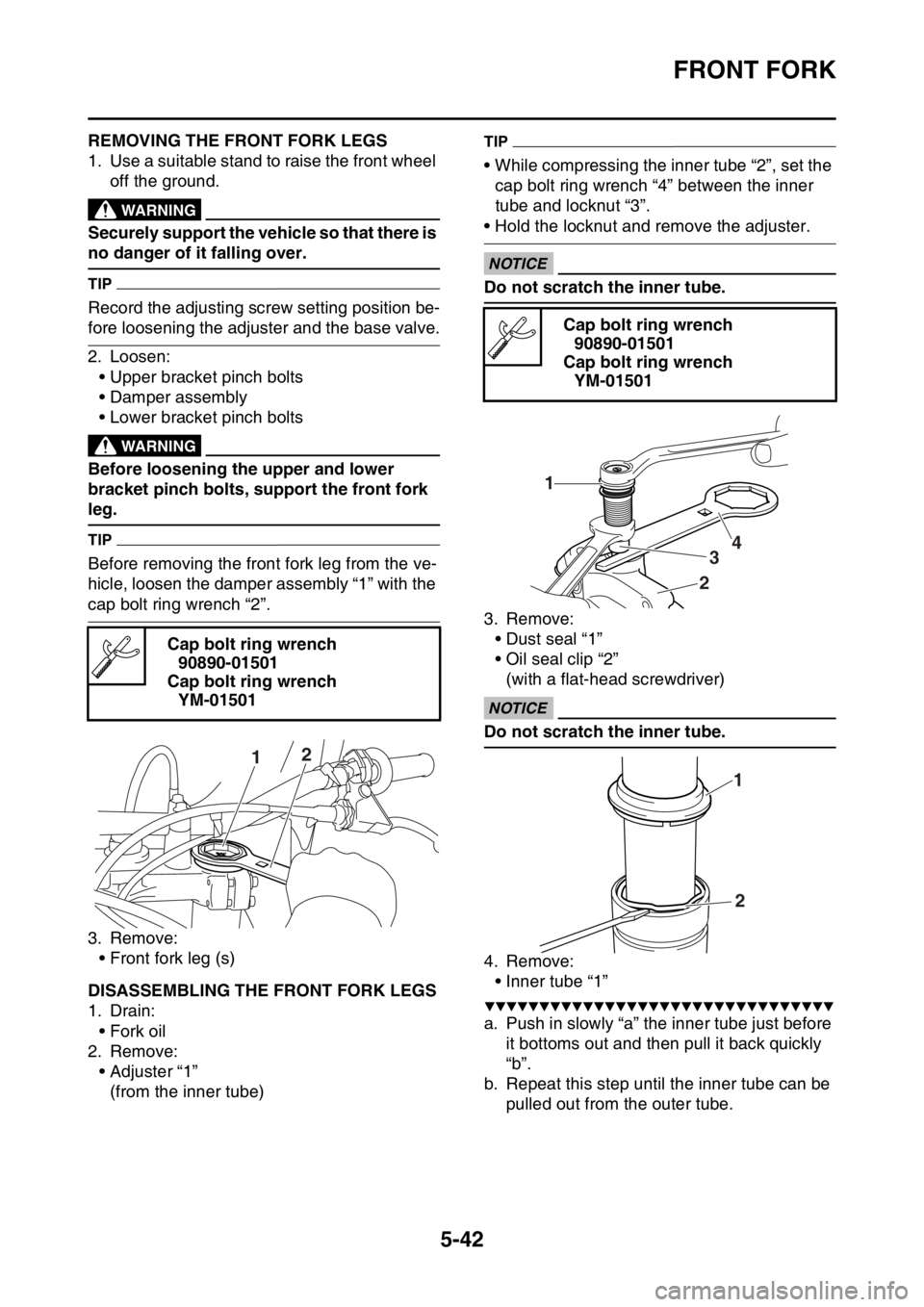
TIP
Before removing the front fork leg from the ve-
hicle, loosen the damper assembly “1” with the
cap bolt ring wrench “2”.
3. Remove:
• Front fork leg (s)
EAS2GB2201DISASSEMBLING THE FRONT FORK LEGS
1. Drain:
• Fork oil
2. Remove:
• Adjuster “1”
(from the inner tube)
TIP
• While compressing the inner tube “2”, set the
cap bolt ring wrench “4” between the inner
tube and locknut “3”.
• Hold the locknut and remove the adjuster.
ECA
NOTICE
Do not scratch the inner tube.
3. Remove:
• Dust seal “1”
• Oil seal clip “2”
(with a flat-head screwdriver)
ECA
NOTICE
Do not scratch the inner tube.
4. Remove:
• Inner tube “1”
▼▼▼▼▼▼▼▼▼▼▼▼▼▼▼▼▼▼▼▼▼▼▼▼▼▼▼▼▼▼▼▼
a. Push in slowly “a” the inner tube just before
it bottoms out and then pull it back quickly
“b”.
b. Repeat this step until the inner tube can be
pulled out from the outer tube. Cap bolt ring wrench
90890-01501
Cap bolt ring wrench
YM-01501
12
Cap bolt ring wrench
90890-01501
Cap bolt ring wrench
YM-01501
1
234
1
2