Page 194 of 430
HANDLEBAR
5-36
NOTICE
• First, tighten the bolts on the front side of
the upper handlebar holder, and then on
the rear side.
• Turn the handlebar all the way to the left
and right. If there is any contact with the
fuel tank, adjust the handlebar position.
3. Tighten:
• Lower handlebar holder nut
4. Install:
• Handlebar grip “1”
▼▼▼▼▼▼▼▼▼▼▼▼▼▼▼▼▼▼▼▼▼▼▼▼▼▼▼▼▼▼▼▼
a. Slightly coat the handlebar left end with a
rubber adhesive.
b. Install the handlebar grip on the handlebar
by pressing the grip from the left side.
c. Wipe off any excess adhesive with a clean
cloth.
EWA
WARNING
Securely support the vehicle so that there is
no danger of it falling over.
TIP
Install the handlebar grip to the handlebar so
that the line “a” between the two arrow marks
faces straight upward.
▲▲▲▲▲▲▲▲▲▲▲▲▲▲▲▲▲▲▲▲▲▲▲▲▲▲▲▲▲▲▲▲
2
1
1
a
3
4
Lower handlebar holder nut
40 Nm (4.0 m·kgf, 29 ft·lbf)
T R..
Page 238 of 430

ENGINE REMOVAL
6-7
EAS2GB2232REMOVING THE ENGINE
1. Remove:
• Pivot shaft “1”
TIP
If the pivot shaft is pulled all the way out, the
swingarm will come loose. If possible, insert a
shaft of similar diameter into the other side of
the swingarm to support it.
2. Remove:
• Engine “1”
From the right side.
TIP
• Make sure that the couplers, the hoses, and
the cables are disconnected.
• Lift up the engine, and remove this from its
lower part toward the right of the chassis.
EAS2GB2233
CLEANING THE SPARK ARRESTEREWA
WARNING
• Be sure the exhaust pipe and muffler are
cool before cleaning the spark arrester.
• Do not start the engine when cleaning the
exhaust system.
1. Remove:
• Muffler cap screws “1”
2. Remove:
• Spark arrester bolts “1”
3. Remove:
• Tail pipe “1”
• Tail pipe gasket “2”
• Spark arrester “3”
Pull the spark arrester out of the muffler.
• Spark arrester gasket “4”
4. Clean:
• Spark arrester
Tap the spark arrester lightly, then use a
wire brush to remove any carbon deposits.
1
Page 308 of 430
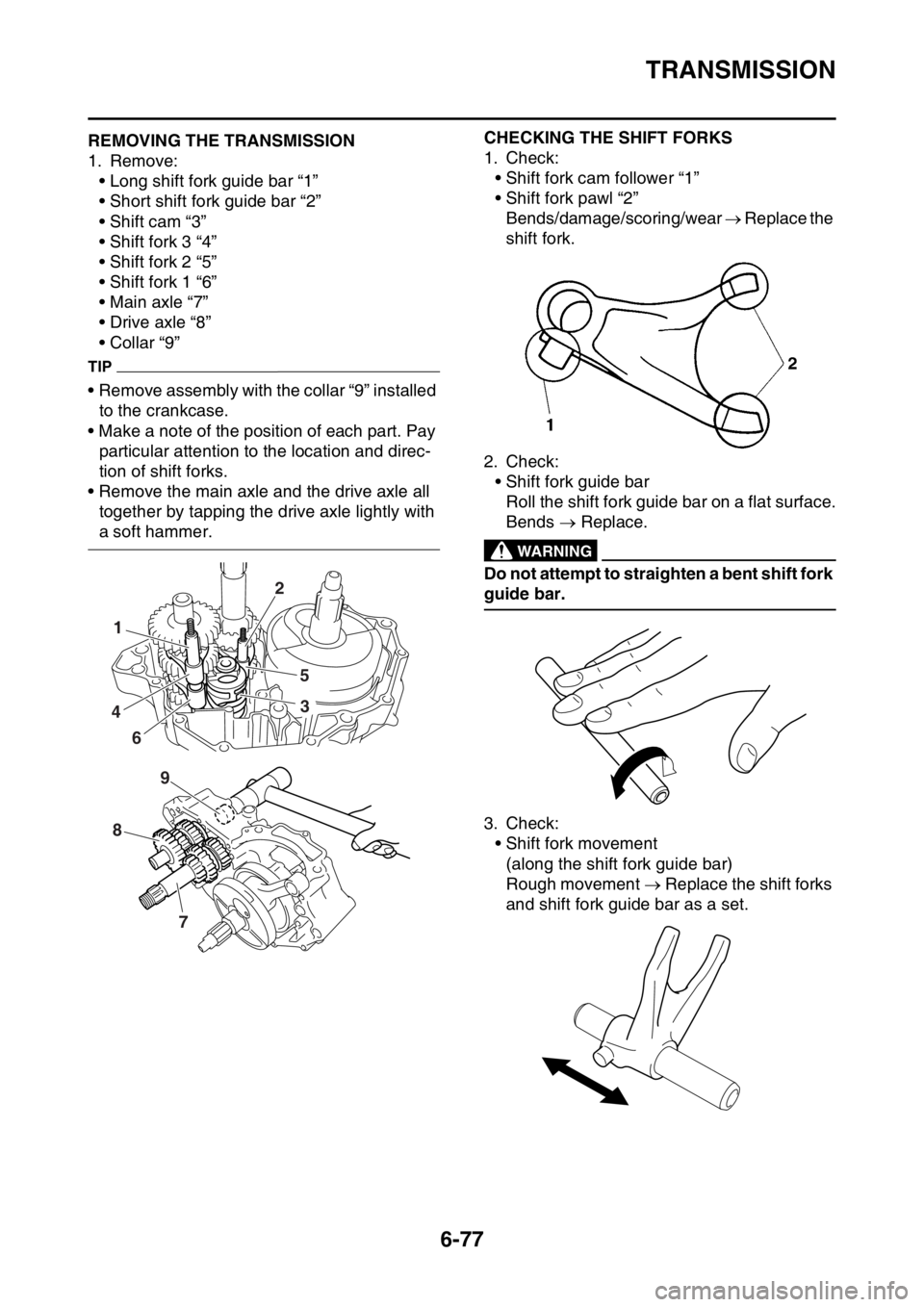
TRANSMISSION
6-77
EAS2GB2325REMOVING THE TRANSMISSION
1. Remove:
• Long shift fork guide bar “1”
• Short shift fork guide bar “2”
• Shift cam “3”
• Shift fork 3 “4”
• Shift fork 2 “5”
• Shift fork 1 “6”
• Main axle “7”
• Drive axle “8”
• Collar “9”
TIP
• Remove assembly with the collar “9” installed
to the crankcase.
• Make a note of the position of each part. Pay
particular attention to the location and direc-
tion of shift forks.
• Remove the main axle and the drive axle all
together by tapping the drive axle lightly with
a soft hammer.
EAS2GB2326
CHECKING THE SHIFT FORKS
1. Check:
• Shift fork cam follower “1”
• Shift fork pawl “2”
Bends/damage/scoring/wear Replace the
shift fork.
2. Check:
• Shift fork guide bar
Roll the shift fork guide bar on a flat surface.
Bends Replace.
EWA
WARNING
Do not attempt to straighten a bent shift fork
guide bar.
3. Check:
• Shift fork movement
(along the shift fork guide bar)
Rough movement Replace the shift forks
and shift fork guide bar as a set.
1
4
62
5
3
8
7
9
Page 325 of 430

FUEL TANK
8-4
EAS2GB2346REMOVING THE FUEL SENDER
1. Remove:
• Fuel sender
ECA
NOTICE
Do not drop the fuel sender or give it a
strong shock.
EAS2GB2347CHECKING THE FUEL SENDER
1. Disconnect:
• Fuel pump coupler
• Fuel sender coupler
(from the wire harness)
2. Disconnect:
• Starter motor lead
(from starter relay)
3. Remove:
• Fuel tank
4. Remove:
• Fuel sender
(from the fuel tank)
5. Connect:
• Fuel sender coupler
6. Push the start switch.
7. Check:
• Fuel level warning light
Out of specification Replace the fuel
sender.
EAS2GB2348INSTALLING THE FUEL SENDER
1. Install:
• Fuel sender gasket
• Fuel sender
TIP
• Do not damage the installation surfaces of the
fuel tank when installing the fuel sender.
• Always use a new fuel sender gasket.
• Install the fuel sender as shown in the illustra-
tion.
• When install the fuel sender, make sure that
the projection “a” faces the rear of the vehicle.
EAS2GB2349INSTALLING THE FUEL TANK
1. Install:
• Fuel tank
2. Connect:
• Fuel hose
ECA
NOTICE
• Connect the fuel hose securely, and check
that the orientation of the installed fuel
hose holder is correct.
• Take care not to kink or pinch the fuel
hose.
Fuel pump is atmosphere “A”
Fuel level warning light is come on
Fuel pump is soaked in fuel “B”
Fuel level warning light is goes off
a
b
4 1
2
6
53
Fuel sender bolts
4.0 Nm (0.40 m·kgf, 2.9 ft·lbf)
AB
New
T R..
a
Page 355 of 430
SIGNALING SYSTEM
9-21
1. Joint connector
2. Joint connector
3. Joint connector
7. Main relay
9. Battery
10.Frame ground
11.Starter relay
12.Main fuse
15.Indicator light
17.Fuel level warning light
18.Resistor
19.Fuel sender
22.ECU (engine control unit)
30.Joint connector
42.Joint connector
46.Speed sensor
47.Multi-function display
48.Frame ground
Page 357 of 430
SIGNALING SYSTEM
9-23
The fuel level warning light fails to come on.
1. Check the fuel sender.
Refer to “CHECKING THE FUEL
SENDER” on page 9-77.NG
Replace the fuel sender assembly.
OK
2. Check the resistor.
Refer to “CHECKING THE RESIST-
ER” on page 9-77.NG
Replace the resistor.
OK
3. Check the entire signaling system’s
wiring.
Refer to “CIRCUIT DIAGRAM” on
page 9-20.NG
Properly connect or repair the signaling
system’s wiring.
OK
Replace the indicator light assembly.
Page 363 of 430
FUEL INJECTION SYSTEM
9-29
1. Joint connector
2. Joint connector
3. Joint connector
4. AC magneto
7. Main relay
9. Battery
10.Frame ground
11.Starter relay
12.Main fuse
15.Indicator light
16.Engine trouble warning light
22.ECU (engine control unit)
25.Injector
30.Joint connector
31.Intake air temperature sensor
32.Coolant temperature sensor
33.Throttle position sensor
34.Intake air pressure sensor
35.Lean angle sensor
36.Engine stop switch
37.Neutral switch
38.Diode
39.Starting circuit cut-off relay
40.Clutch switch
42.Joint connector
48.Frame ground
Page 364 of 430

FUEL INJECTION SYSTEM
9-30
EAS2GB2376ECU SELF-DIAGNOSTIC FUNCTION
The ECU is equipped with a self-diagnostic function in order to ensure that the fuel injection system
is operating normally. If this function detects a malfunction in the system, it immediately operates the
engine under substitute characteristics and illuminates the engine trouble warning light to alert the
rider that a malfunction has occurred in the system. Once a malfunction has been detected, a fault
code number is stored in the memory of the ECU.
• To inform the rider that the fuel injection system is not functioning, the engine trouble warning light
flashes while the start switch is being pushed to start the engine.
• If a malfunction is detected in the system by the self-diagnostic function, the ECU provides an ap-
propriate substitute characteristic operation, and alerts the rider of the detected malfunction by illu-
minating the engine trouble warning light.
Engine trouble warning light indication and fuel injection system operation
* The warning light flashes when any one of the following conditions is present and the start switch
is pushed:
Checking the engine trouble warning light
The engine trouble warning light comes on for around 2 seconds when pushing the start switch to
turn on the meter light and the engine trouble warning light comes on while the start switch is being
pushed.Warning light indica-
tionECU operationFuel injection opera-
tionVehicle operation
Flashing* Warning provided
when unable to start
engineOperation stopped Cannot be operated
Remains on Malfunction detected Operated with substi-
tute characteristics in
accordance with the
description of the mal-
functionCan or cannot be oper-
ated depending on the
fault code
12: Crankshaft position sensor 41: Lean angle sensor
(open or short circuit)
30: Lean angle sensor
(latch up detected)50: ECU internal malfunction
(faulty ECU memory)
33: Ignition coil
(Malfunction detected in the primary wire
of the ignition coil)
a. The meter light does not come on.
b. The meter light comes on.
c. Light OFF
d. Light ON for 2 seconds
ab
c cd