Page 124 of 182
8-14
8
9
10
11
12
13
14
NOTICE●
In order to prevent clutch slippage
(since the engine oil also lubricates
the clutch), do not mix any chemical
additives with oil. Do not use oils with
a diesel specification of “CD” or oils
of a higher quality than specified. In
addition, do not use oils labeled “EN-
ERGY CONSERVING II” or higher.
●
Make sure that no foreign material en-
ters the crankcase.
12. Start the engine, and then let it idle for several minutes while checking it for oil
leakage. If oil is leaking, immediately turn
the engine off and check for the cause.
13. Turn the engine off, wait at least 10 min- utes, and then check the oil level and cor-
rect it if necessary.
14. Install the right rear panel by installing the bolts and the quick fastener screws. 15. Lower the cargo bed.1XP7C_EE.book Page 14 Monday, June 9, 2014 5:17 PM
Page 130 of 182
8-20
8
9
10
11
12
13
14
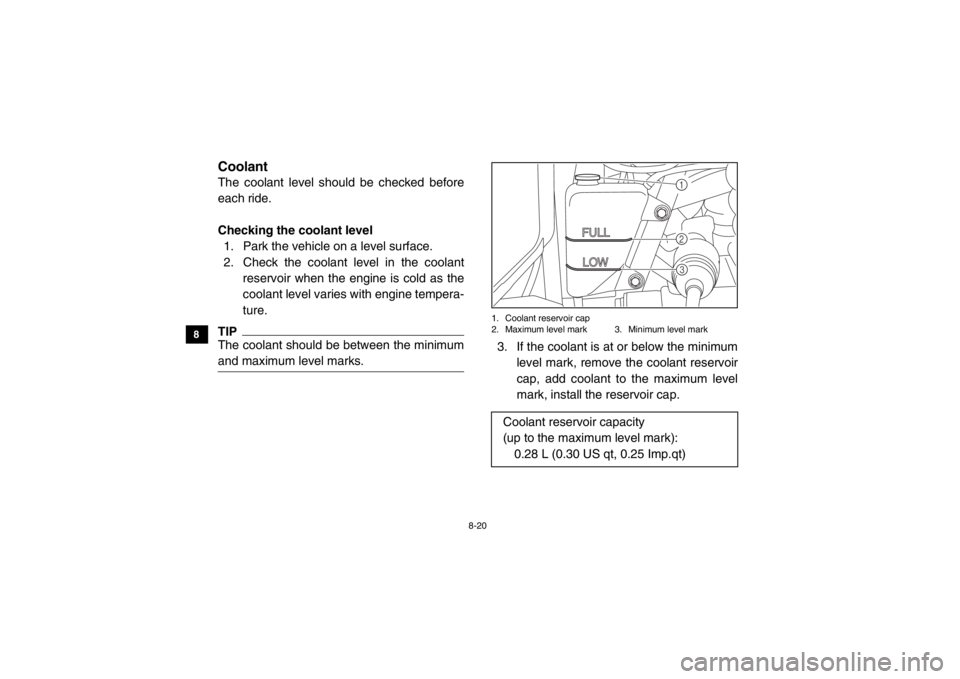
5B410015CoolantThe coolant level should be checked before
each ride.
Checking the coolant level 1. Park the vehicle on a level surface.
2. Check the coolant level in the coolant
reservoir when the engine is cold as the
coolant level varies with engine tempera-
ture. TIPThe coolant should be between the minimum
and maximum level marks.
1. Coolant reservoir cap
2. Maximum level mark 3. Minimum level mark3. If the coolant is at or below the minimum level mark, remove the coolant reservoir
cap, add coolant to the maximum level
mark, install the reservoir cap.
Coolant reservoir capacity
(up to the maximum level mark): 0.28 L (0.30 US qt, 0.25 Imp.qt)
123
1XP7C_EE.book Page 20 Monday, June 9, 2014 5:17 PM
Page 133 of 182
8-23
1
2
3
4
5
6
78
9
10
11
12
13
14
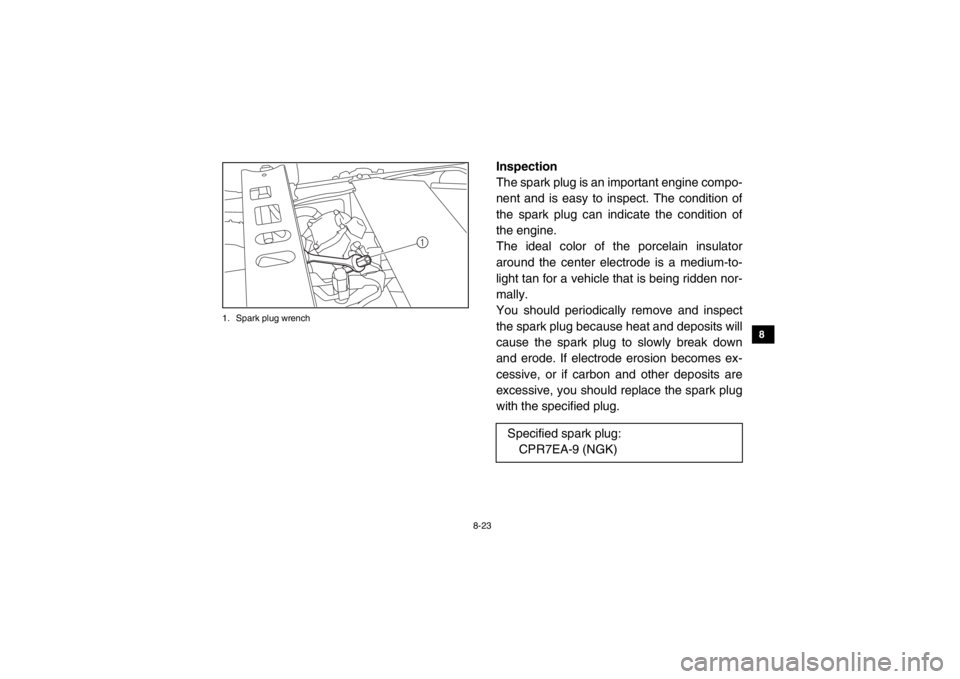
1. Spark plug wrench
Inspection
The spark plug is an important engine compo-
nent and is easy to inspect. The condition of
the spark plug can indicate the condition of
the engine.
The ideal color of the porcelain insulator
around the center electrode is a medium-to-
light tan for a vehicle that is being ridden nor-
mally.
You should periodically remove and inspect
the spark plug because heat and deposits will
cause the spark plug to slowly break down
and erode. If electrode erosion becomes ex-
cessive, or if carbon and other deposits are
excessive, you should replace the spark plug
with the specified plug.
1
Specified spark plug:CPR7EA-9 (NGK)
1XP7C_EE.book Page 23 Monday, June 9, 2014 5:17 PM
Page 135 of 182
8-25
1
2
3
4
5
6
78
9
10
11
12
13
14
5B410016Cleaning the air filter elementThe air filter element should be cleaned every
20–40 hours. It should be cleaned and lubri-
cated more often if the vehicle is operated in
extremely dusty areas. Each time air filter ele-
ment maintenance is performed, check the air
inlet to the air filter case for obstructions.
Check the air filter element rubber joint to the
throttle body and manifold fittings for an air-
tight seal. Tighten all fittings securely to avoid
the possibility of unfiltered air entering the en-
gine.NOTICENever operate the engine with the air filter
element removed. Doing so would allow
unfiltered air to enter, causing rapid en-
gine wear and possible engine damage.
Additionally, the fuel injection system
would be affected, resulting in poor engine
performance and possible overheating.
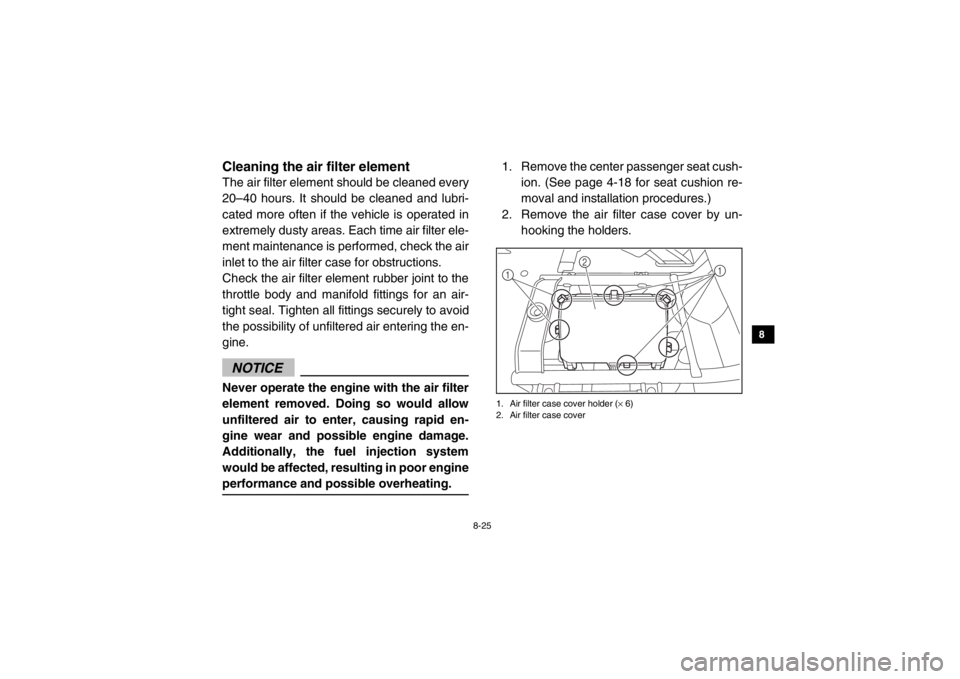
1. Remove the center passenger seat cush-
ion. (See page 4-18 for seat cushion re-
moval and installation procedures.)
2. Remove the air filter case cover by un- hooking the holders.1. Air filter case cover holder ( × 6)
2. Air filter case cover
2
1 1
1XP7C_EE.book Page 25 Monday, June 9, 2014 5:17 PM
Page 140 of 182
8-30
8
9
10
11
12
13
14
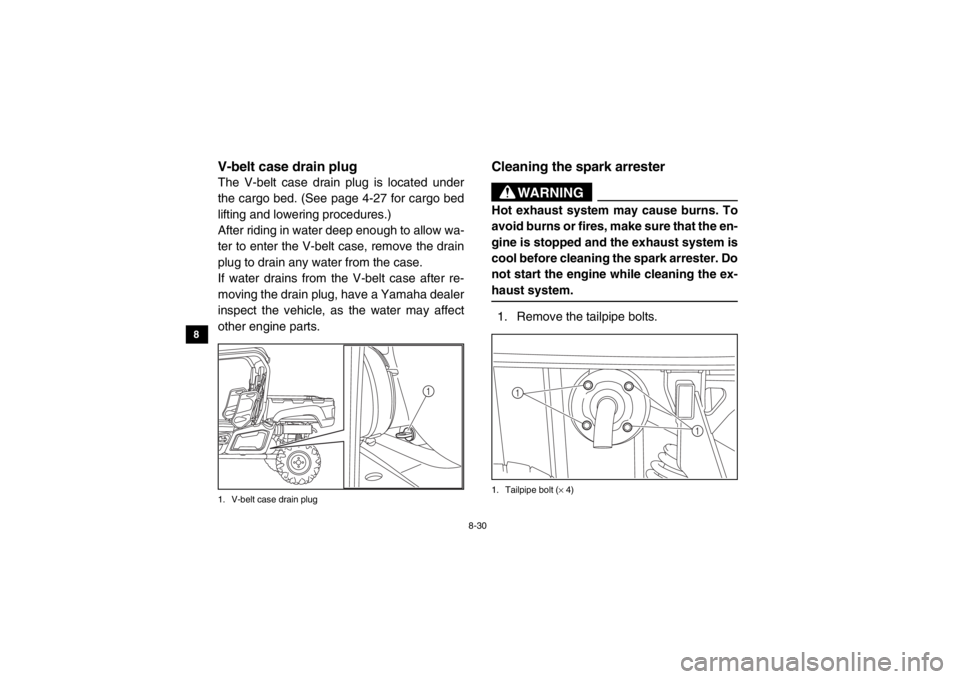
EVU00780V-belt case drain plugThe V-belt case drain plug is located under
the cargo bed. (See page 4-27 for cargo bed
lifting and lowering procedures.)
After riding in water deep enough to allow wa-
ter to enter the V-belt case, remove the drain
plug to drain any water from the case.
If water drains from the V-belt case after re-
moving the drain plug, have a Yamaha dealer
inspect the vehicle, as the water may affect
other engine parts.1. V-belt case drain plug
5B410018Cleaning the spark arrester
WARNING
Hot exhaust system may cause burns. To
avoid burns or fires, make sure that the en-
gine is stopped and the exhaust system is
cool before cleaning the spark arrester. Do
not start the engine while cleaning the ex-
haust system.1. Remove the tailpipe bolts.1. Tailpipe bolt ( × 4)
1
1
1
1XP7C_EE.book Page 30 Monday, June 9, 2014 5:17 PM
Page 141 of 182
8-31
1
2
3
4
5
6
78
9
10
11
12
13
14
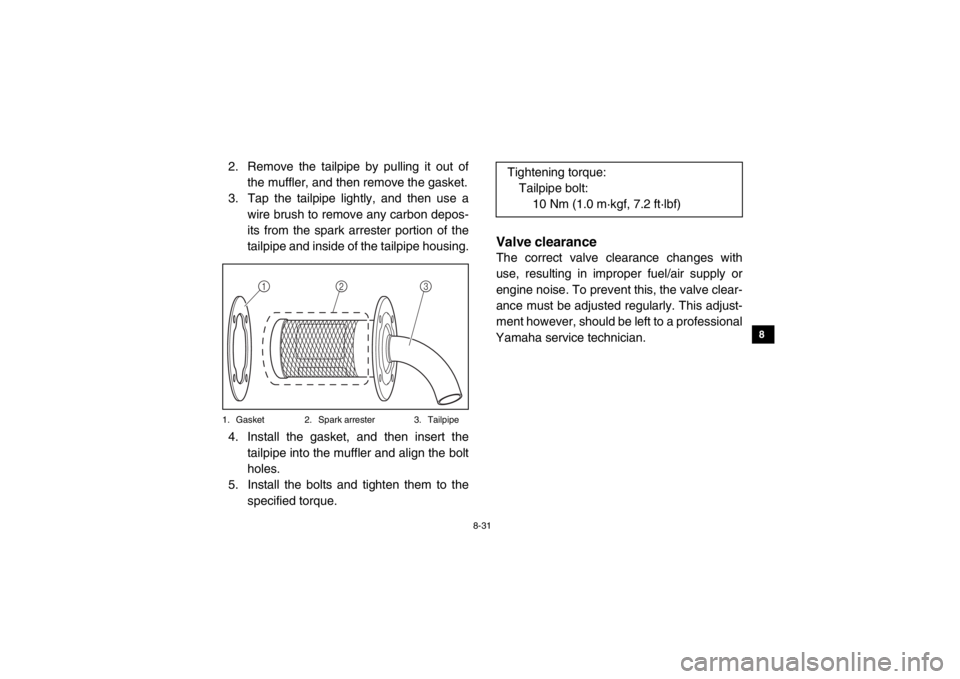
2. Remove the tailpipe by pulling it out ofthe muffler, and then remove the gasket.
3. Tap the tailpipe lightly, and then use a
wire brush to remove any carbon depos-
its from the spark arrester portion of the
tailpipe and inside of the tailpipe housing.1. Gasket 2. Spark arrester 3. Tailpipe4. Install the gasket, and then insert thetailpipe into the muffler and align the bolt
holes.
5. Install the bolts and tighten them to the specified torque.
Valve clearanceThe correct valve clearance changes with
use, resulting in improper fuel/air supply or
engine noise. To prevent this, the valve clear-
ance must be adjusted regularly. This adjust-
ment however, should be left to a professional
Yamaha service technician.
3
2
1
Tightening torque:
Tailpipe bolt:
10 Nm (1.0 m·kgf, 7.2 ft·lbf)
1XP7C_EE.book Page 31 Monday, June 9, 2014 5:17 PM
Page 157 of 182
8-47
1
2
3
4
5
6
78
9
10
11
12
13
14
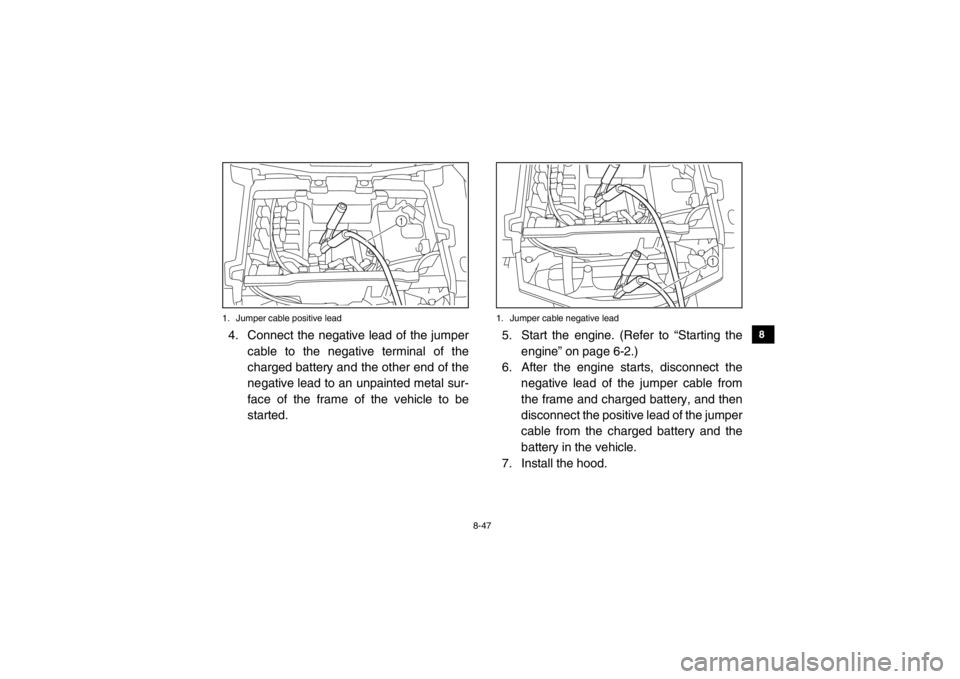
1. Jumper cable positive lead4. Connect the negative lead of the jumpercable to the negative terminal of the
charged battery and the other end of the
negative lead to an unpainted metal sur-
face of the frame of the vehicle to be
started.
1. Jumper cable negative lead5. Start the engine. (Refer to “Starting the engine” on page 6-2.)
6. After the engine starts, disconnect the negative lead of the jumper cable from
the frame and charged battery, and then
disconnect the positive lead of the jumper
cable from the charged battery and the
battery in the vehicle.
7. Install the hood.
1
1
1XP7C_EE.book Page 47 Monday, June 9, 2014 5:17 PM
Page 167 of 182
8-57
1
2
3
4
5
6
78
9
10
11
12
13
14
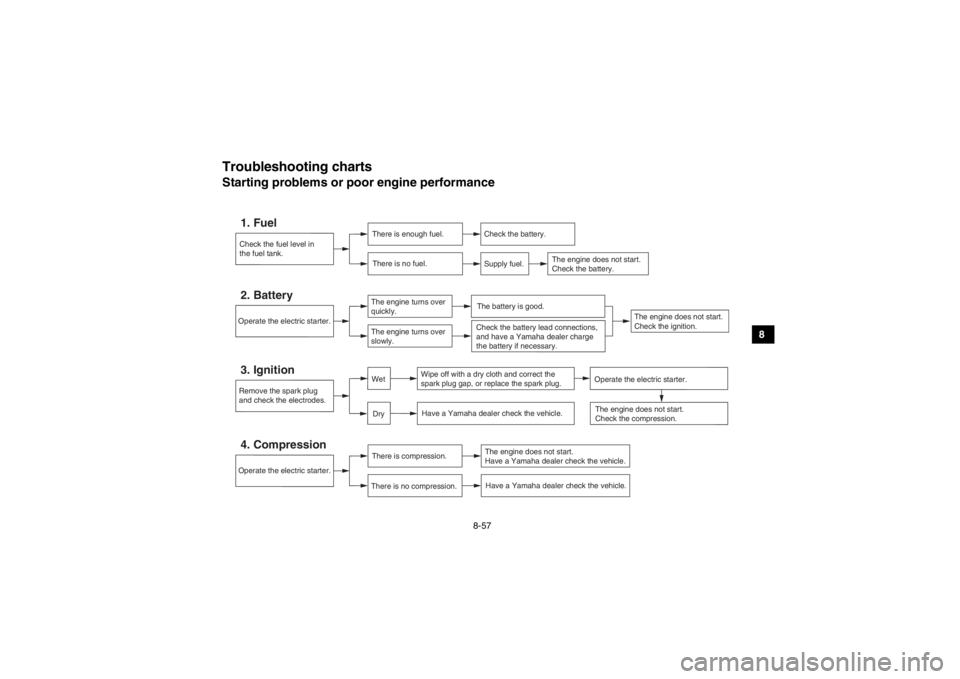
5B410024Troubleshooting chartsStarting problems or poor engine performance
Check the fuel level in
the fuel tank.1. Fuel
There is enough fuel.There is no fuel.
Check the battery.
Supply fuel.
The engine does not start.
Check the battery.
Operate the electric starter.4. Compression
There is compression.
There is no compression.
The engine does not start.
Have a Yamaha dealer check the vehicle.Have a Yamaha dealer check the vehicle.
Remove the spark plug
and check the electrodes.3. Ignition
Wipe off with a dry cloth and correct the
spark plug gap, or replace the spark plug. Have a Yamaha dealer check the vehicle.
The engine does not start.
Check the compression.
Operate the electric starter.2. Battery
The engine turns over
quickly.
The engine turns over
slowly.
The battery is good.
DryWet
Operate the electric starter.
Check the battery lead connections,
and have a Yamaha dealer charge
the battery if necessary.
The engine does not start.
Check the ignition.
1XP7C_EE.book Page 57 Monday, June 9, 2014 5:17 PM