Page 99 of 182
7-15
1
2
3
4
5
67
8
9
10
11
12
13
14
Wear eye protection when operating or riding
the vehicle to reduce the risk of a serious ac-
cident or injury. Eye protection, such as a face
shield or goggles, may reduce the risk of for-
eign material getting in your eyes and help
prevent loss of vision.
Practice for new Yamaha Viking users
You should become familiar with the perfor-
mance characteristics of the vehicle in a large,
flat area that is free of obstacles and other ve-
hicles. Practice controlling the accelerator
pedal, brakes, steering, and drive select lever.
Drive at slow speeds with gradual accelera-
tion and turning. Practice smooth throttle ap-
plication. Practice slowing down before
turning. Practice maintaining a steady throttle
through the turn. Avoid higher speeds until
you are thoroughly familiar with the operation
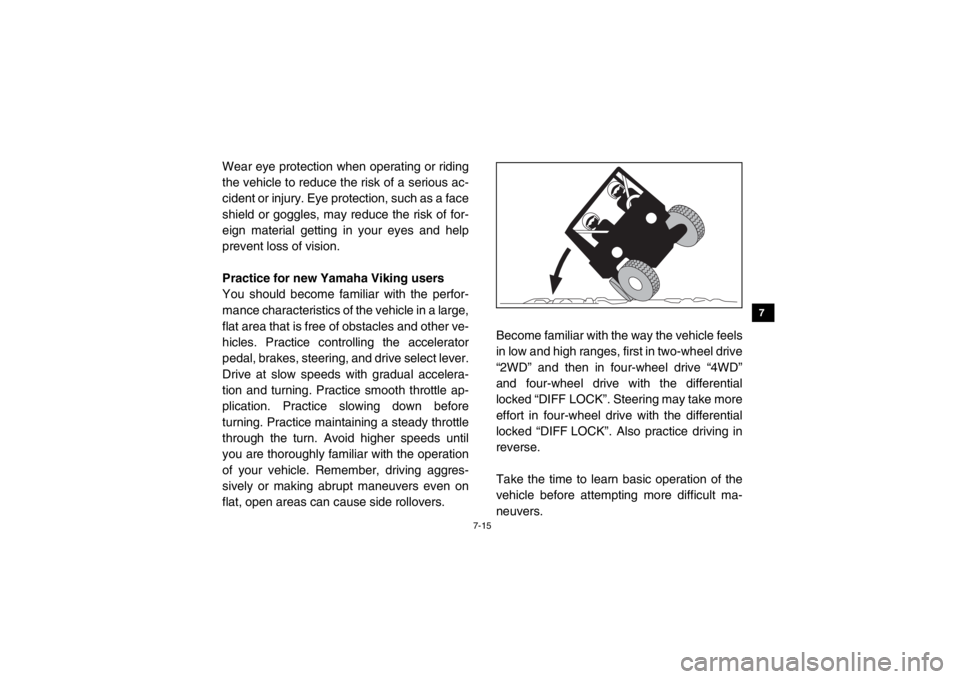
of your vehicle. Remember, driving aggres-
sively or making abrupt maneuvers even on
flat, open areas can cause side rollovers.Become familiar with the way the vehicle feels
in low and high ranges, first in two-wheel drive
“2WD” and then in four-wheel drive “4WD”
and four-wheel drive with the differential
locked “DIFF LOCK”. Steering may take more
effort in four-wheel drive with the differential
locked “DIFF LOCK”. Also practice driving in
reverse.
Take the time to learn basic operation of the
vehicle before attempting more difficult ma-
neuvers.1XP7C_EE.book Page 15 Monday, June 9, 2014 5:17 PM
Page 101 of 182

7-17
1
2
3
4
5
67
8
9
10
11
12
13
14
If you think or feel that the vehicle may tip or
roll, keep your body completely inside the pro-
tective structure of the vehicle:●
Brace yourself by pressing your feet firmly
on the floorboard and keep a firm grip on
the steering wheel or passenger handhold.
●
Do not put your hands or feet outside of the
vehicle for any reason. Do not try to stop a
tipover using your arm or leg.Accelerating
With the engine idling in neutral and your foot
on the brake, shift the drive select lever into
low or high.
NOTICE: Do not shift from low
to high or vice versa without coming to a
complete stop and waiting for the engine
to return to normal idle speed – damage to
the engine or drive train may occur. Then
release the parking brake. Press the accel-
erator pedal slowly and smoothly. The centrif-
ugal clutch will engage and the vehicle will
begin to accelerate.
Avoid higher speeds and sudden or hard ac-
celeration until you are thoroughly familiar
with the operation of your vehicle. Avoid sud-
den or hard acceleration in any turn.
1XP7C_EE.book Page 17 Monday, June 9, 2014 5:17 PM
Page 102 of 182
7-18
7
8
9
10
11
12
13
14
Braking
When slowing down or stopping, take your
foot off the accelerator pedal and press the
brake pedal smoothly. Improper use of the
brakes can cause the tires to lose traction, re-
ducing control of the vehicle and increasing
the possibility of an accident.
Braking ability is affected by type of terrain. In
most cases, gradual application of the brakes
is more effective than abrupt braking, particu-
larly on loose surfaces, such as gravel. Al-
ways allow for greater braking distance on
rough, loose, or slippery surfaces. Engine braking
Engine compression braking is designed to
assist you when operating your Viking off-
road. With this feature, the engine helps slow
the vehicle down after you take your foot off
the accelerator. Engine braking is more no-
ticeable in four-wheel drive. Application of ve-
hicle brakes provides additional stopping
power.1XP7C_EE.book Page 18 Monday, June 9, 2014 5:17 PM
Page 103 of 182

7-19
1
2
3
4
5
67
8
9
10
11
12
13
14
Leaving the vehicle
Do not get out of the vehicle while the engine
is running and the drive select lever is in any
gear. There is a risk of injury because:●
Children or others may accidentally press
the accelerator pedal.
●
Objects tossed into the vehicle may strike
the accelerator pedal.
●
The parking brake may not keep the vehi-
cle from accelerating.
Unwanted vehicle movement can cause seri-
ous injury or death, and it may be dangerous
to try to stop the vehicle. Parking on a flat area
When parking on a flat area, stop the engine
and shift the drive select lever into the neutral
position. Apply the parking brake to help pre-
vent the vehicle from rolling.
Parking on a slope
The parking brake acts only on the rear
wheels when in “2WD”. For the parking brake
to take effect on all four wheels, shift to
“DIFF LOCK” before stopping the engine.
If you park on a hill that is too steep the vehi-
cle may roll out of control. Never park on hills
that are so steep you cannot walk up them
easily. If you must park on an incline follow
these instructions:
1. Bring the vehicle to a stop by applying the
brake pedal.
2. Put the vehicle in “DIFF LOCK”.
3. Turn the key to “ ” (off).
1XP7C_EE.book Page 19 Monday, June 9, 2014 5:17 PM
Page 104 of 182

7-20
7
8
9
10
11
12
13
14
4. With the brake pedal applied, set the parking brake.
5. Block the front and rear wheels with
rocks or other objects.
Loading
The total weight of operator, passengers, ac-
cessories, cargo, trailer tongue weight, and
the vehicle itself must not exceed 1080 kg
(2381 lb). Vehicle loading can affect handling.
See “Loading” on page 6-8.
Operation on differe nt surfaces and
terrainsGo slowly and proceed with caution when op-
erating on an unfamiliar surface or terrain.
This vehicle may handle differently in certain
types of terrains or on certain surfaces. You
may come upon hidden rocks, bumps, or
holes without enough time to react. To avoid
loss of control or rollover, always be alert to
changing surfaces or terrain when operating
the vehicle.
Your Yamaha Viking has higher ground clear-
ance and other features to handle rugged ter-
rain, and as a result, can overturn in situations
where some vehicles may not. Abrupt maneu-
vers or aggressive driving can cause loss of
control, including rollovers – even on flat,
open areas. These rollovers can result in
crushed limbs and other serious injuries or
death to drivers or passengers.
1XP7C_EE.book Page 20 Monday, June 9, 2014 5:17 PM
Page 106 of 182

7-22
7
8
9
10
11
12
13
14
Uphill
Do not attempt to climb hills until you have
mastered basic maneuvers on flat ground.
Drive straight up hills, and avoid crossing the
side of a hill, which increases your risk of roll-
over. Practice first on gentle slopes before at-
tempting steeper hills. Always check the
terrain carefully before attempting any hill.
To climb a hill, you need traction, momentum,
and steady throttle. For more traction and
control for climbing steeper and/or rougher
slopes, shift into low gear and select “4WD” or
“DIFF LOCK”. Travel fast enough to maintain
momentum, but not so fast that you cannot re-
act to changes in the terrain as you climb. Slow down when you reach the crest of the hill
if you cannot see clearly what is on the other
side – there could be another person, an ob-
stacle, or a sharp drop-off.
If you start to lose traction or momentum
when climbing, and decide you will be unable
to continue, use the brakes to stop. Do not at-
tempt to turn the vehicle around. With your
foot on the brake pedal, look behind you and
plan your descent. Shift the drive select lever
into reverse so you can use engine braking to
slow your descent. Release the brake and be-
gin to coast down the hill. Use engine braking
as much as possible, gently applying the
brakes when necessary.1XP7C_EE.book Page 22 Monday, June 9, 2014 5:17 PM
Page 107 of 182

7-23
1
2
3
4
5
67
8
9
10
11
12
13
14
Downhill
Check the terrain carefully before going
downhill. When possible, choose a path that
lets you drive your vehicle straight downhill.
Choose your path carefully and drive slowly
enough to be able to react to obstacles that
you encounter.
For more traction and control, before going
down steeper and/or rougher slopes, shift into
low gear and select “4WD” or “DIFF LOCK”.
Engine braking will help you go downhill slow-
ly. Go as slowly as possible. If you begin to go
too fast, apply the brakes gently. Avoid hard
application of the brakes, which could cause
the vehicle to slide.If you are sliding or skidding, try to steer in the
direction the vehicle is sliding, to regain con-
trol. For example, if you feel the back of the
vehicle start to slide to your right, steer to the
right.
If you must turn on the hill to avoid an obsta-
cle, do so slowly and carefully. If the vehicle
starts to tip, immediately steer in the downhill
direction if there are no obstacles in your path.
As you regain proper balance, gradually steer
again in the direction you want to go.1XP7C_EE.book Page 23 Monday, June 9, 2014 5:17 PM
Page 108 of 182

7-24
7
8
9
10
11
12
13
14
Rough terrain
Operation over rough terrain should be done
with caution.●
Look for and avoid obstacles that could
cause damage to the vehicle or could lead
to a rollover or accident.
●
Do not drive in a way that will get the vehi-
cle airborne, as injury, loss of control, and
damage to the vehicle could occur.
Pavement
This vehicle is designed for off-road use only.
Avoid paved surfaces. Turn gradually and go
slowly if you must drive on pavement. Water
If you must cross shallow, slow-moving water
up to the depth of the vehicle’s floorboard,
choose your path carefully to avoid sharp
drop-offs, large rocks, or slippery surfaces
that could cause the vehicle to overturn. Nev-
er operate through water deeper than 37 cm
(15 in) or fast-flowing water. Choose a path
where both your entrance into and exit point
from the water is a gradual incline. Determine
the water depth and currents before crossing.
Operating this vehicle through deep or fast-
flowing water can lead to loss of control or
overturn. To reduce your risk of drowning or
other injuries, use care when crossing
through water.
Wet brakes may have reduced effectiveness.
After leaving the water, test your brakes. If
necessary, apply the brakes several times to
let friction dry out the linings.
1XP7C_EE.book Page 24 Monday, June 9, 2014 5:17 PM