Page 87 of 182
7-3
1
2
3
4
5
67
8
9
10
11
12
13
14
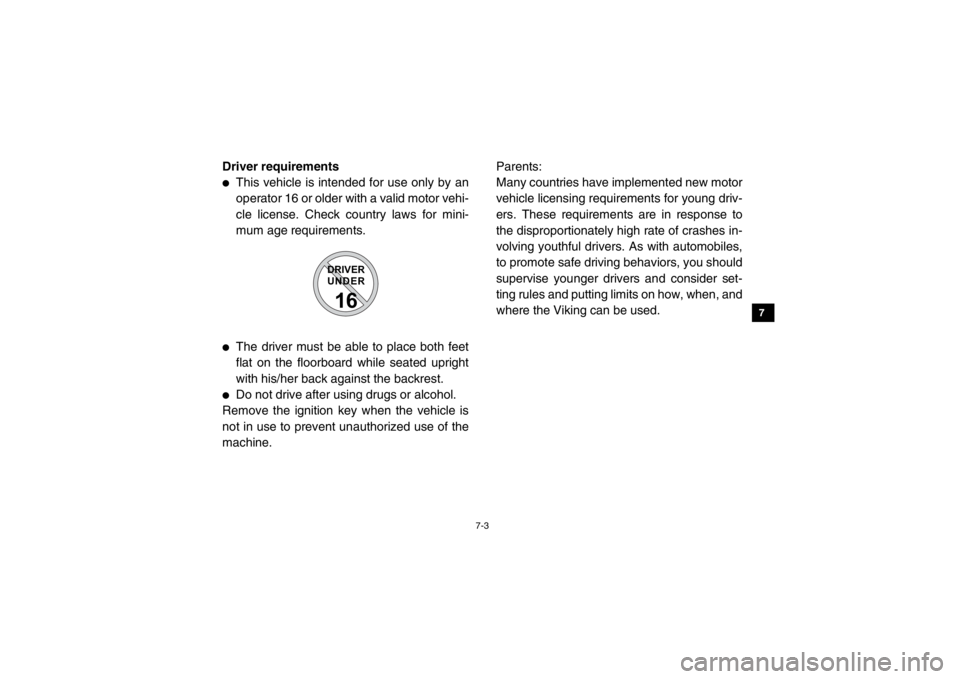
Driver requirements●
This vehicle is intended for use only by an
operator 16 or older with a valid motor vehi-
cle license. Check country laws for mini-
mum age requirements.
●
The driver must be able to place both feet
flat on the floorboard while seated upright
with his/her back against the backrest.
●
Do not drive after using drugs or alcohol.
Remove the ignition key when the vehicle is
not in use to prevent unauthorized use of the
machine. Parents:
Many countries have implemented new motor
vehicle licensing requirements for young driv-
ers. These requirements are in response to
the disproportionately high rate of crashes in-
volving youthful drivers. As with automobiles,
to promote safe driving behaviors, you should
supervise younger drivers and consider set-
ting rules and putting limits on how, when, and
where the Viking can be used.
DRIVER
UNDER16
1XP7C_EE.book Page 3 Monday, June 9, 2014 5:17 PM
Page 103 of 182

7-19
1
2
3
4
5
67
8
9
10
11
12
13
14
Leaving the vehicle
Do not get out of the vehicle while the engine
is running and the drive select lever is in any
gear. There is a risk of injury because:●
Children or others may accidentally press
the accelerator pedal.
●
Objects tossed into the vehicle may strike
the accelerator pedal.
●
The parking brake may not keep the vehi-
cle from accelerating.
Unwanted vehicle movement can cause seri-
ous injury or death, and it may be dangerous
to try to stop the vehicle. Parking on a flat area
When parking on a flat area, stop the engine
and shift the drive select lever into the neutral
position. Apply the parking brake to help pre-
vent the vehicle from rolling.
Parking on a slope
The parking brake acts only on the rear
wheels when in “2WD”. For the parking brake
to take effect on all four wheels, shift to
“DIFF LOCK” before stopping the engine.
If you park on a hill that is too steep the vehi-
cle may roll out of control. Never park on hills
that are so steep you cannot walk up them
easily. If you must park on an incline follow
these instructions:
1. Bring the vehicle to a stop by applying the
brake pedal.
2. Put the vehicle in “DIFF LOCK”.
3. Turn the key to “ ” (off).
1XP7C_EE.book Page 19 Monday, June 9, 2014 5:17 PM
Page 153 of 182
8-43
1
2
3
4
5
6
78
9
10
11
12
13
14
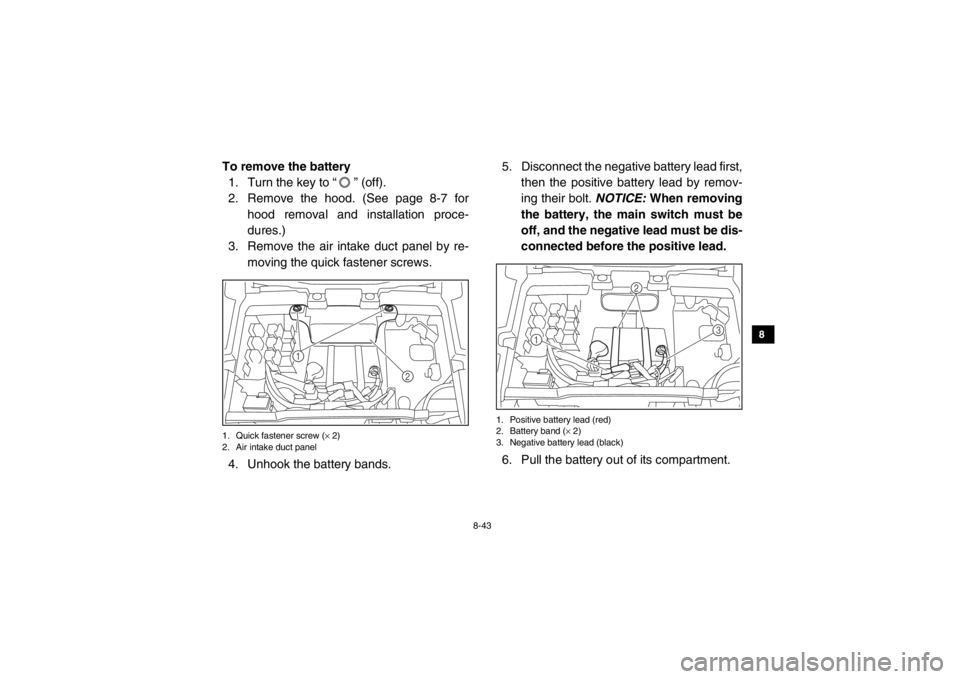
To remove the battery1. Turn the key to “ ” (off).
2. Remove the hood. (See page 8-7 for hood removal and installation proce-
dures.)
3. Remove the air intake duct panel by re-
moving the quick fastener screws.1. Quick fastener screw ( × 2)
2. Air intake duct panel4. Unhook the battery bands. 5. Disconnect the negative battery lead first,
then the positive battery lead by remov-
ing their bolt. NOTICE: When removing
the battery, the main switch must be
off, and the negative lead must be dis-
connected before the positive lead.
1. Positive battery lead (red)
2. Battery band ( × 2)
3. Negative battery lead (black)6. Pull the battery out of its compartment.
2
1
2
1
3
1XP7C_EE.book Page 43 Monday, June 9, 2014 5:17 PM
Page 156 of 182
8-46
8
9
10
11
12
13
14
5B410022Jump-startingJump-starting the vehicle should be avoided.
The battery should be removed and charged
instead.
WARNING
To avoid battery explosion and/or serious
damage to the electrical system:●
Do not connect the negative lead of
the jumper cable to the negative termi-
nal of the battery.
●
Do not touch the positive lead of the
jumper cable to the negative lead.
●
Do not reverse the polarity of the
jumper cables when connecting to the
batteries.
However, if the vehicle must be jump-started,
proceed as follows. 1. Turn the key to “ ” (off).
2. Remove the hood. (See page 8-7 for
hood removal and installation proce-
dures.)
3. Using a charged 12-volt battery, connect the positive lead of the jumper cable to
the positive terminal of the battery in the
vehicle and the other end of the positive
lead to the positive terminal of the
charged battery.
1XP7C_EE.book Page 46 Monday, June 9, 2014 5:17 PM
Page 158 of 182
8-48
8
9
10
11
12
13
14
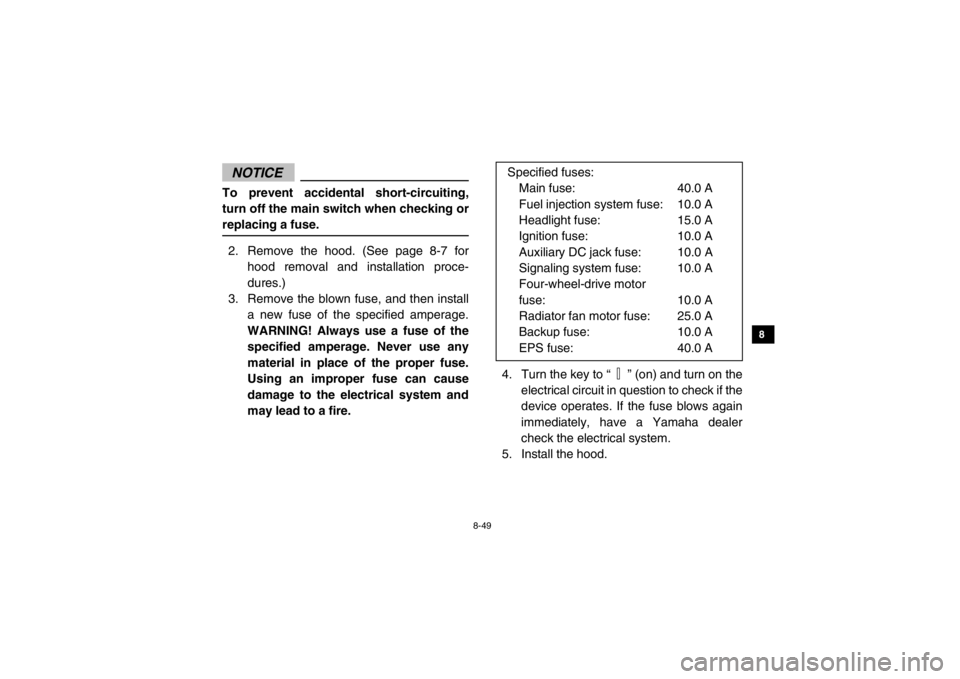
5B410023Fuse replacementThe main fuse, the fuel injection system fuse,
the EPS fuse, and the fuse box are located
under the hood.1. Fuse box 2. Main fuse
3. EPS fuse
4. Fuel injection system fuse
5. Fuel injection system spare fuse 1. Backup fuse “BACK UP” (for clock)
2. Ignition fuse “IGNITION”
3. Four-wheel-drive motor fuse “DIFF”
4. Auxiliary DC jack fuse “TERMINAL”
5. Signaling system fuse “SIGNAL”
6. Headlight fuse “HEAD”
7. Spare fuse (
× 3)
8. Radiator fan motor fuse “FAN”
If a fuse is blown, replace it as follows.
1. Turn the key to “ ” (off) and turn off the
electrical circuit in question.
1 3
2
4
5
1
2
3
4
5
6
8
7
7
1XP7C_EE.book Page 48 Monday, June 9, 2014 5:17 PM
Page 159 of 182
8-49
1
2
3
4
5
6
78
9
10
11
12
13
14
NOTICETo prevent accidental short-circuiting,
turn off the main switch when checking or
replacing a fuse.2. Remove the hood. (See page 8-7 forhood removal and installation proce-
dures.)
3. Remove the blown fuse, and then install a new fuse of the specified amperage.
WARNING! Always use a fuse of the specified amperage. Never use any
material in place of the proper fuse.
Using an improper fuse can cause
damage to the electrical system and
may lead to a fire. 4. Turn the key to “ ” (on) and turn on the
electrical circuit in question to check if the
device operates. If the fuse blows again
immediately, have a Yamaha dealer
check the electrical system.
5. Install the hood. Specified fuses:
Main fuse: 40.0 A
Fuel injection system fuse: 10.0 A
Headlight fuse: 15.0 A
Ignition fuse: 10.0 A
Auxiliary DC jack fuse: 10.0 A
Signaling system fuse: 10.0 A
Four-wheel-drive motor
fuse: 10.0 A
Radiator fan motor fuse: 25.0 A
Backup fuse: 10.0 A
EPS fuse: 40.0 A
1XP7C_EE.book Page 49 Monday, June 9, 2014 5:17 PM