2015 VOLVO XC60 power steering
[x] Cancel search: power steeringPage 303 of 406

07 During your trip
Towing a trailer
07
301
FunctionA vehicle towing a trailer may begin to sway for various reasons. Normally this only occursat high speeds but, for example, if the traileris overloaded or if the load is unevenly dis-tributed in the trailer, there is risk of swayingat speeds between approximately 45-55 mph(70-90 km/h). Swaying may be caused by factors such as: •The vehicle and trailer are hit by a sud- den, strong crosswind
• The vehicle and trailer are traveling on anuneven road surface or drive over a bump
• Sudden movements of the steering wheel
Facts about TSA
•
TSA intervenes at speeds above approxi-mately 40 mph (60 km/h)
• The DSTC symbol (
) in the instru-
ment panel will flash when TSA is working
• If the driver switches off the DSTC sys- tem's Spin Control function, TSA will alsobe switched off (but will be on again thenext time the engine is started)
• TSA may not intervene when the vehicleand trailer begin to sway if the driver triesto compensate for the swaying motion bymoving the steering wheel rapidly
How TSA worksOnce swaying has begun, it can be very diffi- cult to stop, which makes it difficult to controlthe vehicle and trailer. The TSA system continuously monitors the vehicle's movements, particularly lateralmovement. If the system detects a tendencyto sway, the brakes are applied individuallyon the front wheels, which has a stabilizingeffect on the vehicle and trailer. This is oftenenough to enable the driver to regain controlof the vehicle. If this is not adequate to stop the swaying motion, the brakes are applied to all of thewheels on the vehicle and on the trailer if it isequipped with brakes, and engine power istemporarily reduced. As the swaying motionbegins to decrease and the vehicle-trailerhave once again become stable, TSA will nowstop regulating the brakes/engine power andthe driver regains control of the vehicle.
Page 304 of 406

07 During your trip
Emergency towing
07
302
Towing eyelet
Location of the towing eyelet
Attaching the towing eyelet
Attaching the towing eyeletThe towing eyelet is located under the floor of the cargo area, with the spare tireand may be partially concealed. This eye-let must be screwed into the positionsprovided on the right sides of either thefront or rear bumper (see illustration).
There are two different types of covers over the openings for the towing eyeletand they have to be opened differently.
• If the cover has a notch, insert a coin, etc., into the notch and pry open theedge of the cover. Open the covercompletely and remove it.
• If the cover has a mark along one edgeor in a corner, press the mark whileprying out the opposite side/cornerusing a coin, etc. Open the cover andremove it.
Screw the towing eyelet in place, first by hand and then using the tire iron until it issecurely in place. After the vehicle has been towed, the eyelet should be removed and returned to its stor-age location. Press the cover for the attachment point back into position.
WARNING
• When the vehicle is being towed, the ignition should be in mode
II (in mode
I , all of the vehicle's airbags are deac-
tivated). See page 89 for more infor-mation about ignition modes.
• Never remove the remote key from theignition slot when the vehicle is beingtowed. For vehicles with keyless drive,the remote key must remain inside thevehicle.
• The power brakes and power steeringwill not function when the engine is notrunning. Approximately 5 times morepressure will be required on the brakepedal and the steering wheel will beconsiderably harder to turn.
• The towing eyelets must not be usedfor pulling the vehicle out of a ditch orfor any similar purpose involvingsevere strain.
Page 344 of 406

09 Maintenance and specifications
Hood and engine compartment 09
342
Opening and closing the hood
G031911
Pull the lever located under the left side of the dash to release the hood lock. Aninformation symbol will illuminate whenthe hood is open.
Lift the hood slightly. Press the release control (located under the right front edgeof the hood) to the left, and lift the hood.
WARNING
Check that the hood locks properly when closed.
Engine compartment, overview
Coolant expansion tank
Power steering fluid reservoir
Dipstick-engine oil
Filler cap-engine oil
Cover over brake fluid reservoir
Battery
Relay/fuse box
Washer fluid reservoir
Engine compartment - 4-cylinder engines only
Filler cap-engine oil
Coolant expansion tank
Power steering fluid reservoir
Radiator
Brake fluid reservoir
Battery
Relay/fuse box
Washer fluid reservoir
Air cleaner
The appearance of the engine compartment may vary depending on engine model.
Page 349 of 406

09 Maintenance and specifications
Fluids09
347
The brake fluid should always be between the MIN
and MAX marks on the inside of the res-
ervoir. Check, without removing the cap, thatthere is sufficient fluid in the reservoir. Fluid type : DOT 4 boiling point >536 °F
(280 °C), P/N 9437433Replace : The fluid should be replaced
according to the intervals specified in the Warranty and Service Records Informationbooklet. When driving under extremely hard condi- tions (mountain driving, etc), it may be neces-sary to replace the fluid more often. Consult atrained and qualified Volvo service technician. Always entrust brake fluid changing to a trained and qualified Volvo service technician.
WARNING
• If the fluid level is below the
MIN mark
in the reservoir or if a brake-related message is shown in the informationdisplay: DO NOT DRIVE . Have the car
towed to a trained and qualified Volvoservice technician and have the brakesystem inspected.
• Dot 4 should never be mixed with anyother type of brake fluid.
Filling1. Turn and open the cover.
2. Unscrew the reservoir cap and fill the
fluid. The level must be between the MIN
and MAX marks.
Power steering fluid
Check the level frequently. The fluid does not require changing. The fluid level must bebetween the MIN and MAX marks. For
capacities and recommended fluid grade, seepage 386.
WARNING
If a problem should occur in the power steering system or if the vehicle has noelectrical current and must be towed, it isstill possible to steer the vehicle. However,keep in mind that greater effort will berequired to turn the steering wheel.
CAUTION
Keep the area around the power steering fluid reservoir clean when checking.
Page 368 of 406

09 Maintenance and specifications
Fuses 09
366
PosFunctionA
Fuel leakage detection (5-/6-cyl. engines),control module forradiator shutter (5-cyl.engines)5
Fuel leakage detection, A/C relay (4-cyl.engines)15
Coolant pump (4-cyl. engines)50
Cooling fan60 (4/5- cyl.engines)
80 (6-cyl. engines)
Power steering100
AThis position is not used on vehicles with the optional Start/Stop function, refer to the table "Engine compart-ment cold zone" on page 371
Page 370 of 406
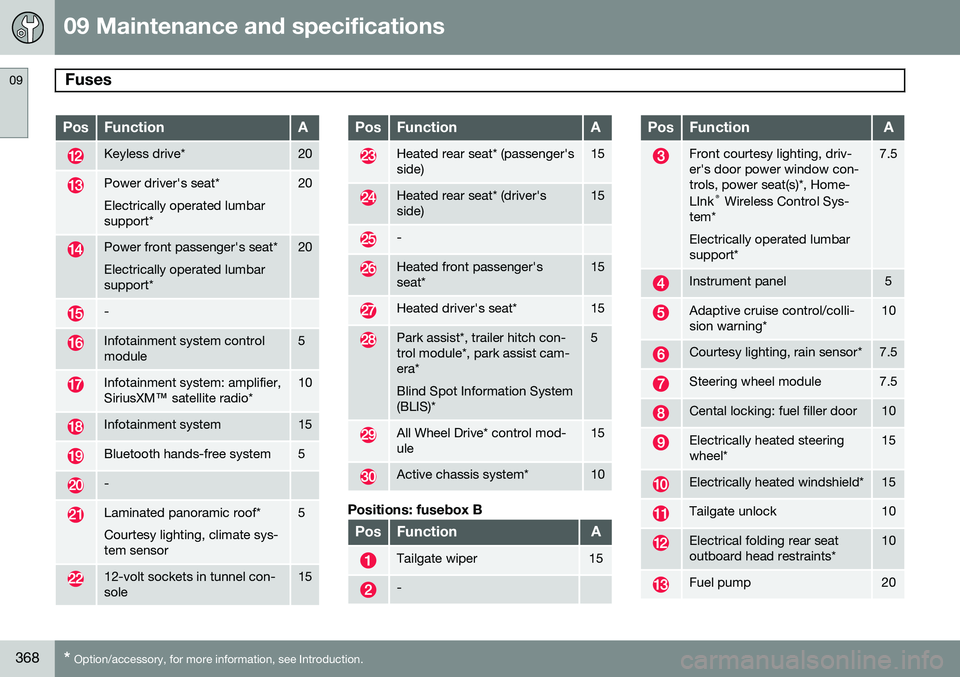
09 Maintenance and specifications
Fuses 09
368* Option/accessory, for more information, see Introduction.
PosFunctionA
Keyless drive*20
Power driver's seat* Electrically operated lumbar support*20
Power front passenger's seat* Electrically operated lumbar support*20
-
Infotainment system control module5
Infotainment system: amplifier, SiriusXM ™ satellite radio*10
Infotainment system15
Bluetooth hands-free system5
-
Laminated panoramic roof* Courtesy lighting, climate sys- tem sensor5
12-volt sockets in tunnel con- sole15
PosFunctionA
Heated rear seat* (passenger's side)15
Heated rear seat* (driver's side)15
-
Heated front passenger's seat*15
Heated driver's seat*15
Park assist*, trailer hitch con- trol module*, park assist cam-era* Blind Spot Information System (BLIS)*5
All Wheel Drive* control mod- ule15
Active chassis system*10
Positions: fusebox B
PosFunctionA
Tailgate wiper15
-
PosFunctionA
Front courtesy lighting, driv- er's door power window con-trols, power seat(s)*, Home- LInk ®
Wireless Control Sys-
tem* Electrically operated lumbar support*7.5
Instrument panel5
Adaptive cruise control/colli- sion warning*10
Courtesy lighting, rain sensor*7.5
Steering wheel module7.5
Cental locking: fuel filler door10
Electrically heated steering wheel*15
Electrically heated windshield*15
Tailgate unlock10
Electrical folding rear seat outboard head restraints*10
Fuel pump20
Page 389 of 406

10 Specifications
Specifications
10
}}
387
FluidSystemVolumeSpecification
Coolant3.2 (6-cyl.)/3.0T9.4 US qts. (8.9 liters)Coolant with corrosion inhibitor mixed with water (50/50 mix), see pack- aging.
All 4-cyl. engines8.8 US qts. (8.3 liters)
Air conditioningAll models1.6 lbs (720 g)Refrigerant: R134a (HFC134a), PAG oil
Brake fluid0.63 US qts (0.6 liters)DOT 4 boiling point >536 °F (>280 °C)
Power steering-Power steering fluid WSS M2C204-A2 or equivalent product.
Washer fluid6.8 US qts (6.5 liters) 4.7 US qts (4.5 litersB
)Use a washer antifreeze recommended by Volvo, mixed with water.
Fuel tank volume18.5 US gallons (70 liters)See page 287 for fuel recommendations
A Under normal driving conditions the transmission oil does not need changing during its service life. However, it may be necessary under adverse driving conditions.
B Models without headlight washers
Electrical system
General information
WARNING
PROPOSITION 65 WARNING! Battery posts, terminals, and related accessories contain lead and lead com-pounds, chemicals known to the state ofCalifornia to cause cancer and reproduc-tive harm. Wash hands after handling.
12 volt system with a voltage-regulated alter- nator. Single pole system in which the chas-sis and engine block are used as conductors.The negative terminal is connected to thechassis.
Page 401 of 406

11 Index
11
399
O
Occupant safety........................................ 16
Occupant weight sensor...................... 26, 27
Octane recommendations....................... 287
Odometer, trip........................................... 86Oilchecking............................................. 344
volumes.............................................. 386
Oil quality................................................. 385
OK button................................................ 207
On Call Roadside Assistance.................. 392
Outside temperature sensor...................... 85
Overhead courtesy lighting.............. 104, 105
Overheating, engine................................... 84
Oxygen sensors, heated.......................... 290
P
Paint, touching up.................................... 376
Park assist....................................... 192, 194
Park Assist Camera................................. 196 Parking brake
electric, applying/releasing................. 145
warning light......................................... 83
Parking lights........................................... 103
Pedestrian detection................................ 177Personal Car Communicator, unique
functions.................................................... 62
Polishing.................................................. 374Power front seat memory function................................... 91
with keyless drive................................. 92
Power meter............................................ 133
Power mirrors.......................................... 112 defroster............................................. 113
Power steering adjustable........................................... 231
fluid..................................................... 347
Power steering fluid................................. 386
Power tailgate.......................................... 291
Power windows....................................... 110 laminated glass................................... 111
Pregnancy, using seat belts during........... 20
PROPOSITION 65 WARNING.. 126, 360, 387
R
Radio SiriusXM ™ satellite radio.................... 252
Radio functions........................................ 248 HD digital radio................................... 250
Rain sensor.............................................. 107
Rear fog lights.................................. 103, 351
Rear park assist............................... 192, 194
Rear seat head restraints........................... 94Rear seats center head restraint............................. 94
folding................................................... 94
heated................................................. 219
Rearview mirror auto-dim function............................... 113
compass............................................. 115
Rear window defroster............................ 113
Recalls, child restraints.............................. 40
Refrigerant............................................... 386
Refueling.......................................... 286, 287 fuel filler cap....................................... 289
fuel filler door...................................... 288
fuel tank volume................................. 386
Registering child restraints........................ 40