Page 90 of 397
If the vehicle battery is too weak, the electrical seat adjustment controls may not work.
Starting the engine stops seat adjustment.
When entering and exiting the vehicle, be careful not to come into contact with any switches that could change the seat adjustment.
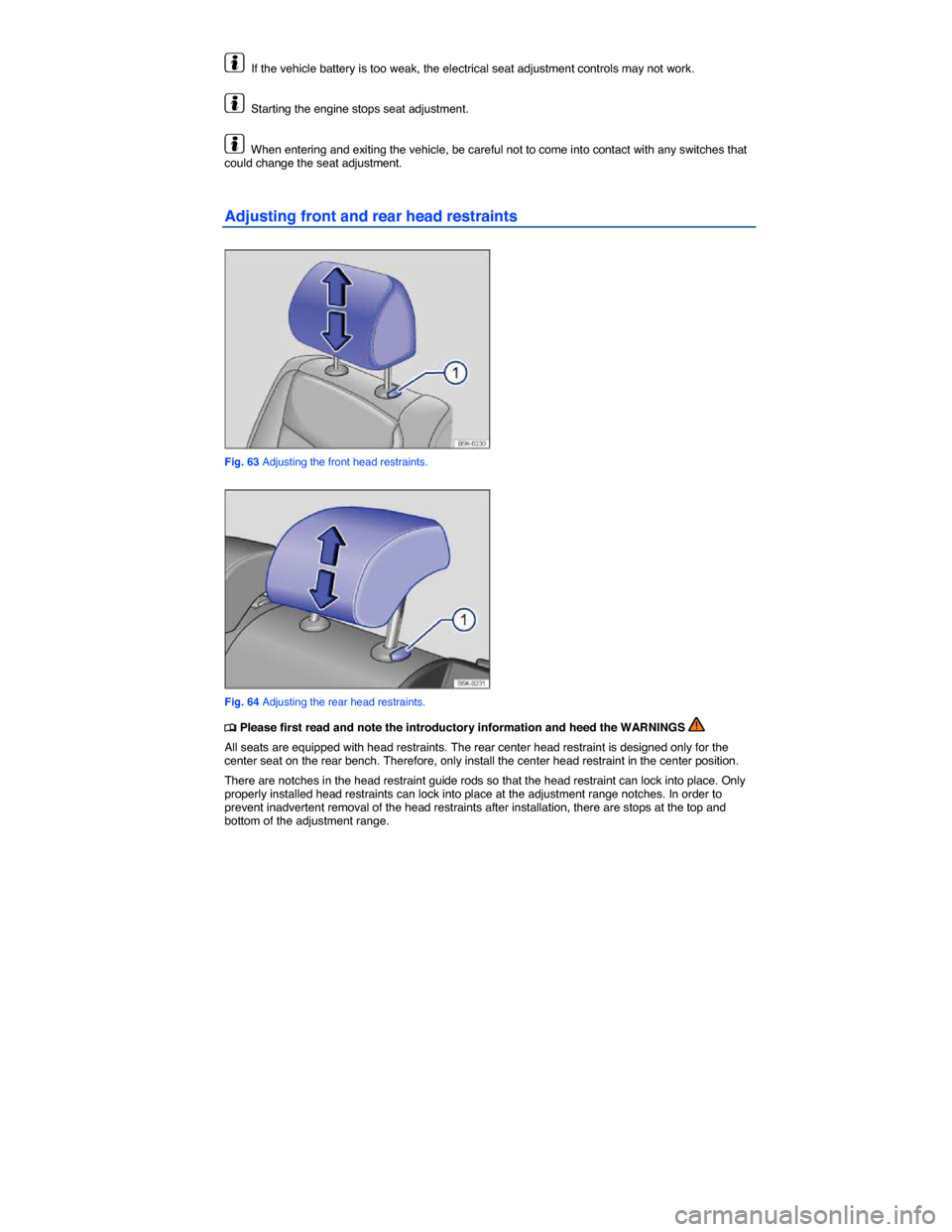
Adjusting front and rear head restraints
Fig. 63 Adjusting the front head restraints.
Fig. 64 Adjusting the rear head restraints.
Page 104 of 397
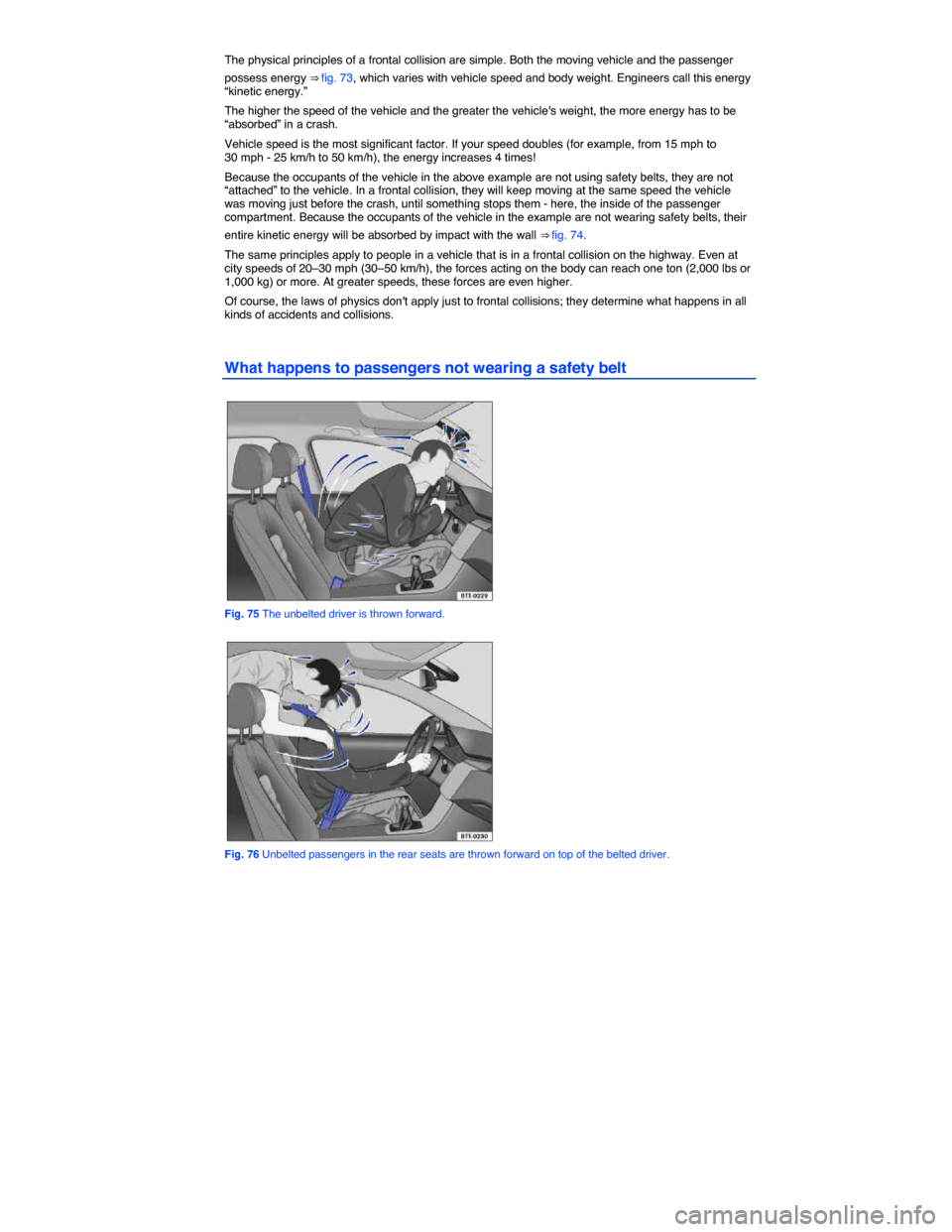
The physical principles of a frontal collision are simple. Both the moving vehicle and the passenger
possess energy ⇒ fig. 73, which varies with vehicle speed and body weight. Engineers call this energy “kinetic energy.”
The higher the speed of the vehicle and the greater the vehicle's weight, the more energy has to be “absorbed” in a crash.
Vehicle speed is the most significant factor. If your speed doubles (for example, from 15 mph to 30 mph - 25 km/h to 50 km/h), the energy increases 4 times!
Because the occupants of the vehicle in the above example are not using safety belts, they are not “attached” to the vehicle. In a frontal collision, they will keep moving at the same speed the vehicle was moving just before the crash, until something stops them - here, the inside of the passenger compartment. Because the occupants of the vehicle in the example are not wearing safety belts, their
entire kinetic energy will be absorbed by impact with the wall ⇒ fig. 74.
The same principles apply to people in a vehicle that is in a frontal collision on the highway. Even at city speeds of 20–30 mph (30–50 km/h), the forces acting on the body can reach one ton (2,000 lbs or 1,000 kg) or more. At greater speeds, these forces are even higher.
Of course, the laws of physics don't apply just to frontal collisions; they determine what happens in all kinds of accidents and collisions.
What happens to passengers not wearing a safety belt
Fig. 75 The unbelted driver is thrown forward.
Fig. 76 Unbelted passengers in the rear seats are thrown forward on top of the belted driver.
Page 128 of 397

NOTICE
To help prevent damage to the wiper blades and the wiper motor when it is cold outside, al-ways make sure that blades are not frozen to the windshield before operating the wipers. Using the service position can be helpful in cold weather so the wipers do not freeze to the wind-
shield ⇒ Windshield wiper service position.
x If the ignition is switched off while the wipers are running, the wipers will continue at the same wiping speed when the ignition is switched on again. Frost, ice, snow, leaves, and other objects on the windshield can damage the wipers and the wiper motor.
x Remove snow and ice from the wipers before you begin driving.
x If the wiper blades freeze to the windshield, loosen them carefully. Volkswagen recom-mends using a deicing spray.
NOTICE
Never switch on the windshield wipers when the windshield is dry because the windshield can be scratched.
The windshield wipers work only if the ignition is switched on and the engine hood is closed. The windshield wipers turn off automatically when the engine hood is opened.
The intermittent wiping for the front windshield depends on the driving speed. The higher the speed, the faster the wipers move.
If the wiper blades freeze to the windshield, loosen them carefully. Volkswagen recommends using a deicing spray.
Windshield wiper functions
Page 131 of 397
x Crack or chip in the windshield: If a stone hits and chips the windshield while the rain sensor is on, this will trigger a wiper cycle. After that, the rain sensor will recognize the change and re-calibrate itself to respond to the sensitive surface's reduced detection zone. Depending on the size of the chip, the sensor's reaction pattern may or may not change.
WARNING
The rain sensor cannot always recognize rain and activate the wipers.
x Switch the wipers on manually when water on the windshield reduces visibility.
Clean the rain sensor's sensitive surface ⇒ fig. 109 (arrow) regularly and check the wiper blades for wear or damage.
To remove wax and coats of polish safely, we recommend using an alcohol-based windshield cleaner.
Checking and refilling windshield washer fluid
Fig. 110 In the engine compartment: Cap of the windshield washer fluid reservoir.
Page 132 of 397

Recommended cleaners
x For the warmer months, Windscreen Clear Summer G 052 184 A1 or equivalent. Mixing ratio 1:100 (1 part concentrate to 100 parts water) in the windshield washer reservoir.
x All-season Windscreen Clear G 052 164 A2 or equivalent. Mixing ratio in winter to 0 °F (-18 °C) about 1:2 (1 part concentrate to 2 parts water), otherwise mixing ratio 1:4 in windshield washer reser-voir.
Filling capacity
The windshield washer fluid reservoir holds about 1.2 gallons (4.5 liters).
WARNING
Never mix antifreeze or similar additives into the windshield washer reservoir. This could produce an oily film on the windshield, which would considerably reduce visibility.
x Use clear water (not distilled water) with a cleaning solution recommended by Volkswagen.
x If necessary, blend with a suitable windshield washer fluid antifreeze agent.
NOTICE
x Never mix cleaning solutions recommended by Volkswagen with other cleaning agents. If you do, this could cause sediments or other by-products that can clog the windshield wiper nozzles.
x When refilling, do not confuse one type of operating liquid with another! Otherwise serious malfunctions and engine damage can occur!
Page 152 of 397

WARNING
Improper use of the trailer hitch can cause accidents and injuries. An improperly installed, incorrect, or damaged trailer hitch can cause the trailer to separate from the towing vehicle and cause serious personal injuries.
x Only use an undamaged, properly mounted trailer hitch.
x Never repair or modify the trailer hitch.
x To reduce the risk of injury in rear-end collisions, and the risk to pedestrians and cyclists when the vehicle is parked, always remove the ball mount when you are not towing a trailer.
x Never install a “weight distributing” or “load equalizing” trailer hitch on your vehicle. The vehicle was not designed for these kinds of trailer hitches. The trailer hitch attachment can fail, causing the trailer to tear loose from the vehicle.
WARNING
Improper trailer towing can cause loss of vehicle control and serious personal injury.
x Driving with a trailer and carrying heavy or large things can change the way the vehicle handles, increase the distance it needs to stop safely, and cause accidents.
x Always secure the load properly with suitable and undamaged straps so that the load will not shift.
x Always adapt your speed and driving to the heavier load and the weight distribution in the vehicle. Take road, weather, traffic, and visibility conditions into account as well.
x Reduce your speed even more than you otherwise would when going downhill and under unfavorable load, weather, or wind conditions.
x Trailers with a high center of gravity tip more easily than trailers with a low center of gravi-ty.
x Always avoid sudden maneuvers and hard braking.
x Be especially careful when passing other vehicles.
x Reduce speed immediately if the trailer shows the slightest sign of swaying.
x Never try to stop the swaying by accelerating.
x Always obey speed limits. In some areas, the speed limits for vehicles towing trailers are lower than for vehicles without trailers. Never drive faster than 50 mph (80 km/h; under ex-ceptional circumstances 60 mph - 100 km/h) when towing a trailer. This applies even if the local speed limit is higher.
If you are driving a new vehicle or a vehicle with a new or rebuilt engine, do not tow a trailer
during the break-in period, about 600 miles (1000 km) ⇒ Parts, accessories, repairs and modifica-tions.
If you tow a trailer, your vehicle may need maintenance more often because of the extra load it has to move.
When you are not towing, remove the trailer hitch ball. This helps keep the trailer hitch from causing damage to your vehicle and to others if your vehicle is hit from behind.
Some models need a trailer hitch to tow or tow-start other vehicles. You may want to always carry the ball mount in the vehicle after it has been removed. Be sure to stow it securely.
Page 155 of 397
If the engine is switched off and accessories in the trailer are on and use electricity from the vehicle, the vehicle battery will be drained as long as the electrical systems of the vehicle and the trailer are connected.
Loading the trailer
Page 157 of 397
x Do not release the parking brake lever until the engine starts to move the vehicle forward. If your vehicle has an automatic transmission, you can also depress and hold the brake pedal for added braking and then let up on the brake pedal when you feel that the vehicle “wants” to move forward.
x Drive ahead slowly.
WARNING
Improper trailer towing can cause loss of vehicle control and serious personal injury.
x Driving with a trailer and carrying heavy or bulky items changes the way the vehicle han-dles and increases the distance it needs to stop safely.
x Always watch what is happening up ahead and around you. Brake earlier than you would if you were not towing a trailer.
x Always adapt your speed and driving to the heavier load and the weight distribution in the vehicle. Take road, weather, traffic, and visibility conditions into account as well.
x Reduce your speed even more than you otherwise would when going downhill and under unfavorable load, weather, or wind conditions.
x Drive especially carefully and accelerate gently. Always avoid sudden maneuvers and hard braking.
x Be especially careful when passing other vehicles.
x Reduce speed immediately if the trailer shows even the slightest sign of swaying.
x Never try to stop the swaying by accelerating.
x Always obey speed limits. In some areas speed limits for vehicles towing trailers are lower than for vehicles without trailers.
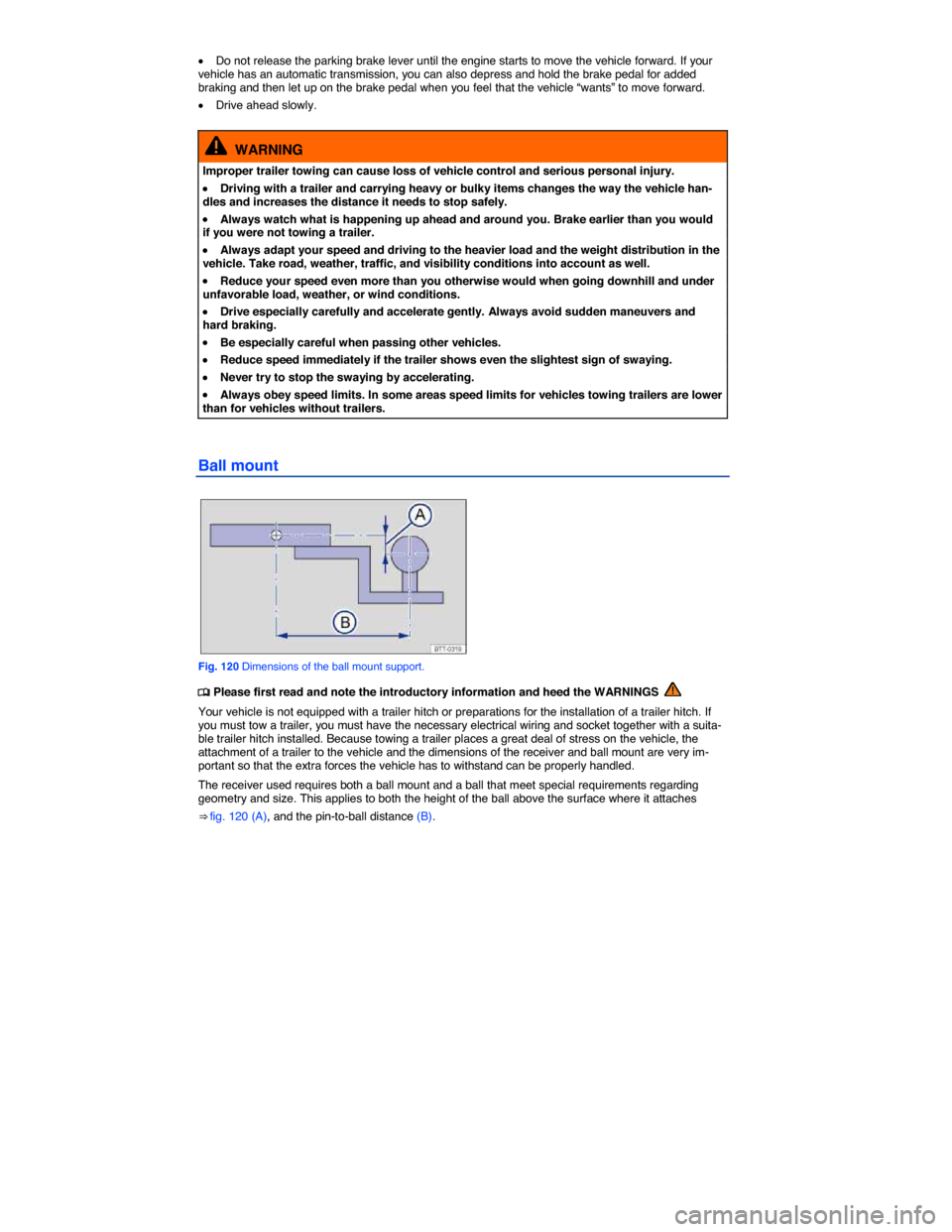
Ball mount
Fig. 120 Dimensions of the ball mount support.