2015 VOLKSWAGEN E GOLF electrical
[x] Cancel search: electricalPage 315 of 394
WARNING
Working on the batteries or the electrical system in your vehicle can cause serious acid burns, fires, explosions, or electrical shocks. Always read and heed the following WARNINGS and safety precautions before working on the batteries or the electrical system.
x Before working on the electrical system, always switch off the ignition and all electrical consumers and disconnect the negative (-) cable from the standard 12 Volt battery.
x When you change a light bulb, always switch off the light first.
x Always keep children away from battery acid and vehicle batteries in general.
x Always wear eye protection. Never let battery acid or lead particles come into contact with your eyes, skin, or clothing.
x Sulfuric battery acid is very corrosive. It can burn unprotected skin and cause blindness. Always wear protective gloves and eye protection. To reduce your risk of injury, never tilt the batteries, as this could spill acid through the vents and burn you.
x If you get battery acid in your eyes or on your skin, immediately rinse with cold water for several minutes and then get immediate medical attention. If you swallow any battery acid, get medical attention immediately.
x When disconnecting the batteries from the vehicle electrical system, always disconnect the negative cable (-) first and then the positive cable (+).
x Always switch off all electrical consumers before reconnecting 12 Volt batteries. Recon-nect the plus cable (+) first and then the negative cable (-). Never reverse the polarity of the connections. This could cause a fire.
x A highly explosive mixture of gases is given off when the battery is being charged.
x Do not smoke and avoid fires, sparks, and open flames when working. Never create sparks or electrostatic charges when handling cables and electrical equipment. Never short circuit the battery terminals. High-energy sparks can cause serious personal injury.
x Never use or attempt to charge a damaged or frozen battery, or a battery that was frozen but has thawed. Charging a frozen or thawed battery could cause explosions and chemical burns! Replace damaged or frozen vehicle batteries immediately. A dead battery can freeze at temperatures around +32 °F (0 °C).
x If the battery has a vent line or tube, make sure that it is properly connected to the battery.
WARNING
California Proposition 65 Warning
x Battery posts, terminals, and related accessories contain lead and lead components, chemicals known to the State of California to cause cancer and reproductive harm. Wash your hands after handling.
NOTICE
x Do not expose the vehicle battery to direct sunlight for an extended period of time as ultra-violet rays may damage the battery housing.
x If the vehicle is left standing in the cold for a long time, protect the vehicle battery from freezing. A battery will be permanently damaged by freezing.
Emergency starting and starting the electric motor with a very weak vehicle battery or after the vehicle battery has been replaced may change or delete system settings (including time, date, per-sonal convenience settings, and programming). Check the settings and correct as necessary once the vehicle battery has built up a sufficient charge.
Page 317 of 394

should always be replaced by a qualified technician, since the vehicle's onboard electrical system management has to be reset after replacing the battery. Only a qualified service facility is able to perform this necessary adjustment. Therefore, Volkswagen recommends to always have the 12 volt vehicle battery replaced by an authorized Volkswagen dealer or an authorized Volkswagen Service Facility.
Only use maintenance-free vehicle batteries meeting standards TL 825 06 and VW 7 50 73. These standards must date from July 2012 or later.
Disconnecting the 12 Volt vehicle battery
If the battery must be disconnected from the vehicle's electrical system, note the following:
x Switch off all electrical systems and devices and the ignition.
x Unlock the vehicle before disconnecting the battery; otherwise the alarm system will go off.
x First disconnect the negative cable (-) and then the positive cable (+) ⇒ .
Connecting the 12 volt vehicle battery
x Prior to reconnecting the battery, switch off all electrical systems and devices and the ignition.
x Connect the positive cable (+) first and then the negative cable (-) ⇒ .
After the battery is connected and the ignition is switched on, different indicator lights may light up. They should go out after you drive a short distance at 10–12 mph (15–20 km/h). If the indicator lights do not go out, contact an authorized Volkswagen dealer or an authorized Volkswagen Service Facility and have the vehicle checked.
If the battery was disconnected for a long time, the next scheduled service may not be correctly calcu-
lated and displayed ⇒ Instrument cluster. The maximum permissible service and maintenance inter-
vals are shown in the ⇒ Booklet Warranty and Maintenance.
Vehicles with Keyless Access
If the ignition will not start after reconnecting the vehicle battery, lock the vehicle from the outside and
unlock it again ⇒ Unlocking or locking the vehicle with Keyless Access. Then try to start the ignition again. If the ignition cannot be switched on, contact an authorized Volkswagen dealer, an authorized Volkswagen Service Facility, or another qualified workshop for assistance.
Automatic electrical load deactivation
If the vehicle battery drain is high, the intelligent onboard electrical system management automatically takes steps to help prevent battery drain.
x The idle speed is increased so that the alternator provides more power.
x The power to devices that consume a lot of electricity is cut back or switched off completely.
The onboard electrical system management cannot always keep the battery from being drained. For example, the battery will drain if the electric motor is not activated, but the ignition is switched on or the parking lights are left on for a long time when parked.
What drains the vehicle battery?
x Long periods when the electric motor is not activated, especially when the ignition is on.
x Using electrical systems or devices when the electric motor is switched off.
x Leaving the vehicle unlocked for several days when not in use.
x The selector lever is left for a long period of time in any position other than Park (P) when the
ignition is switched off ⇒ Selector lever.
Page 318 of 394
WARNING
Failure to use the proper battery with proper mounting and connections may cause short circuits, fires, and serious personal injuries.
x Always use only maintenance-free or cycle-free, leak-proof batteries with the same speci-fications and dimensions as the original equipment battery. Specifications are listed on the battery housing.
WARNING
When the vehicle battery is charged, it produces highly explosive hydrogen gas.
x Charge vehicle batteries only in well-ventilated areas.
x Never charge a frozen or thawed battery. A dead battery can freeze at temperatures around +32 °F (0 °C).
x You must replace the vehicle battery if it was frozen.
x Incorrectly connected cables can cause a short-circuit. First connect the positive cable (+) and then the negative cable (-).
NOTICE
x Never disconnect the vehicle battery or connect 2 vehicle batteries to each other when the ignition is switched on or the electric motor is activated. Doing this may damage the electrical system or electronic components.
x Never use a vehicle battery that does not meet the specifications for the vehicle battery for your vehicle. Using the wrong battery can damage the electrical system or electronic compo-nents and cause electrical malfunctions.
x Never connect power generating equipment, such as a solar panel or battery charger, to the 12 Volt socket in order to charge the vehicle battery. This can damage the vehicle's electrical system.
Dispose of the vehicle battery according to regulations. Vehicle batteries contain poisonous substances such as sulfuric acid and lead.
Battery acid can pollute the environment. Catch leaking operating fluids and dispose of them properly.
Page 331 of 394
Treating stains
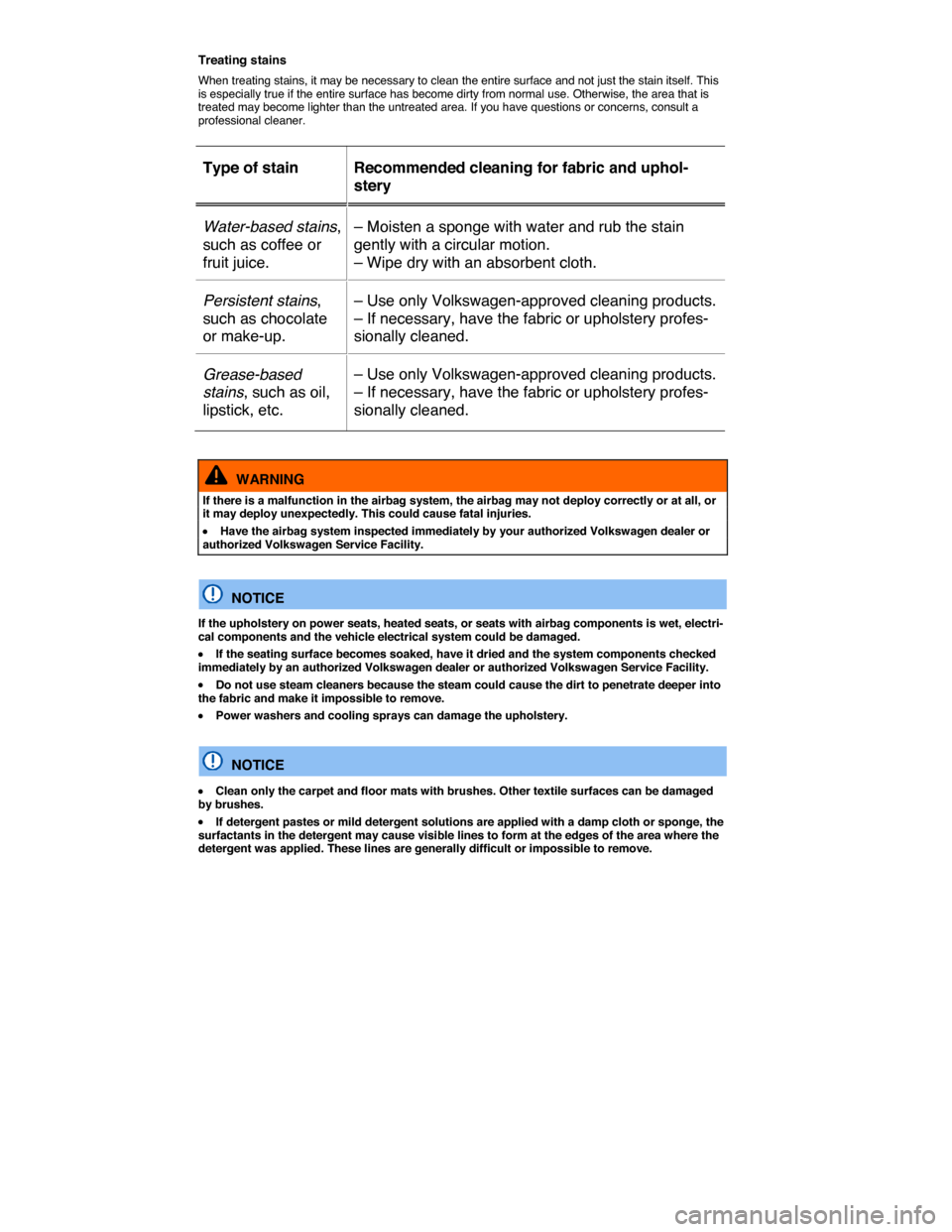
When treating stains, it may be necessary to clean the entire surface and not just the stain itself. This is especially true if the entire surface has become dirty from normal use. Otherwise, the area that is treated may become lighter than the untreated area. If you have questions or concerns, consult a professional cleaner.
Type of stain Recommended cleaning for fabric and uphol-
stery
Water-based stains,
such as coffee or
fruit juice.
– Moisten a sponge with water and rub the stain
gently with a circular motion.
– Wipe dry with an absorbent cloth.
Persistent stains,
such as chocolate
or make-up.
– Use only Volkswagen-approved cleaning products.
– If necessary, have the fabric or upholstery profes-
sionally cleaned.
Grease-based
stains, such as oil,
lipstick, etc.
– Use only Volkswagen-approved cleaning products.
– If necessary, have the fabric or upholstery profes-
sionally cleaned.
WARNING
If there is a malfunction in the airbag system, the airbag may not deploy correctly or at all, or it may deploy unexpectedly. This could cause fatal injuries.
x Have the airbag system inspected immediately by your authorized Volkswagen dealer or authorized Volkswagen Service Facility.
NOTICE
If the upholstery on power seats, heated seats, or seats with airbag components is wet, electri-cal components and the vehicle electrical system could be damaged.
x If the seating surface becomes soaked, have it dried and the system components checked immediately by an authorized Volkswagen dealer or authorized Volkswagen Service Facility.
x Do not use steam cleaners because the steam could cause the dirt to penetrate deeper into the fabric and make it impossible to remove.
x Power washers and cooling sprays can damage the upholstery.
NOTICE
x Clean only the carpet and floor mats with brushes. Other textile surfaces can be damaged by brushes.
x If detergent pastes or mild detergent solutions are applied with a damp cloth or sponge, the surfactants in the detergent may cause visible lines to form at the edges of the area where the detergent was applied. These lines are generally difficult or impossible to remove.
Page 340 of 394
WARNING
Leaving the optional safety belt extender attached to the safety belt buckle on the front pas-senger seat when the safety belt is not being used will prevent the Advanced Airbag System from working properly and can increase the risk of serious personal injury in a collision.
x Leaving the extender attached to the safety belt buckle when the front seat is occupied and the safety belt is not being used will signal to the airbag control unit that the front pas-senger seat is occupied and that the safety belt is being used. The electronic control unit for the airbag system will then receive incorrect information that will
– cause the safety belt pretensioner to deploy unnecessarily in collisions and
– cause the front passenger airbag to deploy later in collisions in which the front airbag would otherwise be triggered earlier to help protect an unrestrained front seat passenger.
x Always remove the safety belt extender when it is not needed and stow it safely.
x Never use the safety belt extender to secure a child restraint.
WARNING
Items stored between the safety belt buckle and the center console can cause safety belt buckle to send the wrong information to the airbag control unit and prevent the Advanced Airbag System from working properly.
x Always make sure that nothing can interfere with the safety belt buckles and that they are not obstructed.
WARNING
Improper care and servicing, and improper modification and repair work, can increase the risk of personal injury and death by preventing an airbag from deploying when needed or deploying an airbag unexpectedly:
x Never repair, adjust, or change any parts of the airbag system.
x All work on the airbag system, steering wheel, instrument panel, front seats or electrical system (including the installation of audio equipment, mobile telephones and CB radios, etc.) should be performed by authorized Volkswagen dealers or authorized Volkswagen Service Facilities. They have the necessary manuals, training, and special equipment.
x The airbag system can be activated only once. After an airbag has inflated, it must be replaced.
x Use only original equipment airbags approved by Volkswagen. Have them installed by a trained technician who has the necessary tools and diagnostic equipment to properly replace any airbag in your vehicle and assure system effectiveness in a crash.
x Never permit salvaged or recycled airbags to be installed in your vehicle.
Undeployed airbag modules and safety belt pretensioners are classified as Perchlorate Materi-al. Special handling may apply – see http://www.dtsc.ca.gov/hazardouswaste/perchlorate. Obey all applicable legal requirements regarding handling and disposal of the vehicle or parts of its restraint system, including airbag modules and safety belts with pretensioners. Authorized Volkswagen dealers and authorized Volkswagen Service Facilities are familiar with the requirements, and we recommend that you have them perform this service for you.
Page 357 of 394
x Slip the cover up and over the selector lever ⇒ .
Emergency release for the selector lever (version A)
x With the screwdriver from the vehicle tool kit, carefully push the release lever ⇒ fig. 166 A in the direction of the arrow and hold it in this position.
x Press the release button in the selector lever handle and shift the selector lever to Neutral (N).
x Carefully press the selector gate cover back in place, making sure that the electrical wiring stays in the correct position and is not pinched or damaged.
Emergency release for the selector lever (version B)
x Push the colored release lever ⇒ fig. 166 B in the direction of the arrow and hold it in this position.
x Press the release button in the selector lever handle and shift the selector lever to Neutral (N).
x Carefully press the selector gate cover back in place, making sure that the electrical wiring stays in the correct position and is not pinched or damaged.
WARNING
Never shift the transmission out of Park (P) without first firmly applying the parking brake. Otherwise, the vehicle can start to roll unexpectedly, especially on hills or inclines, and cause an accident and serious injuries.
NOTICE
Even with the selector lever is in Neutral (N), the automatic transmission will be damaged if the vehicle is towed (or you let it coast) for an extended period or at high speed with the electric motor shut off.
Emergency release for the charging connector
Page 381 of 394
Replacing a fuse
In some vehicles, there are plastic tweezers for removing blade fuses on the inside of the fuse box cover in the electric motor compartment.
x Open the fuse box cover in the electric motor compartment ⇒ Fuses in the vehicle and remove the plastic tweezers.
x Depending on the type of fuse, slide the tweezers ⇒ fig. 181 A (1) or ⇒ fig. 181 B (1) onto the fuse from the side.
x Pull out the fuse.
x If the fuse is blown, replace the fuse with a new fuse of the same amperage (same color and same
imprint) and same size ⇒ .
x Clip the plastic tweezers back into the holder inside the fuse box cover.
x Replace the fuse box cover.
NOTICE
If a fuse is replaced with a fuse with higher amperage, then damage can occur at various plac-es in the electrical system.
Page 383 of 394
WARNING
Improper use of jumper cables when jump-starting a vehicle with a dead battery can cause the battery to explode, leading to serious personal injury. To help reduce the risk of battery explosion:
x All work on the batteries or the electrical system in your vehicle can cause serious acid burns, fires, or electrical shocks. Always read and heed the following WARNINGS and safety
precautions before working on the batteries or the electrical system ⇒ 12 Volt vehicle bat-tery.
x Always make sure that the battery providing starting assistance (the booster battery) has the same voltage as the dead battery (12 V) and about the same amperage capacity (see bat-tery label).
x Never jump-start a vehicle with a thawed or frozen vehicle battery. The battery can ex-plode. A dead battery can freeze at temperatures around +32 °F (0 °C).
x A battery that is frozen or was frozen, but has since thawed, must be replaced.
x When the vehicle battery is jump-started, it gives off hydrogen gas, which is highly explo-sive! Always keep fire, sparks, open flame, and smoking materials far away from vehicle bat-teries. Never use a mobile telephone while connecting or disconnecting jumper cables.
x Jump-start batteries only in well-ventilated areas. Batteries give off highly explosive hy-drogen gas during jump-starting.
x Always route the jumper cables so that they cannot get caught in any moving parts in the electric motor compartment.
x Never short out the battery terminals by connecting the positive (+) and negative (-) termi-nals with each other.
x Never connect the negative cable from the other vehicle directly to the negative terminal of the dead battery, as this may cause the hydrogen gas given off by the dead battery to ex-plode.
x Never attach the negative cable from the vehicle providing starting assistance to any part of the brake hoses or brake lines.
x Never allow the non-insulated parts of the battery clamps to touch.
x Never allow the jumper cable attached to the positive battery terminal to contact metal parts of the vehicle.
x Always follow the instructions of the jumper cable manufacturer.
NOTICE
To help prevent extensive damage to the vehicle electrical system, read and heed the follow-ing:
x Connecting jumper cables improperly can cause a short circuit and do expensive damage to the vehicle's electrical system.
x Do not let the vehicles touch each other while the jumper cables are connected. If they do, electrical current may flow between the vehicles when the positive (+) terminals are connected, causing electrical system damage.