2015 VOLKSWAGEN E GOLF battery
[x] Cancel search: batteryPage 53 of 394

A driver message appears in the instrument cluster display if there is no remote control vehicle key inside the vehicle or if the system does not recognize the remote control vehicle key. The key may not be recognized, for example, if it is covered by something that interferes with the signal (such as a briefcase), or if the remote control vehicle key battery is weak. Electronic devices such as mobile phones can also interfere with the signal.
Dirt on the door handles that contains a lot of salt (especially in winter) can affect the way the
door handle sensors work. Cleaning the door handles can help with this problem ⇒ page 334, Exterior care and cleaning.
If the automatic transmission is not in Park (P) position, the electronic steering column lock will not lock and the vehicle will not lock via sensors in the front door handles or the remote control vehicle key.
Anti-theft alarm system
Page 77 of 394

If your vehicle is equipped with electrical controls for the front seats, the controls on the front passen-ger seat either mirror those on the driver seat or there may be different combinations of electrical and manual controls.
There may be manual and electrical controls on the same seat.
Press the switch in the direction of the arrow ⇒ fig. 35:
(1) (A) Slide the seat forward or back.
(B) Adjust the seat cushion angle.
(C) Raise or lower the seat cushion.
(2) (D) Adjust the backrest angle.
Press the switch in the corresponding area ⇒ fig. 36:
(1) or (2) Adjust the curve of the lumbar support.
(3) or (4) Adjust the height of the lumbar support.
WARNING
Improper use of electrical seat controls can cause serious personal injuries.
x The front seats in your vehicle can be electrically adjusted even when the vehicle key has been removed from the ignition or, on a vehicle with Keyless Access, even if there is no key in the vehicle.
x Never leave children and persons who need help in the vehicle alone because the unsu-pervised use of the electric seat adjustments can result in serious personal injury.
x Always make sure that no one is in the way while the front seats are being adjusted, or while calling up the stored memory settings for the front seats. In an emergency, stop auto-matic seat adjustment by pressing a seat adjustment switch.
NOTICE
To help prevent damage to electrical parts in the seat, do not kneel on the front seats or apply concentrated pressure to a small area of the seat or backrest.
If the vehicle battery is too weak, the electrical seat adjustment controls may not work.
Starting the electric motor may stop seat adjustment.
Page 172 of 394

Passenger car tire
A tire intended for use on passenger cars, multipurpose passenger vehicles, and trucks, that have a gross vehicle weight rating (GVWR) of 10,000 pounds or less.
Ply
A layer of rubber-coated parallel cords.
Ply separation
A parting of rubber compound between adjacent plies.
Pneumatic tire
A mechanical device made of rubber, chemicals, fabric, and steel or other materials, that, when mounted on an automotive wheel, provides the traction and contains the gas or fluid that sustains the load.
Production options weight
The combined weight of installed regular production options weighing over 5 lbs (2.3 kg) more than the standard items they replace, and not previously considered as curb weight or accessory weight. These include, for example, heavy-duty brakes, ride levelers, roof rack, heavy-duty battery, and special trim.
Radial ply tires
A pneumatic tire in which the ply cords that extend to the beads are laid at substantially 90 degrees to the centerline of the tread.
Recommended inflation pressure
The tire pressure recommended by the vehicle manufacturer for a tire of a specified size that has not been driven for more than a couple of miles (kilometers) at low speeds in the 3 hour period before the tire pressure is measured or adjusted.
Reinforced tire
A tire designed to operate at higher loads and at higher inflation pressures than the corresponding standard tire.
Rim
The outer edge of a wheel upon which the tire beads are seated.
Rim diameter
The nominal diameter of the wheel's tire bead seating surface. If you change your wheel size, to wheels of a different diameter, you will have to purchase new tires to match the new wheels.
Rim size
Designation means rim diameter and width.
Rim type designation
The industry or manufacturer's designation for a rim by style or code.
Rim width
The nominal distance between wheel rim flanges.
Section width
The linear distance between the exteriors of the sidewalls of an inflated tire, excluding elevations due to labeling decoration, or protective bands.
Sidewall
The portion of a tire between the bead and the tread.
Page 200 of 394

If the ignition is on but the electric motor is not activated, the vehicle battery will be drained by any device that is plugged in and turned on. For this reason, never use the electrical sockets unless the electric motor is activated.
To help prevent damage from voltage fluctuations, switch off all electrical devices connected to a 12 Volt socket before switching the ignition on or off or starting the electric motor.
The vehicle may have 12 Volt sockets at the following places:
x In the lower center console ⇒ fig. 117.
x In the luggage compartment ⇒ fig. 118.
x In the front center armrest storage compartment ⇒ Storage compartment in the front center arm-rest.
NOTICE
x Follow the manufacturer's instructions for connected devices!
x Never exceed the maximum power consumption, or the entire vehicle electrical system may be damaged.
x 12 Volt socket:
– Only use equipment that has been tested for electromagnetic compatibility and complies with applicable guidelines.
– Never feed current into the socket, with a solar panel, for example.
Unshielded devices may interfere with radio reception or the vehicle's electrical system.
Page 202 of 394

DANGER
High-voltage systems in the electric motor compartment and in other places on the vehicle can cause electrical shocks or even electrocution, severe burns, other serious injuries, and even death!
x The high-voltage system may also be active even when the ignition is switched off!
x Never touch high-voltage cables, the high-voltage battery, the poles of the high-voltage battery or any other parts of the high-voltage system, especially if these parts are damaged.
x Never attempt to work on any parts of the high-voltage system, the high-voltage cables or the high-voltage battery.
x Never open, maintain, disconnect or repair components or parts of the high-voltage sys-tem.
x Never damage, change or remove the orange high-voltage cables or disconnect them from the high-voltage system.
x Never open, modify or remove the cover of the high-voltage battery.
x Any work on the high-voltage system, or any other systems connected to it, should only be done by properly trained and qualified experts.
x Never perform any work near high-voltage components and high-voltage cables with ma-chining, shaping and sharp-edged tools or heat sources, for example, welding, soldering, hot air or thermal adhesives.
x The Volkswagen standards and guidelines must be adhered to when working on the high-voltage system or the high-voltage battery.
x During such work, keep the vehicle key safe and far enough away from the vehicle to pre-vent any risk of the ignition being accidentally switched on and the electrical system activat-ed.
x Any gasses emitted by or escaping from the high-voltage battery may be toxic or flamma-ble.
x Damage to the vehicle or to the high-voltage battery could lead to a leak of toxic gases, either immediately or at a later time. These emitted gases could also potentially cause a fire. If damage has been incurred, it is vital to then open the vehicle windows to allow any emitted gases to disperse. Do not inhale these gases.
x Never touch any liquids or expose yourself to any gases leaking from the high-voltage battery, especially if the battery has been damaged.
x Always inform any attending emergency services that the vehicle is equipped with a high-voltage battery.
WARNING
Switching off the electric drive while the vehicle is moving can make the vehicle harder to stop and result in loss of vehicle control, leading to collisions and severe personal injuries.
x Brake and steering assistance systems, the airbag system, safety belt pretensioners, and other vehicle safety features only work when the electric motor is activated.
x Switch off the electric drive only when the vehicle is not moving.
Page 206 of 394

x The charging port (B)
x Covers on components of the high-voltage system (B)
Power output of the electric motor
The maximum torque of the electric motor is available as soon as you press the accelerator pedal ⇒
.
As the charge level of the high-voltage battery increases, the recuperation and thus also the electric motor braking effect will decrease when the vehicle is braked and when the vehicle rolls in overrun mode or drives downhill. No brake energy recuperation occurs and therefore no electric motor braking
effect is available once the high-voltage battery is fully charged ⇒ .
DANGER
High-voltage systems in the electric motor compartment and in other places on the vehicle can cause electrical shocks or even electrocution, severe burns, other serious injuries, and even death!
x Touching damaged orange high-voltage cables, the high-voltage battery or other parts of the high-voltage electrical system can cause fatal electric shock.
x The high-voltage system may also be active even when the ignition is switched off!
x Electrolyte fluid in the high-voltage battery will cause severe chemical burns. If electrolyte fluid contacts skin, thoroughly flush affected area with clean water for at least 15 minutes and then wash affected area with soap and water; medical attention is recommended.
x Any work on the high-voltage system, or on systems which could be directly or indirectly affected by it, must only be carried out by properly trained and qualified experts.
WARNING
Rapid acceleration can cause loss of traction and skidding, particularly on slippery roads. This can cause you to lose control of the vehicle, which can lead to accidents and serious injuries.
x Always adjust your driving style in accordance with the flow of traffic.
x Only use the kickdown or fast acceleration if visibility, weather, road and traffic conditions permit, and other road users are not put at risk due to the acceleration and the driving style.
WARNING
Medium, high and very high recuperation can lead to loss of traction and skidding, particular-ly on slippery roads. This can cause you to lose control of the vehicle, which can lead to accidents and serious injuries.
x Only use medium, high or very high recuperation if visibility, weather, road and traffic conditions permit, and other road users are not put at risk due to the vehicle's acceleration and your driving style.
WARNING
The higher the charge level of the high-voltage battery, the lower the electric motor braking effect, to the point where no electric motor braking effect may be generated at all.
x Reduce your speed before driving down a long, steep gradient.
x When driving down a long, steep gradient, slow the vehicle using the vehicle brake.
Page 207 of 394
NOTICE
After a collision or other kind of accident, or after the underside of the vehicle has struck something, the high-voltage battery must be thoroughly inspected.
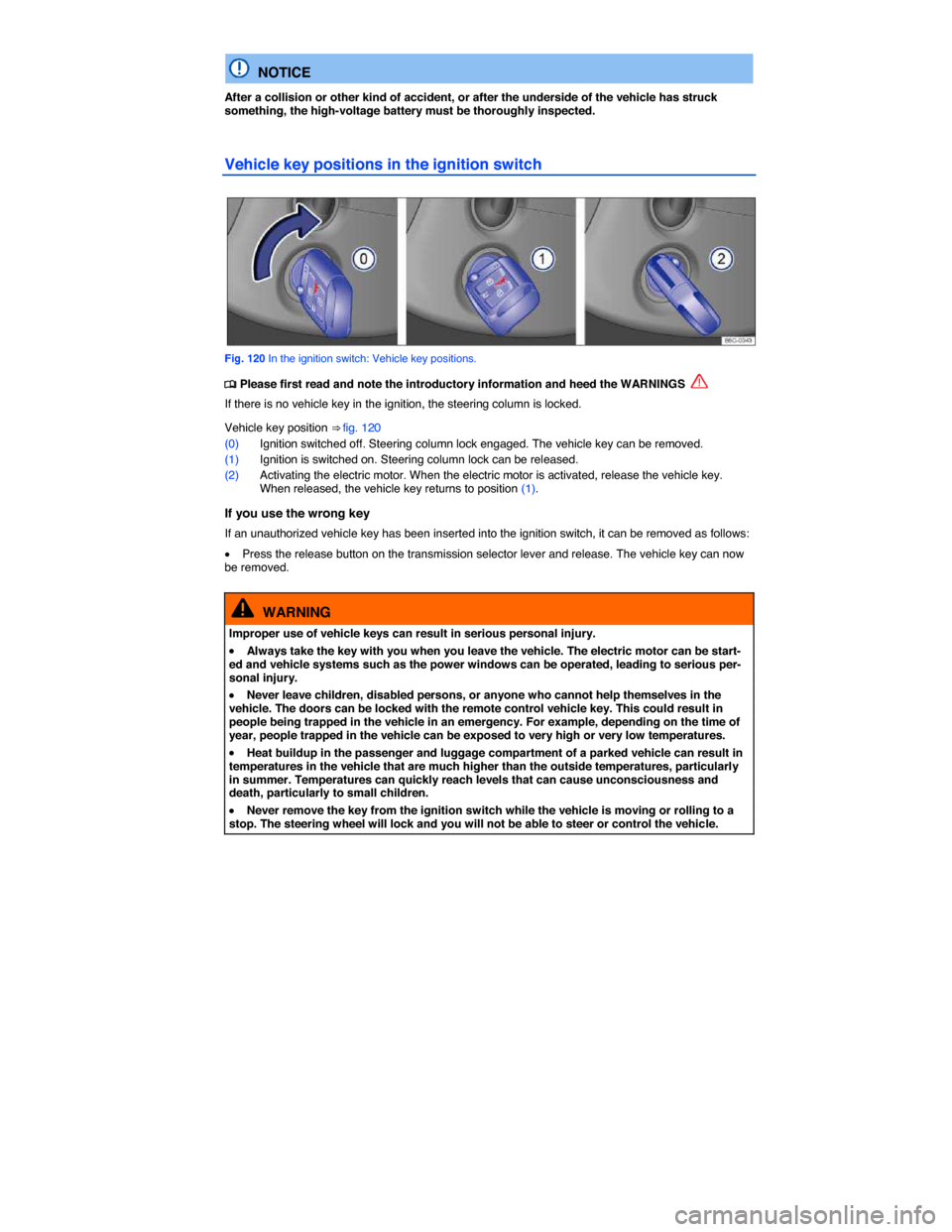
Vehicle key positions in the ignition switch
Fig. 120 In the ignition switch: Vehicle key positions.
Page 208 of 394
Leaving the key in the ignition for a long time when the electric motor is not activated will drain the vehicle battery.
Leaving the selector lever for a long period of time in any position other than Park (P) when the ignition is switched off can drain the vehicle battery.
On automatic transmission vehicles, the vehicle key can be removed from the ignition switch only when the transmission is in Park (P). You may have to press the release button on the transmis-sion selector lever to put the lever into Park (P).
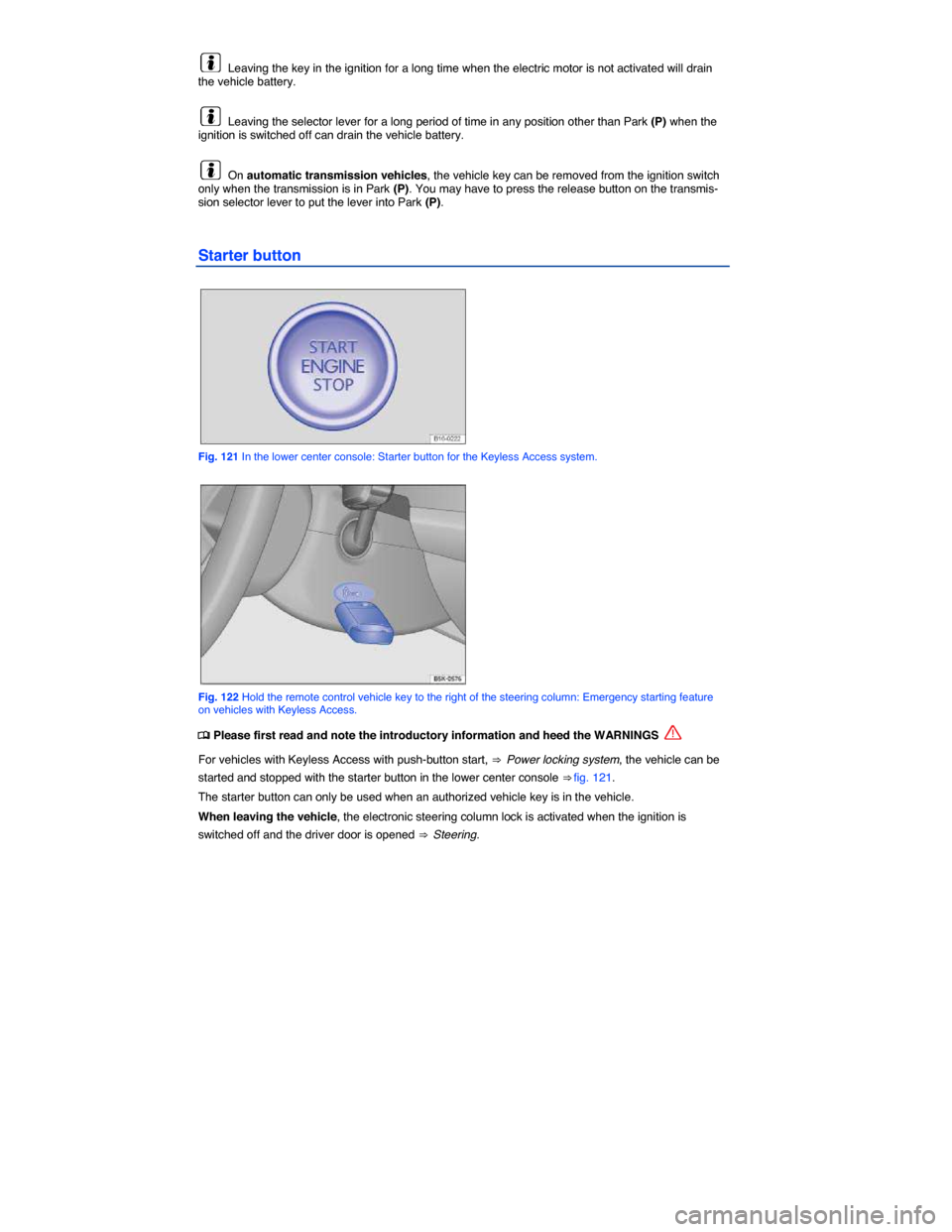
Starter button
Fig. 121 In the lower center console: Starter button for the Keyless Access system.
Fig. 122 Hold the remote control vehicle key to the right of the steering column: Emergency starting feature on vehicles with Keyless Access.