2015 VAUXHALL MOVANO_B winter tyres
[x] Cancel search: winter tyresPage 158 of 209

156Vehicle careWheels and tyres
Tyre condition, wheel condition
Drive over edges slowly and at right
angles if possible. Driving over sharp
edges can cause tyre and wheel
damage. Do not trap tyres on the kerb when parking.
Regularly check the wheels for
damage. Seek the assistance of a
workshop in the event of damage or
unusual wear.
Tyres Factory-fitted tyres are matched to
the chassis and offer optimum driving
comfort and safety.
Winter tyres Winter tyres improve driving safety attemperatures below 7 °C and shouldtherefore be fitted on all wheels.
In accordance with country-specific
regulations, affix the maximum speed
sticker in the driver's field of view.Tyre designations
E.g. 215/65 R 16 C 109 R215=Tyre width, mm65=Cross-section ratio (tyre height
to tyre width), %R=Belt type:RadialRF=Type:RunFlat16=Wheel diameter, inchesC=Cargo or commercial use88=Load index e.g. 109 is
equivalent to approx. 1030 kgR=Speed code letter
Speed code letter:
Q=up to 100 mphS=up to 112 mphT=up to 118 mphH=up to 130 mphV=up to 150 mphW=up to 168 mph
Tyre pressure
Check the pressure of cold tyres at
least every 14 days and before any
long journey. Do not forget the spare
wheel. This also applies to vehicles
with tyre pressure monitoring system.
Tyre pressures 3 198. Always inflate
tyres to the pressures shown on the
label on the driver's door frame.
The tyre pressure data refers to cold
tyres. It applies to summer and winter tyres.
Always inflate the spare tyre to the
pressure specified for full load.
Incorrect tyre pressures will impair
safety, vehicle handling, comfort and
fuel economy and will increase tyre
wear.
Tyre pressures differ depending on
various options. For the correct tyre
pressure value, follow the procedure
below:
1. Identify the engine identifier code.
Engine data 3 182.
2. Identify the respective tyre.
The tyre pressure tables show all possible tyre combinations 3 198.
For the tyres approved for your
vehicle, refer to the EEC Certificate of
Conformity provided with your vehicle or other national registration
documents.
Page 162 of 209

160Vehicle care
other than those recommended
could prevent the TPMS from
functioning properly.
■ Operating electronic devices or being near facilities using radio
wave frequencies similar to the
TPMS could cause the TPMS
sensors to malfunction.
If the TPMS is not functioning
properly, it cannot detect or signal
a low tyre condition. Consult a
workshop for service if control
indicator w illuminates and a
corresponding message appears in the Driver Information Centre.
Tread depth Check tread depth at regular
intervals.
Tyres should be replaced for safety
reasons at a tread depth of 2-3 mm
(4 mm for winter tyres).
For safety reasons it is recommended
that the tread depth of the tyres on
one axle should not vary by more than
2 mm.
The legally permissible minimum
tread depth (1.6 mm) has been
reached when the tread has worn
down as far as one of the tread wear
indicators (TWI). Their position is
indicated by markings on the
sidewall.
If there is more wear at the front than
the rear, swap round front wheels and rear wheels periodically. Ensure that
the direction of rotation of the wheels
is the same as before.
Tyres age, even if they are not used.
We recommend tyre replacement
every 6 years.
Changing tyre and wheel
size
If tyres of a different size than those
fitted at the factory are used, it may be necessary to reprogramme the
speedometer as well as the nominal tyre pressure and make other vehicle modifications.
After converting to a different tyre
size, have the label with tyre
pressures replaced.9 Warning
Use of unsuitable tyres or wheels
may lead to accidents and will
invalidate the vehicle type
approval.
Wheel covers
Wheel covers and tyres that are
factory approved for the respective
vehicle and comply with all of the
relevant wheel and tyre combination requirements must be used.
Page 168 of 209
166Vehicle care
twin rear wheels), 264 Nm (Rear-
wheel drive with single rear
wheels).
9. Refit wheel cover.
10. Stow the replaced wheel 3 166
and the vehicle tools 3 155.
11. Have the new wheel balanced on the vehicle. Check the tyre
pressure of the installed tyre
3 198 and also the wheel bolt/nut
torque as soon as possible.
Have the defective tyre renewed or
repaired.
Spare wheel Some vehicles are equipped with a
tyre repair kit instead of a spare wheel
3 161.
If mounting a spare wheel which is
different from the other wheels, this
wheel might be classified as a
temporary spare wheel and the
corresponding speed limits apply,
even though no label indicates this.
Seek the assistance of a workshop to
check the applicable speed limit.Caution
The use of a spare wheel that is smaller than the other wheels or in combination with winter tyres
could affect driveability. Have the defective tyre replaced as soon as
possible.
The spare wheel is held under the
vehicle frame using a winch and
secured by tightening a cable using
the wheel wrench and adapter.
It may be necessary to jack the
vehicle up to gain access to the spare
wheel on a fully loaded vehicle with a flat rear tyre.
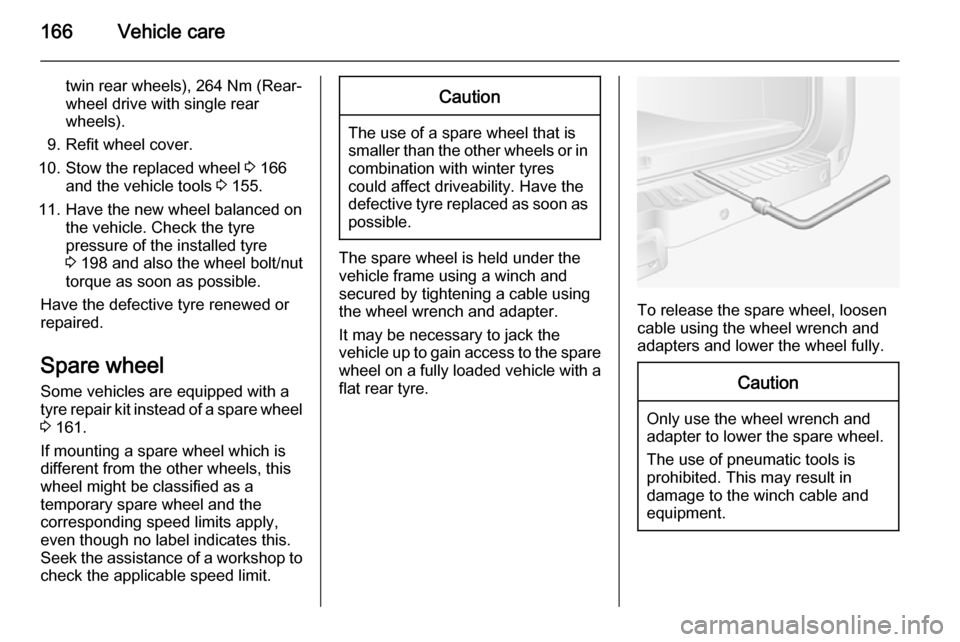
To release the spare wheel, loosen
cable using the wheel wrench and
adapters and lower the wheel fully.
Caution
Only use the wheel wrench and
adapter to lower the spare wheel.
The use of pneumatic tools is
prohibited. This may result in
damage to the winch cable and
equipment.
Page 169 of 209
Vehicle care167
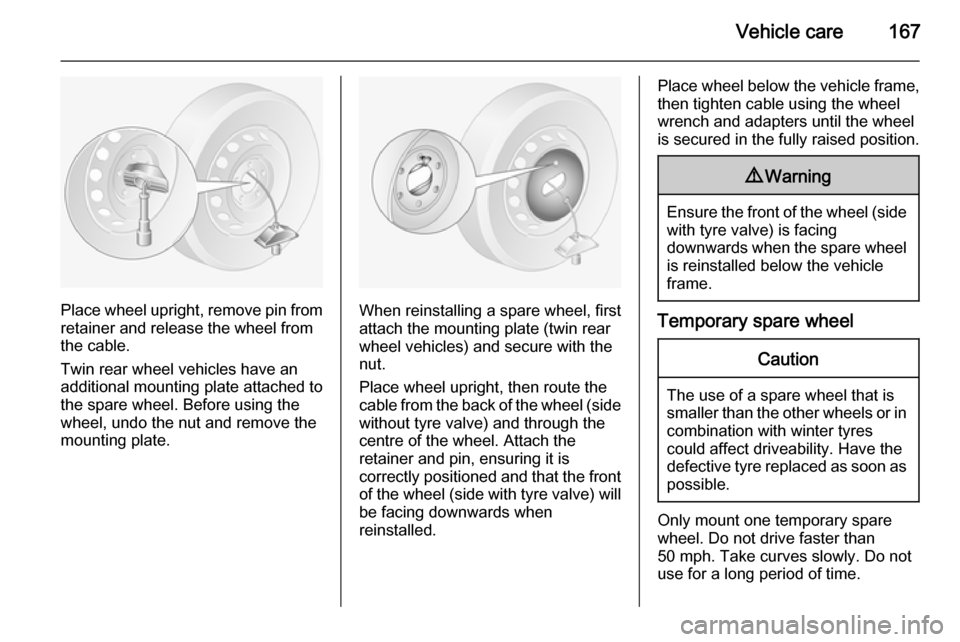
Place wheel upright, remove pin fromretainer and release the wheel from
the cable.
Twin rear wheel vehicles have an
additional mounting plate attached to
the spare wheel. Before using the
wheel, undo the nut and remove the
mounting plate.When reinstalling a spare wheel, first
attach the mounting plate (twin rear
wheel vehicles) and secure with the
nut.
Place wheel upright, then route the
cable from the back of the wheel (side
without tyre valve) and through the
centre of the wheel. Attach the
retainer and pin, ensuring it is
correctly positioned and that the front
of the wheel (side with tyre valve) will be facing downwards when
reinstalled.
Place wheel below the vehicle frame,
then tighten cable using the wheel
wrench and adapters until the wheel
is secured in the fully raised position.9 Warning
Ensure the front of the wheel (side
with tyre valve) is facing
downwards when the spare wheel is reinstalled below the vehicle
frame.
Temporary spare wheel
Caution
The use of a spare wheel that is smaller than the other wheels or in
combination with winter tyres
could affect driveability. Have the defective tyre replaced as soon as
possible.
Only mount one temporary spare
wheel. Do not drive faster than
50 mph. Take curves slowly. Do not
use for a long period of time.
Page 170 of 209

168Vehicle care
If your vehicle gets a flat tyre on therear while towing another vehicle,
mount the temporary spare wheel in the front and the full tyre in the rear.
Tyre chains 3 161.
Summer and winter tyres
If you use winter tyres, the spare
wheel may still be fitted with a
summer tyre.
If you use the spare wheel when it is
fitted with a summer tyre the vehicle's
driveability may be affected,
especially on slippery road surfaces.
Directional tyres Fit directional tyres such that they rollin the direction of travel. The rolling
direction is indicated by a symbol
(e.g. an arrow) on the sidewall.
The following applies to tyres fitted
opposing the rolling direction:
■ Driveability may be affected. Have the defective tyre renewed or
repaired as soon as possible.
■ Do not drive faster than 50 mph.
■ Drive particularly carefully on wet and snow-covered road surfaces.Jump starting
Do not start with a quick charger.
A vehicle with a discharged battery
can be started using jump leads and
the battery of another vehicle.9 Warning
Be extremely careful when starting
with jump leads. Any deviation
from the following instructions can
lead to injuries or damage caused
by battery explosion or damage to the electrical systems of both
vehicles.
9 Warning
Avoid contact with eyes, skin,
fabrics, and painted surfaces. The fluid contains sulphuric acid which can cause injuries and damage in
the event of direct contact.
Caution
The air suspension system must
be switched off prior to jump
starting.
9 Warning
Avoid contact of the battery with
eyes, skin, fabrics and painted
surfaces. The fluid contains
sulphuric acid which can cause
injuries and damage in the event
of direct contact.
■ Never expose the vehicle battery to
naked flames or sparks.
■ A discharged vehicle battery can already freeze at a temperature of
0 °C. Defrost the frozen vehicle
battery before connecting jump
leads.
■ Wear eye protection and protective
clothing when handling a vehicle
battery.
Page 208 of 209

206
Traction Control system ............. 123
Trailer coupling ........................... 132
Trailer stability assist .................134
Trailer towing ............................. 133
Transmission ............................... 15
Transmission display ...........76, 117
Tread depth ............................... 160
Trip computer .............................. 86
Triple-Info-Display .......................85
Trip odometer .............................. 74
Turn and lane-change signals .....91
Turn signal ................................... 79
Tyre chains ................................ 161
Tyre changing ............................. 164
Tyre designations ......................156
Tyre pressure ............................ 156
Tyre pressure monitoring system ............................... 82, 157
Tyre pressures ........................... 198
Tyre repair kit ............................. 161
Tyres .......................................... 156
Tyres and wheel size, changing. 160
U
Ultrasonic parking assist............. 128
Underseat storage .......................63
Upholstery .................................. 173
Upshift .......................................... 81
Using this manual ..........................3V
Vehicle battery ........................... 141
Vehicle checks............................ 136
Vehicle data ................................ 181
Vehicle data recording and privacy ..................................... 200
Vehicle dimensions .................... 189
Vehicle Identification Number ....178
Vehicle jack ................................ 155
Vehicle messages .......................85
Vehicle security ............................ 27
Vehicle specific data ......................3
Vehicle storage ........................... 135
Vehicle tools ............................... 155
Vehicle unlocking ........................... 6
Vehicle weight ........................... 184
Ventilation ..................................... 96
W
Warning chimes ........................... 86
Warning lights ............................... 74
Warning triangle .......................... 66
Washer and wiper systems .........14
Washer fluid ............................... 140
Washing the vehicle ...................171
Wheel changing .........................164
Wheel covers ............................. 160
Wheels and tyres .......................156
Wide view mirror ........................... 31Windows....................................... 32
Windscreen wiper/washer ...........70
Winter tyres ............................... 156
Wiper blade replacement ..........143