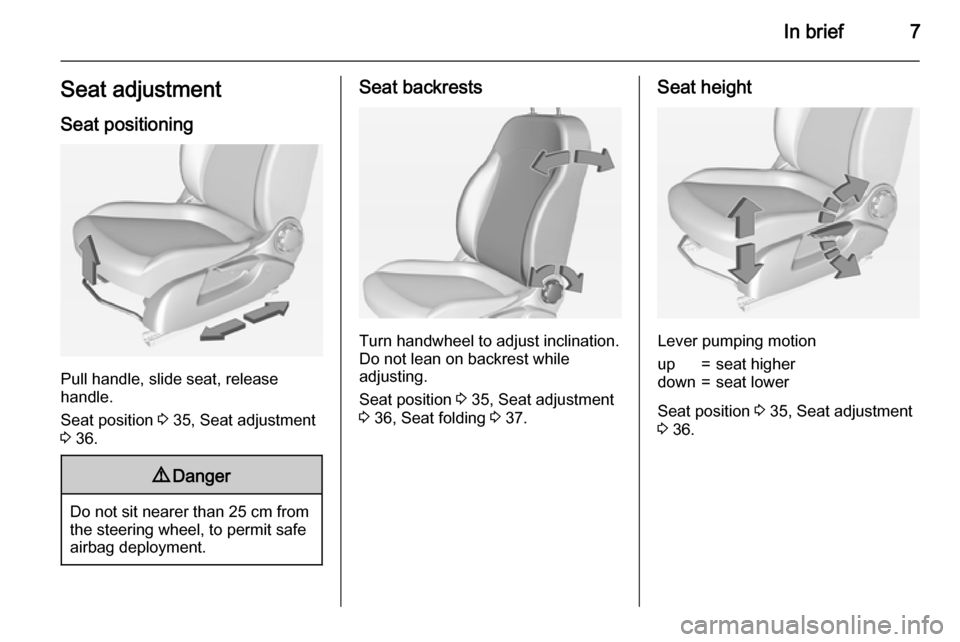
In brief7Seat adjustmentSeat positioning
Pull handle, slide seat, release
handle.
Seat position 3 35, Seat adjustment
3 36.
9 Danger
Do not sit nearer than 25 cm from
the steering wheel, to permit safe
airbag deployment.
Seat backrests
Turn handwheel to adjust inclination.
Do not lean on backrest while
adjusting.
Seat position 3 35, Seat adjustment
3 36, Seat folding 3 37.
Seat height
Lever pumping motion
up=seat higherdown=seat lower
Seat position 3 35, Seat adjustment
3 36.
Seats, restraints37
Seat backrests
Turn handwheel to adjust inclination.
Do not lean on backrest while
adjusting.
Seat height
Lever pumping motion
up=seat higherdown=seat lowerSeat folding
Pull release lever towards the front
and fold backrest forwards. Then
slide seat forwards to the stop.
To restore, slide the seat backwards
to the stop. Lift backrest to upright
position without operating the release
lever. Allow backrest to engage.
The memory function allows the seat
to engage in its original position after
folding.
Do not operate handwheel for
backrest inclination when backrest is
folded forwards.
240Customer informationVehicle data recording
and privacy
Event data recorders
Data storage modules in the vehicle
A large number of electronic
components of your vehicle contain
data storage modules temporarily or
permanently storing technical data
about the condition of the vehicle,
events and errors. In general, this
technical information documents the
condition of parts, modules, systems
or the environment:
■ operating conditions of system components (e.g. filling levels)
■ status messages of the vehicle and
its single components ( e.g. number
of wheel revolutions / rotational
speed, deceleration, lateral
acceleration)
■ dysfunctions and defects in important system components■ vehicle reactions in particular driving situations (e.g. inflation ofan airbag, activation of the stability
regulation system)
■ environmental conditions (e.g. temperature)
These data are exclusively technical
and help identifying and correcting
errors as well as optimizing vehicle
functions.
Motion profiles indicating travelled
routes cannot be created with these
data.
If services are used (e.g. repair works, service processes, warranty
cases, quality assurance),
employees of the service network
(manufacturer included) are able to
read out this technical information
from the event and error data storage
modules applying special diagnostic
devices. If required, you will receive
further information at these
workshops. After an error has been
corrected, the data are deleted from
the error storage module or they are
constantly overwritten.When using the vehicle, situations
may occur in which these technical
data related to other information
(accident report, damages on the
vehicle, witness statements etc.) may be associated with a specific person -possibly, with the assistance of an
expert.
Additional functions contractually
agreed upon with the client (e.g.
vehicle location in emergency cases)
allow the transmission of particular
vehicle data from the vehicle.