2015 TOYOTA YARIS control
[x] Cancel search: controlPage 319 of 364

3198-1. Specifications
8
Vehicle specifications
■If your engine knocks
●Consult your Toyota dealer.
● You may occasionally notice light knocking for a short time while accelerat-
ing or driving uphill. This is normal and there is no need for concern.
NOTICE
■Notice on fuel quality
● Do not use improper fuels. If improper fuels are used, the engine will be
damaged.
● Do not use leaded gasoline.
Leaded gasoline can cause damage to your vehicle’s three-way catalytic
converters causing the emission control system to malfunction.
● Do not use gasohol other than the type previously stated.
Other gasohol may cause fuel system damage or vehicle performance
problems.
● Using unleaded gasoline with an octane number or rating lower than the
level previously stated will cause persistent heavy knocking.
At worst, this will lead to engine damage.
■ Fuel-related poor driveability
If poor driveability is encountered after using a different type of fuel (poor
hot starting, vaporization, engine knocking, etc.), discontinue the use of that
type of fuel.
■ When refueling with gasohol
Take care not to spill gasohol. It can damage your vehicle’s paint.
Page 324 of 364

3248-1. Specifications
This information has been prepared in accordance with regulations
issued by the National Highway Traffic Safety Administration of the
U.S. Department of Transportation.
It provides the purchasers and/or prospective purchasers of Toyota
vehicles with information on uniform tire quality grading.
Your Toyota dealer will help answer any questions you may have as
you read this information.
■DOT quality grades
All passenger vehicle tires must c onform to Federal Safety Require-
ments in addition to these grades. Quality grades can be found
where applicable on the tire sidewall between tread shoulder and
maximum section width.
For example: Treadwear 200 Traction AA Temperature A
■Treadwear
The treadwear grade is a comparative rating based on the wear
rate of the tire when tested under controlled conditions on a speci-
fied government test course.
For example, a tire graded 150 wo uld wear one and a half (1 - 1/2)
times as well on the government course as a tire graded 100.
The relative performance of tire s depends upon the actual condi-
tions of their use. Performance may differ significantly from the norm
due to variations in driving habits , service practices and differences
in road characteristics and climate.
Uniform Tire Quality Grading
Page 325 of 364

3258-1. Specifications
8
Vehicle specifications
■Traction AA, A, B, C
The traction grades, from highest to lowest, are AA, A, B and C,
and they represent the tire’s ability to stop on wet pavement as
measured under controlled conditions on specified government test
surfaces of asphalt and concrete.
A tire marked C may have poor traction performance.
Warning: The traction grade assigned to this tire is based on braking
(straight ahead) traction tests and does not include cornering (turn-
ing) traction.
■Temperature A, B, C
The temperature grades are A (the hi ghest), B, and C, representing
the tire’s resistance to the generation of heat and its ability to dissi-
pate heat when tested under cont rolled conditions on a specified
indoor laboratory test wheel.
Sustained high temperature can cause the material of the tire to
degenerate and reduce tire life, and excessive temperature can lead
to sudden tire failure.
The grade C corresponds to a level of performance which all pas-
senger car tires must meet under the Federal Motor Vehicle Safety
Standard No. 109.
Grades B and A represent higher le vels of performance on the labo-
ratory test wheel than the minimum required by law.
Warning: The temperature grades for this tire are established for a
tire that is properly inflated and not overloaded.
Excessive speed, underinflation, or excessive loading, either sepa-
rately or in combination, can cause heat buildup and possible tire
failure.
Page 333 of 364

3338-2. Customization
8
Vehicle specifications
Customizable features
Some function settings are changed simultaneously with other func-
tions being customized. Contact your Toyota dealer for further details.
■Wireless remote control ( P. 85, 89)
■Door lock ( P. 8 9 )
Your vehicle includes a variety of electronic features that can be
personalized to suit your preferences. Programming these pref-
erences requires specialized e quipment and may be performed
by your Toyota dealer.
Customizable features
FunctionDefault settingCustomized setting
Unlocking operation The driver’s door
unlocked in one
step, all the doors
unlocked in two
stepsAll the doors
unlocked in one
step
Time elapsed before automatic
door lock function is activated if
door is not opened after being
unlocked
60 seconds
30 seconds
120 seconds
FunctionDefault settingCustomized setting
Unlocking using a key The driver’s door
unlocked in one
step, all the doors
unlocked in two
stepsAll the doors
unlocked in one
step
Page 340 of 364
340
ATTENTION
■Port de la ceinture de sécurité
● Ne pas passer la sangle diagonale sous le bras.
● Faites toujours passer votre ceinture de sécurité au plus bas sur vos
hanches et bien dans l’axe.
■ Dommages et usure de la ceinture de sécurité
Inspectez les ceintures de sécurité périodiquement. Contrôlez qu’elles ne
sont pas entaillées, effilochées, et que leurs ancrages ne sont pas desser-
rés. Ne pas utiliser une ceinture de sécurité défectueuse avant qu’elle ne
soit remplacée. Une ceinture de sécurité défectueuse n’apporte aucune
garantie de protection de l’occupant contre des blessures graves, voire
mortelles.
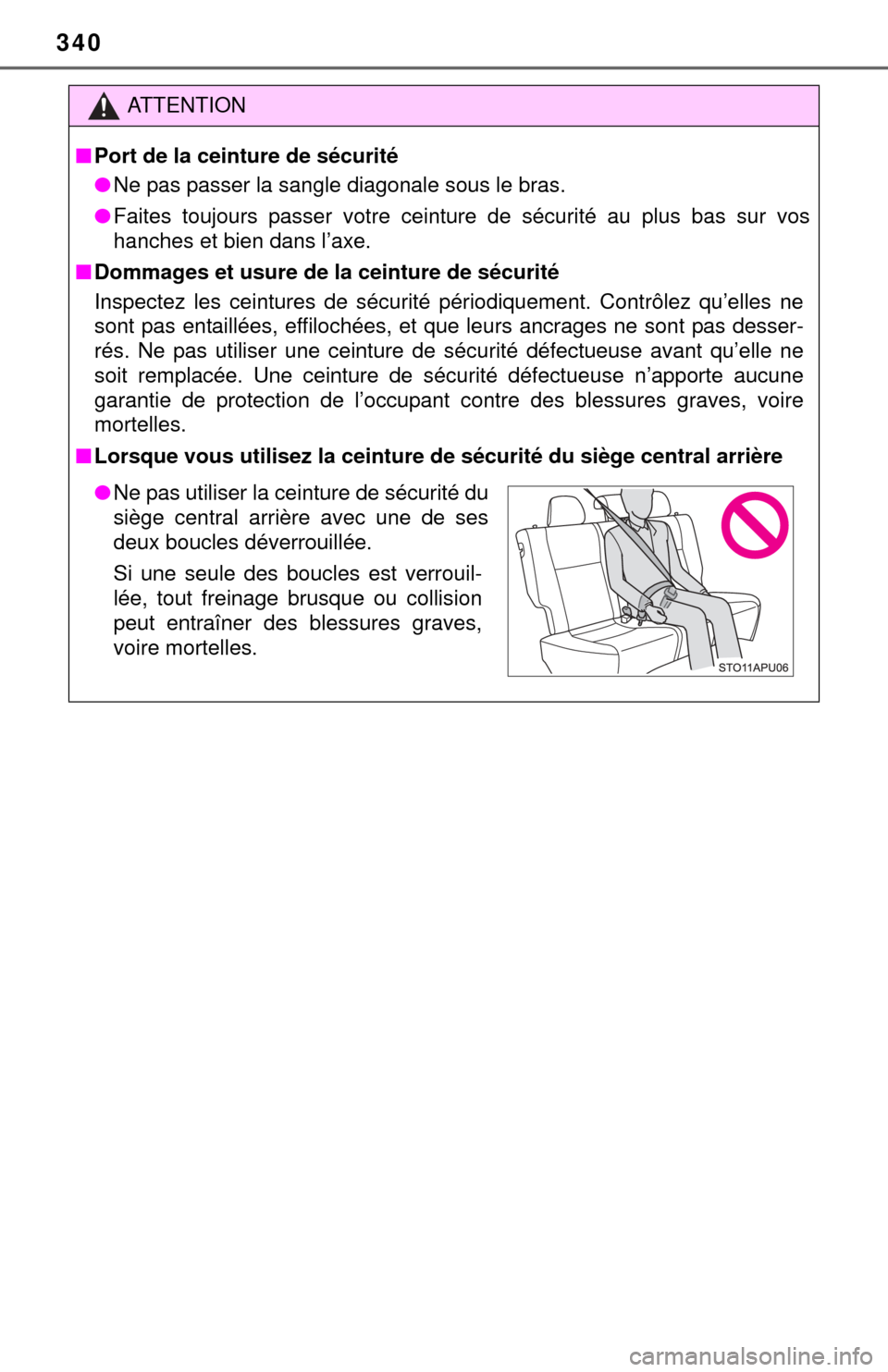
■ Lorsque vous utilisez la ceinture de sécurité du siège central arrière
●Ne pas utiliser la ceinture de sécurité du
siège central arrière avec une de ses
deux boucles déverrouillée.
Si une seule des boucles est verrouil-
lée, tout freinage brusque ou collision
peut entraîner des blessures graves,
voire mortelles.
Page 345 of 364

345
9
For owners
ATTENTION
■Précautions avec les coussins gonflables SRS
Respectez les précautions suivantes concernant les coussins gonflables
SRS.
À défaut, des blessures graves, voire mortelles, pourraient s’ensuivre.
● Le conducteur et tous les passagers à bord du véhicule doivent porter leur
ceinture de sécurité correctement.
Les coussins gonflables SRS sont des dispositifs de protection complé-
mentaires aux ceintures de sécurité.
● Le coussin gonflable SRS conducteur se déploie avec une puissance con-
sidérable et peut occasionner des blessures graves, voire mortelles, \
nota-
mment lorsque le conducteur se trouve très près du coussin gonflable.
L’autorité fédérale chargée de la sécurité routière aux États-Unis, la
NHTSA (National Highway Traffic Safety Administration) conseille:
Sachant que la zone de danger pour le coussin gonflable conducteur se
trouve dans les premiers 50 à 75 mm (2 à 3 pouces) du déploiement,
placez-vous à 250 mm (10 pouces) du coussin gonflable conducteur pour
garantir une marge de sécurité suffisante. Cette distance est à mesurer
entre le moyeu du volant de direction et le sternum. Si vous êtes assis à
moins de 10 in. (250 mm), vous pouvez changer votre position de con-
duite de plusieurs façons:
• Reculez votre siège le plus possible, tout en continuant à pouvoir
atteindre confortablement les pédales.
• Inclinez légèrement le dossier du siège. Bien que les véhicules soient
différents les uns des autres, la plupart des conducteurs peuvent
s’asseoir à une distance de 250 mm (10 in.), même avec le siège con-
ducteur complètement avancé, simplement en inclinant un peu le dos-
sier de siège. Si vous avez des difficultés à voir la route après avoir
incliné votre siège, utilisez un coussin ferme et antidérapant pour vous
rehausser ou, si votre véhicule est équipé du réglage en hauteur du
siège, remontez-le.
• Si votre volant de direction est réglable, inclinez-le vers le bas. Cela vous permet d’orienter le coussin gonflable vers votre buste plutôt que
vers la tête et le cou.
Le siège doit être réglé selon les recommandations de la NHTSA ci-des-
sus, tout en conservant le contrôle des pédales et du volant, et la vue des
commandes au tableau de bord.
Page 355 of 364

355Alphabetical index
Alphabetical index
A/C ............................................ 172Air conditioning filter ............. 238
Manual air conditioning system ......... ....................... 172
ABS (Anti-lock Brake System) .................................. 162 Function ................................ 162
Warning light ......................... 273
Air conditioning filter .............. 238
Air conditioning system.......... 172 Air conditioning filter ............. 238
Manual air conditioning system ......... ....................... 172
Airbags ....................................... 34 Airbag operating conditions .... 41
Airbag precautions for your child .............................. 36
Airbag warning light .............. 273
Correct driving posture ........... 24
Curtain shield airbag operating conditions ............. 41
Curtain shield airbag
precautions ........................... 39
Front passenger occupant classification syst em............. 46
General airbag precautions .... 36
Locations of airbags................ 34
Modification and disposal of airbags ............... 40
Side airbag operating conditions ............................. 41
Side airbag precautions .......... 38
Side and curtain shield airbags operating
conditions ............................. 41
Side and curtain shield airbags precautions .............. 38
SRS airbags............................ 34 Anchor brackets ........................ 58
Anti-lock Brake System
(ABS) ...................................... 162
Function ................................ 162
Warning light......................... 273
Assist grips .............................. 192
Audio input .............................. 181
Automatic transmission ......... 139 If the shift lever cannot be shifted from P ..................... 296
AUX port ................................... 181
Back door Back door ............................... 94
Luggage compartment light....................................... 95
Back-up lights Replacing light bulb .............. 258
Wattage ................................ 316
Battery ...................................... 219 If the battery is discharged ... 297
Preparing and checking
before winter ...................... 167
Warning light......................... 272
Bottle holders .......................... 186
Brake Fluid ...................................... 314
Parking brake ....................... 143
Warning light......................... 272
Brake assist ............................. 162
Break-in tips ............................ 119
Brightness control Instrument panel light
control .................................. 77
A
B
Page 356 of 364

356Alphabetical index
Care................................... 194, 197Aluminum wheels.................. 195
Exterior ................................. 194
Interior................................... 197
Seat belts .............................. 198
Chains....................................... 168
Child restraint system ............... 53 Infant seats, definition ............. 54
Infant seats, installation .......... 59
Convertible seat, definition ..... 54
Convertible seat,installation ...................... 59, 60
Installing CRS with LATCH
anchors................................. 58
Installing CRS with seat belts .............................. 59
Installing CRS with top tether strap ........................... 63
Booster seats, definition ......... 54
Booster seats, installation ....... 62
Child safety ................................ 52 Airbag precautions .................. 36
Back door precautions ............ 95
Battery precautions ............... 220
Child restraint system ............. 53
How your child should wear
the seat belt .......................... 29
Installing child restraints ......... 57
Power window lock switch .... 113
Power window precautions ... 114
Rear door child-protectors ...... 92
Removed key battery
precautions ......................... 242
Seat belt precautions .............. 30
Child-protectors......................... 92
Cleaning ........................... 194, 197 Aluminum wheels.................. 195
Exterior ................................. 194
Interior................................... 197
Seat belts .............................. 198 Clock........................................... 80
Clutch ....................................... 313
Condenser................................ 218
Coolant ..................................... 216
Capacity................................ 311
Checking............................... 216
Preparing and checking before winter ...................... 167
Cooling system........................ 216 Engine overheating............... 300
CRS (Child Restraint System) .................................... 53
Cruise control .......................... 158
Warning lights ....................... 274
Cup holders ............................. 185
Curtain shield airbags............... 34
Customizable features ............ 333
Defogger Outside rear view mirrors ..... 176
Rear window ......................... 176
Windshield ............................ 175
Dimensions .............................. 306
Display Drive information .................... 79
Multi-information display ......... 78
Do-it-yourself maintenance .... 206
Door lock
Back door ............................... 94
Side doors .............................. 89
Wireless remote control .......... 85
Doors Back door ............................... 94
Door glasses......................... 113
Door lock ................................ 91
Open door warning buzzer ... 274
Open door warning light ....... 274
Outside rear view mirrors ..... 111
Rear door child-protector ........ 92
Side doors .............................. 89
Side windows........................ 113
C
D