Page 188 of 364
1885-4. Using the storage features
Luggage compartment features
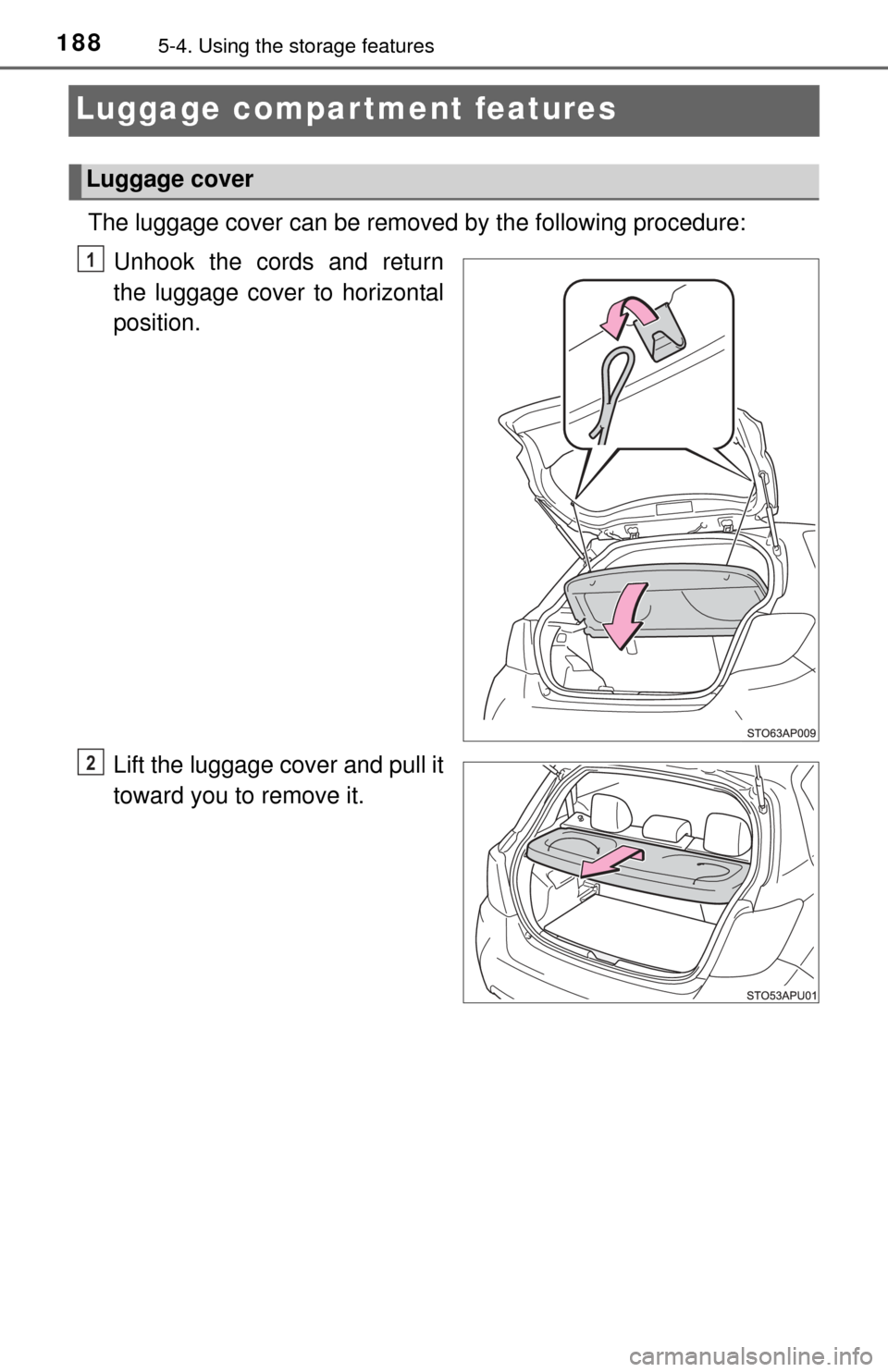
The luggage cover can be removed by the following procedure:
Unhook the cords and return
the luggage cover to horizontal
position.
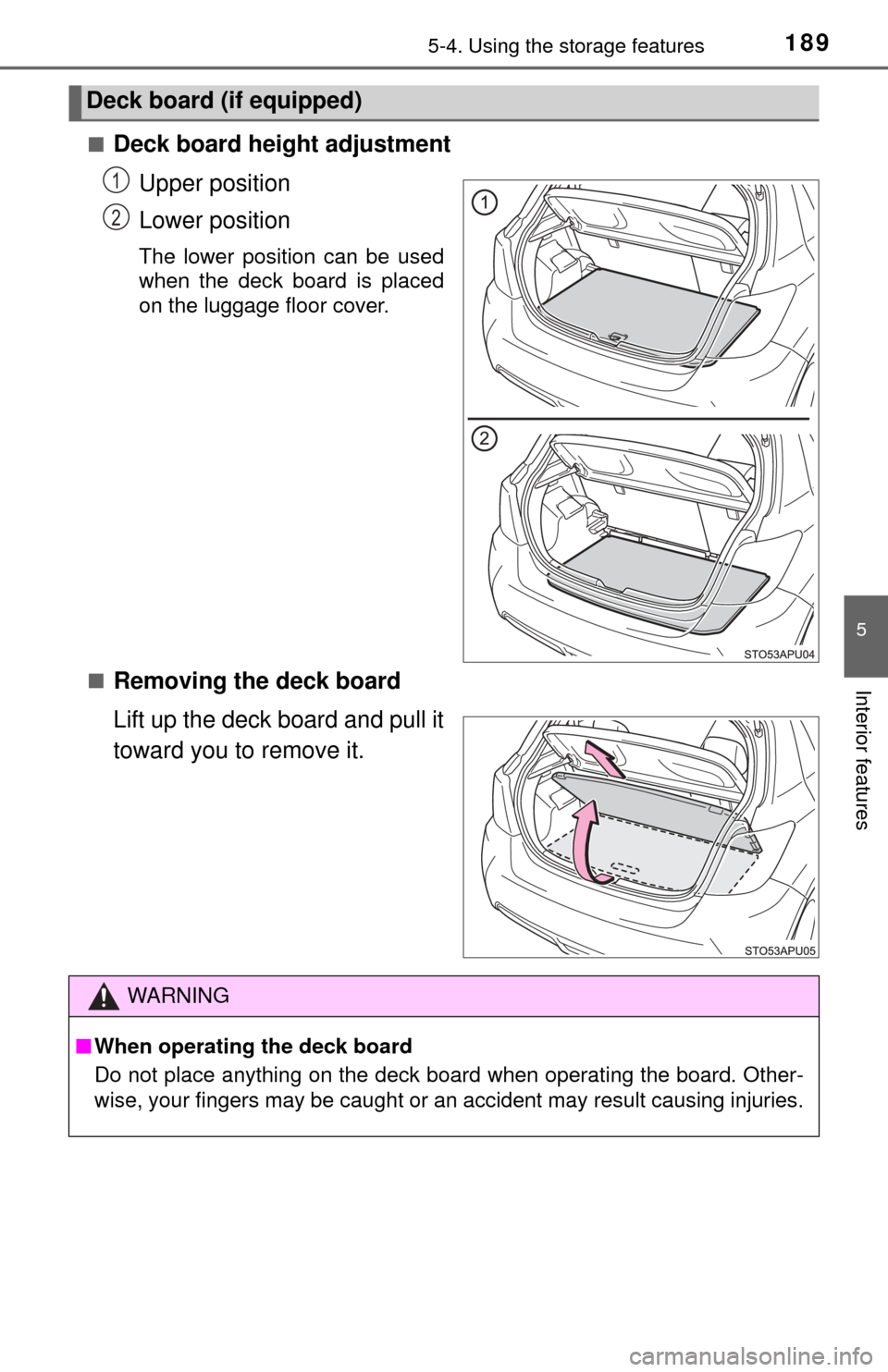
Lift the luggage cover and pull it
toward you to remove it.
Luggage cover
1
2
Page 189 of 364
1895-4. Using the storage features
5
Interior features
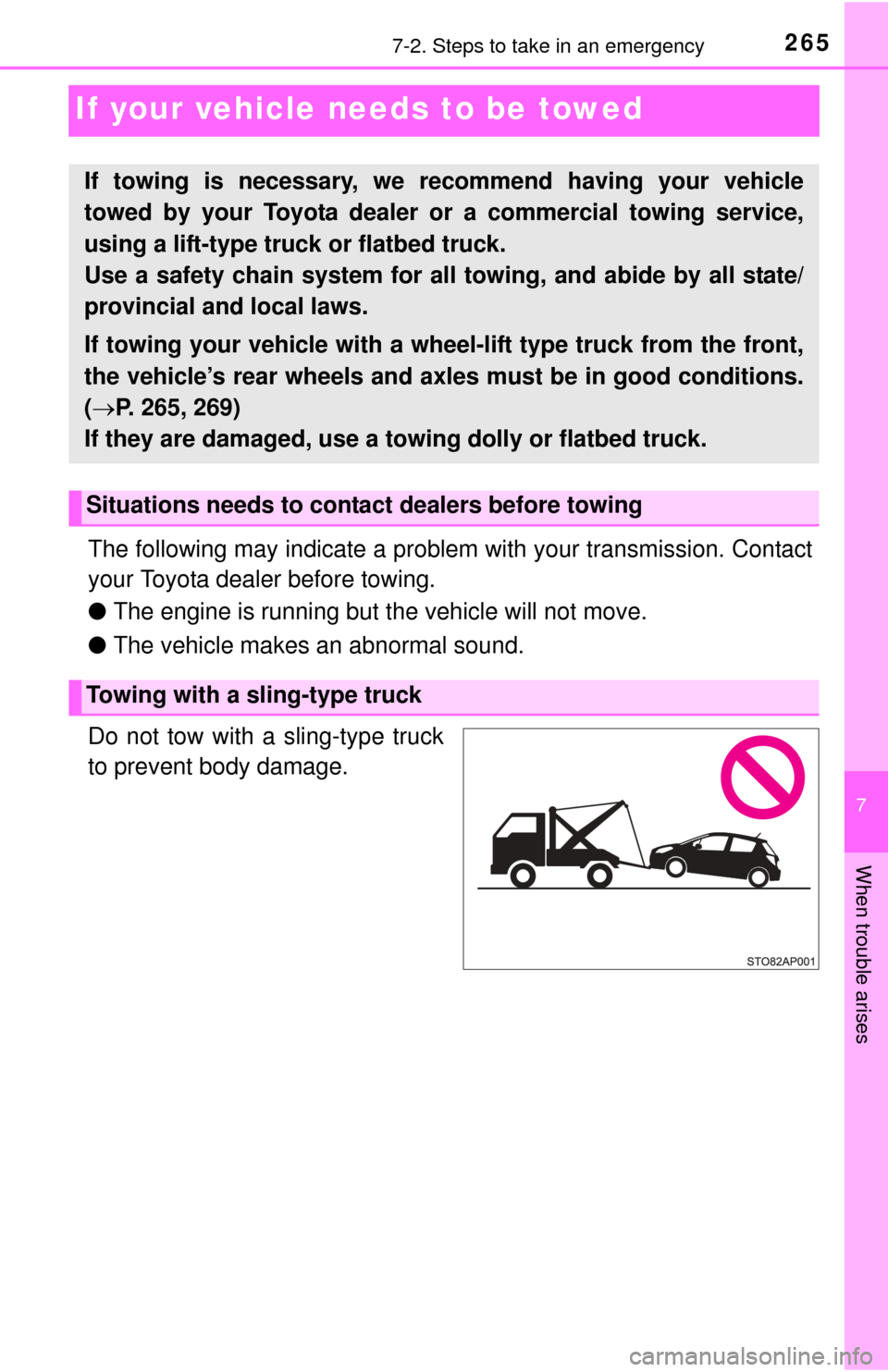
■Deck board height adjustmentUpper position
Lower position
The lower position can be used
when the deck board is placed
on the luggage floor cover.
■
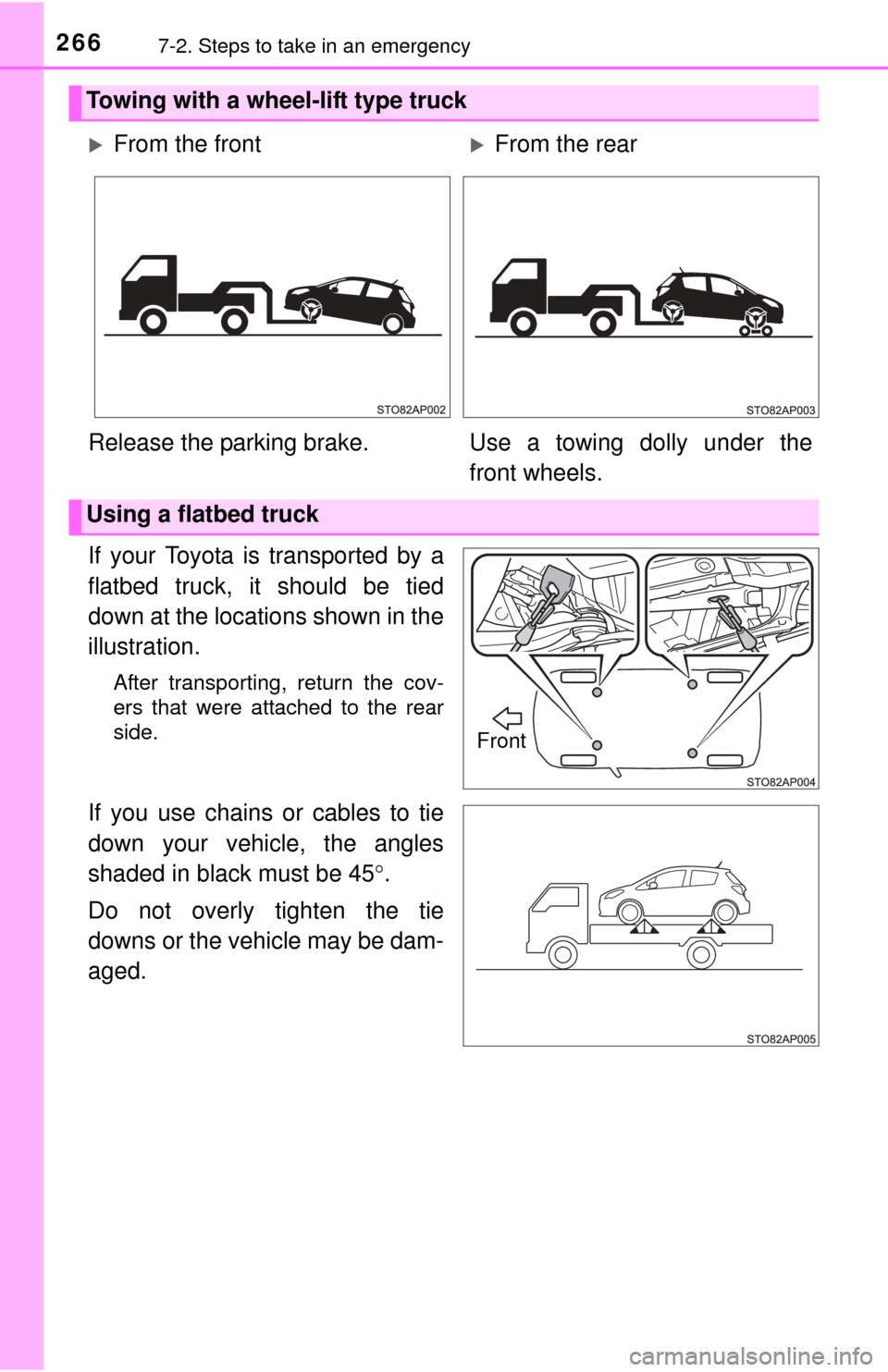
Removing the deck board
Lift up the deck board and pull it
toward you to remove it.
Deck board (if equipped)
1
2
WARNING
■ When operating the deck board
Do not place anything on the deck board when operating the board. Other-
wise, your fingers may be caught or an accident may result causing injuries.
Page 206 of 364
2066-3. Do-it-yourself maintenance
Do-it-yourself ser vice precautions
If you perform maintenance by yourself, be sure to follow the
correct procedure as given in these sections.
ItemsParts and tools
Battery condition
( P. 219)• Warm water• Baking soda• Grease
• Conventional wrench (for terminal clamp bolts)
• Distilled water
Brake fluid level
( P. 218)• FMVSS No.116 DOT 3 or SAE J1703 brake fluid
• Rag or paper towel
• Funnel (used only for adding brake fluid)
Engine coolant
level ( P. 216)
• “Toyota Super Long Life Coolant” or a similar high
quality ethylene glycol-based non-silicate, non-
amine, non-nitrite and non-borate coolant with long-
life hybrid organic acid technology
Except Canada
“Toyota Super Long Life Coolant” is pre-mixed with
50% coolant and 50% deionized water.
Canada
“Toyota Super Long Life Coolant” is pre-mixed with
55% coolant and 45% deionized water.
• Funnel (used only for adding engine coolant)
Engine oil level
( P. 214)• “Toyota Genuine Motor Oil” or equivalent
• Rag or paper towel
• Funnel (used only for adding engine oil)
Page 229 of 364
2296-3. Do-it-yourself maintenance
6
Maintenance and care
WARNING
■When inspecting or replacing tires
Observe the following precautions to prevent accidents.
Failure to do so may cause damage to parts of the drive train as well as
dangerous handling characteristics, which may lead to an accident
resulting in death or serious injury.
●Do not mix tires of different makes, models or tread patterns.
Also, do not mix tires of remarkably different treadwear.
●Do not use tire sizes other than those recommended by Toyota.
●Do not mix differently constructed ti res (radial, bias-belted or bias-ply
tires).
●Do not mix summer, all season and snow tires.
●Do not use tires that have been used on another vehicle.
Do not use tires if you do not know how they were used previously.
●Do not tow if your vehicle has a compact spare tire installed.
■When initializing the tire pressure warning system (vehicles with a
tire pressure warning system)
Do not operate the tire pressure warning reset switch without first
adjusting the tire inflation pressure to the specified level. Otherwise, the
tire pressure warning light may not come on even if the tire inflation
pressure is low, or it may come on when the tire inflation pressure is
actually normal.
Page 261 of 364
261
7When trouble arises
7-1. Essential informationEmergency flashers .......... 262
If your vehicle has to be stopped in
an emergency ................. 263
7-2. Steps to take in an emergency
If your vehicle needs to be towed ......................... 265
If you think something is wrong .............................. 270
Fuel pump shut off system ............................ 271
If a warning light turns on or a warning buzzer
sounds ............................ 272
If you have a flat tire.......... 281
If the engine will not start .. 294
If the shift lever cannot be shifted from P (vehicles
with an automatic
transmission) .................. 296
If the vehicle battery is discharged ...................... 297
If your vehicle overheats ... 300
If the vehicle becomes stuck ............................... 303
Page 265 of 364
265
7
When trouble arises
7-2. Steps to take in an emergency
If your vehicle needs to be towed
The following may indicate a problem with your transmission. Contact
your Toyota dealer before towing.
●The engine is running but the vehicle will not move.
● The vehicle makes an abnormal sound.
Do not tow with a sling-type truck
to prevent body damage.
If towing is necessary, we re commend having your vehicle
towed by your Toyota dealer or a commercial towing service,
using a lift-type truc k or flatbed truck.
Use a safety chain system for all towing, and abide by all state/
provincial and local laws.
If towing your vehicle with a wheel-lift type truck from the front,
the vehicle’s rear wheels and axles must be in good conditions.
( P. 265, 269)
If they are damaged, use a towing dolly or flatbed truck.
Situations needs to contact dealers before towing
Towing with a sling-type truck
Page 266 of 364
2667-2. Steps to take in an emergency
If your Toyota is transported by a
flatbed truck, it should be tied
down at the locations shown in the
illustration.
After transporting, return the cov-
ers that were attached to the rear
side.
If you use chains or cables to tie
down your vehicle, the angles
shaded in black must be 45.
Do not overly tighten the tie
downs or the vehicle may be dam-
aged.
Towing with a wheel-lift type truck
From the frontFrom the rear
Release the parking brake. Use a towing dolly under the front wheels.
Using a flatbed truck
Front
Page 267 of 364
2677-2. Steps to take in an emergency
7
When trouble arises
If a tow truck is not available in an emergency, your vehicle may be
temporarily towed using a cable or chain secured to the emergency
towing eyelet. This should only be attempted on hard surfaced roads
for 50 miles (80 km) at under 18 mph (30 km/h).
A driver must be in the vehicle to steer and operate the brakes. The
vehicle’s wheels, drive train, axles, steering and brakes must be in
good condition.
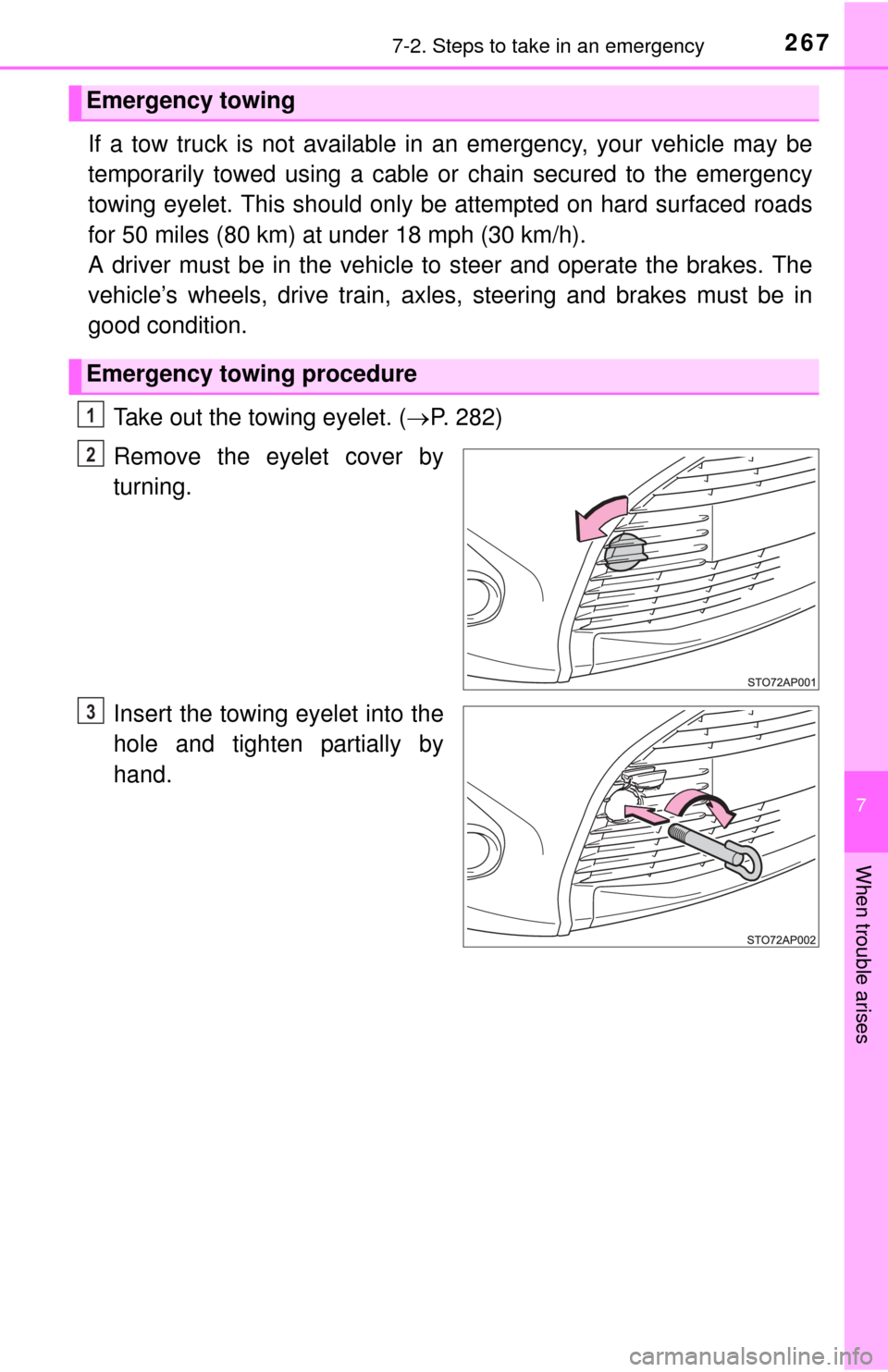
Take out the towing eyelet. ( P. 282)
Remove the eyelet cover by
turning.
Insert the towing eyelet into the
hole and tighten partially by
hand.
Emergency towing
Emergency towing procedure
1
2
3