Page 203 of 540
203
4
4-2. Driving procedures
Driving
YARIS_F_WE_52G04E
Parking brake
To set the parking brake, fully
pull the parking brake lever
while depressing the brake
pedal.
To release the parking brake,
slightly raise the lever and
lower it completely while press-
ing the button.
■ Parking brake engaged warning buzzer
P. 431
■ Usage in winter time
P. 268
Operation instructions
1
2
NOTICE
■Before driving
Fully release the parking brake.
Driving the vehicle with the parking brake set will lead to brake components
overheating, which may affect braking performance and increase brake
wear.
Page 207 of 540

2074-3. Operating the lights and wipers
4
Driving
YARIS_F_WE_52G04E
Vehicle category N1*
*: To distinguish the vehicle category, ask any authorized Toyota dealer or
repairer, or another duly qualified and equipped professional.
■ Daytime running light system
To make your vehicle more visible to other drivers during daytime driving, the
daytime running lights turn on automatically whenever the engine is started
and the parking brake is released with the headlight switch off or in the
“AUTO” position. (Illuminate brighter than the front position lights.) Daytime
running lights are not designed for use at night.
■ Headlight control sensor (if equipped)
Loading conditionControl switch position
Driver only0
Driver + full luggage loading to the lug-
gage room4
The sensor may not function properly if an
object is placed on the sensor, or anything
that blocks the sensor is affixed to the
windshield.
Doing so interferes with the sensor
detecting the level of ambient light and
may cause the automatic headlight sys-
tem to malfunction.
Page 259 of 540

2594-6. Using the driving support systems
4
Driving
YARIS_F_WE_52G04E
WARNING
■When the Stop & Start system is operating
● Keep the shift lever in N (manual transmission) and apply the brake pedal
or parking brake for safety while the engine is stopped due to the Stop &
Start system (while the Stop & Start indicator is on).
Unexpected accidents may occur due to the automatic engine start func-
tion.
● Do not leave the vehicle while the engine is stopped due to the Stop &
Start system (while the Stop & Start indicator is on).
Unexpected accidents may occur due to the automatic engine start func-
tion.
● Ensure that the engine is not stopped by the Stop & Start system while the
vehicle is in a poorly ventilated area. The engine may restart due to the
automatic engine start function, causing exhaust gases to collect and
enter the vehicle and resulting in death or a serious health hazard.
NOTICE
■ To ensure the system operates correctly
If any one of the following situations occurs, the Stop & Start system may
not operate correctly, thus, please have your vehicle checked by any autho-
rized Toyota dealer or repairer, or another duly qualified and equipped pro-
fessional.
● While the driver’s seat belt is fastened, the driver’s and front passenger’s
seat belt reminder light flashes.
● Even when the driver’s seat belt is not fastened, the driver’s and front pas-
senger’s seat belt reminder light remains off.
● Even when the driver’s door is closed, the open door warning light comes
on, or the interior light comes on when the interior light switch is in the door
position.
● Even when the driver’s door is opened, the open door warning light does
not come on, or the interior light does not come on when the interior light
switch is in the door position.
Page 268 of 540

2684-7. Driving tips
YARIS_F_WE_52G04E
Accelerate the vehicle slowly, keep a safe distance between you and
the vehicle ahead, and drive at a reduced speed suitable to road con-
ditions.
Park the vehicle and move the shift lever to P (Multidrive) 1 or R (man-
ual transmission) without setting the parking brake. The parking brake
may freeze up, preventing it from being released. If necessary, block
the wheels to prevent inadvertent sliding or creeping.
Use the correct tire chain size when mounting the tire chains.
Chain size is regulated for each tire size.
Side chain
Except 175/65R14 tires:
3 mm (0.12 in.) in diameter
175/65R14 tires:
4 mm (0.16 in.) in diameter
Cross chain
Except 175/65R14 tires:
4 mm (0.16 in.) in diameter
175/65R14 tires:
5 mm (0.20 in.) in diameter
Regulations regarding the use of tire chains vary depending on loca-
tion and type of road. Always check local regulations before installing
chains.
When driving the vehicle
When parking the vehicle
Selecting tire chains
1
2
Regulations on the use of tire chains
Page 424 of 540
4248-2. Steps to take in an emergency
YARIS_F_WE_52G04E
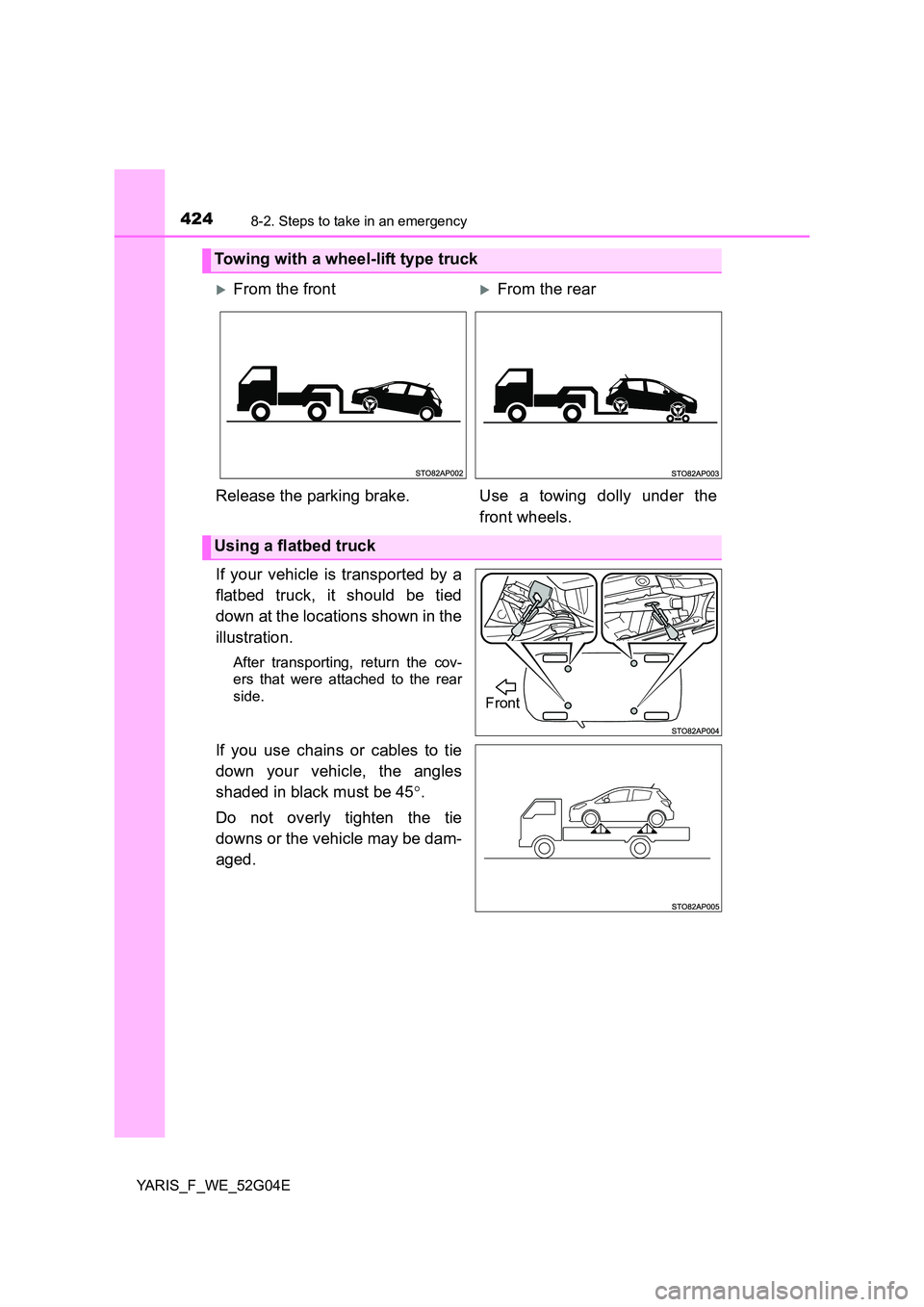
If your vehicle is transported by a
flatbed truck, it should be tied
down at the locations shown in the
illustration.
After transporting, return the cov-
ers that were attached to the rear
side.
If you use chains or cables to tie
down your vehicle, the angles
shaded in black must be 45 .
Do not overly tighten the tie
downs or the vehicle may be dam-
aged.
Towing with a wheel-lift type truck
From the frontFrom the rear
Release the parking brake. Use a towing dolly under the
front wheels.
Using a flatbed truck
Front
Page 426 of 540
4268-2. Steps to take in an emergency
YARIS_F_WE_52G04E
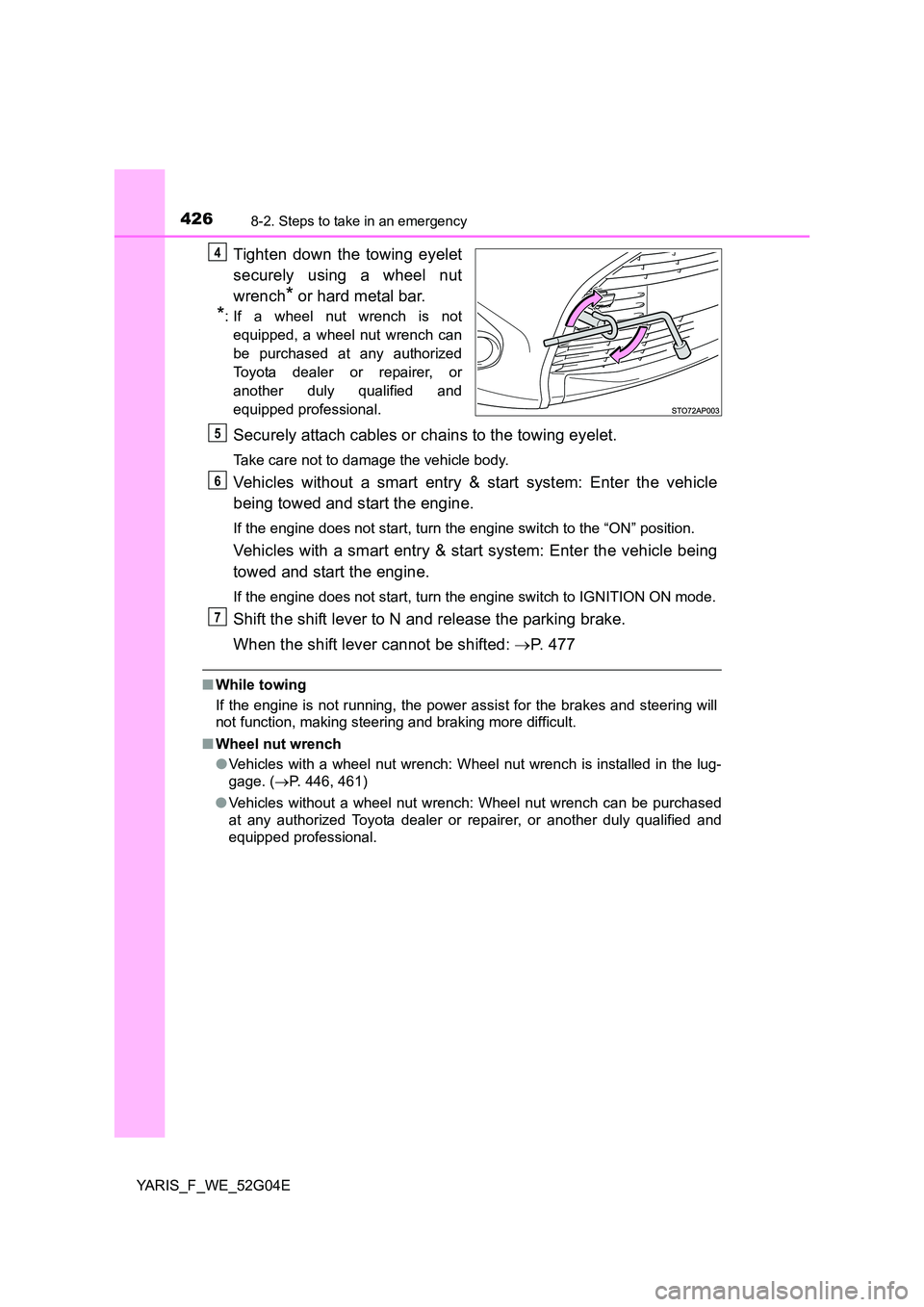
Tighten down the towing eyelet
securely using a wheel nut
wrench* or hard metal bar.
*: If a wheel nut wrench is not
equipped, a wheel nut wrench can
be purchased at any authorized
Toyota dealer or repairer, or
another duly qualified and
equipped professional.
Securely attach cables or chains to the towing eyelet.
Take care not to damage the vehicle body.
Vehicles without a smart entry & start system: Enter the vehicle
being towed and start the engine.
If the engine does not start, turn the engine switch to the “ON” position.
Vehicles with a smart entry & start system: Enter the vehicle being
towed and start the engine.
If the engine does not start, turn the engine switch to IGNITION ON mode.
Shift the shift lever to N and release the parking brake.
When the shift lever cannot be shifted: P. 477
■While towing
If the engine is not running, the power assist for the brakes and steering will
not function, making steering and braking more difficult.
■ Wheel nut wrench
● Vehicles with a wheel nut wrench: Wheel nut wrench is installed in the lug-
gage. ( P. 446, 461)
● Vehicles without a wheel nut wrench: Wheel nut wrench can be purchased
at any authorized Toyota dealer or repairer, or another duly qualified and
equipped professional.
4
5
6
7
Page 431 of 540

4318-2. Steps to take in an emergency
8
When trouble arises
YARIS_F_WE_52G04E
If a war ning light tur ns on or a warning
buzzer sounds
Calmly perform the following actions if any of the warning lights
comes on or flashes. If a light comes on or flashes, but then
goes off, this does not necessarily indicate a malfunction in the
system. However, if this continues to occur, have the vehicle
inspected by any authorized Toyota dealer or repairer, or
another duly qualified and equipped professional.
Warning light and warning buzzer list
Warning lightWarning light/Details/Actions
Brake system warning light (warning buzzer)*1
• Low brake fluid
• Malfunction in the brake system
This light also comes on when the parking brake is not
released. If the light turns off after the parking brake is fully
released, the system is operating normally.
Immediately stop the vehicle in a safe place and con-
tact any authorized Toyota dealer or repairer, or
another duly qualified and equipped professional.
Continuing to drive the vehicle may be dangerous.
Charging system warning light
Indicates a malfunction in the vehicle’s charging system.
Immediately stop the vehicle in a safe place and con-
tact any authorized Toyota dealer or repairer, or
another duly qualified and equipped professional.
Low engine oil pressure warning light
Indicates that the engine oil pressure is too low.
Immediately stop the vehicle in a safe place and con-
tact any authorized Toyota dealer or repairer, or
another duly qualified and equipped professional.
(Red warning light flashes or comes on)
High engine coolant temperature warning light
Indicates that the engine is overheating.
As the coolant temperature rises, it changes from flashing
to steady on.
P. 485
Page 437 of 540

4378-2. Steps to take in an emergency
8
When trouble arises
YARIS_F_WE_52G04E
*1: Parking brake engaged warning buzzer:
The buzzer sounds to indicate that the parking brake is still engaged (with
the vehicle having reached a speed of 5 km/h [3 mph]).
*2: If equipped
*3: Open door warning buzzer:
A buzzer will sound if the vehicle reaches a speed of 5 km/h (3 mph) or
more with any door open.
Engine oil change reminder light (diesel engine only)
When the light flashes:
Indicates that the engine oil is scheduled to be changed.
• Vehicles without a DPF system*6:
Flashes approximately 35000 km (22000 miles) after the
engine oil is changed. (The indicator will not work prop-
erly unless the oil maintenance data has been reset).
• Vehicles with a DPF system*6:
Flashes approximately 14500 km (9000 miles) after the
engine oil is changed. ( P. 439) (The indicator will not
work properly unless the oil maintenance data has been
reset).
Check the engine oil, and change if necessary. After
changing the engine oil, the oil change system
should be reset. ( P. 364)
When the light comes on:
Indicates that the engine oil should be changed.
• Vehicles without a DPF system*6:
Comes on approximately 40000 km (25000 miles) after
the engine oil is changed (and the oil maintenance data
has been reset).
• Vehicles with a DPF system*6:
Comes on approximately 15000 km (9300 miles) after
the engine oil is changed (and the oil maintenance data
has been reset).
Check and change the engine oil, and oil filter by any
authorized Toyota dealer or repairer, or another duly
qualified and equipped professional. After changing
the engine oil, the oil chan ge system should be reset.
( P. 364)
Warning lightWarning light/Details/Actions