Page 371 of 540
3717-3. Do-it-yourself maintenance
7
Maintenance and care
YARIS_F_WE_52G04E
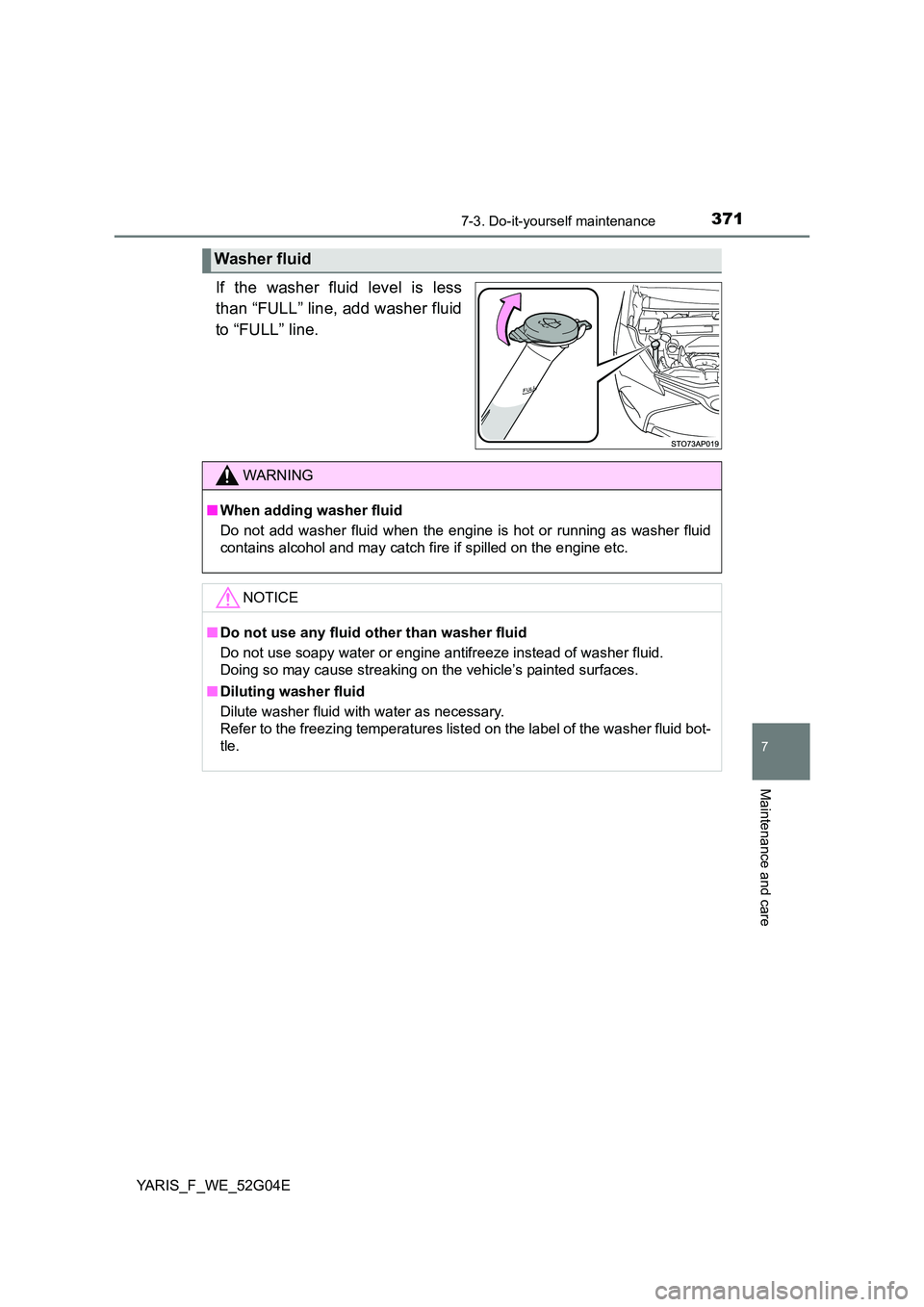
If the washer fluid level is less
than “FULL” line, add washer fluid
to “FULL” line.
Washer fluid
WARNING
■ When adding washer fluid
Do not add washer fluid when the engine is hot or running as washer fluid
contains alcohol and may catch fire if spilled on the engine etc.
NOTICE
■ Do not use any fluid other than washer fluid
Do not use soapy water or engine antifreeze instead of washer fluid.
Doing so may cause streaking on the vehicle’s painted surfaces.
■ Diluting washer fluid
Dilute washer fluid with water as necessary.
Refer to the freezing temperatures list ed on the label of the washer fluid bot-
tle.
Page 372 of 540
3727-3. Do-it-yourself maintenance
YARIS_F_WE_52G04E
You may drain the fuel filter yourself. However, as the operation is dif-
ficult, we recommend having it drained by any authorized Toyota
dealer or repairer, or another duly qualified and equipped profes-
sional. Even if you decide to drain it yourself, contact any authorized
Toyota dealer or repairer, or another duly qualified and equipped pro-
fessional.
The water in the fuel filter needs to be drained if the fuel filter warning
light comes on. (P. 434)
Turn the engine switch to the “LOCK” position (vehicles without a
smart entry & start system) or off (vehicles with a smart entry & start
system).
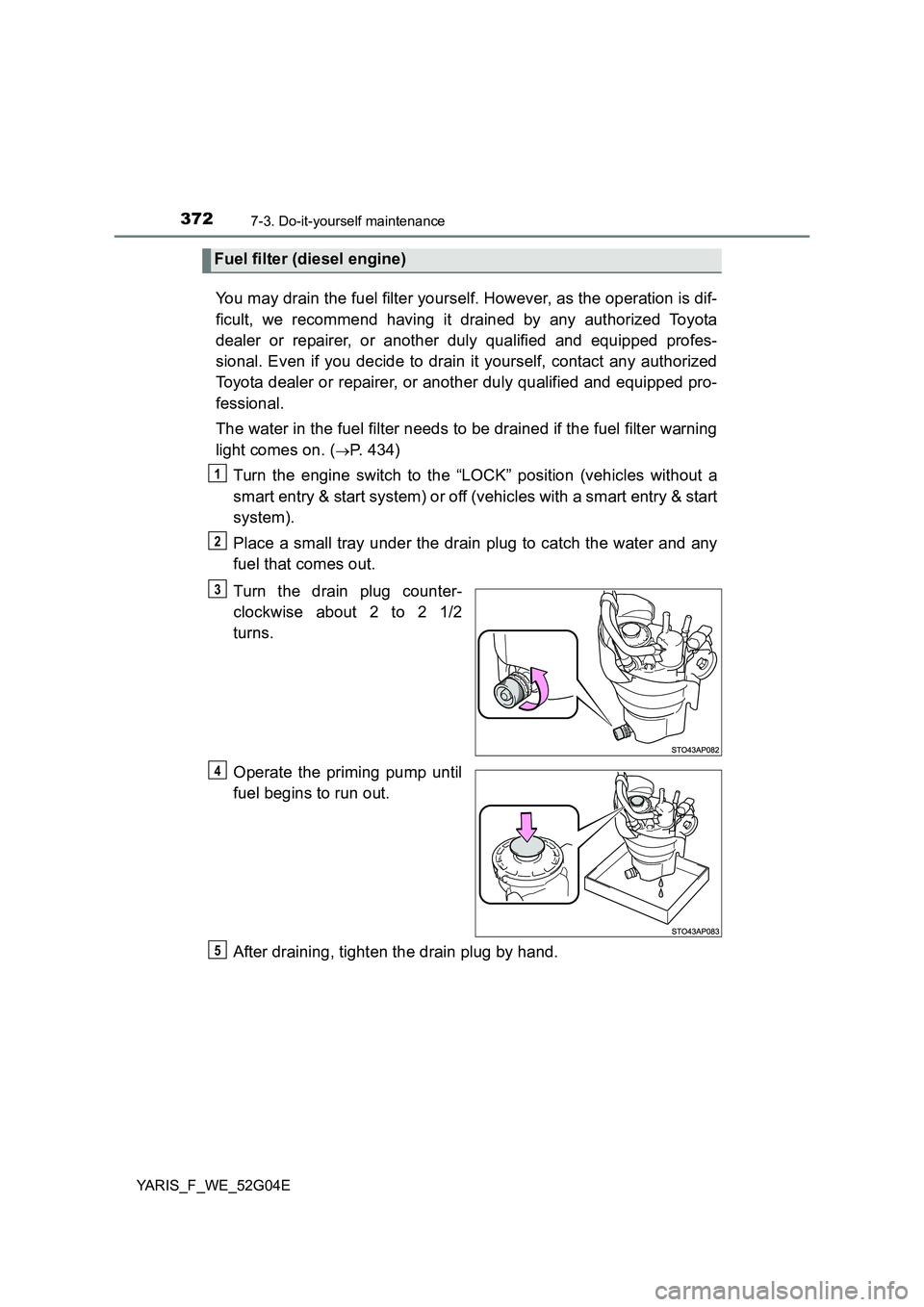
Place a small tray under the drain plug to catch the water and any
fuel that comes out.
Turn the drain plug counter-
clockwise about 2 to 2 1/2
turns.
Operate the priming pump until
fuel begins to run out.
After draining, tighten the drain plug by hand.
Fuel filter (diesel engine)
1
2
3
4
5
Page 376 of 540
3767-3. Do-it-yourself maintenance
YARIS_F_WE_52G04E
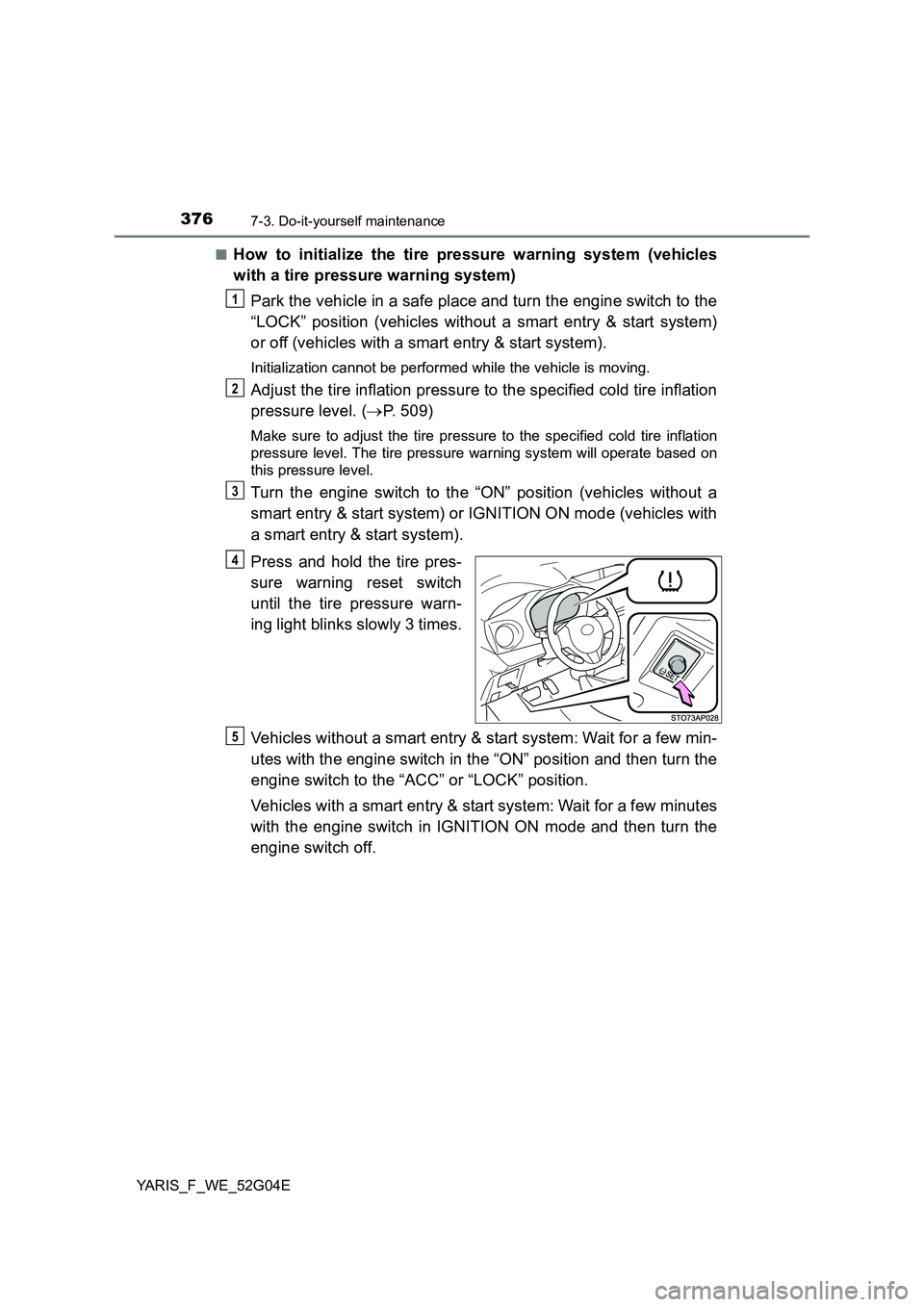
■How to initialize the tire pressure warning system (vehicles
with a tire pressure warning system)
Park the vehicle in a safe place and turn the engine switch to the
“LOCK” position (vehicles without a smart entry & start system)
or off (vehicles with a smart entry & start system).
Initialization cannot be performed while the vehicle is moving.
Adjust the tire inflation pressure to the specified cold tire inflation
pressure level. ( P. 509)
Make sure to adjust the tire pressure to the specified cold tire inflation
pressure level. The tire pressure warning system will operate based on
this pressure level.
Turn the engine switch to the “ON” position (vehicles without a
smart entry & start system) or IGNITION ON mode (vehicles with
a smart entry & start system).
Press and hold the tire pres-
sure warning reset switch
until the tire pressure warn-
ing light blinks slowly 3 times.
Vehicles without a smart entry & start system: Wait for a few min-
utes with the engine switch in the “ON” position and then turn the
engine switch to the “ACC” or “LOCK” position.
Vehicles with a smart entry & start system: Wait for a few minutes
with the engine switch in IGNITION ON mode and then turn the
engine switch off.
1
2
3
4
5
Page 392 of 540
3927-3. Do-it-yourself maintenance
YARIS_F_WE_52G04E
Air conditioning filter
Turn the engine switch to the “LOCK” position (vehicles without a
smart entry & start system) or off (vehicles with a smart entry & start
system).
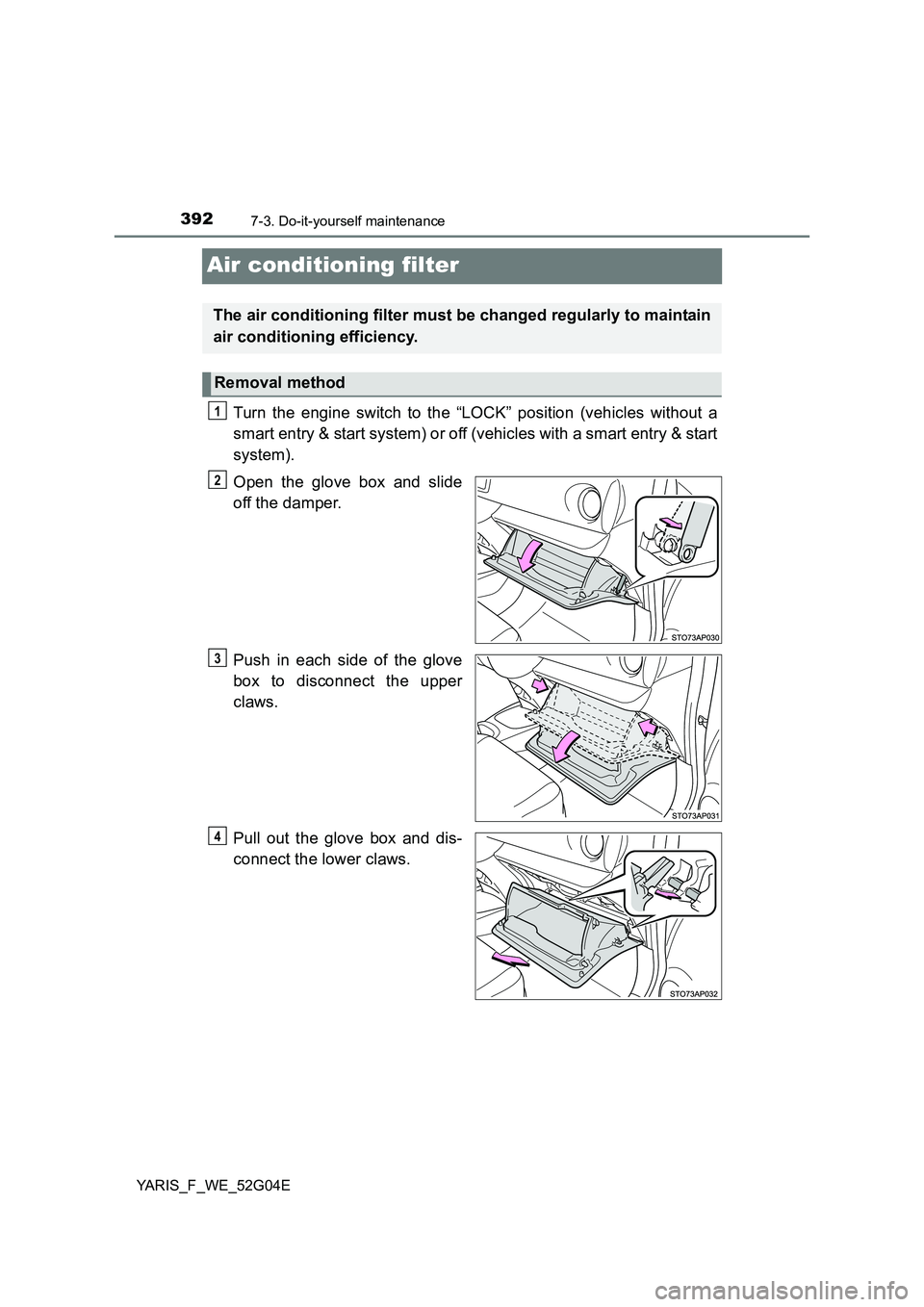
Open the glove box and slide
off the damper.
Push in each side of the glove
box to disconnect the upper
claws.
Pull out the glove box and dis-
connect the lower claws.
The air conditioning filter must be changed regularly to maintain
air conditioning efficiency.
Removal method
1
2
3
4
Page 397 of 540
3977-3. Do-it-yourself maintenance
7
Maintenance and care
YARIS_F_WE_52G04E
Checking and replacing fuses
Turn the engine switch to the “LOCK” position (vehicles without a
smart entry & start system) or off (vehicles with a smart entry & start
system).
Open the fuse box cover.
Engine compartment: type A and B fuse boxes
Type A fuse box
Push the tab in and lift the lid off.
Type B fuse box
Push the tab in and lift the lid off.
If any of the electrical components do not operate, a fuse may
have blown. If this happens, check and replace the fuses as nec-
essary.
1
2
1
2
Page 398 of 540
3987-3. Do-it-yourself maintenance
YARIS_F_WE_52G04E
Engine compartment: type C fuse box (left-hand drive vehicles)
Pull the rubber strip on the
edge to unhook it from the
cover, and then push the
tabs in and lift the cover off.
Remove the battery terminal
cover and then the fuse box
cover.
Engine compartment: type C fuse box (right-hand drive vehicles)
Pull the rubber strip on the
edge to unhook it from the
cover, and then push the
tabs in and lift the cover off.
Remove the battery terminal
cover and then the fuse box
cover.
1
2
1
2
Page 419 of 540

419
8When trouble arises
YARIS_F_WE_52G04E
8-1. Essential information
Emergency flashers ........... 420
If your vehicle has to
be stopped in
an emergency .................. 421
8-2. Steps to take in
an emergency
If your vehicle needs to
be towed .......................... 423
If you think something is
wrong ............................... 429
Fuel pump shut off system
(gasoline engine only) ..... 430
If a warning light turns on
or a warning buzzer
sounds ............................. 431
If you have a flat tire
(vehicles with
a spare tire) ..................... 445
If you have a flat tire
(vehicles with
an emergency tire
puncture repair kit)........... 460
If the engine will not start ... 475
If the shift lever cannot be
shifted from P (vehicles
with a Multidrive).............. 477
If the electronic key does
not operate properly
(vehicles with a smart
entry & start system)........ 478
If the vehicle battery is
discharged ....................... 480
If your vehicle overheats .... 485
If you run out of fuel and
the engine stalls
(diesel engine only) ......... 489
If the vehicle becomes
stuck ................................ 491
Page 420 of 540
4208-1. Essential information
YARIS_F_WE_52G04E
Emergency flashers
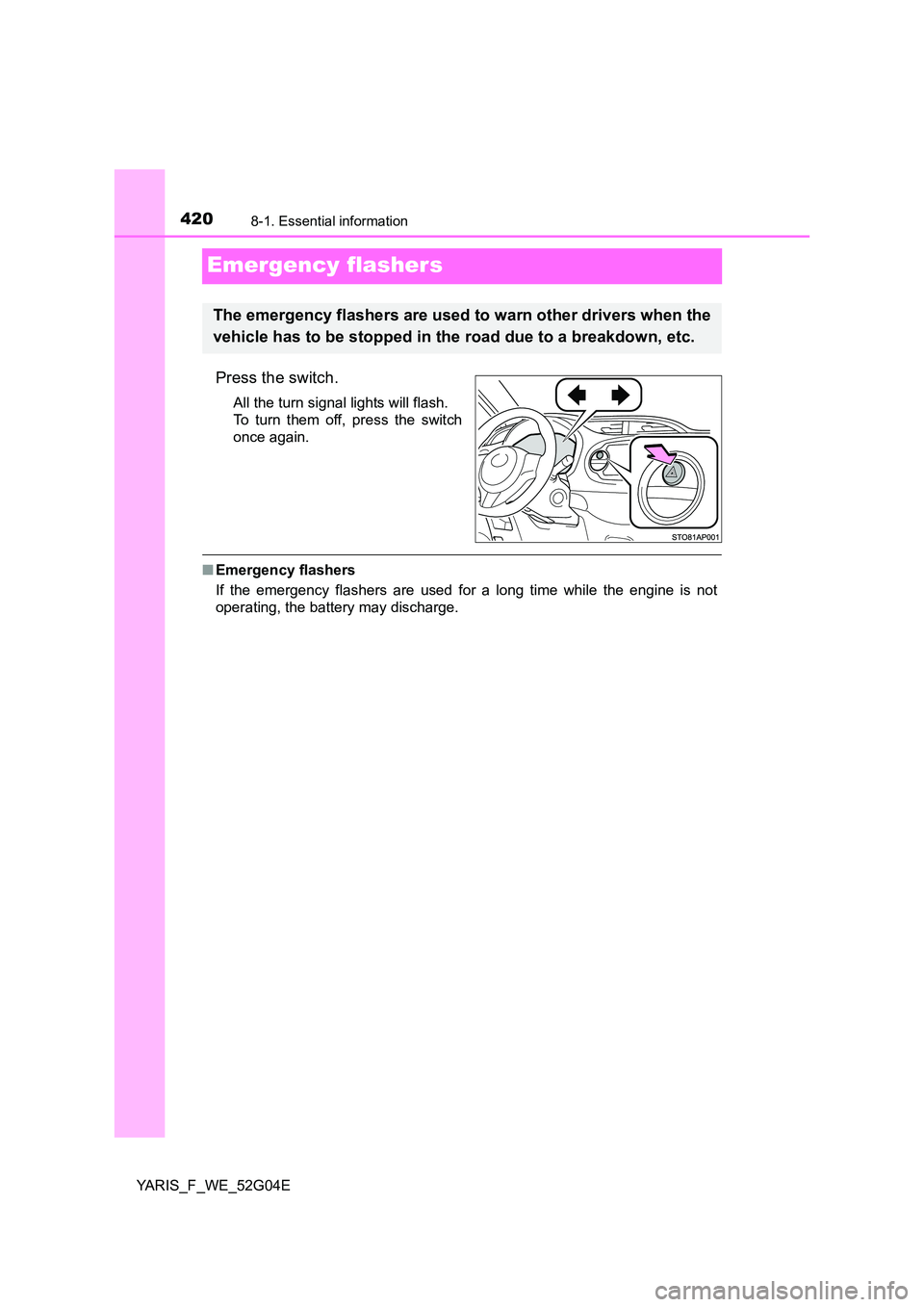
Press the switch.
All the turn signal lights will flash.
To turn them off, press the switch
once again.
■ Emergency flashers
If the emergency flashers are used for a long time while the engine is not
operating, the battery may discharge.
The emergency flashers are used to warn other drivers when the
vehicle has to be stopped in the road due to a breakdown, etc.