Page 5 of 564
1
2
3
4
5
6
5
4-1. Maintenance and care
Cleaning and protecting
the vehicle exterior ........... 354
Cleaning and protecting
the vehicle interior ............ 358
4-2. Maintenance
Maintenance
requirements..................... 361
4-3. Do-it-yourself
maintenance
Do-it-yourself service
precautions ....................... 364
Hood ................................... 367
Positioning a floor jack ........ 368
Engine compartment........... 370
Tires .................................... 384
Tire inflation pressure ......... 395
Wheels ................................ 397
Air conditioning filter ........... 400
Wireless remote control/
electronic key battery........ 403
Checking and replacing
fuses ................................. 407
Light bulbs .......................... 4235-1. Essential information
Emergency flashers ........... 436
If your vehicle needs to be
towed ............................... 437
If you think something is
wrong ............................... 445
Fuel pump shut off
system.............................. 446
5-2. Steps to take in an
emergency
If a warning light turns
on or a warning buzzer
sounds... ......................... 447
If you have a flat tire
(vehicles with a spare
tire) ................................... 462
If you have a flat tire
(vehicles with an
emergency tire puncture
repair kit) .......................... 475
If the engine will not
start .................................. 492
If the shift lever cannot be
shifted from P ................... 495
If you lose your keys .......... 496
If the electronic key does
not operate properly ......... 497
4Maintenance and care5When trouble arises
Page 280 of 564
280 3-1. Using the air conditioning system and defogger
CAUTION
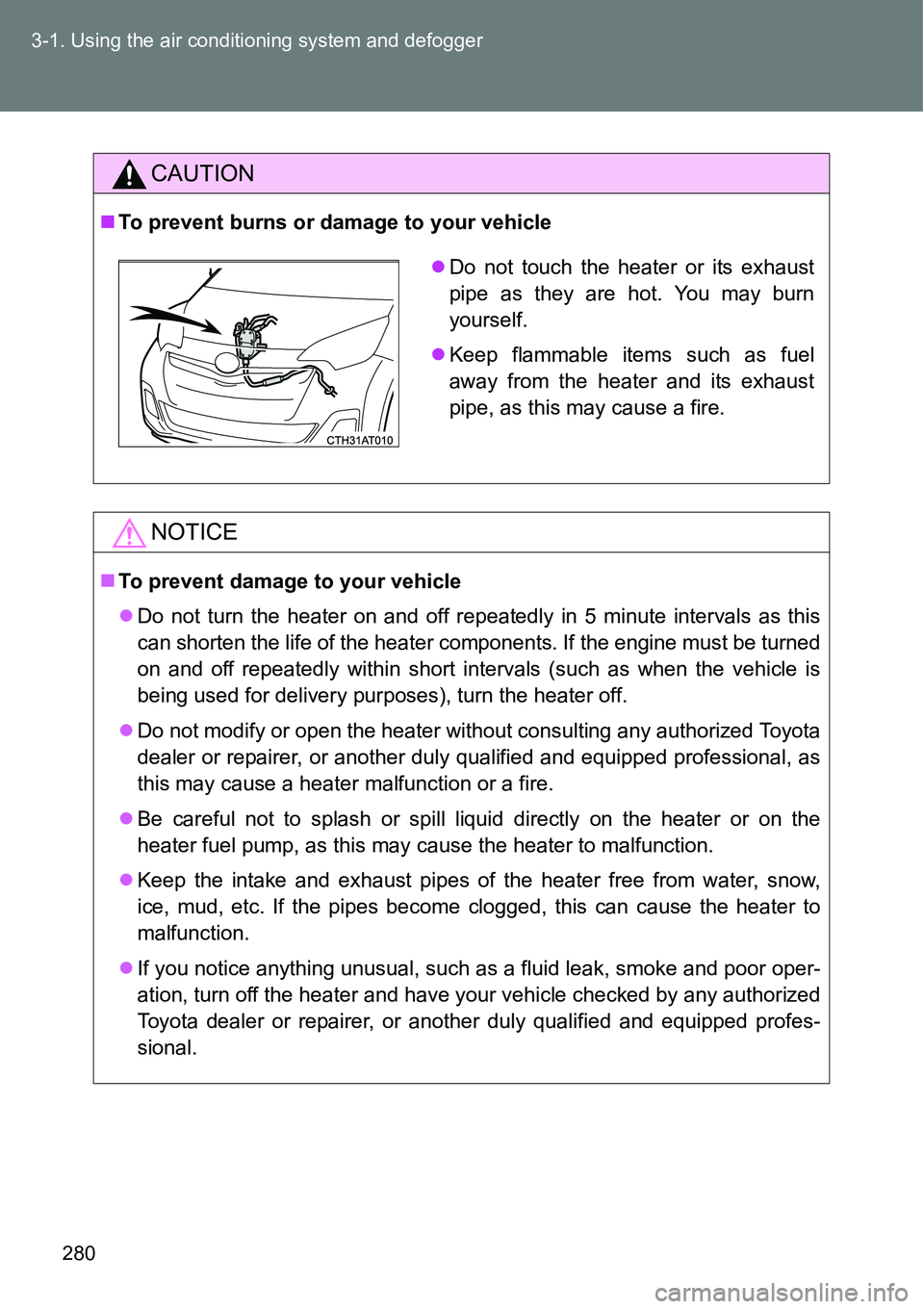
To prevent burns or damage to your vehicle
NOTICE
To prevent damage to your vehicle
Do not turn the heater on and off repeatedly in 5 minute intervals as this
can shorten the life of the heater components. If the engine must be turned
on and off repeatedly within short intervals (such as when the vehicle is
being used for delivery purposes), turn the heater off.
Do not modify or open the heater without consulting any authorized Toyota
dealer or repairer, or another duly qualified and equipped professional, as
this may cause a heater malfunction or a fire.
Be careful not to splash or spill liquid directly on the heater or on the
heater fuel pump, as this may cause the heater to malfunction.
Keep the intake and exhaust pipes of the heater free from water, snow,
ice, mud, etc. If the pipes become clogged, this can cause the heater to
malfunction.
If you notice anything unusual, such as a fluid leak, smoke and poor oper-
ation, turn off the heater and have your vehicle checked by any authorized
Toyota dealer or repairer, or another duly qualified and equipped profes-
sional.
Do not touch the heater or its exhaust
pipe as they are hot. You may burn
yourself.
Keep flammable items such as fuel
away from the heater and its exhaust
pipe, as this may cause a fire.
Page 435 of 564

5When trouble arises
435
5-1. Essential information
Emergency flashers .......... 436
If your vehicle needs to
be towed ......................... 437
If you think something is
wrong .............................. 445
Fuel pump shut
off system ....................... 446
5-2. Steps to take in an
emergency
If a warning light turns
on or a warning buzzer
sounds... ........................ 447
If you have a flat tire
(vehicles with a spare
tire) ................................. 462
If you have a flat tire
(vehicles with an
emergency tire puncture
repair kit)......................... 475
If the engine will not
start ................................ 492
If the shift lever cannot be
shifted from P ................. 495
If you lose your keys ......... 496If the electronic key does
not operate properly ....... 497
If the battery is
discharged ...................... 501
If your vehicle
overheats ........................ 509
If you run out of fuel and
the engine stalls.............. 514
If the vehicle becomes
stuck ............................... 516
If your vehicle has to
be stopped in an
emergency ...................... 518
Page 446 of 564
446
5-1. Essential information
Fuel pump shut off system (gasoline engine only)
Follow the procedure below to restart the engine after the system is
activated.
Vehicles without a smart entry & start system
Turn the engine switch to the “ACC” or “LOCK” position.
Restart the engine.
Vehicles with a smart entry & start system
Turn the “ENGINE START STOP” switch to ACCESSORY mode
or turn it off.
Restart the engine.
NOTICE
Before starting the engine
Inspect the ground under the vehicle.
If you find that fuel has leaked onto the ground, the fuel system has been
damaged and is in need of repair. Do not restart the engine.
To minimize the risk of fuel leakage when the engine stalls or when
an airbag inflates upon collision, the fuel pump shut off system
stops the supply of fuel to the engine.
STEP1
STEP2
STEP1
STEP2
Page 461 of 564
5
461 5-2. Steps to take in an emergency
When trouble arises
CAUTION
If a blowout or sudden air leakage should occur
The tire pressure warning system may not activate immediately.
NOTICE
To ensure the tire pressure warning system operates properly
Do not install tires with different specifications or makers, as the tire pres-
sure warning system may not operate properly.
If the fuel filter warning light comes on (diesel engine only)
Never drive the vehicle with the warning light on. Continued driving with
water accumulated in the fuel filter will damage the fuel injection pump.
When the DPF system warning light comes on (diesel engine only)
If the DPF system warning light is left on without performing cleaning, after
an additional 100 to 300 km (62 to 187 miles), the malfunction indicator lamp
may come on. If this happens, have the vehicle inspected by any authorized
Toyota dealer or repairer, or another duly qualified and equipped profes-
sional immediately.
Page 514 of 564
514
5-2. Steps to take in an emergency
If you run out of fuel and the engine stalls (diesel engine only)
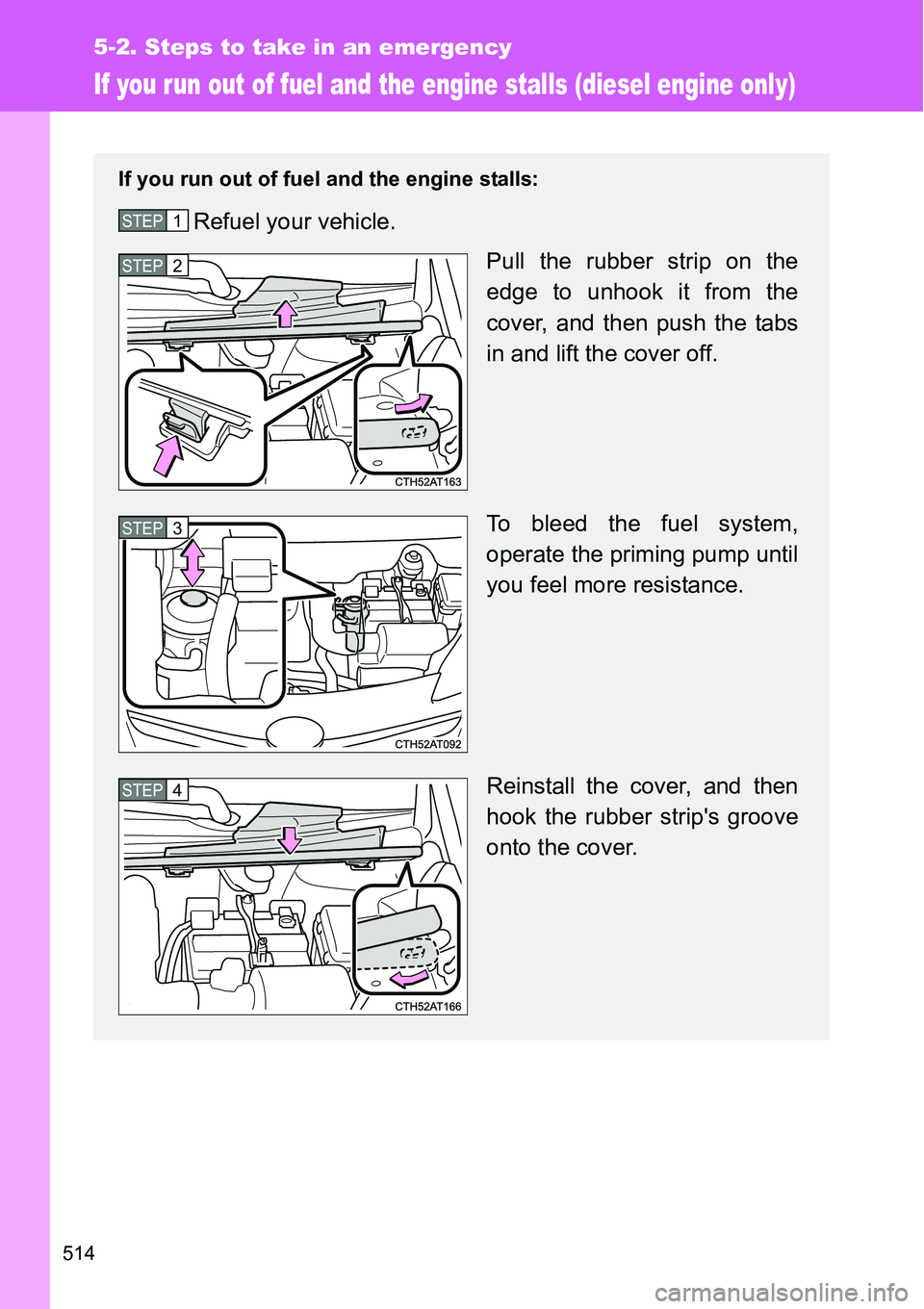
If you run out of fuel and the engine stalls:
Refuel your vehicle.
Pull the rubber strip on the
edge to unhook it from the
cover, and then push the tabs
in and lift the cover off.
To bleed the fuel system,
operate the priming pump until
you feel more resistance.
Reinstall the cover, and then
hook the rubber strip's groove
onto the cover.STEP1
STEP2
STEP3
STEP4
Page 515 of 564
5
515 5-2. Steps to take in an emergency
When trouble arises
NOTICE
When restarting the engine
Do not crank the engine before refueling and operating the priming pump.
This may damage the engine and fuel system.
Vehicles without a smart entry & start system: Do not crank for more than
30 seconds at a time. This may overheat the starter and wiring system.
Start the engine. (P. 173, 182)
If the engine does not start after the above steps have been per-
formed, wait for 10 seconds and then try steps 2 and 3 again. If
the engine still does not start, contact any authorized Toyota
dealer or repairer, or another duly qualified and equipped profes-
sional.
After starting the engine, depress the accelerator pedal lightly until
the engine runs smoothly.
STEP5
Page 537 of 564
537
6-1. Specifications
6
Vehicle specifications
Fuel infor mation
Fuel tank opening for unleaded gasoline
To help prevent incorrect fueling, your vehicle has a fuel tank opening that
only accommodates the special nozzle on unleaded fuel pumps.
If you plan to drive in foreign countries
Low sulfur diesel fuel may not be available, so please check the availability
with your distributor.
If your engine knocks
Consult any authorized Toyota dealer or repairer, or another duly quali-
fied and equipped professional.
You may occasionally notice light knocking for a short time while acceler-
ating or driving uphill. This is normal and there is no need for concern.
Gasoline engine
EU area:
Your vehicle must use only unleaded gasoline conforming to Euro-
pean standard EN228.
For optimum engine performance, select unleaded gasoline with a
Research Octane Number of 95 or higher.
Except EU area:
Your vehicle must use only unleaded gasoline.
For optimum engine performance, select unleaded gasoline with a
Research Octane Number of 95 or higher.
Diesel engine
EU area:
Your vehicle must use only diesel fuel conforming to European
standard EN590.
Except EU area:
Your vehicle must use only diesel fuel that contains 50 ppm or less
of sulfur and has a cetane number of 48 or higher.