Page 17 of 564
17
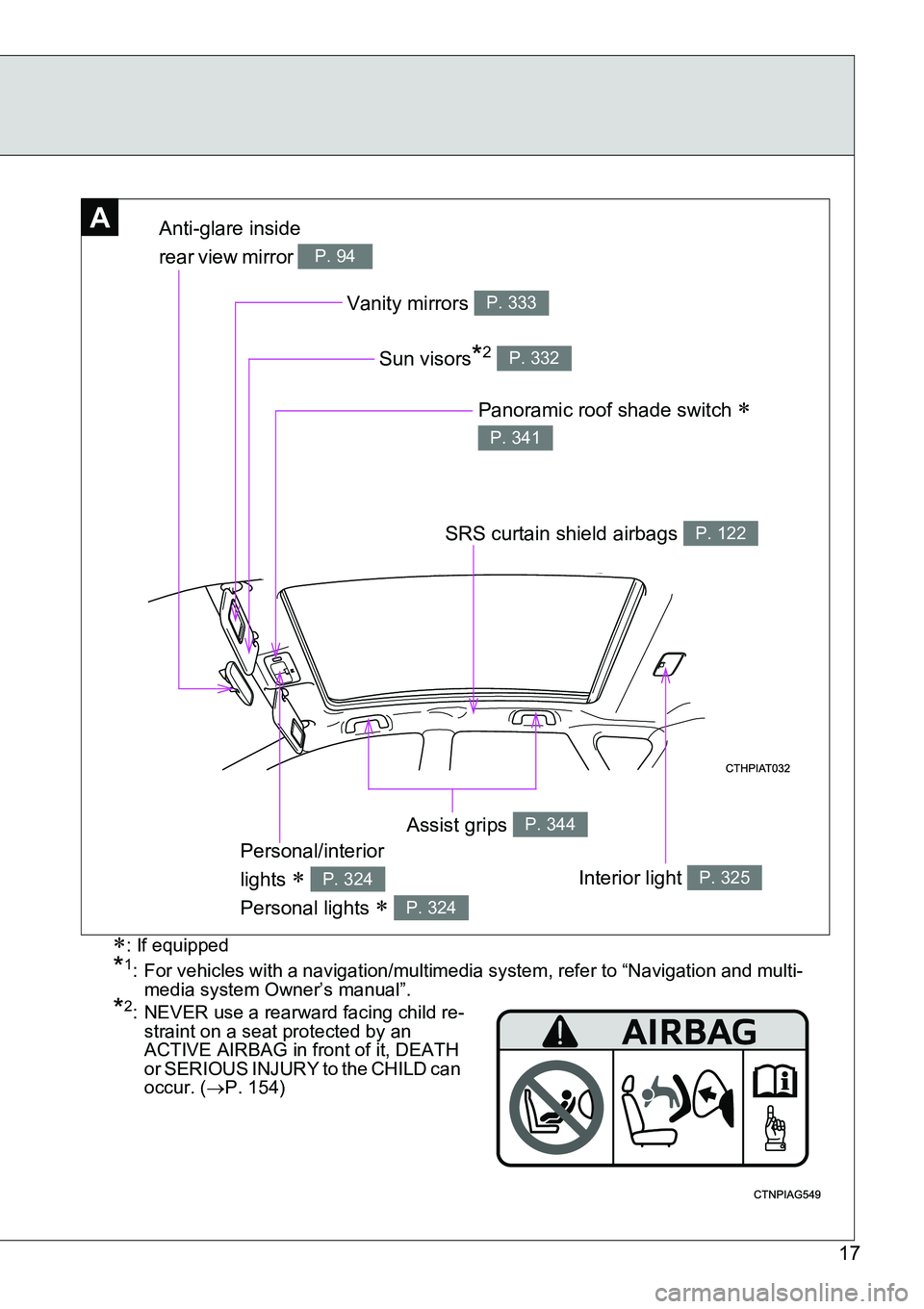
*2: NEVER use a rearward facing child re-
straint on a seat protected by an
ACTIVE AIRBAG in front of it, DEATH
or SERIOUS INJURY to the CHILD can
occur. (P. 154)
AAnti-glare inside
rear view mirror
P. 94
Panoramic roof shade switch
P. 341
Interior light P. 325
Vanity mirrors P. 333
Personal/interior
lights
Personal lights
P. 324
P. 324
Sun visors*2 P. 332
SRS curtain shield airbags P. 122
: If equipped
*1: For vehicles with a navigation/multimedia system, refer to “Navigation and multi-
media system Owner’s manual”.
Assist grips P. 344
Page 19 of 564
19
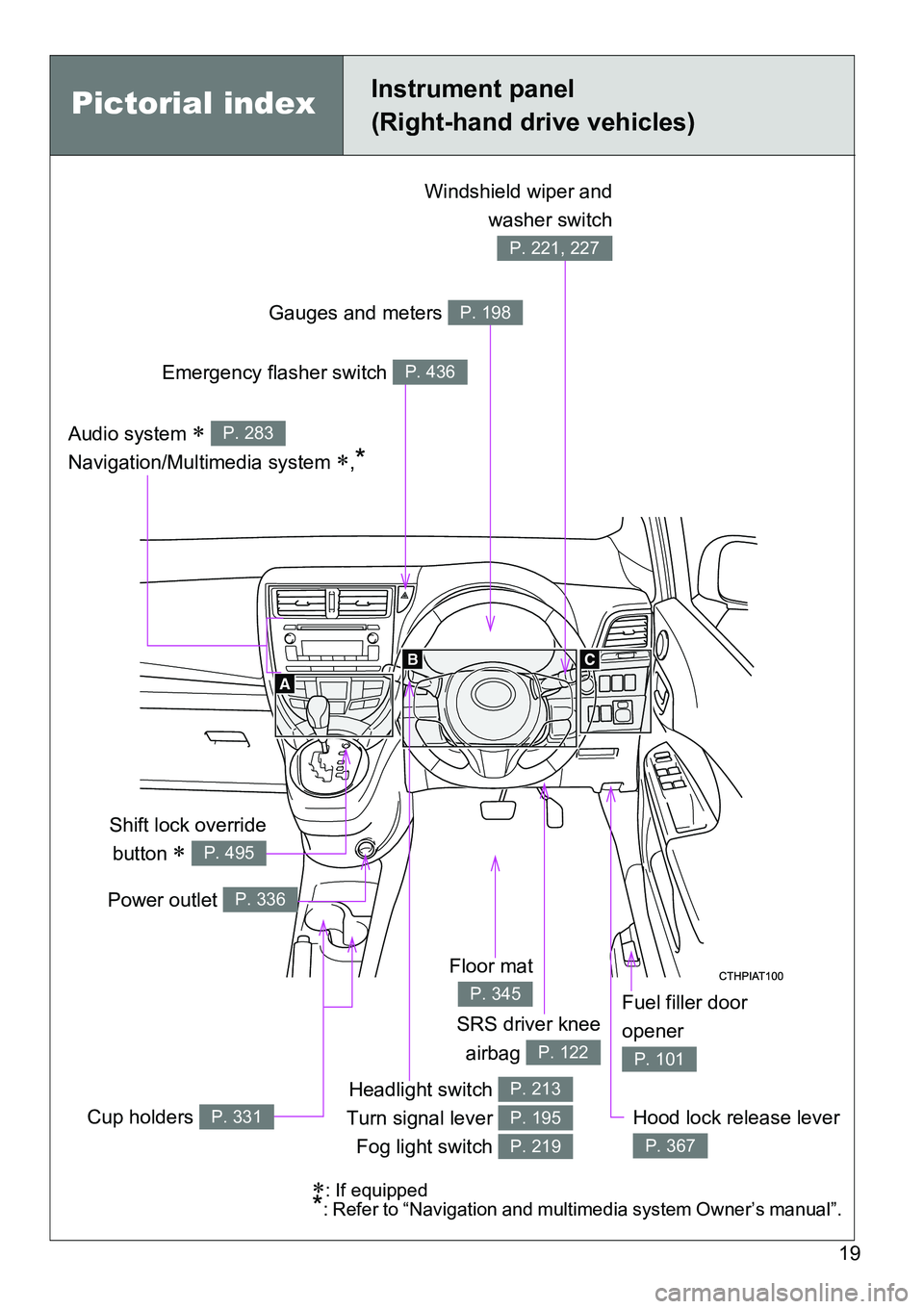
Headlight switch
Turn signal lever
Fog light switch P. 213
P. 195
P. 219
Hood lock release lever
P. 367
SRS driver knee
airbag
P. 122
Audio system
Navigation/Multimedia system
,*
P. 283
Fuel filler door
opener
P. 101
Floor mat
P. 345
Emergency flasher switch P. 436
Gauges and meters P. 198
Windshield wiper and
washer switch
P. 221, 227
Shift lock override
button
P. 495
Power outlet P. 336
: If equipped*: Refer to “Navigation and multimedia system Owner’s manual”.
Cup holders P. 331
Pictorial indexInstrument panel
(Right-hand drive vehicles)
Page 21 of 564
21
B
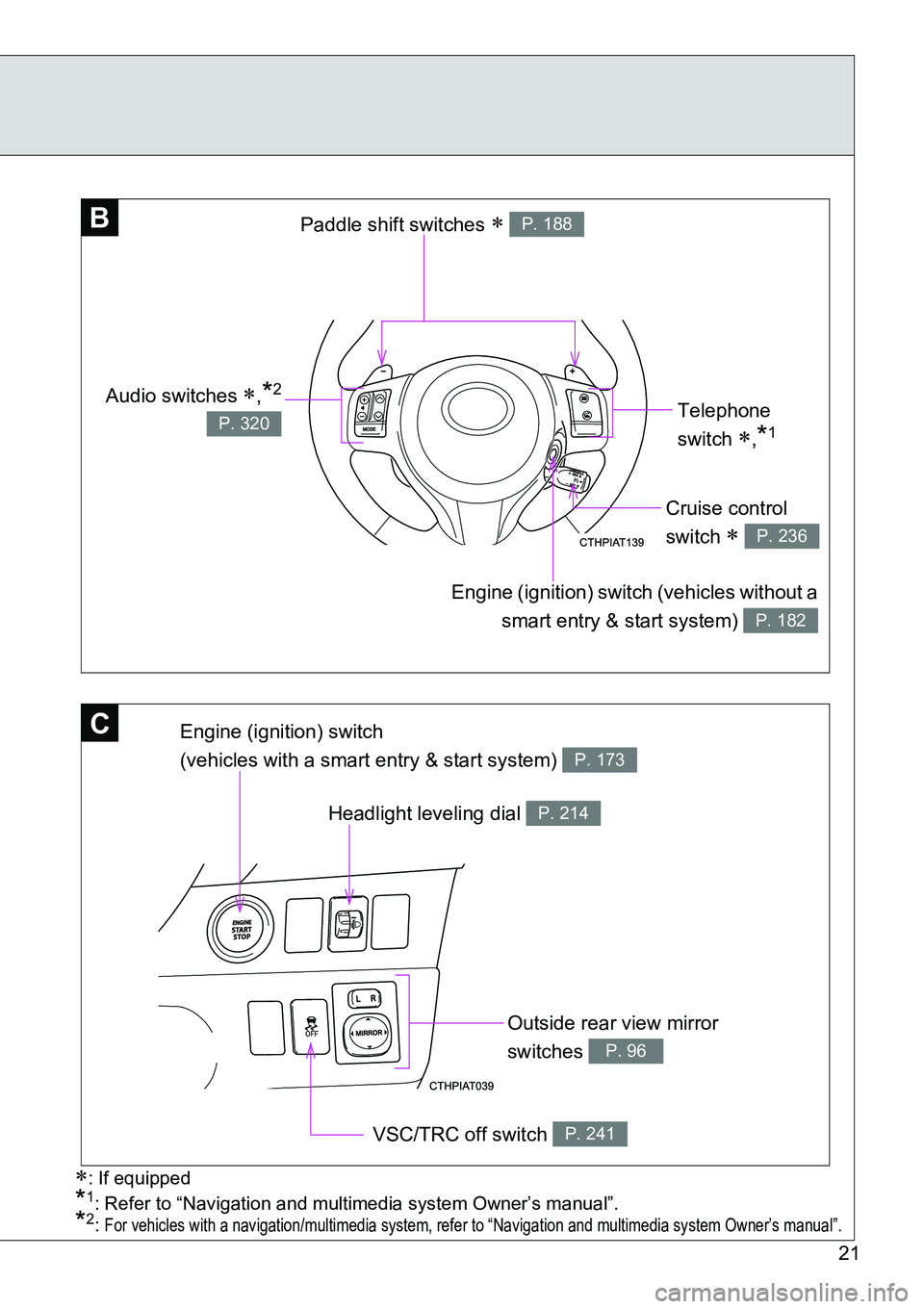
Telephone
switch
,*1
Engine (ignition) switch (vehicles without a
smart entry & start system)
P. 182
Paddle shift switches P. 188
Audio switches ,*2
P. 320
C
Headlight leveling dial P. 214
Outside rear view mirror
switches
P. 96
VSC/TRC off switch P. 241
Engine (ignition) switch
(vehicles with a smart entry & start system)
P. 173
Cruise control
switch
P. 236
: If equipped
*1: Refer to “Navigation and multimedia system Owner’s manual”.
*2: For vehicles with a navigation/multimedia system, refer to “Navigation and multimedia system Owner’s manual”.
Page 38 of 564
38 1-2. Opening, closing and locking the doors
Operation signals
The emergency flashers flash to indicate that the doors have been locked/
unlocked. (Locked: once; Unlocked: twice)
When the door cannot be locked by the lock sensor
Alarms and warning indicators
A combination of exterior and interior alarms as well as warning lights are
used to prevent theft of the vehicle and unforeseeable accidents resulting
from erroneous operation. Take appropriate measures for the warning light
that comes on. (P. 455)
The following table describes circumstances and correction procedures
when only alarms are sounded.
Use your palm to touch the lock sensor.
Page 43 of 564

43 1-2. Opening, closing and locking the doors
1
Before driving
Notes for locking the doors
Touching the door lock sensor while wearing gloves may delay or prevent
lock operation. Remove the gloves and touch the lock sensor again.
When the lock operation is performed using the lock sensor, recognition
signals will be shown up to two consecutive times. After this, no recogni-
tion signals will be given.
If the door handle becomes wet while the electronic key is within the
effective range, the door may lock and unlock repeatedly. Place the key
in a position 2 m (6 ft.) or more separate from the vehicle while the vehi-
cle is being washed. (Take care to ensure that the key is not stolen.)
If the electronic key is inside the vehicle and a door handle becomes wet
during a car wash, a buzzer will sound outside the vehicle. To turn off the
alarm, lock all the doors.
The lock sensor may not work properly if it comes into contact with ice,
snow, mud, etc. Clean the lock sensor and attempt to operate it again.
Notes for the unlocking function
A sudden approach to the effective range or door handle may prevent the
doors from being unlocked. In this case, return the door handle to the
original position and check that the doors unlock before pulling the door
handle again.
Gripping the door handle when wearing a glove may not unlock the door.
Remove the gloves and touch the sensor on the back of the handle
again.
If the door handle becomes wet while the electronic key is within the
effective range, the door may lock and unlock repeatedly. Place the key
in a position 2 m (6 ft.) or more separate from the vehicle while the vehi-
cle is being washed. (Take care to ensure that the key is not stolen.)
If there is another electronic key in the detection area, it may take slightly
longer to unlock the doors after the door handle is gripped.
When the vehicle is not driven for extended periods
To prevent theft of the vehicle, do not leave the electronic key within 2 m
(6 ft.) of the vehicle.
The smart entry & start system can be deactivated in advance. (P. 540)
Page 75 of 564
75 1-2. Opening, closing and locking the doors
1
Before driving
CAUTION
Operating the back door
Observe the following precautions.
Failure to do so may cause parts of the body to be caught, resulting in seri-
ous injury.
Remove any heavy loads, such as snow and ice, from the back door
before opening it. Failure to do so may cause the back door to suddenly
shut again after it is opened.
When opening or closing the back door, thoroughly check to make sure
the surrounding area is safe.
If anyone is in the vicinity, make sure they are safe and let them know that
the back door is about to open or close.
Use caution when opening or closing the back door in windy weather as it
may move abruptly in strong wind.
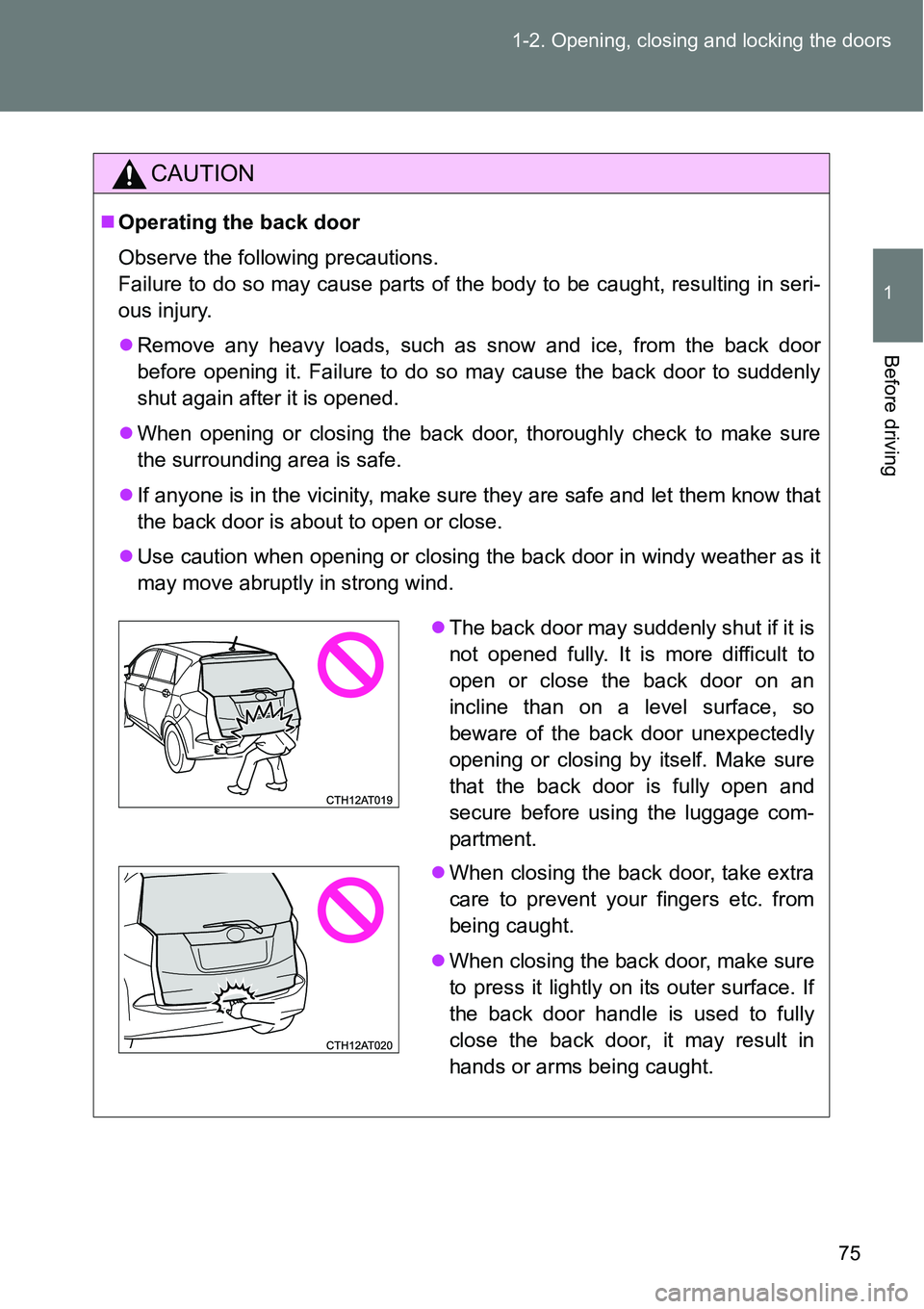
The back door may suddenly shut if it is
not opened fully. It is more difficult to
open or close the back door on an
incline than on a level surface, so
beware of the back door unexpectedly
opening or closing by itself. Make sure
that the back door is fully open and
secure before using the luggage com-
partment.
When closing the back door, take extra
care to prevent your fingers etc. from
being caught.
When closing the back door, make sure
to press it lightly on its outer surface. If
the back door handle is used to fully
close the back door, it may result in
hands or arms being caught.
Page 90 of 564
90 1-3. Adjustable components (seats, mirrors, steering wheel)
CAUTION
Observe the following precautions to reduce the risk of injury in the event of
sudden braking, sudden swerving or an accident.
Failure to do so may cause death or serious injury.
Wearing a seat belt
Ensure that all passengers wear a seat belt.
Always wear a seat belt properly.
Each seat belt should be used by one person only. Do not use a seat belt
for more than one person at once, including children.
Toyota recommends that children be seated in the rear seat and always
use a seat belt and/or an appropriate child restraint system.
To achieve a proper seating position, do not recline the seat more than
necessary. The seat belt is most effective when the occupants are sitting
up straight and well back in the seats.
Do not wear the shoulder belt under your arm.
Always wear your seat belt low and snug across your hips.
When children are in the vehicle
Do not allow children to play with the seat belt. If the seat belt becomes
twisted around a child’s neck, choking or other serious injuries may result in
death.
If this occurs and the buckle cannot be unfastened, scissors should be used
to cut the belt.
Seat belt pretensioners
If the pretensioner has activated, the SRS warning light will come on. In that
case, the seat belt cannot be used again and must be replaced at any autho-
rized Toyota dealer or repairer, or another duly qualified and equipped pro-
fessional.
Page 94 of 564
94
1-3. Adjustable components (seats, mirrors, steering wheel)
Anti-glare inside rear view mirror
Glare from the headlights of vehicles behind can be reduced by
using the following functions:
Manual anti-glare inside rear view mirror
Normal position
Anti-glare position
Auto anti-glare inside rear view mirror
In automatic mode, sensors are used to detect the headlights of
vehicles behind and the reflected light is automatically reduced.
Turns automatic mode on/off
The indicator comes on when
automatic mode is turned on.
Vehicles without a smart
entry & start system
The mirror will revert to the
automatic mode each time the
engine switch is turned to the
“ON” position.
Vehicles with a smart entry &
start system
The mirror will revert to the
automatic mode each time the
“ENGINE START STOP”
switch is turned to IGNITION
ON mode.