Page 137 of 650
137 1-6. Theft deterrent system
1
Before driving
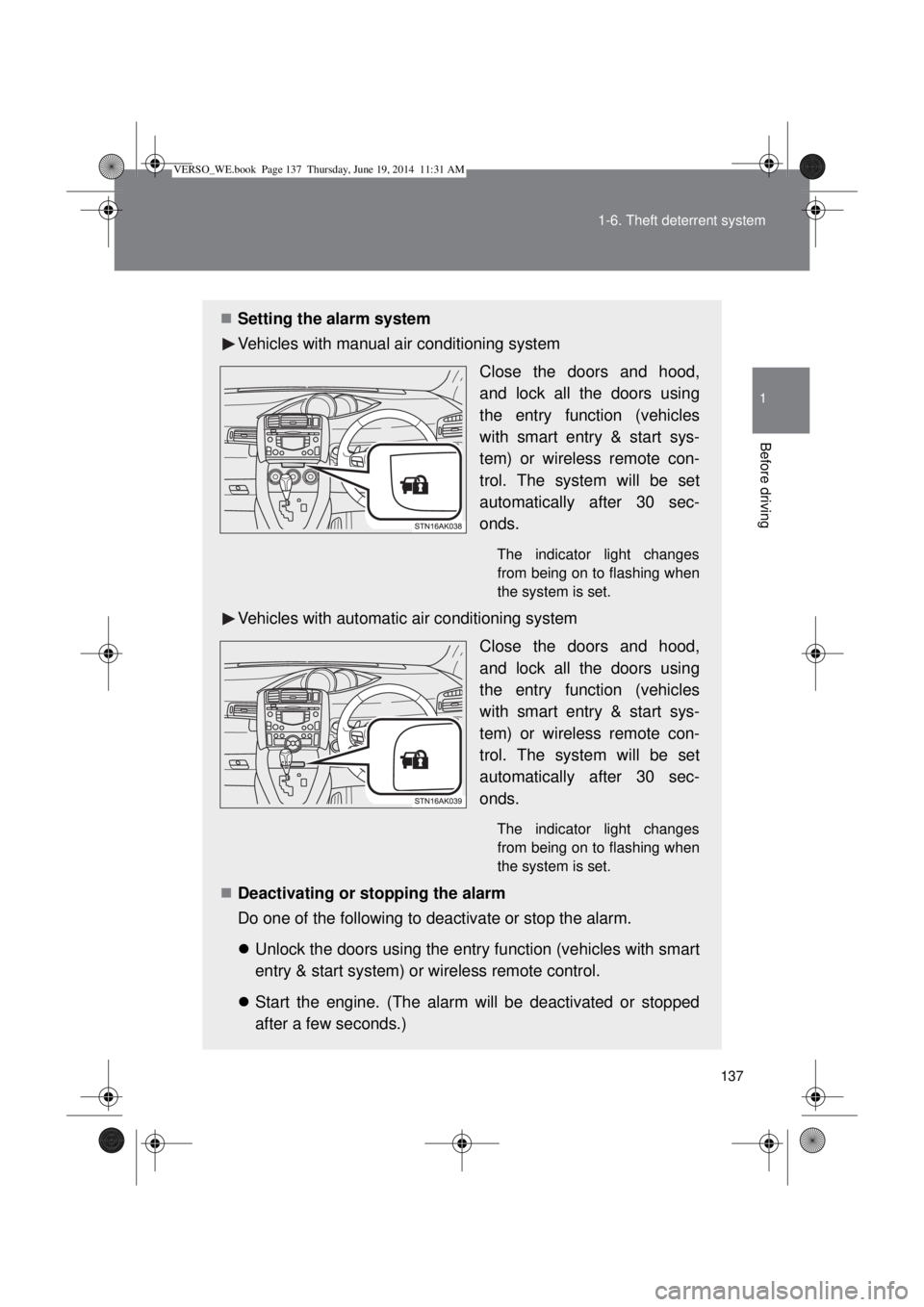
Setting the alarm system
Vehicles with manual air conditioning system
Close the doors and hood,
and lock all the doors using
the entry function (vehicles
with smart entry & start sys-
tem) or wireless remote con-
trol. The system will be set
automatically after 30 sec-
onds.
The indicator light changes
from being on to flashing when
the system is set.
Vehicles with automatic air conditioning system
Close the doors and hood,
and lock all the doors using
the entry function (vehicles
with smart entry & start sys-
tem) or wireless remote con-
trol. The system will be set
automatically after 30 sec-
onds.
The indicator light changes
from being on to flashing when
the system is set.
Deactivating or stopping the alarm
Do one of the following to deactivate or stop the alarm.
Unlock the doors using the entry function (vehicles with smart
entry & start system) or wireless remote control.
Start the engine. (The alarm will be deactivated or stopped
after a few seconds.)
VERSO_WE.book Page 137 Thursday, June 19, 2014 11:31 AM
Page 138 of 650

138 1-6. Theft deterrent system
Intrusion sensor (if equipped)
The intrusion sensor detects an intruder or movement in the vehicle.
The intrusion sensor can be canceled using the cancel switch.
This system is designed to deter and prevent vehicle theft but does
not guarantee absolute security against all intrusions.
Canceling the intrusion sensor
Vehicles without smart entry &
start system: Turn the engine
switch to the “LOCK” position
and press the intrusion sensor
cancel switch.
Vehicles with smart entry & start
system: Turn the “ENGINE
START STOP” switch off and
press the intrusion sensor cancel
switch.
Pressing the switch again will re-
enable the intrusion sensor.
To cancel the intrusion sensor, perform the necessary procedure
each time canceling the sensor is desired.
System maintenance
The vehicle has a maintenance-free type alarm system.
Items to check before locking the vehicle
To prevent unexpected triggering of the alarm and vehicle theft, make sure
of the following.
Nobody is in the vehicle.
The windows is closed before the alarm is set.
No valuables or other personal items are left in the vehicle.
VERSO_WE.book Page 138 Thursday, June 19, 2014 11:31 AM
Page 139 of 650
139 1-6. Theft deterrent system
1
Before driving
Triggering of the alarm
The alarm may be triggered in the following situations. (Stopping the alarm
deactivates the alarm system.)
When the battery is disconnected
Be sure to cancel the alarm system.
If the battery is discharged before canceling the alarm, the system may be
triggered when the battery is reconnected.
Alarm-operated door lock
When the alarm is operating, the doors are locked automatically to pre-
vent intruders.
Do not leave the key inside the vehicle when the alarm is operating, and
make sure the key is not inside the vehicle when recharging or replacing
the battery.The doors are unlocked using the
mechanical key.
A person inside the vehicle opens a
door or hood.
The battery is recharged or replaced
when the vehicle is locked.
VERSO_WE.book Page 139 Thursday, June 19, 2014 11:31 AM
Page 140 of 650

140 1-6. Theft deterrent system
Canceling and automatic re-enabling of the intrusion sensor
The alarm will still be set even when the intrusion sensor is canceled.
Vehicles without smart entry & start system: After the intrusion sensor is
canceled, turn the engine switch to the “ON” position or unlocking the
doors using the wireless remote control will re-enable the intrusion sen-
sor.
Vehicles with smart entry & start system: After the intrusion sensor is
canceled, pressing the “ENGINE START STOP” switch or unlocking the
doors using the smart entry & start system or wireless remote control will
re-enable the intrusion sensor.
When the alarm system is set again, the intrusion sensor will also be set.
Intrusion sensor considerations
The sensor may trigger the alarm in the following situations.
Persons or pets are in the vehicle.
Unstable items, such as dangling
accessories or clothes hanging on the
coat hooks, are in the vehicle.
The vehicle is parked in a place where
extreme vibrations or noises occur,
such as in a parking garage.
VERSO_WE.book Page 140 Thursday, June 19, 2014 11:31 AM
Page 145 of 650
145
1
Before driving
1-7. Safety information
Correct driving posture
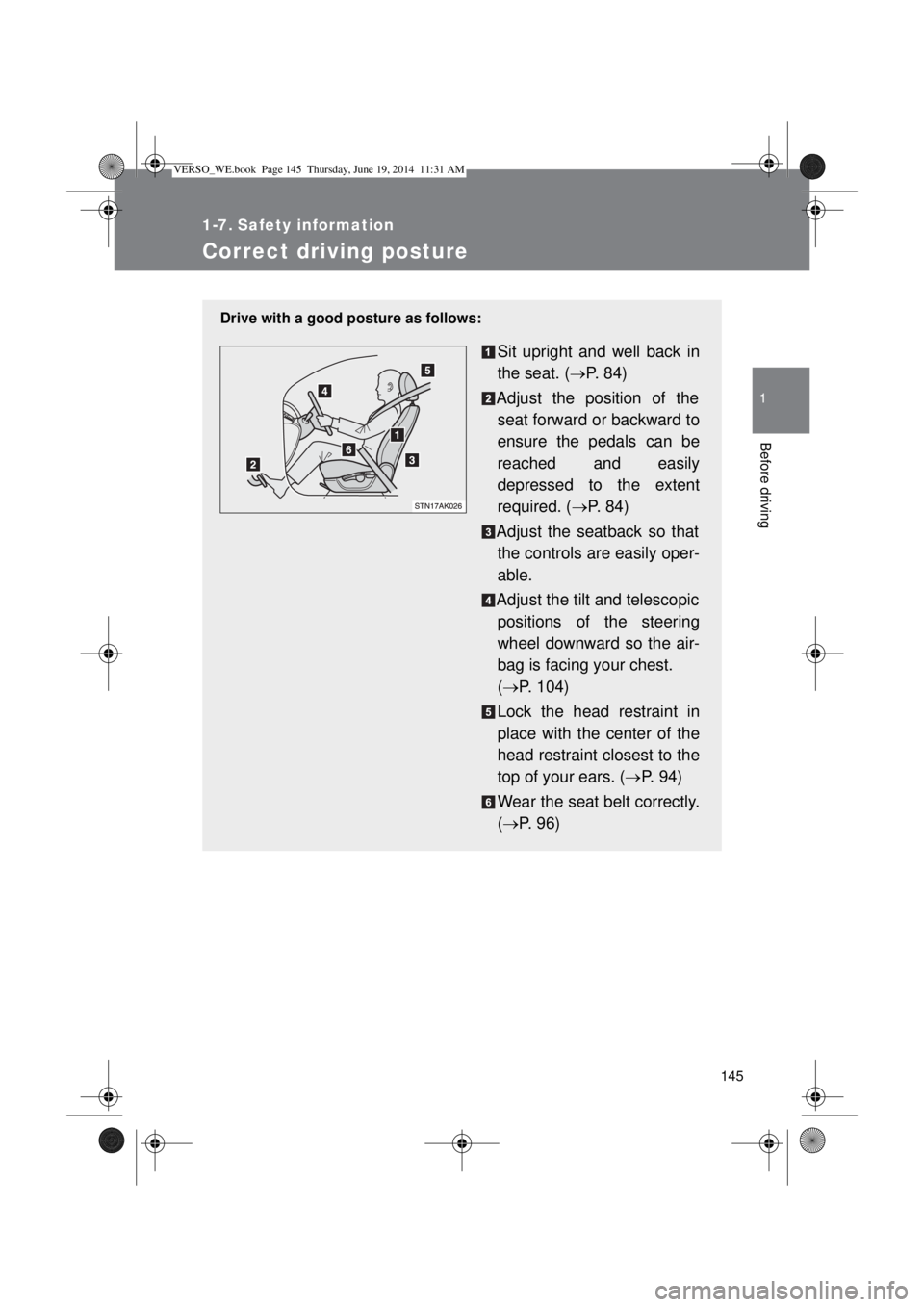
Drive with a good posture as follows:
Sit upright and well back in
the seat. (P. 84)
Adjust the position of the
seat forward or backward to
ensure the pedals can be
reached and easily
depressed to the extent
required. (P. 84)
Adjust the seatback so that
the controls are easily oper-
able.
Adjust the tilt and telescopic
positions of the steering
wheel downward so the air-
bag is facing your chest.
(P. 104)
Lock the head restraint in
place with the center of the
head restraint closest to the
top of your ears. (P. 94)
Wear the seat belt correctly.
(P. 96)
VERSO_WE.book Page 145 Thursday, June 19, 2014 11:31 AM
Page 146 of 650
146 1-7. Safety information
CAUTION
While driving
Do not adjust the position of the driver’s seat.
Doing so could cause the driver to lose control of the vehicle.
Do not place a cushion between the driver or passenger and the seatback.
A cushion may prevent correct posture from being achieved, and reduce
the effectiveness of the seat belt and head restraint, increasing the risk of
death or serious injury to the driver or passenger.
Do not place anything under the front seats except for putting them in the
auxiliary box.
Objects placed under the front seats may become jammed in the seat
tracks and stop the seat from locking in place. This may lead to an acci-
dent, resulting in death or serious injury. The adjustment mechanism may
also be damaged.
Adjusting the seat position
Do not recline the seat more than necessary when the vehicle is in motion,
to reduce the risk of sliding under the lap belt.
If the seat is too reclined during an accident, the lap belt may slide past the
hips and apply restraint forces directly to the abdomen or your neck may
contact the shoulder belt, increasing the risk of death or serious injury.
Take care when adjusting the seat position to ensure that other passen-
gers are not injured by the moving seat.
Do not put your hands under the seat or near the moving parts to avoid
injury.
Fingers or hands may become jammed in the seat mechanism.
VERSO_WE.book Page 146 Thursday, June 19, 2014 11:31 AM
Page 166 of 650
166
1-7. Safety information
Installing child restraints
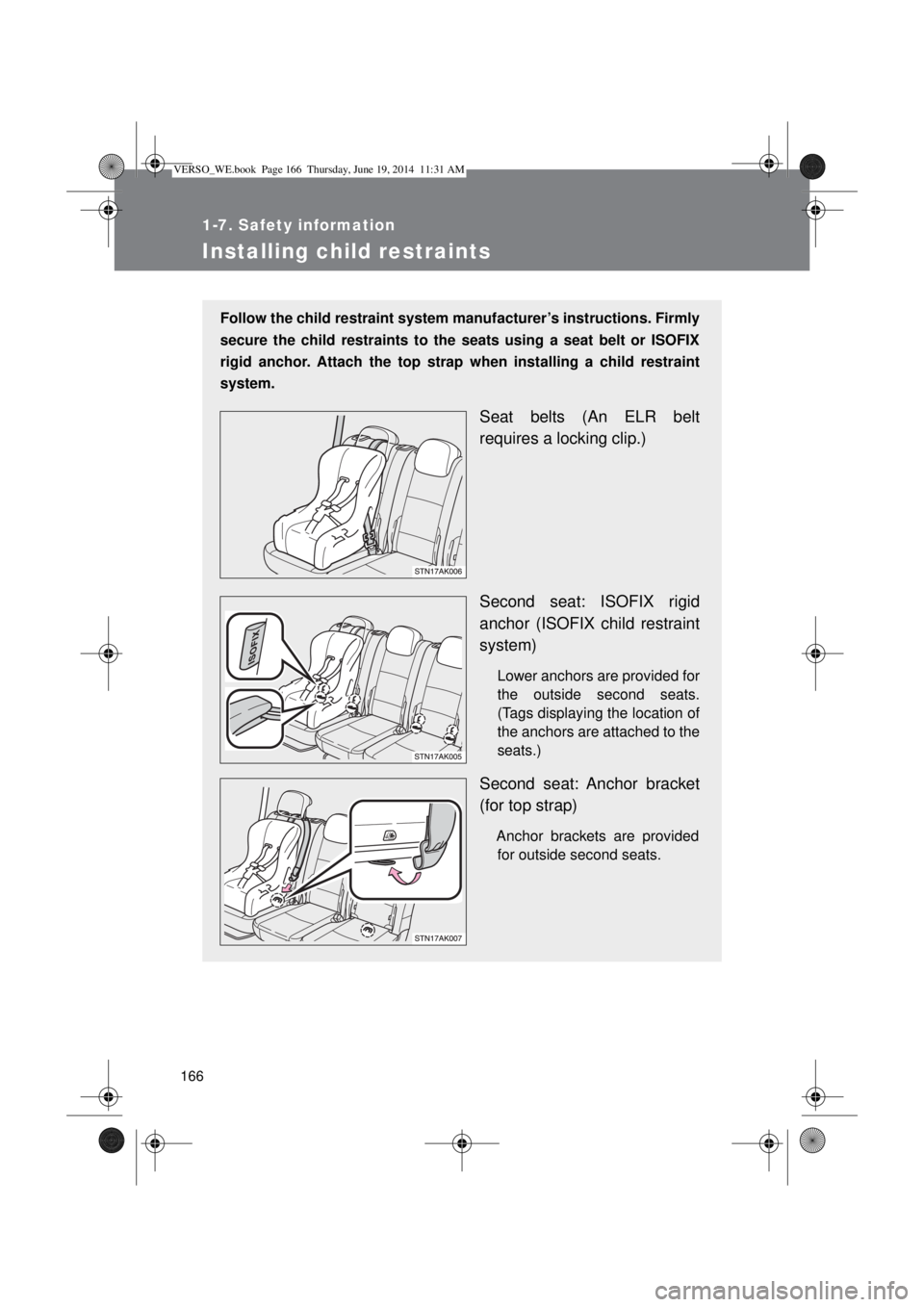
Follow the child restraint system manufacturer’s instructions. Firmly
secure the child restraints to the seats using a seat belt or ISOFIX
rigid anchor. Attach the top strap when installing a child restraint
system.
Seat belts (An ELR belt
requires a locking clip.)
Second seat: ISOFIX rigid
anchor (ISOFIX child restraint
system)
Lower anchors are provided for
the outside second seats.
(Tags displaying the location of
the anchors are attached to the
seats.)
Second seat: Anchor bracket
(for top strap)
Anchor brackets are provided
for outside second seats.
VERSO_WE.book Page 166 Thursday, June 19, 2014 11:31 AM
Page 167 of 650
167 1-7. Safety information
1
Before driving
Installing child restraints using a seat belt
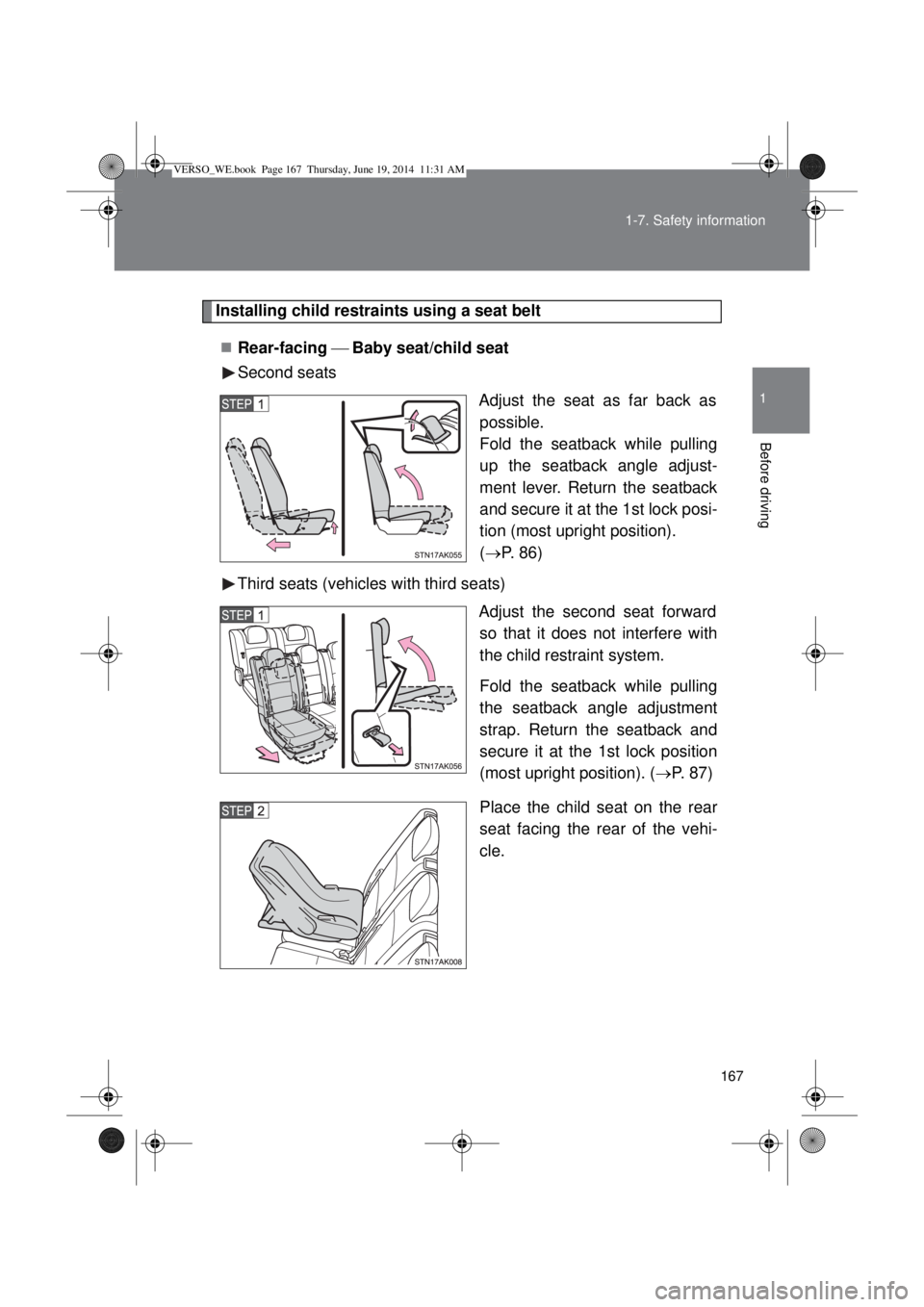
Rear-facing Baby seat/child seat
Second seats
Adjust the seat as far back as
possible.
Fold the seatback while pulling
up the seatback angle adjust-
ment lever. Return the seatback
and secure it at the 1st lock posi-
tion (most upright position).
(P. 86)
Third seats (vehicles with third seats)
Adjust the second seat forward
so that it does not interfere with
the child restraint system.
Fold the seatback while pulling
the seatback angle adjustment
strap. Return the seatback and
secure it at the 1st lock position
(most upright position). (P. 87)
Place the child seat on the rear
seat facing the rear of the vehi-
cle.
VERSO_WE.book Page 167 Thursday, June 19, 2014 11:31 AM