Page 2 of 590

TABLE OF CONTENTSIndex
2
1-1. Key informationKeys ..................................... 30
1-2. Opening, closing and locking the doors
Wireless remote control ....... 32
Side doors ............................ 35
Access doors (Access Cab models only) ....................... 39
Tailgate ................................ 40
1-3. Adjustable components (seats, mirrors, steering
wheel)
Front seats ........................... 45
Rear seats ............................ 49
Head restraints ..................... 53
Seat belts ............................. 57
Steering wheel ..................... 63
Anti-glare inside rear view mirror .................................. 64
Outside rear view mirrors ..... 68
1-4. Opening and closing the windows
Power windows .................... 71
Back window (vehicles with sliding type) ........................ 73 1-5. Refueling
Opening the fuel tank cap..... 74
1-6. Theft deterrent system Engine immobilizer system ... 77
1-7. Safety information Correct driving posture ......... 80
SRS airbags ......................... 82
Front passenger occupant classification system ........... 95
Child restraint systems ....... 100
Installing child restraints ..... 104
2-1. Driving procedures Driving the vehicle .............. 120
Engine (ignition) switch....... 131
Automatic transmission ...... 134
Manual transmission........... 138
Turn signal lever ................. 141
Parking brake ..................... 142
Horn .................................... 144
2-2. Gauges and meters Gauges and meters ............ 145
Indicators and warning lights ................................. 148
1Before driving
2When driving
Page 16 of 590
16
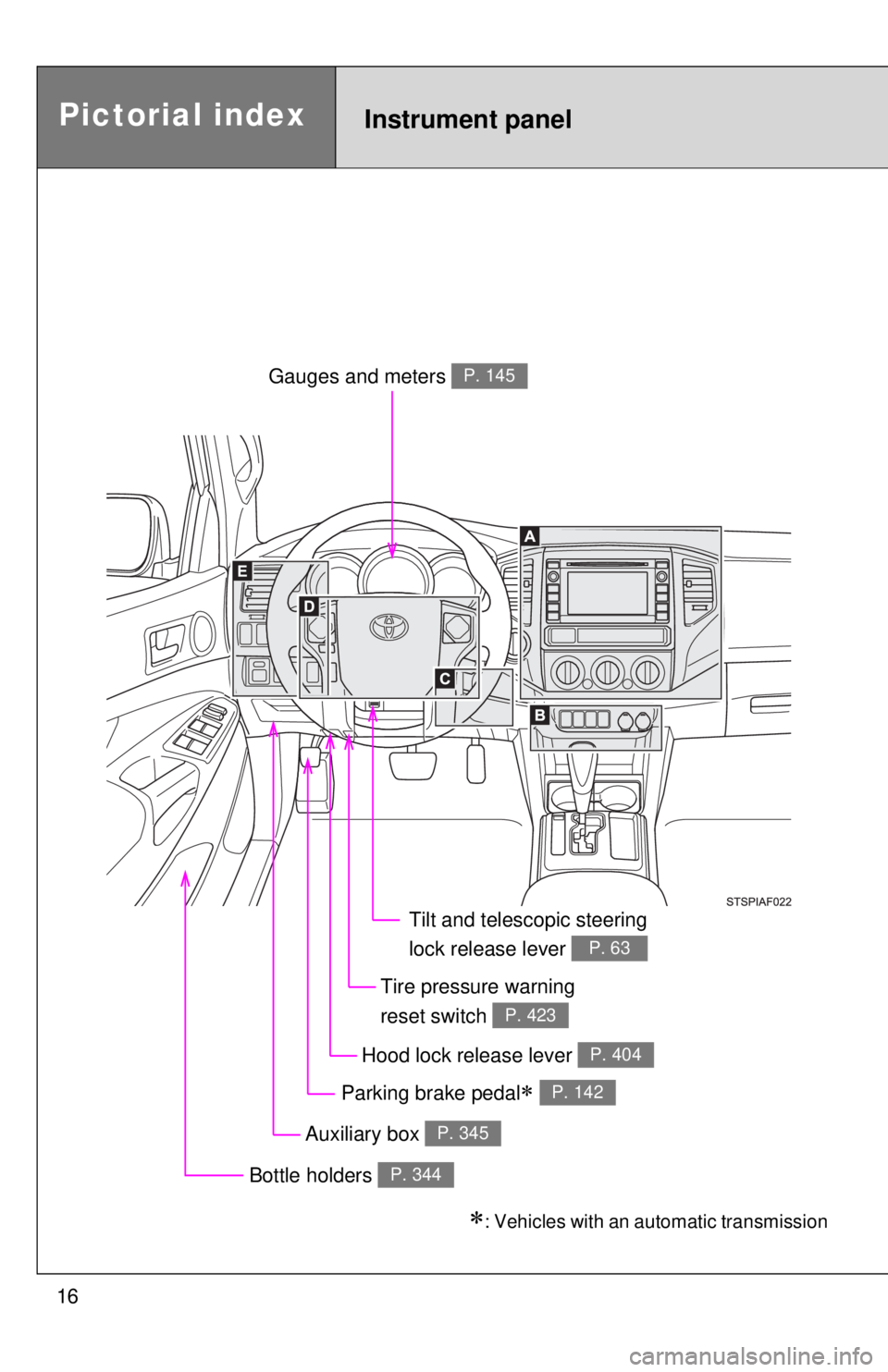
Pictorial indexInstrument panel
Auxiliary box P. 345
Gauges and meters P. 145
Hood lock release lever P. 404
Tilt and telescopic steering
lock release lever
P. 63
Bottle holders P. 344
Parking brake pedal P. 142
Tire pressure warning
reset switch
P. 423
: Vehicles with an automatic transmission
Page 18 of 590
18
Engine (ignition) switch P. 131
Audio remote control switches*
Windshield wipers and
washer switch
P. 156
Parking brake lever3 P. 142
Telephone switches*
Talk switch*
Cruise control switch1 P. 162
Pictorial indexInstrument panel
Page 23 of 590

23
Installation of a mobile two-way radio system
The installation of a mobile two-way radio system in your vehicle could affect
electronic systems such as:
●Multiport fuel injection system/sequential multiport fuel injection system
● Cruise control system
● Anti-lock brake system
● SRS airbag system
● Seat belt pretensioner system
Be sure to check with your Toyota dealer for precautionary measures or spe-
cial instructions regarding installation of a mobile two-way radio system.
Vehicle data recordings
Your Toyota is equipped with several sophisticated computers that will record
certain data, such as:
• Engine speed
• Accelerator status
• Brake status
• Vehicle speed
• Shift position (except manual transmission)
The recorded data varies according to the vehicle grade level and options
with which it is equipped. Furthermore, these computers do not record con-
versations, sounds or pictures.
● Data usage
Toyota may use the data recorded in these computers to diagnose malfunc-
tions, conduct research and development, and improve quality.
Toyota will not disclose the recorded data to a third party except:
• With the consent of the vehicle owner or with the consent of the lessee if the vehicle is leased
• In response to an official request by the police, a court of law or a govern-
ment agency
• For use by Toyota in a lawsuit
• For research purposes where the data is not tied to a specific vehicle or
vehicle owner
Page 24 of 590

24
Event data recorder
This vehicle is equipped with an event data recorder (EDR). The main pur-
pose of an EDR is to record, in certain crash or near crash-like situations,
such as an airbag deployment or hitting a road obstacle, data that will assist
in understanding how a vehicle’s systems performed. The EDR is designed
to record data related to vehicle dynamics and safety systems for a short
period of time, typically 30 seconds or less.
The EDR in this vehicle is designed to record such data as:
• How various systems in your vehicle were operating;
• Whether or not the driver and passenger safety belts were buckled/fas-tened;
• How far (if at all) the driver was depressing the accelerator and/or brake pedal; and,
• How fast the vehicle was traveling.
These data can help provide a better understanding of the circumstances in
which crashes and injuries occur.
NOTE: EDR data are recorded by your vehicle only if a non-trivial crash situ-
ation occurs; no data are recorded by the EDR under normal driving condi-
tions and no personal data (e.g., name, gender, age, and crash location) are
recorded. However, other parties, such as law enforcement, could combine
the EDR data with the type of personally identifying data routinely acquired
during a crash investigation.
To read data recorded by an EDR, special equipment is required, and access
to the vehicle or the EDR is needed. In addition to the vehicle manufacturer,
other parties, such as law enforcement, that have the special equipment, can
read the information if they have access to the vehicle or the EDR.
Page 119 of 590
When driving2
119
2-1. Driving proceduresDriving the vehicle............ 120
Engine (ignition) switch .... 131
Automatic transmission .... 134
Manual transmission ........ 138
Turn signal lever .............. 141
Parking brake ................... 142
Horn ................................. 144
2-2. Gauges and meters Gauges and meters ......... 145
Indicators and warning lights .............................. 148
2-3. Operating the lights and wipers
Headlight switch ............... 152
Fog light switch ................ 155
Windshield wipers and washer ........................... 156 2-4. Using other driving systems
Cruise control ................... 162
Rear view monitor system ........................... 166
Four-wheel drive system ........................... 177
Active traction control system ........................... 181
AUTO LSD system........... 183
Rear differential lock system ........................... 185
Downhill Assist Control system ........................... 188
Clutch start cancel switch ............................. 190
Driving assist systems ..... 191
2-5. Driving information Off-road precautions (4WD models and
PreRunner) .................... 197
Cargo and luggage .......... 202
Vehicle load limits ............ 207
Winter driving tips ............ 209
Trailer towing ................... 213
Dinghy towing .................. 233
Page 120 of 590
120
2-1. Driving procedures
Driving the vehicle
The following procedures should be observed to ensure safe driv-
ing.
■ Starting the engine
P. 131
■ Driving
Automatic transmission
With the brake pedal depressed, shift the shift lever to D. ( P. 134)
Release the parking brake. ( P. 142)
Gradually release the brake pedal and gently depress the
accelerator pedal to accelerate the vehicle.
Manual transmission With the clutch pedal fully depressed, shift the shift lever to
1. ( P. 138)
Release the parking brake. ( P. 142)
Gradually release the clutch pedal. At the same time, gently
depress the accelerator pedal to accelerate the vehicle.
■ Stopping
Automatic transmission
With the shift lever in D, depress the brake pedal.
If necessary, set the parking brake.
When the vehicle is stopped for an extended period of time, shift
the shift lever to P or N. (
P. 1 3 4)
Manual transmission
With the clutch pedal fully depressed, depress the brake
pedal.
If necessary, set the parking brake.
When the vehicle is stopped for an extended period of time, shift
the shift lever to N. ( P. 138)
Page 121 of 590
121
2-1. Driving procedures
2
When driving
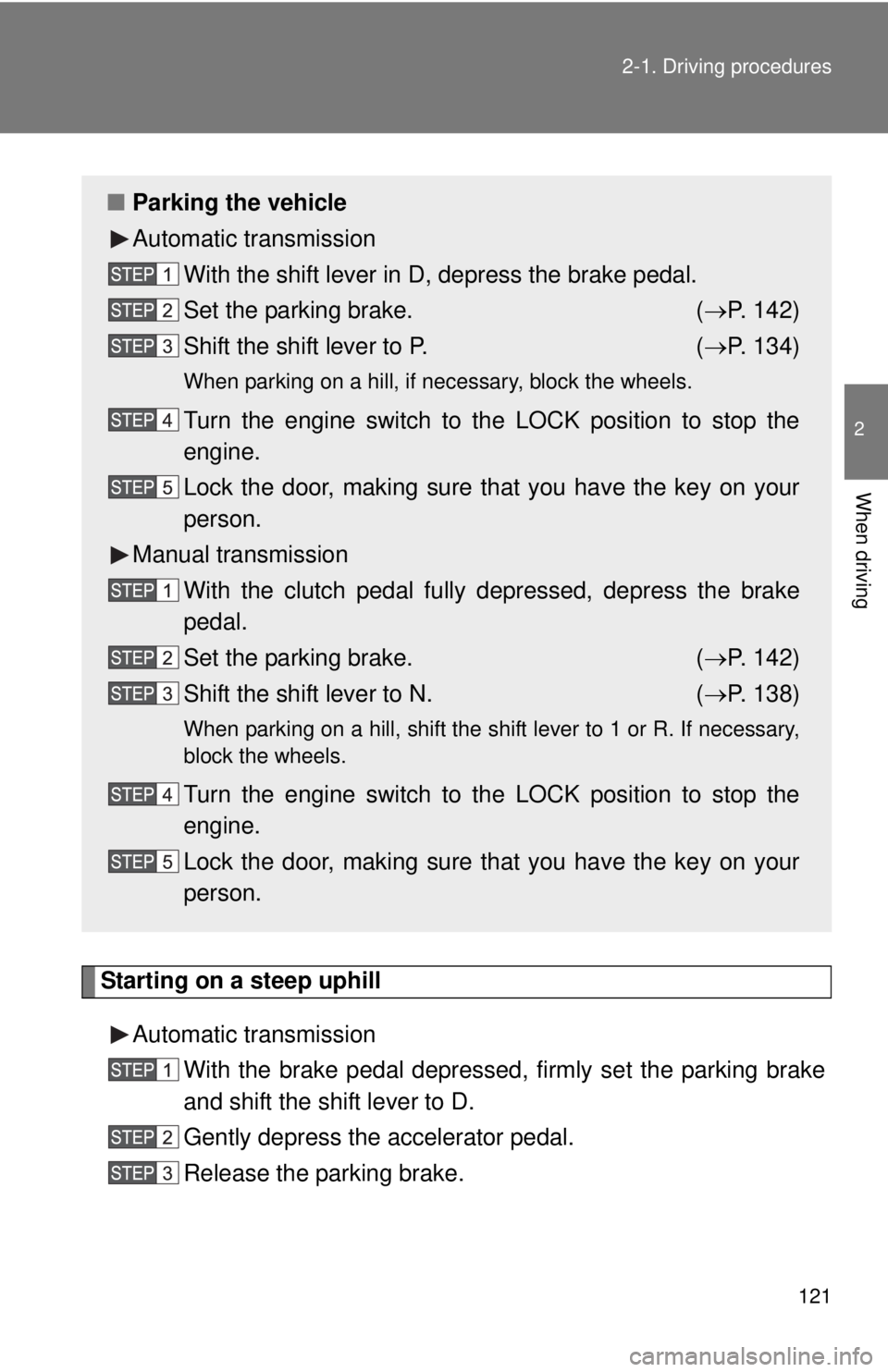
Starting on a steep uphill
Automatic transmission With the brake pedal depressed, firmly set the parking brake
and shift the shift lever to D.
Gently depress the accelerator pedal.
Release the parking brake.
■Parking the vehicle
Automatic transmission
With the shift lever in D, depress the brake pedal.
Set the parking brake. ( P. 142)
Shift the shift lever to P. ( P. 134)
When parking on a hill, if necessary, block the wheels.
Turn the engine switch to the LOCK position to stop the
engine.
Lock the door, making sure that you have the key on your
person.
Manual transmission With the clutch pedal fully depressed, depress the brake
pedal.
Set the parking brake. ( P. 142)
Shift the shift lever to N. ( P. 138)
When parking on a hill, shift the shift lever to 1 or R. If necessary,
block the wheels.
Turn the engine switch to the LOCK position to stop the
engine.
Lock the door, making sure that you have the key on your
person.