Page 546 of 664
546
SIENNA_OM_01999-08001_(U)
8-2. Steps to take in an emergency
If a war ning message is displayed
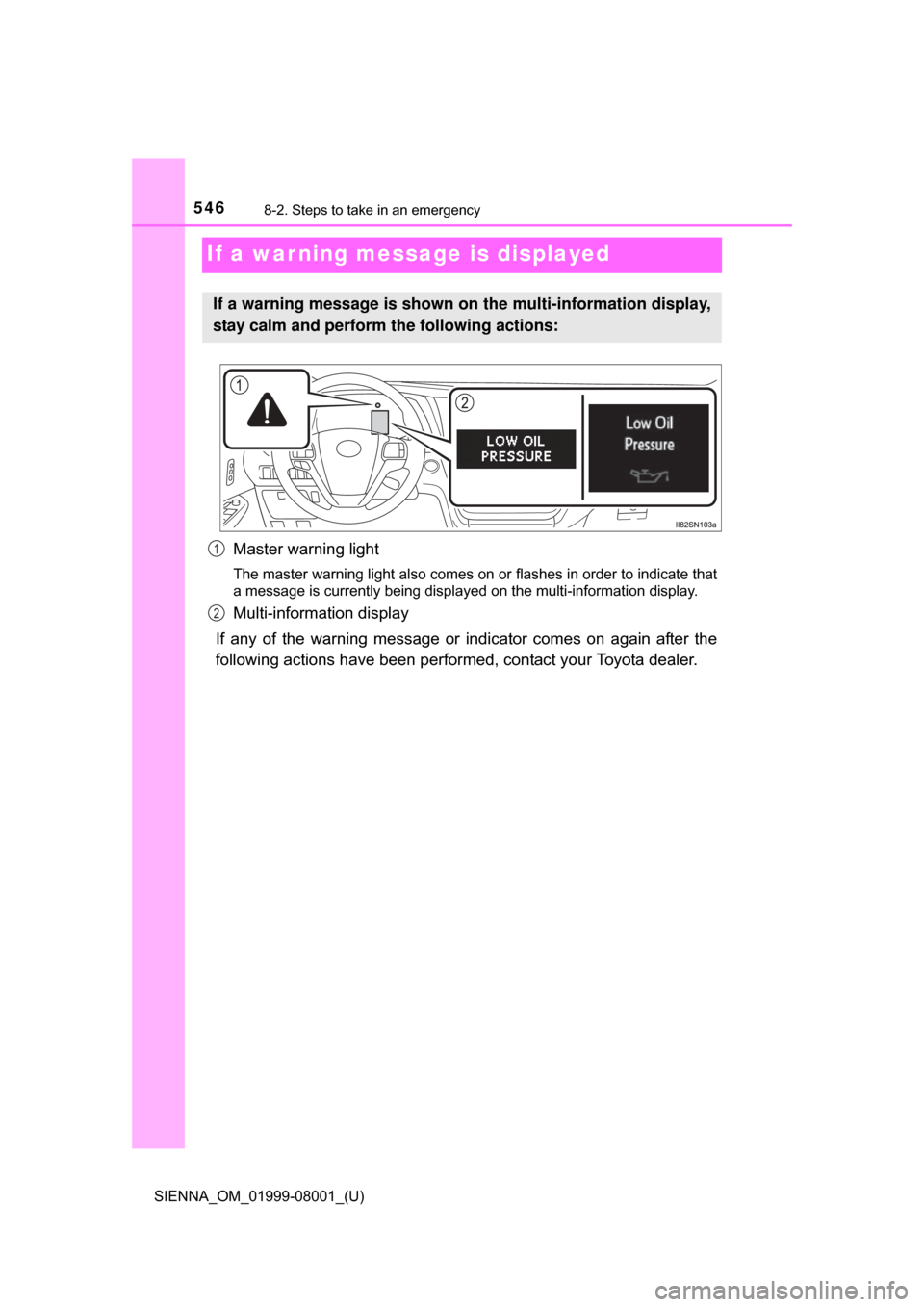
Master warning light
The master warning light also comes on or flashes in order to indicate that
a message is currently being displayed on the multi-information display.
Multi-information display
If any of the warning message or indicator comes on again after the
following actions have been performed, contact your Toyota dealer.
If a warning message is shown on the multi-information display,
stay calm and perform the following actions:
1
2
Page 553 of 664
5538-2. Steps to take in an emergency
SIENNA_OM_01999-08001_(U)
8
When trouble arises
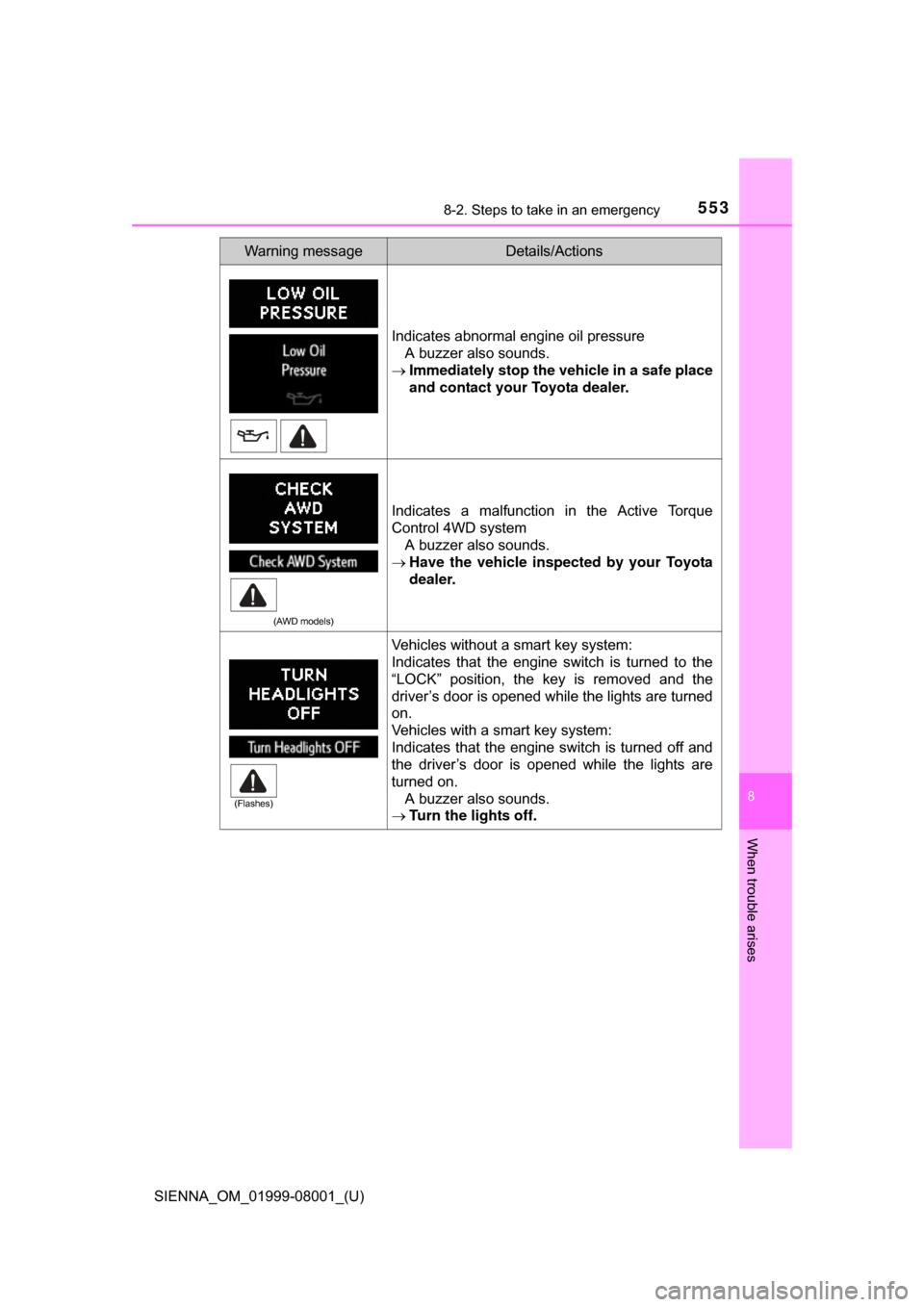
Indicates abnormal engine oil pressureA buzzer also sounds.
Immediately stop the vehicle in a safe place
and contact your Toyota dealer.
(AWD models)
Indicates a malfunction in the Active Torque
Control 4WD system
A buzzer also sounds.
Have the vehicle inspected by your Toyota
dealer.
Vehicles without a smart key system:
Indicates that the engine switch is turned to the
“LOCK” position, the key is removed and the
driver’s door is opened while the lights are turned
on.
Vehicles with a smart key system:
Indicates that the engine switch is turned off and
the driver’s door is opened while the lights are
turned on. A buzzer also sounds.
Turn the lights off.
Warning messageDetails/Actions
(Flashes)
Page 558 of 664
5588-2. Steps to take in an emergency
SIENNA_OM_01999-08001_(U)
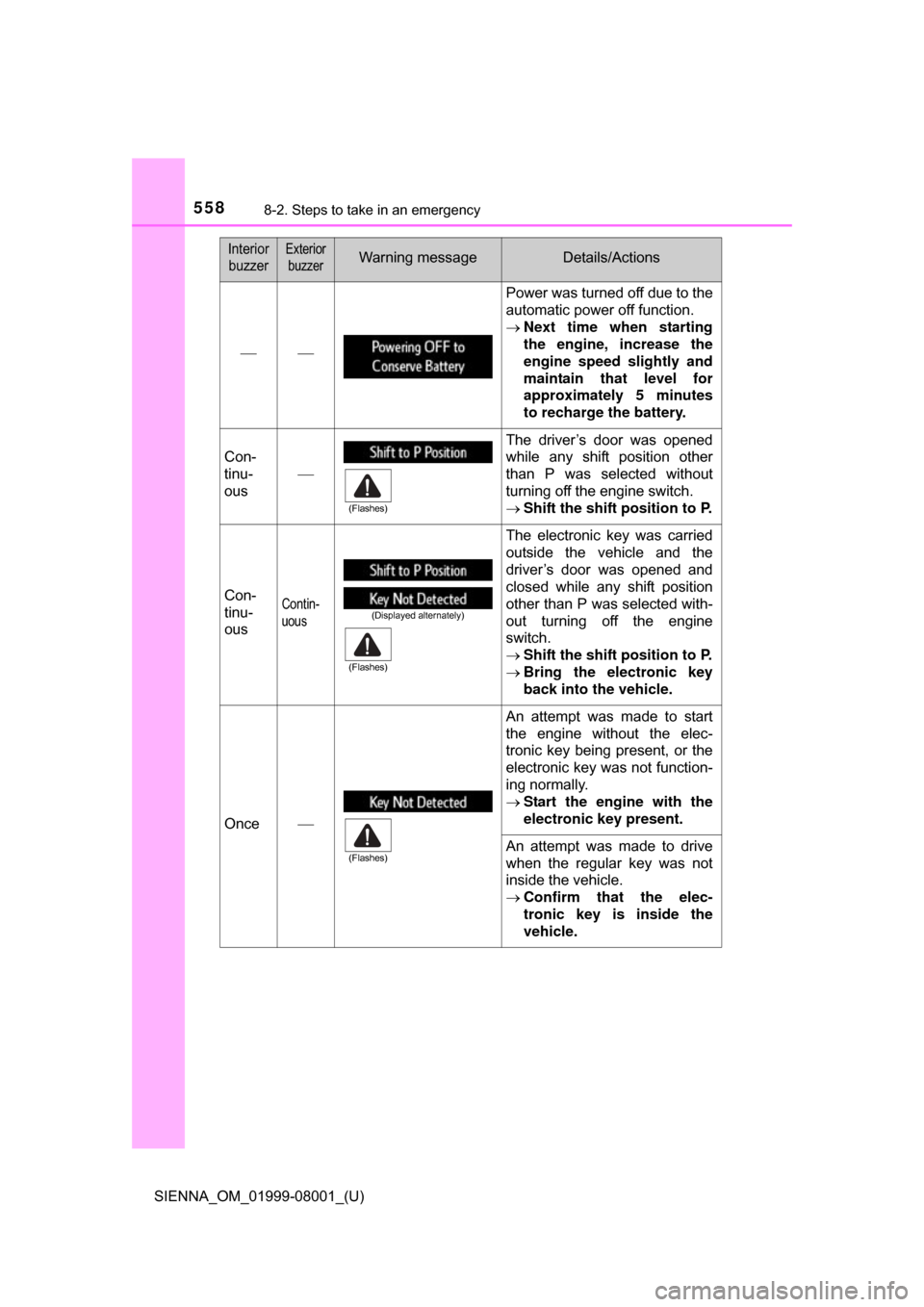
InteriorbuzzerExterior buzzerWarning messageDetails/Actions
Power was turned off due to the
automatic power off function.
Next time when starting
the engine, increase the
engine speed slightly and
maintain that level for
approximately 5 minutes
to recharge the battery.
Con-
tinu-
ous The driver’s door was opened
while any shift position other
than P was selected without
turning off the engine switch.
Shift the shift position to P.
Con-
tinu-
ousContin-
uous
The electronic key was carried
outside the vehicle and the
driver’s door was opened and
closed while any shift position
other than P was selected with-
out turning off the engine
switch.
Shift the shift position to P.
Bring the electronic key
back into the vehicle.
Once An attempt was made to start
the engine without the elec-
tronic key being present, or the
electronic key was not function-
ing normally.
Start the engine with the
electronic key present.
An attempt was made to drive
when the regular key was not
inside the vehicle.
Confirm that the elec-
tronic key is inside the
vehicle.
(Flashes)
(Displayed alternately)
(Flashes)
(Flashes)
Page 562 of 664
562
SIENNA_OM_01999-08001_(U)
8-2. Steps to take in an emergency
If you have a flat tire (vehicles with run-flat
tires)
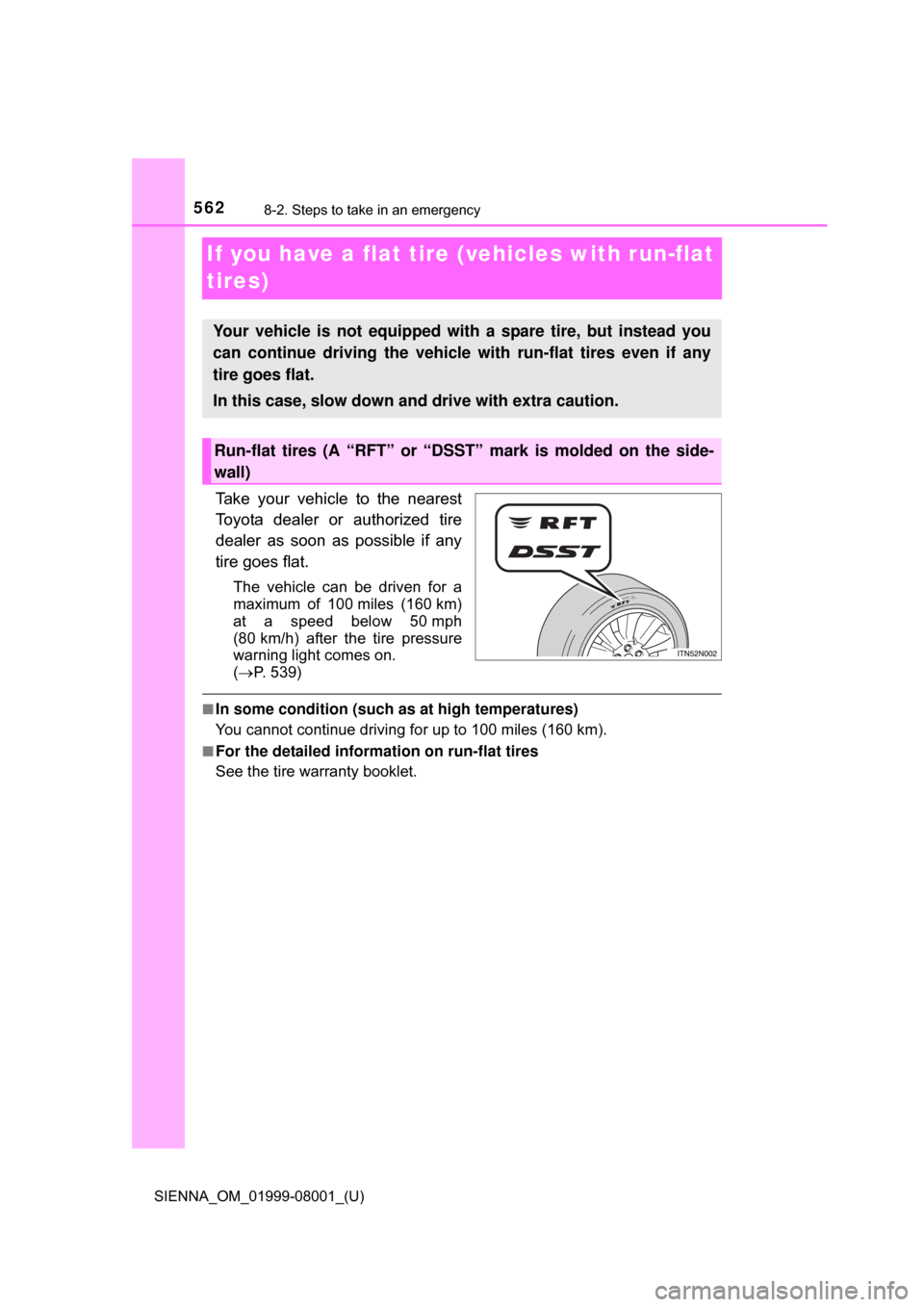
Take your vehicle to the nearest
Toyota dealer or authorized tire
dealer as soon as possible if any
tire goes flat.
The vehicle can be driven for a
maximum of 100 miles (160 km)
at a speed below 50 mph
(80 km/h) after the tire pressure
warning light comes on.
( P. 539)
■In some condition (such as at high temperatures)
You cannot continue driving for up to 100 miles (160 km).
■For the detailed information on run-flat tires
See the tire warranty booklet.
Your vehicle is not equipped wi th a spare tire, but instead you
can continue driving the vehicle with run-flat tires even if any
tire goes flat.
In this case, slow down and drive with extra caution.
Run-flat tires (A “RFT” or “DSS T” mark is molded on the side-
wall)
Page 569 of 664
5698-2. Steps to take in an emergency
SIENNA_OM_01999-08001_(U)
8
When trouble arises
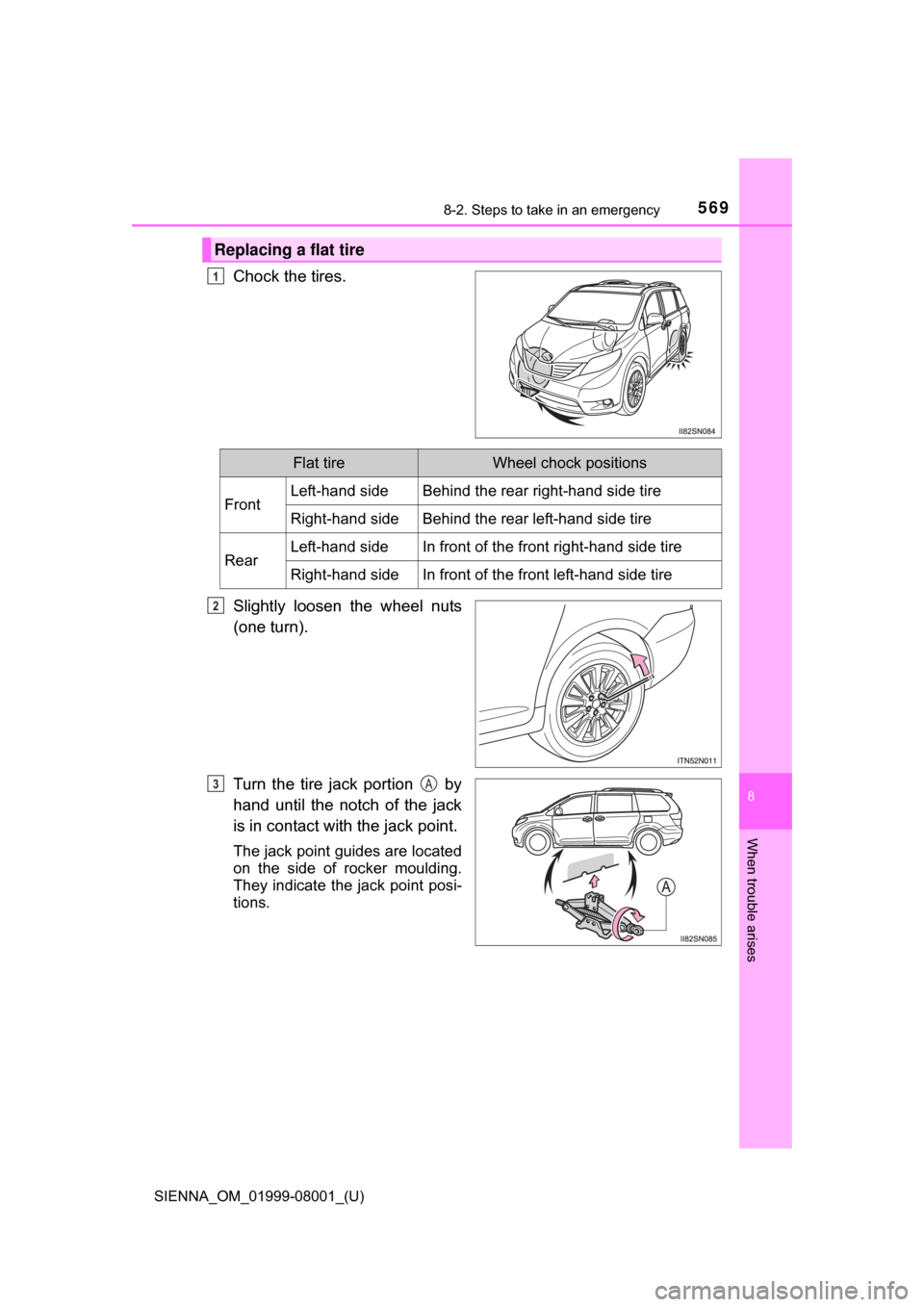
Chock the tires.
Slightly loosen the wheel nuts
(one turn).
Turn the tire jack portion by
hand until the notch of the jack
is in contact with the jack point.
The jack point guides are located
on the side of rocker moulding.
They indicate the jack point posi-
tions.
Replacing a flat tire
1
Flat tireWheel chock positions
FrontLeft-hand sideBehind the rear right-hand side tire
Right-hand sideBehind the rear left-hand side tire
RearLeft-hand sideIn front of the front right-hand side tire
Right-hand sideIn front of the front left-hand side tire
2
3A
Page 570 of 664
5708-2. Steps to take in an emergency
SIENNA_OM_01999-08001_(U)
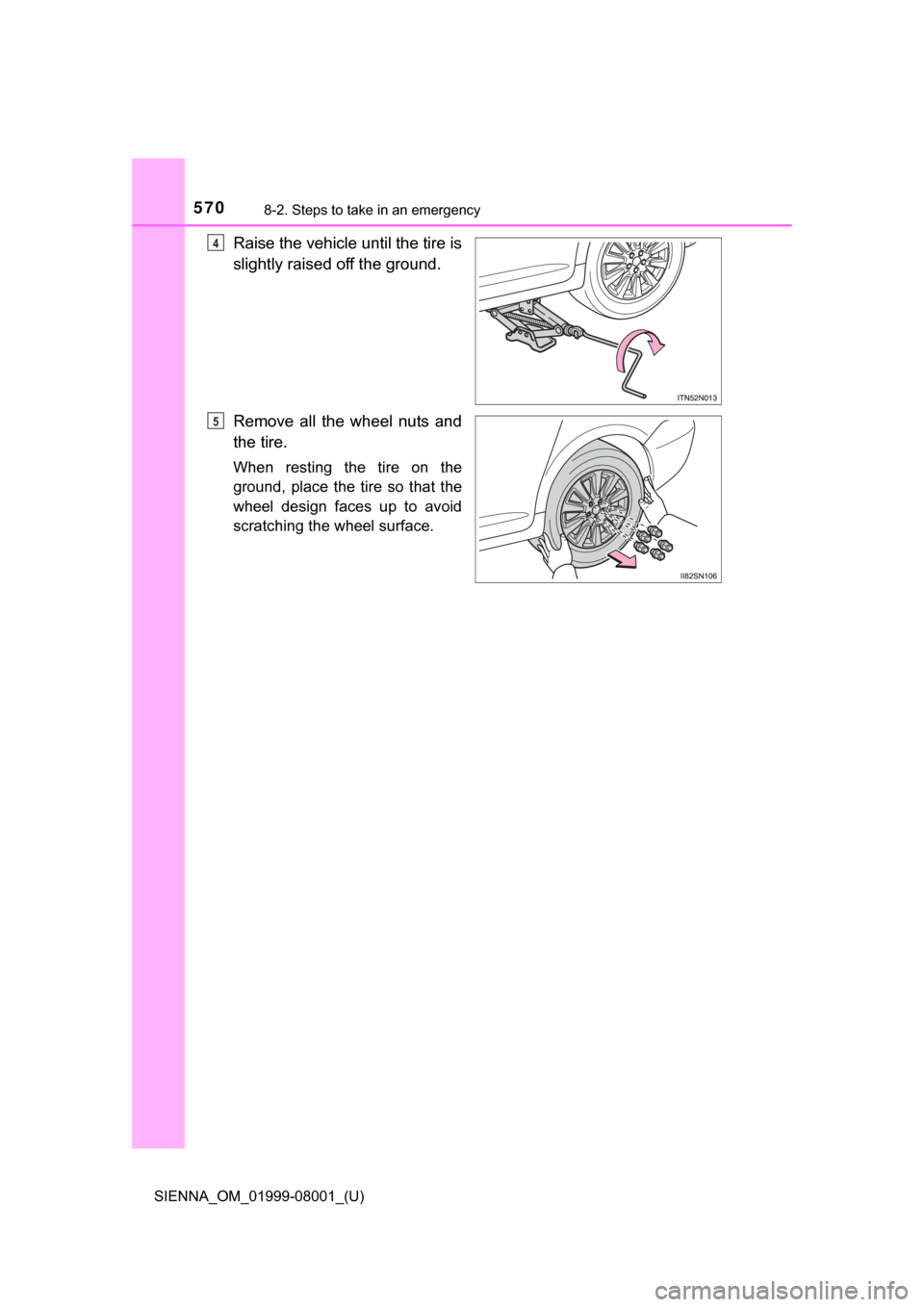
Raise the vehicle until the tire is
slightly raised off the ground.
Remove all the wheel nuts and
the tire.
When resting the tire on the
ground, place the tire so that the
wheel design faces up to avoid
scratching the wheel surface.
4
5
Page 575 of 664

5758-2. Steps to take in an emergency
SIENNA_OM_01999-08001_(U)
8
When trouble arises
■The compact spare tire
●The compact spare tire is identified by the label “TEMPORARY USE
ONLY” on the tire sidewall.
Use the compact spare tire temporarily, and only in an emergency.
●Make sure to check the tire inflatio n pressure of the compact spare tire.
( P. 601)
■After completing the tire change
The tire pressure warning system must be reset. ( P. 489)
■When using the compact spare tire
As the compact spare tire is not equipped with a tire pressure warning
valve and transmitter, lo w inflation pressure of the spare tire will not be
indicated by the tire pressure warning system. Also, if you replace the
compact spare tire after the tire pressure warning light comes on, the light
remains on.
■When the compact spare tire is equipped
The vehicle becomes lower when driving with the compact spare tire
compared to when driving with standard tires
■If you have a flat front tire on a road covered with snow or ice
Install the compact spare tire on one of the rear wheels of the vehicle.
Perform the following steps and fit tire chains to the front tires:
Replace a rear tire with the compact spare tire.
Replace the flat front tire with the tire removed from the rear of the vehi-
cle.
Fit tire chains to the front tires.
1
2
3
Page 578 of 664
578
SIENNA_OM_01999-08001_(U)
8-2. Steps to take in an emergency
If the engine will not start
One of the following may be the cause of the problem:
●There may not be sufficient fuel in the vehicle’s tank.
Refuel the vehicle.
● The engine may be flooded.
Try to restart the engine again following correct starting procedures.
( P. 223, 226)
● There may be a malfunction in the engine immobilizer system.
( P. 75)
One of the following may be the cause of the problem:
● The battery may be discharged. ( P. 583)
● The battery terminal connections may be loose or corroded.
The engine starting system may be malfunctioning due to an electrical
problem such as an electronic key battery depletion or a blown fuse.
However, an interim measure is available to start the engine.
( P. 579)
If the engine will not start even though correct starting proce-
dures are being followed ( P. 223, 226), consider each of the fol-
lowing points:
The engine will not start even though the starter motor operates
normally.
The starter motor turns over slowly, the interior lights and head-
lights are dim, or the horn does not sound or sounds at a low
volume.
The starter motor does not turn over (vehicles with a smart key
system)