Page 357 of 692
357
2-5. Driving information
PRIUS PHV_OM_OM47A11U_(U)
2
When driving
Selecting tire chains
Use the tire chains of correct size and type.
Use SAE Class “S” type radial tire chains except radial cable chains
or V-bar type chains.
Regulations on the use of tire chains
Regulations regarding the use of ti re chains vary depending on loca-
tion and type of road. Always chec k local regulations before installing
chains.
■ Tire chain installation
Observe the following precautions when installing and removing chains:
●Install and remove tire chains in a safe location.
● Install tire chains on the front tires only. Do not install tire chains on the
rear tires.
● Install tire chains on front tires as tightly as possible. Retighten chains
after driving 1/4 - 1/2 mile (0.5 - 1.0 km).
● Install tire chains following the instructions provided with the tire chains.
Page 545 of 692

5
When trouble arises
545
5-2. Steps to take in an emergency
PRIUS PHV_OM_OM47A11U_(U)
■If the tire pressure warning system is not functioning
The tire pressure warning system will be disabled in the following condi-
tions:
(When the condition be
comes normal, the system will work properly.)
●If tires not equipped with tire pressure warning valves and transmit-
ters are used
●If the ID code on the tire pressure warning valves and transmitters is
not registered in the tire pressure warning computer
●If the tire inflation pressure is 73 psi (500 kPa, 5.1 kgf/cm2 or bar) or
higher
The tire pressure warning system may be disabled in the following condi-
tions:
(When the condition be comes normal, the system will work properly.)
●If electronic devices or facilities using similar radio wave frequencies
are nearby
●If a radio set at a similar frequency is in use in the vehicle
●If a window tint that affects the radio wave signals is installed
●If there is a lot of snow or ice on the vehicle, particularly around the
wheels or wheel housings
●If non-genuine Toyota wheels are used (Even if you use Toyota
wheels, the tire pressure warning system may not work properly with
some types of tires.)
●If tire chains are used
Page 585 of 692
5
When trouble arises
585
5-2. Steps to take in an emergency
PRIUS PHV_OM_OM47A11U_(U)
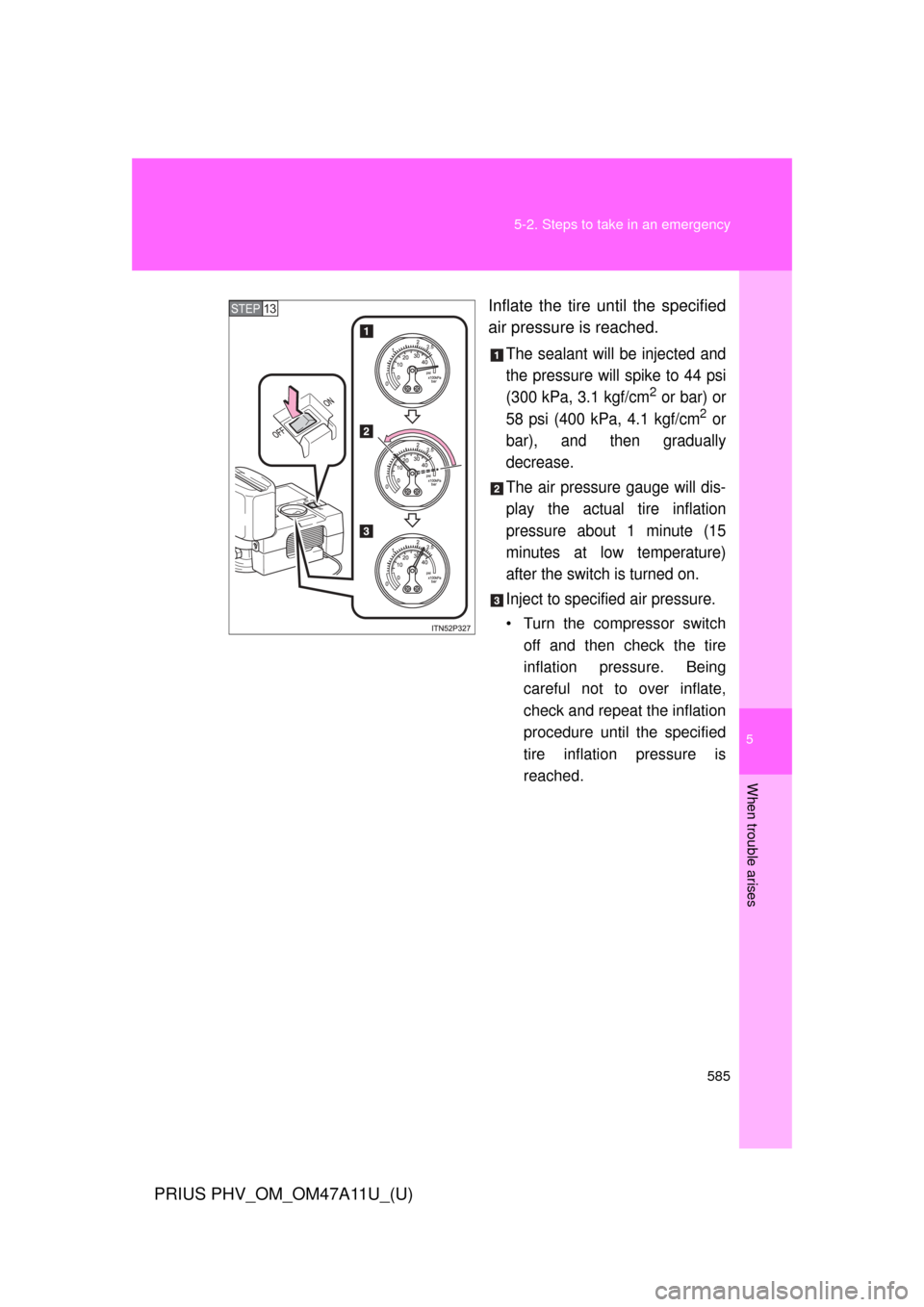
Inflate the tire until the specified
air pressure is reached.
The sealant will be injected and
the pressure will spike to 44 psi
(300 kPa, 3.1 kgf/cm
2 or bar) or
58 psi (400 kPa, 4.1 kgf/cm2 or
bar), and then gradually
decrease.
The air pressure gauge will dis-
play the actual tire inflation
pressure about 1 minute (15
minutes at low temperature)
after the switch is turned on.
Inject to specified air pressure.
• Turn the compressor switch
off and then check the tire
inflation pressure. Being
careful not to over inflate,
check and repeat the inflation
procedure until the specified
tire inflation pressure is
reached.
STEP13
Page 588 of 692
588 5-2. Steps to take in an emergency
PRIUS PHV_OM_OM47A11U_(U)
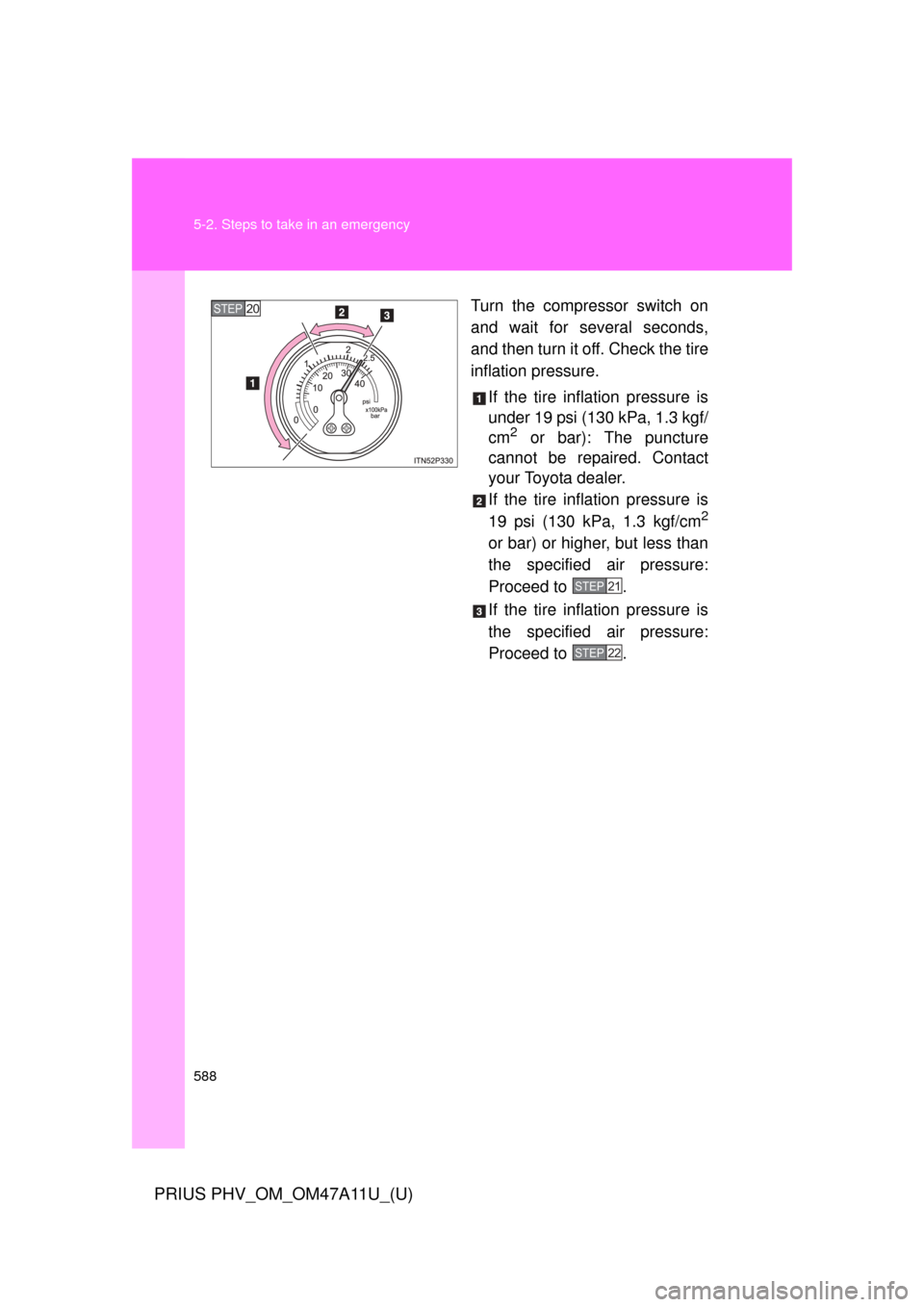
Turn the compressor switch on
and wait for several seconds,
and then turn it off. Check the tire
inflation pressure.If the tire inflation pressure is
under 19 psi (130 kPa, 1.3 kgf/
cm
2 or bar): The puncture
cannot be repaired. Contact
your Toyota dealer.
If the tire inflation pressure is
19 psi (130 kPa, 1.3 kgf/cm
2
or bar) or higher, but less than
the specified air pressure:
Proceed to .
If the tire inflation pressure is
the specified air pressure:
Proceed to .
STEP20
STEP21
STEP22
Page 594 of 692

594 5-2. Steps to take in an emergency
PRIUS PHV_OM_OM47A11U_(U)
CAUTION
■Driving to spread the liquid sealant evenly
Observe the following precautions to reduce the risk of accidents.
Failing to do so may result in a loss of vehicle control and cause death or
serious injury.
●Drive the vehicle carefully at a lo w speed. Be especially careful when
turning and cornering.
●If the vehicle does not drive straight or you feel a pull through the
steering wheel, stop the vehicle and check the following.
• Tire condition. The tire may have separated from the wheel.
• Tire inflation pressure. If the tire inflation pressure is 19 psi (130
kPa, 1.3 kgf/cm
2 or bar) or less, the tire may be severely damaged.
NOTICE
■When performing an emergency repair
●A tire should only be repaired with the emergency tire puncture repair
kit if the damage is caused by a sharp object such as nail or screw
passing through the tire tread.
Do not remove the sharp object from the tire. Removing the object may
widen the opening and disenable emergency repair with the repair kit.
●The repair kit is not waterproof. Make sure that the repair kit is not
exposed to water, such as when it is being used in the rain.
●Do not put the repair kit directly onto dusty ground such as sand at the
side of the road. If the repair ki t vacuums up dust etc., a malfunction
may occur.
Page 627 of 692
627
6-1. Specifications
6
Vehicle specifications
PRIUS PHV_OM_OM47A11U_(U)
Brakes
*1: Minimum pedal clearance when depressed with a force of 44.1 lbf (196 N,
20.0 kgf) while the hybrid system is operating.
*2: Parking brake pedal travel when depressed with a force of 67.5 lbf (300 N,30.6 kgf).
Steering
Tires and wheels
Pedal clearance*13.03 in. (77 mm) Min.
Pedal free play 0.04 0.24 in. (1.0 6.0 mm)
Brake pad wear limit 0.04 in. (1.0 mm)
Parking brake lining wear limit 0.04 in. (1.0 mm)
Parking brake pedal travel*28 11 clicks
Fluid type SAE J1703 or FMVSS No. 116 DOT 3
Free playLess than 1.2 in. (30 mm)
Tire sizeP195/65R15 89S
Tire inflation pressure
(Recommended cold tire
inflation pressure)Front tire
35 psi (240 kPa, 2.4 kgf/cm2 or bar)
Rear tire 33 psi (230 kPa, 2.3 kgf/cm
2 or bar)
Wheel size 15 6J
Wheel nut torque 76 ft•lbf (103 N•m, 10.5 kgf•m)