Page 145 of 712
1453-2. Opening, closing and locking the doors
3
Operation of each component
HIGHLANDER_U (OM48E98U)
WARNING
●Do not pull on the glass hatch damper stay to close the glass hatch, and
do not hang on the glass hatch damper stay.
Doing so may cause hands to be caught or the glass hatch damper stay to
break, causing an accident.
● Do not attach any accessories other than genuine Toyota parts to the
glass hatch. Such additional weight on the glass hatch may cause the
glass hatch to suddenly shut again after it is opened, resulting in death or
serious injury.
● Do not open the glass hatch while the rear wiper is switched on. (If the rear
wiper is switched on while the glass hatch is open, the wiper motor drive
disc will be rotating on the door panel.)
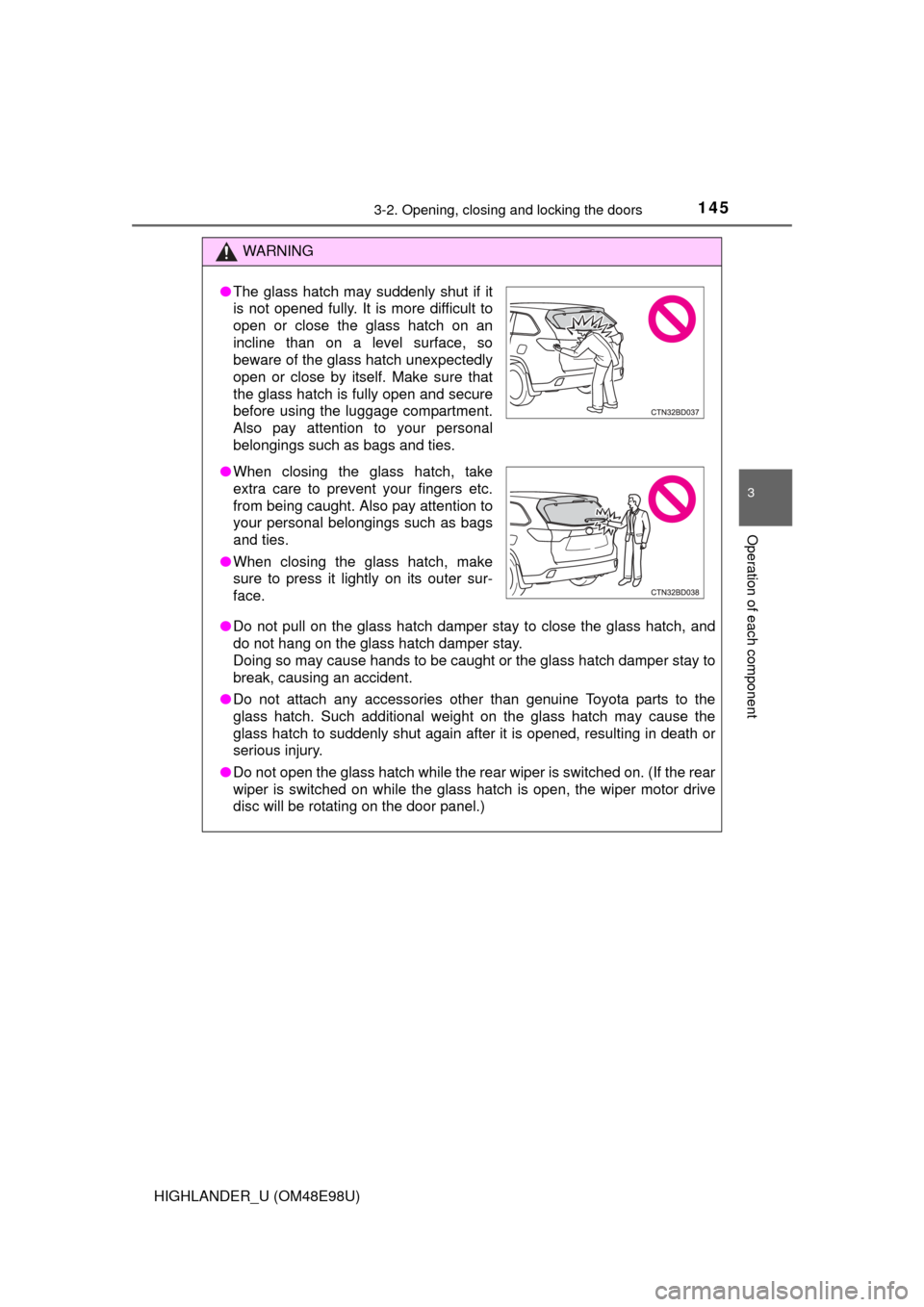
●The glass hatch may suddenly shut if it
is not opened fully. It is more difficult to
open or close the glass hatch on an
incline than on a level surface, so
beware of the glass hatch unexpectedly
open or close by itself. Make sure that
the glass hatch is fully open and secure
before using the luggage compartment.
Also pay attention to your personal
belongings such as bags and ties.
● When closing the glass hatch, take
extra care to prevent your fingers etc.
from being caught. Also pay attention to
your personal belongings such as bags
and ties.
● When closing the glass hatch, make
sure to press it lightly on its outer sur-
face.
Page 151 of 712

1513-2. Opening, closing and locking the doors
3
Operation of each component
HIGHLANDER_U (OM48E98U)■
Note for the entry function
●Even when the electronic key is within the effective range (detection areas),
the system may not operate properly in the following cases:
• The electronic key is too close to the window or outside door handle, near
the ground, or in a high place when the doors are locked or unlocked.
• The electronic key is near the ground or in a high place, or too close to
the rear bumper center when the back door is opened.
• The electronic key is on the instrument panel or floor, or in the auxiliary box of the driver's side instrument panel, door pockets or glove box when
the engine is started or engine switch modes are changed.
● Do not leave the electronic key on top of the instrument panel or near the
door pockets when exiting the vehicle. Depending on the radio wave recep-
tion conditions, it may be detected by the antenna outside the cabin and the
door will become lockable from the outside, possibly trapping the electronic
key inside the vehicle.
● As long as the electronic key is within the effective range, the doors may be
locked or unlocked by anyone. However, only the doors detecting the elec-
tronic key can be used to unlock the vehicle.
● Even if the electronic key is not inside the vehicle, it may be possible to start
the engine if the electronic key is near the window.
● The doors may unlock or lock if a large amount of water splashes on the
door handle, such as in the rain or in a car wash when the electronic key is
within the effective range. (The doors will automatically be locked after
approximately 60 seconds if the doors are not opened and closed.)
● If the wireless remote control is used to lock the doors when the electronic
key is near the vehicle, there is a possibility that the door may not be
unlocked by the entry function. (Use the wireless remote control to unlock
the doors.)
● Touching the door lock or unlock sensor while wearing gloves may prevent
lock or unlock operation. Remove the gloves and touch the lock or unlock
sensor again.
● When the lock operation is performed using the lock sensor, recognition sig-
nals will be shown up to two consecutive times. After this, no recognition
signals will be given.
● If the door handle becomes wet while the electronic key is within the effec-
tive range, the door may lock and unlock repeatedly. In that case, follow the
following correction procedures to wash the vehicle:
• Place the electronic key in a location 6 ft. (2 m) or more away from the
vehicle. (Take care to ensure that the key is not stolen.)
• Set the electronic key to battery-saving mode to disable the smart key system. ( P. 149)
Page 159 of 712
1593-3. Adjusting the seats
3
Operation of each component
HIGHLANDER_U (OM48E98U)■
Before folding down the second seats
Stow the armrest. ( P. 463)
With a side table: Stow the side table. ( P. 465)
Stow the second seat belt buckles.
Pass the outer seat belts
through the seat belt hangers
and secure the seat belt
plates.
This prevents the shoulder belts
from being damaged.
Make sure that the seat belts
are removed from the hangers
before using them.
Lower the head restraints to the lowest position. ( P. 168)
Folding down the second seats
1
2
3
Without a side tableWith a side table
4
5
Page 161 of 712
1613-3. Adjusting the seats
3
Operation of each component
HIGHLANDER_U (OM48E98U)■
Returning the second seats
Lift up the seat
backs until they
lock.
■Before folding down the third seats
Stow the third seat belt buck-
les.
Pass the outer seat belts
through the seat belt hangers
and secure the seat belt
plates.
This prevents the shoulder belts
from being damaged.
Make sure that the seat belts
are removed from the hangers
before using them.
Lower the head restraints to the lowest position. ( P. 168)
Folding down the third seats
1
2
3
Page 163 of 712

1633-3. Adjusting the seats
3
Operation of each component
HIGHLANDER_U (OM48E98U)
WARNING
■When folding the rear seatbacks down
Observe the following precautions. Failure to do so may result in death or
serious injury.
● Do not fold the seatbacks down while driving.
● Stop the vehicle on level ground, set the parking brake and shift the shift
lever to P.
● Do not allow anyone to sit on a folded seatback or in the luggage compart-
ment while driving.
● Do not allow children to enter the luggage compartment.
● Do not fold down a rear seatback when there are passengers sitting in the
rear seats or when there is luggage placed on the rear seats.
● Be careful not to catch your hand when folding the rear seatbacks.
■ Seat adjustment
● To reduce the risk of sliding under the lap belt during a collision, do not
recline the seat more than necessary.
If the seat is too reclined, the lap belt may slide past the hips and apply
restraint forces directly to the abdomen, or your neck may contact the
shoulder belt, increasing the risk of death or serious injury in the event of
an accident.
Adjustments should not be made while driving as the seat may unexpect-
edly move and cause the driver to lose control of the vehicle.
● Be careful that the seat does not hit passengers or luggage.
● Be careful not to get your hands or feet caught in the seat.
■ After adjusting or returning the seats
Observe the following precautions. Failure to do so may result in death or
serious injury.
● Make sure that the seat and seatback are securely locked in position by
lightly rocking them back and forth.
● Check that the seat belts are not twisted or caught in the seatback.
Page 172 of 712
172
HIGHLANDER_U (OM48E98U)
3-4. Adjusting the steering wheel and mirrors
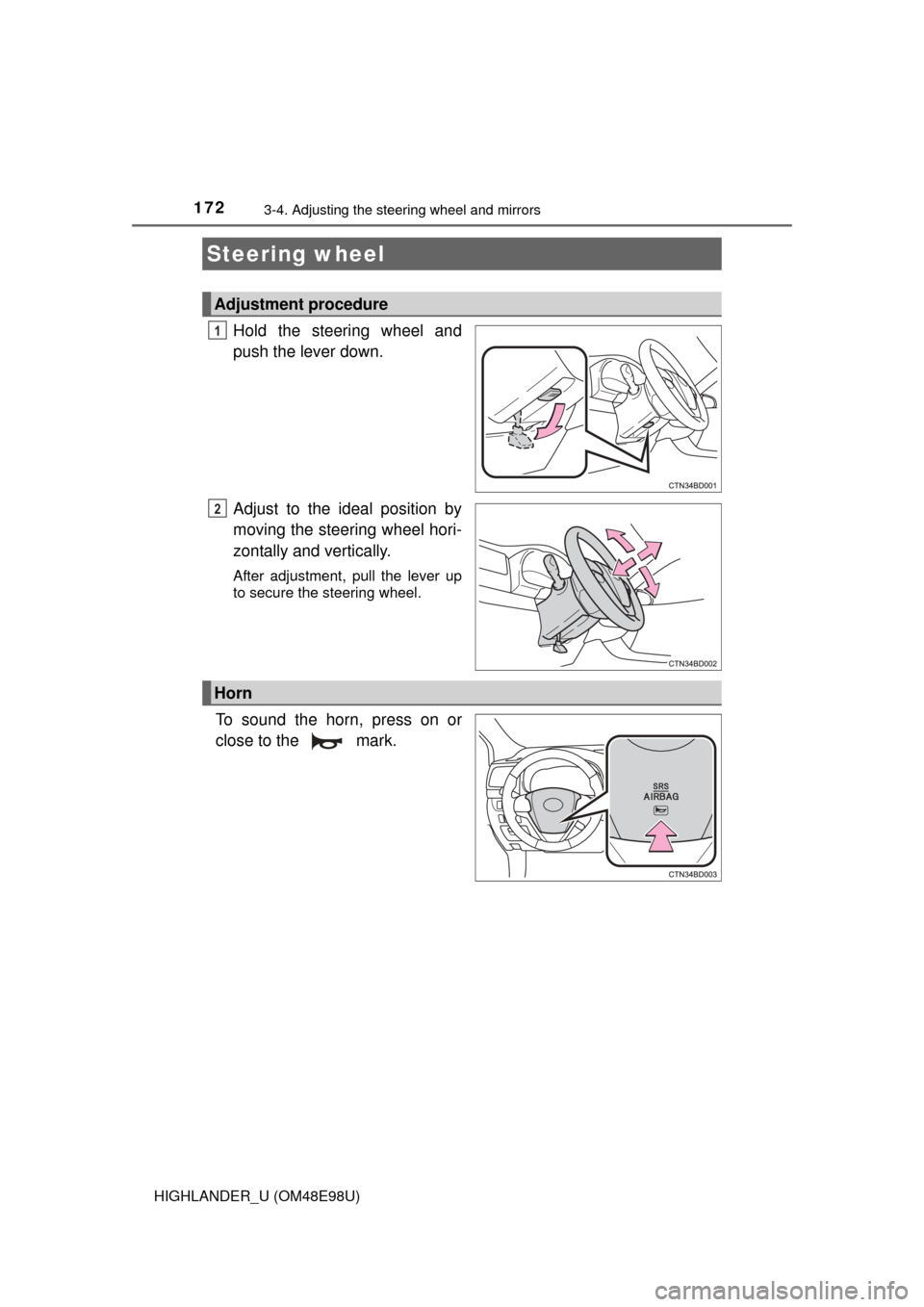
Hold the steering wheel and
push the lever down.
Adjust to the ideal position by
moving the steering wheel hori-
zontally and vertically.
After adjustment, pull the lever up
to secure the steering wheel.
To sound the horn, press on or
close to the mark.
Steering wheel
Adjustment procedure
1
2
Horn
Page 173 of 712
1733-4. Adjusting the steering wheel and mirrors
3
Operation of each component
HIGHLANDER_U (OM48E98U)
WARNING
■Caution while driving
Do not adjust the steering wheel while driving.
Doing so may cause the driver to mishandle the vehicle and cause an acci-
dent, resulting in death or serious injury.
■ After adjusting the steering wheel
Make sure that the steering wheel is securely locked.
Otherwise, the steering wheel may move suddenly, possibly causing an
accident, and resulting in death or serious injury. Also, the horn may not
sound if the steering wheel is not securely locked.
Page 197 of 712
1974-1. Before driving
4
Driving
HIGHLANDER_U (OM48E98U)
WARNING
Observe the following precautions.
Failure to do so may result in death or serious injury.
■If you hear a squealing or scraping noise (brake pad wear limit indica-
tors)
Have the brake pads checked and replaced by your Toyota dealer as soon
as possible.
Rotor damage may result if the pads are not replaced when needed.
It is dangerous to drive the vehicle when the wear limits of the brake pads
and/or those of the brake discs are exceeded.
■ When the vehicle is stopped
● Do not race the engine.
If the vehicle is in any gear other than P or N, the vehicle may accelerate
suddenly and unexpectedly, causing an accident.
● In order to prevent accidents due to the vehicle rolling away, always keep
depressing the brake pedal while the engine is running, and apply the
parking brake as necessary.
● If the vehicle is stopped on an incline, in order to prevent accidents caused
by the vehicle rolling forward or backward, always depress the brake pedal
and securely apply the parking brake as needed.
● Avoid revving or racing the engine.
Running the engine at high speed while the vehicle is stopped may cause
the exhaust system to overheat, which could result in a fire if combusti\
ble
material is nearby.