Page 324 of 464
324 4-3. Do-it-yourself maintenance
CAUTION
Proper inflation is critical to save tire performance
Keep your tires properly inflated. Otherwise, the following conditions may
occur and result in an accident causing death or serious injury.
Excessive wear
Uneven wear
Poor handling
Possibility of blowouts resulting from overheated tires
Poor sealing of the tire bead
Wheel deformation and/or tire separation
A greater possibility of tire damage from road hazards
NOTICE
When inspecting and adjusting tire pressure
Be sure to reinstall the tire valve caps.
Without the valve caps, dirt or moisture could get into the valve and cause
air leakage, which could result in an accident. If the caps have been lost,
replace them as soon as possible.
Page 325 of 464
325
4-3. Do-it-yourself maintenance
4
Maintenance and care
Wheels
If a wheel is bent, cracked or heavily corroded, it should be replaced.
Otherwise, the tire may separate from the wheel or cause loss of
handling control.
Wheel selection
When replacing wheels, care should be taken to ensure that
they are equivalent to those removed in load capacity, diameter,
rim width, and inset
*.
Replacement wheels are available at any authorized Toyota
dealer or repairer, or another duly qualified and equipped profes-
sional.
*: Conventionally referred to as “offset”.
Toyota does not recommend using:
Wheels of different sizes or types
Used wheels
Bent wheels that have been straightened
Aluminum wheel precautions
Use only Toyota wheel nuts and wrenches designed for use
with your aluminum wheels.
When rotating, repairing or changing your tires, check that the
wheel nuts are still tight after driving 1600 km (1000 miles).
Be careful not to damage the aluminum wheels when using
tire chains.
Use only Toyota genuine balance weights or equivalent and a
plastic or rubber hammer when balancing your wheels.
Page 327 of 464
327 4-3. Do-it-yourself maintenance
4
Maintenance and care
NOTICE
Replacing tire pressure warning valves and transmitters
Because tire repair or replacement may affect the tire pressure warning
valves and transmitters, make sure to have tires serviced by any autho-
rized Toyota dealer or repairer, or another duly qualified and equipped pro-
fessional or other qualified service shop. In addition, make sure to
purchase your tire pressure warning valves and transmitters at any autho-
rized Toyota dealer or repairer, or another duly qualified and equipped pro-
fessional.
Ensure that only genuine Toyota wheels are used on your vehicle.
Tire pressure warning valves and transmitters may not work properly with
non-genuine wheels.
Page 370 of 464
370
5-1. Essential information
If you think something is wrong
If you notice any of the following symptoms, your vehicle probably
needs adjustment or repair. Contact any authorized Toyota dealer or
repairer, or another duly qualified and equipped professional as
soon as possible.
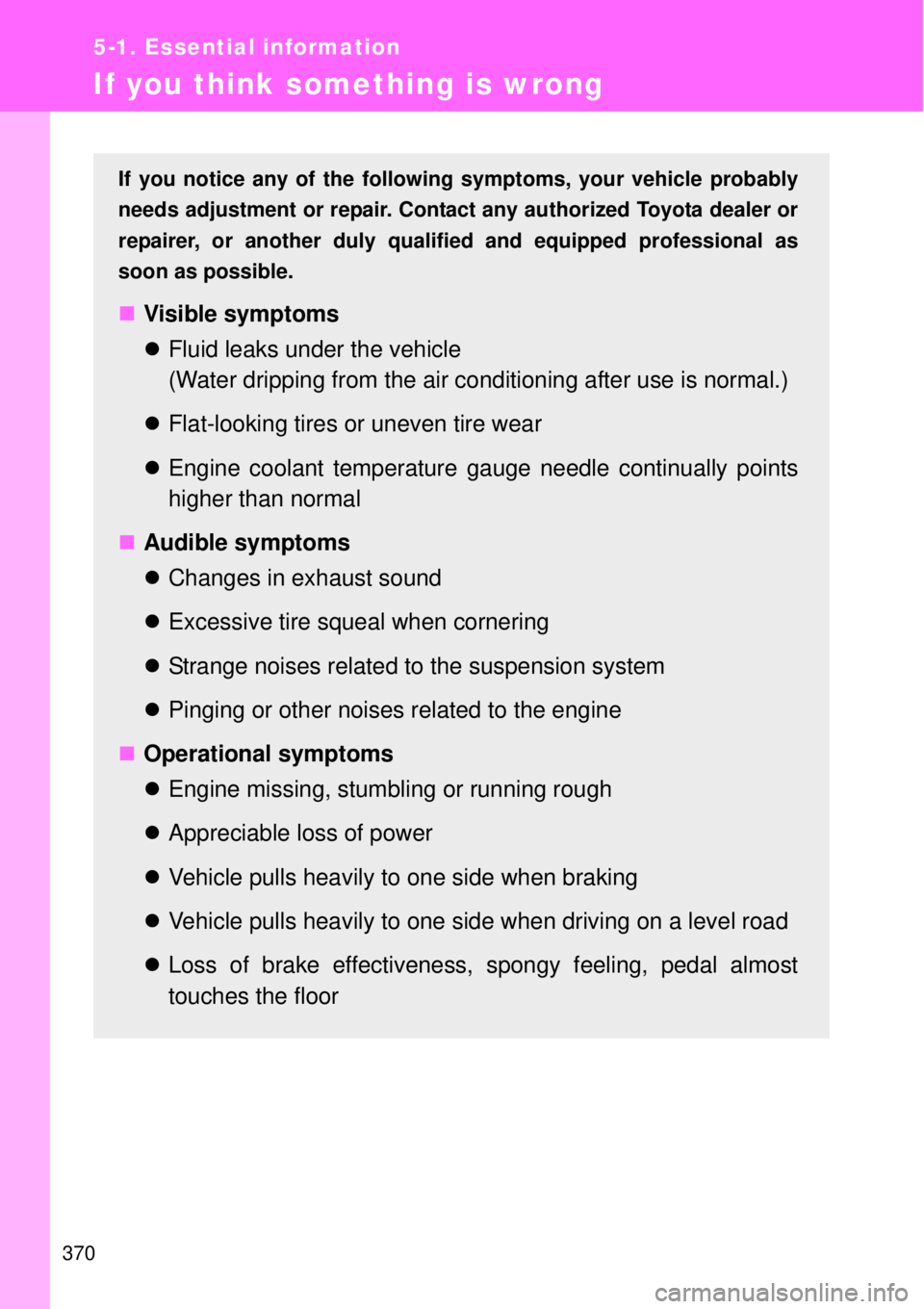
Visible symptoms
Fluid leaks under the vehicle
(Water dripping from the air conditioning after use is normal.)
Flat-looking tires or uneven tire wear
Engine coolant temperature gauge needle continually points
higher than normal
Audible symptoms
Changes in exhaust sound
Excessive tire squeal when cornering
Strange noises related to the suspension system
Pinging or other noises related to the engine
Operational symptoms
Engine missing, stumbling or running rough
Appreciable loss of power
Vehicle pulls heavily to one side when braking
Vehicle pulls heavily to one side when driving on a level road
Loss of brake effectiveness, spongy feeling, pedal almost
touches the floor
Page 378 of 464

378 5-2. Steps to take in an emergency
If the tire pressure warning system is inoperative
The tire pressure warning system will be disabled in the following conditions:
(When the condition becomes normal, the system will work properly.)
If tires not equipped with tire pressure warning valves and transmitters
are used.
If the ID code on the tire pressure warning valves and transmitters is not
registered in the tire pressure warning computer.
If the tire inflation pressure is 380 kPa (3.87 kgf/cm
2 or bar, 55 psi) or
higher.
The tire pressure warning system may be disabled in the following condi-
tions:
(When the condition becomes normal, the system will work properly.)
If electronic devices or facilities using similar radio wave frequencies are
nearby.
If a radio set at similar frequencies is in use in the vehicle.
If a window tint that affects the radio wave signals is installed.
If there is a lot of snow or ice on the vehicle, in particular around the
wheels or wheel housings.
If non-genuine Toyota wheels are used. (Even if you use Toyota wheels,
the tire pressure warning system may not work properly with some types
of tires.)
If tire chains are used.
If a large metallic object which can interfere with signal reception is put in
the trunk.
If the tire pressure warning light frequently comes on after blinking for
approximately one minute
If the tire pressure warning light frequently comes on after blinking for
approximately one minute when the “ENGINE START STOP” switch is
turned to IGNITION ON mode (vehicles with a smart entry & start system) or
the engine switch is turned to the “ON” position (vehicles without a smart
entry & start system), have it checked by any authorized Toyota dealer or
repairer, or another duly qualified and equipped professional.
Page 379 of 464

5
379 5-2. Steps to take in an emergency
When trouble arises
CAUTION
If the tire pressure warning light comes on
Be sure to observe the following precautions. Failure to do so could cause
loss of vehicle control and result in death or serious injury.
Stop your vehicle in a safe place as soon as possible. Adjust the tire infla-
tion pressure immediately.
If the tire pressure warning light comes on even after tire inflation pressure
adjustment, it is probable that you have a flat tire. Check the tires. If the
tire is flat, change to the spare tire and have the flat tire repaired by the
nearest any authorized Toyota dealer or repairer, or another duly qualified
and equipped professional.
Avoid abrupt maneuvering and braking. If the vehicle tires deteriorate, you
could lose control of the steering wheel or the brakes.
If a blowout or sudden air leakage should occur
The tire pressure warning system may not activate immediately.
NOTICE
To ensure the tire pressure warning system operates properly
Do not install tires with different specifications or makers, as the tire pres-
sure warning system may not operate properly.
Page 385 of 464
5
385 5-2. Steps to take in an emergency
When trouble arises
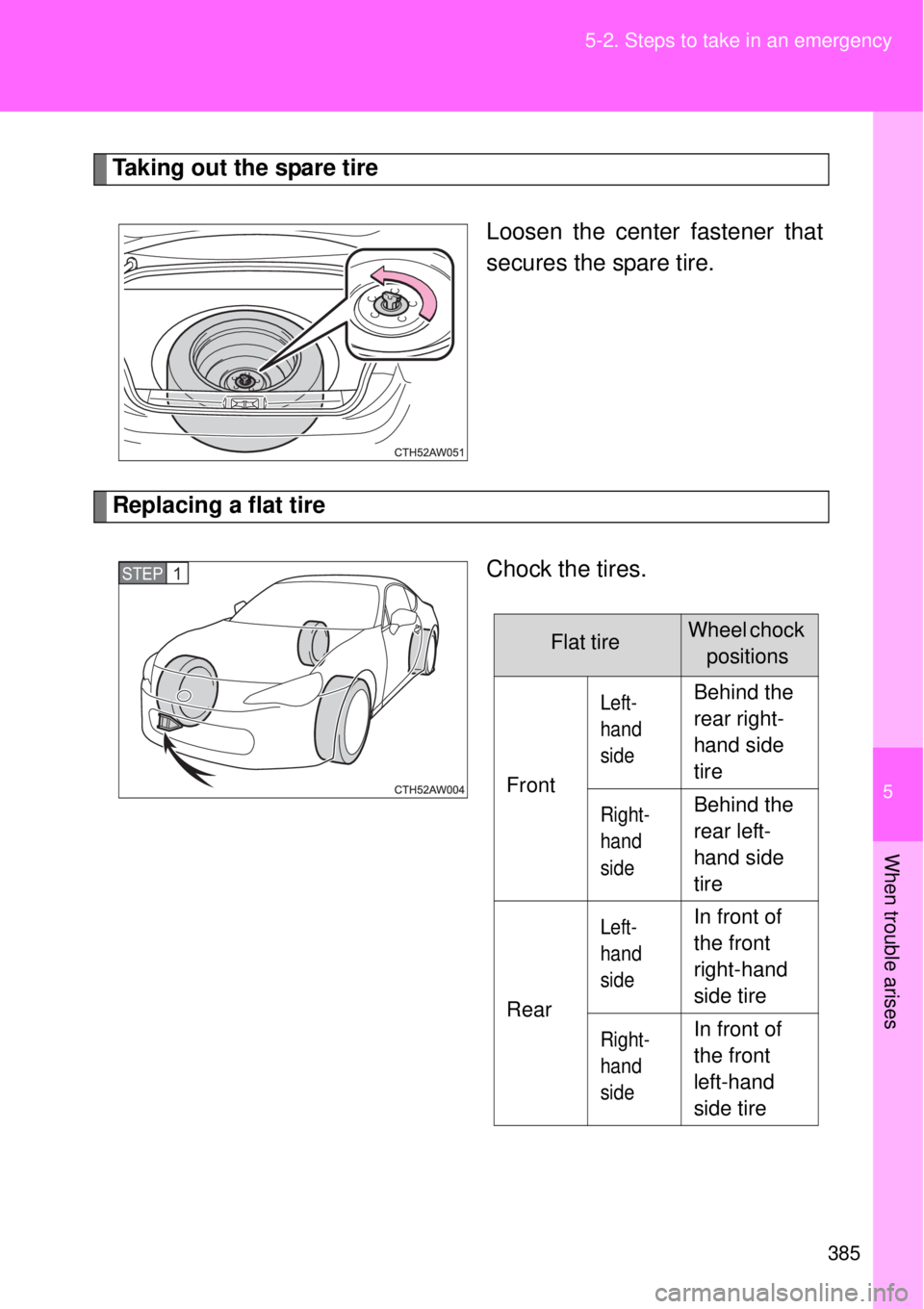
Taking out the spare tire
Loosen the center fastener that
secures the spare tire.
Replacing a flat tire
Chock the tires.
STEP 1
Flat tireWheel chock
positions
Front
Left-
hand
sideBehind the
rear right-
hand side
tire
Right-
hand
sideBehind the
rear left-
hand side
tire
Rear
Left-
hand
sideIn front of
the front
right-hand
side tire
Right-
hand
sideIn front of
the front
left-hand
side tire
Page 390 of 464

390 5-2. Steps to take in an emergency
CAUTION
Using the tire jack
Improper use of the tire jack may lead to death or serious injuries due to the
vehicle suddenly falling off the jack.
Do not use the tire jack for any purpose other than replacing tires or install-
ing and removing tire chains.
Only use the tire jack that comes with this vehicle for replacing a flat tire.
Do not use it on other vehicles, and do not use other tire jacks for replac-
ing tires on this vehicle.
Always check that the tire jack is securely set to the jack point.
Do not put any part of your body under the vehicle supported by a jack.
Do not start or run the engine while your vehicle is supported by the jack.
Do not raise the vehicle while someone is in it.
When raising the vehicle, do not put an object on or under the jack.
Do not raise the vehicle to a height greater than that required to replace
the tire.
Use a jack stand if it is necessary to get under the vehicle.
Take particular care when lowering the vehicle to ensure that no one working
on or near the vehicle may be injured.