2015 TOYOTA AVENSIS steering wheel
[x] Cancel search: steering wheelPage 234 of 648
2344-3. Operating the lights and wipers
AVENSIS_OM_OM20C20E_(EE)
AFS (Adaptive Front-lighting System) improves visibility at intersec-
tions and on curves by automatically adjusting the lateral angle of the
headlights according to vehicle speed and the degree of the tire angle
that are controlled by steering input.
Operates at speed of 10 km/h (6 mph) or higher.
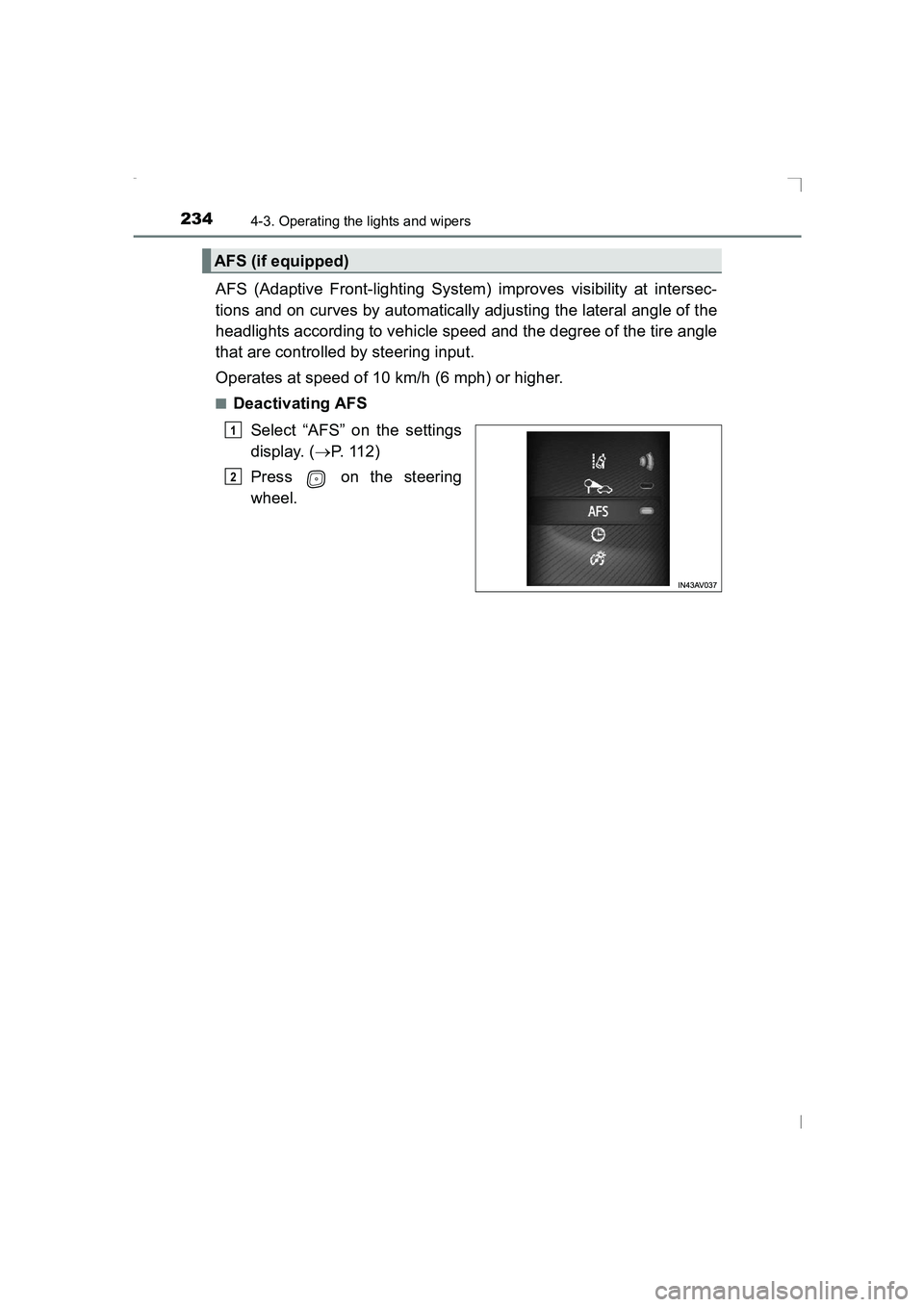
■Deactivating AFSSelect “AFS” on the settings
display. ( →P. 1 1 2 )
Press on the steering
wheel.
AFS (if equipped)
1
2
AVENSIS_OM_OM20C20E_(EE).book Page 234 Thursday, January 29, 2015 1:47 PM
Page 236 of 648
2364-3. Operating the lights and wipers
AVENSIS_OM_OM20C20E_(EE)
This system allows the headlights to be turned on for 30 seconds
when the engine switch is turned to the “LOCK” position (vehicles
without a smart entry & start system) or off (vehicles with a smart
entry & start system).
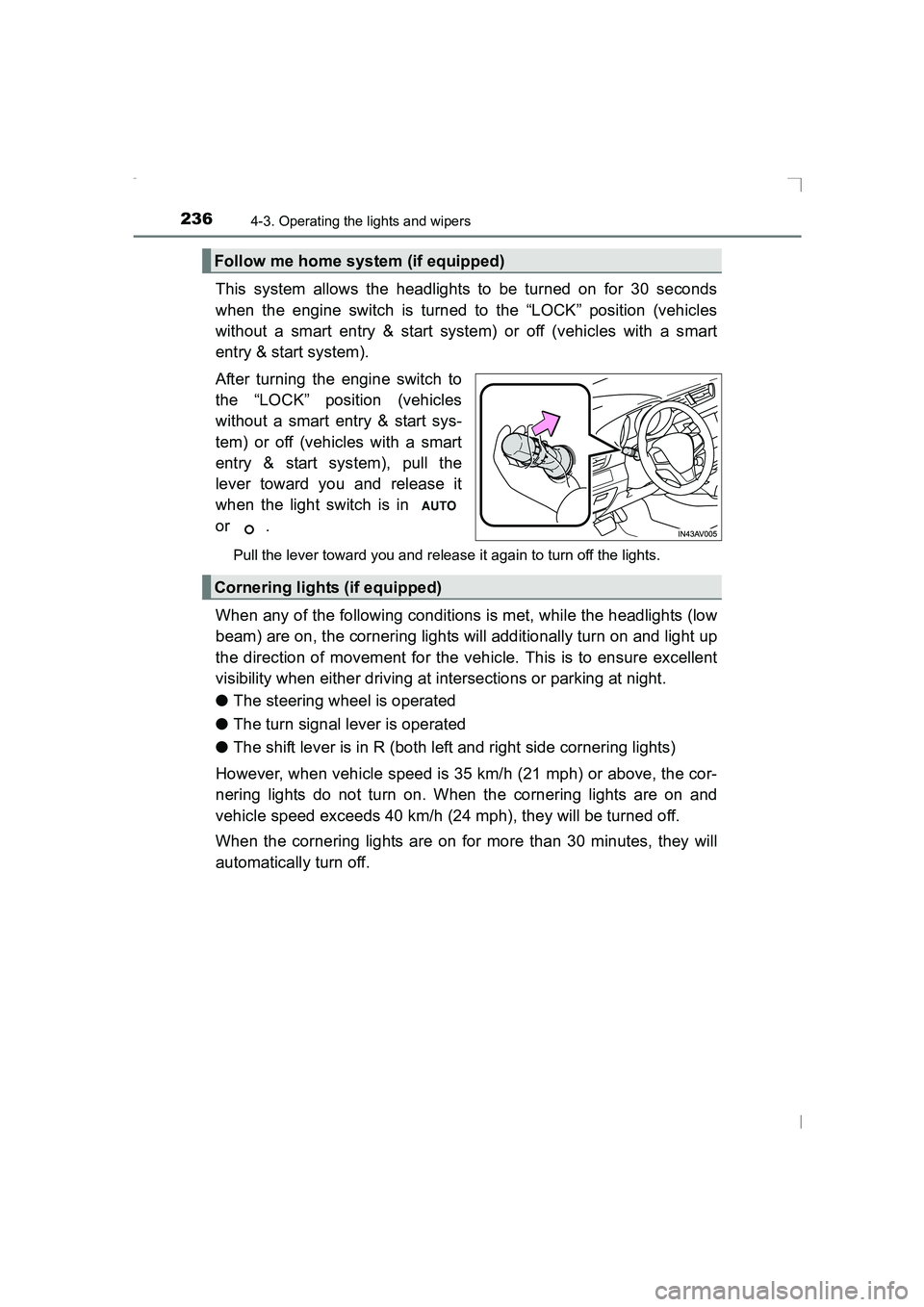
After turning the engine switch to
the “LOCK” position (vehicles
without a smart entry & start sys-
tem) or off (vehicles with a smart
entry & start system), pull the
lever toward you and release it
when the light switch is in
or .
Pull the lever toward you and release it again to turn off the lights.
When any of the following conditions is met, while the headlights (low
beam) are on, the cornering lights will additionally turn on and light up
the direction of movement for the vehicle. This is to ensure excellent
visibility when either driving at intersections or parking at night.
●The steering wheel is operated
● The turn signal lever is operated
● The shift lever is in R (both left and right side cornering lights)
However, when vehicle speed is 35 km/h (21 mph) or above, the cor-
nering lights do not turn on. When the cornering lights are on and
vehicle speed exceeds 40 km/h (24 mph), they will be turned off.
When the cornering lights are on for more than 30 minutes, they will
automatically turn off.
Follow me home system (if equipped)
Cornering lights (if equipped)
AVENSIS_OM_OM20C20E_(EE).book Page 236 Thursday, January 29, 2015 1:47 PM
Page 257 of 648

2574-5. Toyota Safety Sense
4
Driving
AVENSIS_OM_OM20C20E_(EE)
■Operational conditions
The pre-crash safety system is enabled and determines that the possibility of
a frontal collision with a vehicle (e xcept motorcycles and bicycles) is high.
● Pre-crash warning:
• Vehicle speed is approximately 15 to 140 km/h (10 to 87 mph).
• The relative speed between your vehicle and the vehicle ahead is greater
than approximately 15 km/h (10 mph).
● Pre-crash brake assist:
• Vehicle speed is approximately 30 to 80 km/h (19 to 50 mph).
• The relative speed between your vehicle and the vehicle ahead is greater
than approximately 30 km/h (19 mph).
● Pre-crash braking:
• Vehicle speed is approximately 10 to 80 km/h (7 to 50 mph).
• The relative speed between your vehicle and the vehicle ahead is greater
than approximately 10 km/h (7 mph).
The system may not operate in the following situations:
● If a battery terminal has been disconnected and reconnected and then the
vehicle has not been driven for a certain amount of time
● If VSC is disabled (only the pre-crash warning function will be operational)
● If the PCS warning light is flashing or illuminated
■ Cancelation of the pre-crash braking
●If either of the following situations occur while the pre-crash braking function
is operating, it will be canceled:
• The accelerator pedal is depressed strongly.
• The steering wheel is turned sharply or abruptly.
● If the vehicle is stopped by the operation of the pre-crash braking function,
the operation of the pre-crash braking function will be canceled after the
vehicle has been stopped for approximately 2 seconds.
AVENSIS_OM_OM20C20E_(EE).book Page 257 Thursday, January 29, 2015 1:47 PM
Page 261 of 648

2614-5. Toyota Safety Sense
4
Driving
AVENSIS_OM_OM20C20E_(EE)
WARNING
■ Limitations of the pre-crash safety system
●The driver is solely responsible for sa fe driving. Always drive safely, taking
care to observe your surroundings.
Do not use the pre-crash safety sy stem instead of normal braking opera-
tions under any circumstances. This system will not prevent collisions or
lessen damage or injuries in every situation. Do not overly rely on this
system. Failure to do so may lead to an accident, resulting in death or
serious injury.
Although this system is designed to help avoid and reduce the impact of a
collision, its effectiveness may change according to various conditions
( → P. 257). As a result, the system may not always provide the same level
of performance.
● The pre-crash braking function may not operate if certain operations are
performed by the driver. If the accelerator pedal is being depressed
strongly or the steering wheel is bei ng turned, the system may determine
that the driver is taking evasive action and possibly prevent the pre-crash
braking function from operating.
● In some situations, while the pre-cr ash braking function is operating, oper-
ation of the function may be canceled if the accelerator pedal is depressed
strongly or the steering wheel is turned and the system determines that
the driver is taking evasive action.
● A large amount of braking force is applied while the pre-crash braking
function is operating. Additionally, as the vehicle may creep after the pre-
crash braking function has operated, the driver should depress the brake
pedal as necessary.
sec_04-05.fm Page 261 Friday, February 20, 2015 3:44 PM
Page 267 of 648
2674-5. Toyota Safety Sense
4
Driving
AVENSIS_OM_OM20C20E_(EE)■
When changing the tires
Depending on the tires used, sufficient performance may not be maintainable.
■ Warning messages for the LDA system
Warning messages are used to indicate a system malfunction or to inform the
driver of the need for caution while driving.
■ Customization
The LDA system sensor sensitivity can be changed.
(Customizable features: →P. 619)
WARNING
■ Before using the LDA
Do not rely solely on the LDA system. The LDA system does not drive the
vehicle automatically, nor does it reduce the amount of care you need to
take. As such, the driver must always assume full responsibility for under-
standing his/her surroundings, for operat ing the steering wheel to correct
the driving line, and for driving safely.
Inappropriate or negligent driving could lead to an accident.
■ To avoid operating the LDA by mistake
Switch the LDA system off using the LDA switch when not in use.
AVENSIS_OM_OM20C20E_(EE).book Page 267 Thursday, January 29, 2015 1:47 PM
Page 279 of 648
2794-5. Toyota Safety Sense
4
Driving
AVENSIS_OM_OM20C20E_(EE)■
When driving vehicle in country with different speed unit
Since RSA recognizes signs based on the set unit of the meter, it is neces-
sary to change the set unit of the meter. Adjust the set unit of the meter to the
speed unit of signs in the current location. ( →P. 619)
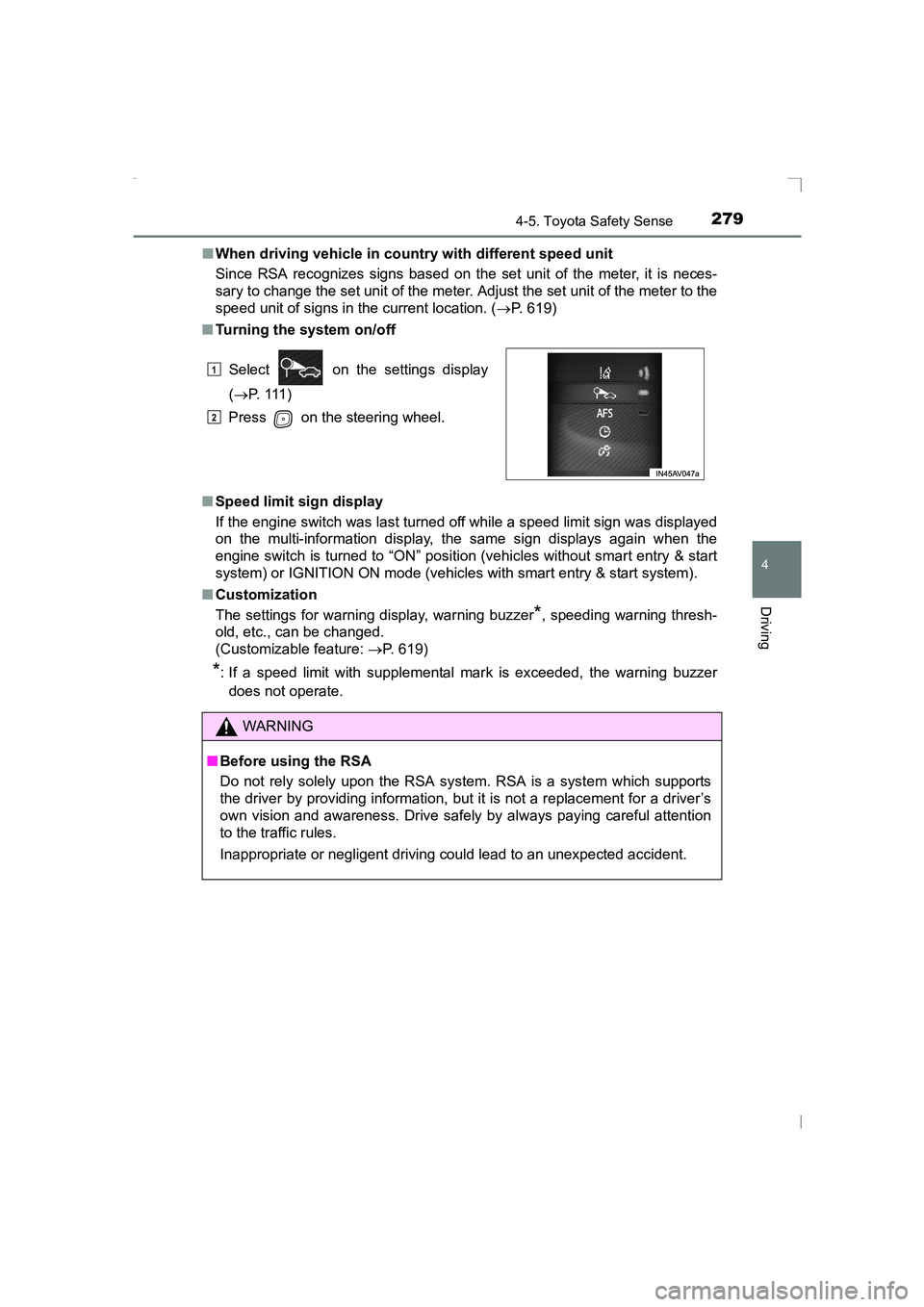
■ Turning the system on/off
■ Speed limit sign display
If the engine switch was last turned off while a speed limit sign was displayed
on the multi-information display, the same sign displays again when the
engine switch is turned to “ON” position (vehicles without smart entry & start
system) or IGNITION ON mode (vehicles with smart entry & start system).
■ Customization
The settings for warning display, warning buzzer
*, speeding warning thresh-
old, etc., can be changed.
(Customizable feature: →P. 619)
*: If a speed limit with supplemental mark is exceeded, the warning buzzer
does not operate. Select on the settings display
(→ P. 111 )
Press on the steering wheel.
WARNING
■ Before using the RSA
Do not rely solely upon the RSA system. RSA is a system which supports
the driver by providing information, but it is not a replacement for a driver’s
own vision and awareness. Drive safely by always paying careful attention
to the traffic rules.
Inappropriate or negligent driving could lead to an unexpected accident.
1
2
AVENSIS_OM_OM20C20E_(EE).book Page 279 Thursday, January 29, 2015 1:47 PM
Page 288 of 648
2884-6. Using the driving support systems
AVENSIS_OM_OM20C20E_(EE)
■Operating conditions
●The Stop & Start system is operational when all of the following conditions
are met:
• The clutch pedal is not being depressed.
• The shift lever is in N.
• The engine is adequately warmed up.
• The outside temperature is -5 °C (23 °F) or higher.
• The windshield defogger is off.
• The power heater is turned off.
• The parking brake is not in operation. ( →P. 229)
• The hood is closed. ( →P. 289)
• The driver’s seat belt is fastened.
• The driver’s door is closed.
● In the following circumstances the engine may not be stopped by the Stop &
Start system. This is not a malfunction of the Stop & Start system.
• The air conditioning system is being used when the ambient temperature
is high or low.
• The battery is not sufficiently charged, or is undergoing a periodic recharge.
• The brake booster vacuum is low.
• The vehicle is stopped on an incline.
• The steering wheel is being operated
• Due to traffic or other circumstances the vehicle is stopped repeatedly, resulting in the amount of time the engine is stopped by the Stop & Start
system to become excessively high.
• At high altitude.
• The engine coolant temperature is extremely high or low.
• The battery fluid temperature is excessively high or low.
• The battery was recently replaced or the battery terminals were recently
disconnected.
When the above conditions improve, the Stop & Start system will stop and
restart the engine from the next time the vehicle is stopped.
AVENSIS_OM_OM20C20E_(EE).book Page 288 Thursday, January 29, 2015 1:47 PM
Page 289 of 648
2894-6. Using the driving support systems
4
Driving
AVENSIS_OM_OM20C20E_(EE)■
Automatic engine start function
●In the following circumstances, the engine will automatically restart when
the engine is stopped by the Stop & Start system. (In order to have the
engine stopped by the Stop & Start system again, drive the vehicle once.)
• The air conditioning system is turned on.
• The windshield defogger is turned on.
• The power heater is turned on.
• The parking brake switch is pulled. ( →P. 229)
• The steering wheel is operated.
• The driver’s seat belt is unfastened.
• The driver’s door is opened.
• The Stop & Start cancel switch is pressed.
• The vehicle starts to roll on an incline.
● In the following circumstances, the engine may automatically restart when
the engine is stopped by the Stop & Start system. (In order to have the
engine stopped by the Stop & Start system again, drive the vehicle once.)
• The brake pedal is pumped or strongly depressed.
• The air conditioning system is being used.
• The battery is not sufficiently charged.
■ Parking brake
●Even if the automatic engine restart conditions are met while the parking
brake is engaging, the engine does not immediately restart. The engine
restarts when the parking brake is engaged.
● If the parking brake switch is pressed while the engine is restarting, the
engine restart may be canceled. If the operation was canceled, the engine
restarts when the parking brake is engaged.
■ Hood
●If the hood is opened while the engine is stopped by the Stop & Start sys-
tem, the engine cannot be restarted by the Stop & Start system or the auto-
matic engine start function. Shift the shift lever to N and restart the engine
with the engine switch operation. ( →P. 209, 212)
● Even if the hood is closed after the engine is started with the hood open, the
Stop & Start system does not operate. Close the hood, turn the engine
switch off, wait for a while, and then start the engine.
AVENSIS_OM_OM20C20E_(EE).book Page 289 Thursday, January 29, 2015 1:47 PM