2015 TOYOTA AVALON ESP
[x] Cancel search: ESPPage 309 of 500
309
6
Maintenance and care
AVALON (U)_(OM41456U)
6-2. Maintenance
General maintenance should be performed on a daily basis. This can
be done by yourself or by a Toyota dealer.
Scheduled maintenance should be performed at specified intervals
according to the maintenance schedule.
For details about maintenance items and schedules, refer to the “Sched-
uled Maintenance Guide” or “Owner’s Manual Supplement”.
You can perform some maintenance procedures by yourself.
Please be aware that do-it-yourself maintenance may affect warranty
coverage.
The use of Toyota Repair Manuals is recommended.
For details about warranty coverage, refer to the separate “Owner’s War-
ranty Information Booklet” or “Owner’s Manual Supplement”.
Maintenance requirements
To ensure safe and economical driv ing, day-to-day care and reg-
ular maintenance are essential. It is the owner’s responsibility to
perform regular checks. Toyota recommends the following main-
tenance:
General maintenance
Scheduled maintenance
Do-it-yourself maintenance
Page 339 of 500

3396-3. Do-it-yourself maintenance
6
Maintenance and care
AVALON (U)_(OM41456U)■
Initializing the tire pressure warning system
Initialize the system with the tire infl
ation pressure adjusted to the speci-
fied level.
■If the tread on snow tires wears down below 0.16 in. (4 mm)
The effectiveness of the tire s as snow tires is lost.
■If you press the tire pressure warning reset switch accidentally
If initialization is performed, adjust the tire inflation pressure to the speci-
fied level and initialize the tire pressure warning system again.
■When initialization of the tire pr essure warning system has failed
Initialization can be completed in a few minutes. However, in the following
cases, the settings have not been recorded and the system will not oper-
ate properly. If repeated attempts to record tire inflation pressure settings
are unsuccessful, have the vehicle inspected by your Toyota dealer.
●When operating the tire pressure wa rning reset switch, the tire pressure
warning light does not blink 3 times.
●After driving for a certain period of time since the initialization has been
completed, the warning light comes on after blinking for 1 minute.
■Tire pressure warning system certification
For vehicles sold in the U.S.A.
FCC ID: PAXPMVC010
NOTE:
This device complies with part 15 of the FCC Rules. Operation is subject
to the following two cond itions: (1) this device may not cause harmful
interference, and (2) this device must accept any interference received,
including interference that may cause undesired operation.
FCC WARNING:
Changes or modifications not expressly approved by the party responsi-
ble for compliance could void the user ’s authority to operate the equip-
ment.
For vehicles sold in Canada
NOTE:
Operation is subject to the following two conditions: (1) this device may
not cause interference, and (2) this device must accept any interference,
including interference that may cause undesired operation of the device.
Page 397 of 500

3977-2. Steps to take in an emergency
7
When trouble arises
AVALON (U)_(OM41456U)
CAUTION
■Maintenance of the tires
Each tire, including the spare (if provided), should be checked monthly
when cold and inflated to the inflation pressure recommended by the
vehicle manufacturer on the vehicle placard or tire inflation pressure
label (tire and load information label). (If your vehicle has tires of a dif-
ferent size than the size indicated on the vehicle placard or tire inflation
pressure label [tire and load information label], you should determine
the proper tire inflation pressure for those tires.)
As an added safety feature, your vehicle has been equipped with a tire
pressure monitoring system (TPMS-ti re pressure warning system) that
illuminates a low tire pre ssure telltale (tire pressure warning light) when
one or more of your tires is significantly under-inflated. Accordingly,
when the low tire pressure telltale (tire pressure warning light) illumi-
nates, you should stop and check your tires as soon as possible, and
inflate them to the proper pressure. Driving on a significantly under-
inflated tire causes the tire to overheat and can lead to tire failure.
Under-inflation also reduces fuel effi ciency and tire tread life, and may
affect the vehicle’s hand ling and stopping ability.
Please note that the TPMS (tire pres sure warning system) is not a sub-
stitute for proper ti re maintenance, and it is the driver’s responsibility to
maintain correct tire pressure, even if under-inflation has not reached
the level to trigger illumina tion of the TPMS low tire pressure telltale (tire
pressure warning light).
Your vehicle has also been equipped with a TPMS (tire pressure warn-
ing system) malfunction indicator to indicate when the system is not
operating properly. The TPMS (tire pressure warning system) malfunc-
tion indicator is combined with the lo w tire pressure telltale (tire pressure
warning light). When the system dete cts a malfunction, the telltale will
flash for approximately one minute and then remain continuously illumi-
nated. This sequence will continue up on subsequent vehicle start-ups
as long as the malfunction exists. When the malfunction indicator is illu-
minated, the system may not be able to detect or signal low tire pres-
sure as intended.
Page 421 of 500

4217-2. Steps to take in an emergency
7
When trouble arises
AVALON (U)_(OM41456U)
■Starting the engine when the battery is discharged
The engine cannot be started by push-starting.
■ To prevent battery discharge
●Turn off the headlights and the audio system while the engine is off.
● Turn off any unnecessary electrical components when the vehicle is running
at a low speed for an extended period, such as in heavy traffic.
■ Charging the battery
The electricity stored in the battery will discharge gradually even when the
vehicle is not in use, due to natural discharge and the draining effects of cer-
tain electrical appliances. If the vehicle is left for a long time, the battery may
discharge, and the engine may be unable to start. (The battery recharges
automatically during driving.)
■ When recharging or replacing the battery
●In some cases, it may not be possible to unlock the doors using the smart
key system when the battery is discharged. Use the wireless remote control
or the mechanical key to lock or unlock the doors.
● The engine may not start on the first attempt after the battery has recharged
but will start normally after the second attempt. This is not a malfunction.
● The engine switch mode is memorized by the vehicle. When the battery is
reconnected, the system will return to the mode it was in before the battery
was discharged. Before disconnecting the battery, turn the engine switch off.
If you are unsure what mode the engine switch was in before the battery dis-
charged, be especially careful when reconnecting the battery.
● Make sure that the key is not inside the vehicle when recharging or replac-
ing the battery. The key may be locked in the vehicle if the alarm is acti-
vated. ( P. 69)
Page 425 of 500
4257-2. Steps to take in an emergency
7
When trouble arises
AVALON (U)_(OM41456U)
CAUTION
■When inspecting under the hood of your vehicle
Observe the following precautions.
Failure to do so may result in serious injury such as burns.
● If steam is seen coming from under the hood, do not open the hood until
the steam has subsided. The engine compartment may be very hot.
● Keep hands and clothing (especially a tie, a scarf or a muffler) away from
the fans and belts.
NOTICE
■When adding engine coolant
Wait until the engine has cooled down before adding engine coolant.
When adding coolant, do so slowly. Adding cool coolant to a hot engine too
quickly can cause damage to the engine.
■ To prevent damage to the cooling system
Observe the following precautions:
● Avoid contaminating the coolant with foreign matter (such as sand or dust
etc.).
● Do not use any coolant additive.
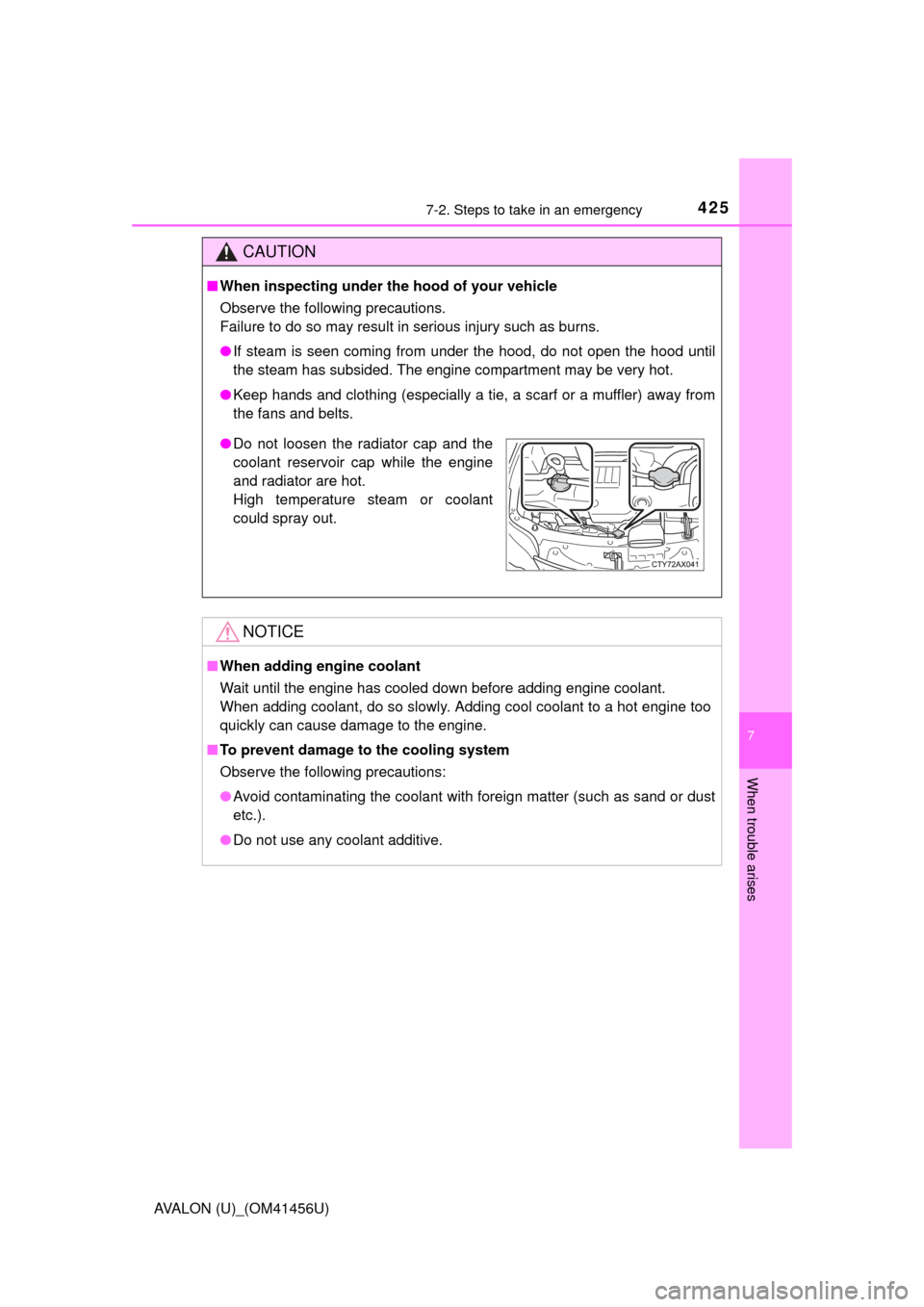
●Do not loosen the radiator cap and the
coolant reservoir cap while the engine
and radiator are hot.
High temperature steam or coolant
could spray out.
Page 448 of 500

4488-1. Specifications
AVALON (U)_(OM41456U)■
Temperature A, B, C
The temperature grades are A (the hi
ghest), B, and C, representing
the tire’s resistance to the generation of heat and its ability to dissi-
pate heat when tested under cont rolled conditions on a specified
indoor laboratory test wheel.
Sustained high temperature can cause the material of the tire to
degenerate and reduce tire life, and excessive temperature can lead
to sudden tire failure.
Grade C corresponds to a level of performance which all passenger
car tires must meet under the Federal Motor Vehicle Safety Stan-
dard No. 109.
Grades B and A represent higher le vels of performance on the labo-
ratory test wheel than the minimum required by law.
Warning: The temperature grades of a tire assume that it is properly
inflated and not overloaded.
Excessive speed, underinflation, or excessive loading, either sepa-
rately or in combination, can cause heat buildup and possible tire
failure.
Page 471 of 500

471
9
For owners
AVALON (U)_(OM41456U)
AT T E N T I O N
■Précautions concernant les coussins gonflables SRS
Respectez les précautions suivantes avec les coussins gonflables SRS.
Autrement, des blessures graves, voire mortelles, pourraient s’ensuiv\
re.
● Le conducteur et les passagers du véhicule doivent porter correctement
leur ceinture de sécurité.
Les coussins gonflables SRS sont des dispositifs supplémentaires à utili-
ser avec les ceintures de sécurité.
● Le coussin gonflable SRS conducteur se déploie avec une violence consi-
dérable, qui peut être très dangereuse, voire mortelle, si le conducteur se
trouve très près du coussin gonflable. L’autorité fédérale chargée de la
sécurité routière aux États-Unis (NHTSA) conseille:
Sachant que la zone de danger pour le coussin gonflable conducteur se
trouve dans les premiers 2 à 3 in. (50 - 75 mm) de déploiement, vous pla-
cer à 10 in. (250 mm) de votre coussin gonflable conducteur vous garantit
une marge de sécurité suffisante. Cette distance est à mesurer entre l’axe
du volant et le sternum. Si vous êtes assis à moins de 10 in. (250 mm),
vous pouvez changer votre position de conduite de plusieurs façons:
• Reculez votre siège le plus possible, de manière à pouvoir encore
atteindre confortablement les pédales.
• Inclinez légèrement le dossier du siège. Bien que les véhicules puissent être différents les uns des autres, la
plupart des conducteurs peuvent s’asseoir à une distance de 10 in.
(250 mm), même avec le siège conducteur complètement avancé, sim-
plement en inclinant un peu le dossier de siège. Si vous avez des diffi-
cultés à voir la route après avoir incliné votre siège, utilisez un coussin
ferme et antidérapant pour vous rehausser ou, si votre véhicule est
équipé du réglage en hauteur du siège, remontez-le.
• Si votre volant est réglable, inclinez-le vers le bas. Cela a pour effet d’orienter le coussin gonflable en direction de votre poitrine plutôt que
de votre tête et de votre cou.
Réglez votre siège selon ces recommandations de la NHTSA, tout en
conservant le contrôle des pédales, du volant et la vue des commandes
du tableau de bord.
Page 474 of 500
474
AVALON (U)_(OM41456U)
AT T E N T I O N
■Précautions concernant les coussins gonflables SRS
● Ne suspendez aucun cintre ni objet dur aux crochets à vêtements. En cas
de déploiement des coussins gonflables rideau SRS, tous ces objets pour-
raient se transformer en projectiles et causer des blessures graves, voire
mortelles.
● Si un cache en vinyle recouvre la partie où le coussin gonflable de genoux
SRS se déploie, veillez à l’enlever.
● N’utilisez aucun accessoire de siège venant recouvrir les zones de
déploiement des coussins gonflables latéraux SRS, car il risquerait d’en
gêner le déploiement. De tels accessoires peuvent empêcher les coussins
gonflables latéraux de fonctionner correctement, désactiver le dispositif ou
entraîner le déploiement accidentel des coussins gonflables latéraux, ce
qui pourrait entraîner la mort ou des blessures graves.
● Ne faites pas subir de chocs ou de pressions excessives aux zones ren-
fermant les composants des coussins gonflables SRS.
En effet, cela pourrait entraîner un fonctionnement anormal des coussins
gonflables SRS.
● Ne touchez aucun composant du système immédiatement après le
déploiement (gonflage) des coussins gonflables SRS, car ils peuvent être
chauds.
● Si vous avez des difficultés à respirer après le déploiement des coussins
gonflables SRS, ouvrez une porte ou une vitre pour faire entrer de l’air
frais, ou bien descendez du véhicule si cela ne présente pas de danger.
Essuyez tout résidu dès que possible afin d’éviter d’éventuelles irritations
de la peau.
● Si les parties renfermant les coussins gonflables SRS, telles que la garni-
ture du volant et les garnitures de montants avant et arrière, sont abîmées
ou craquelées, faites-les remplacer par votre concessionnaire Toyota.
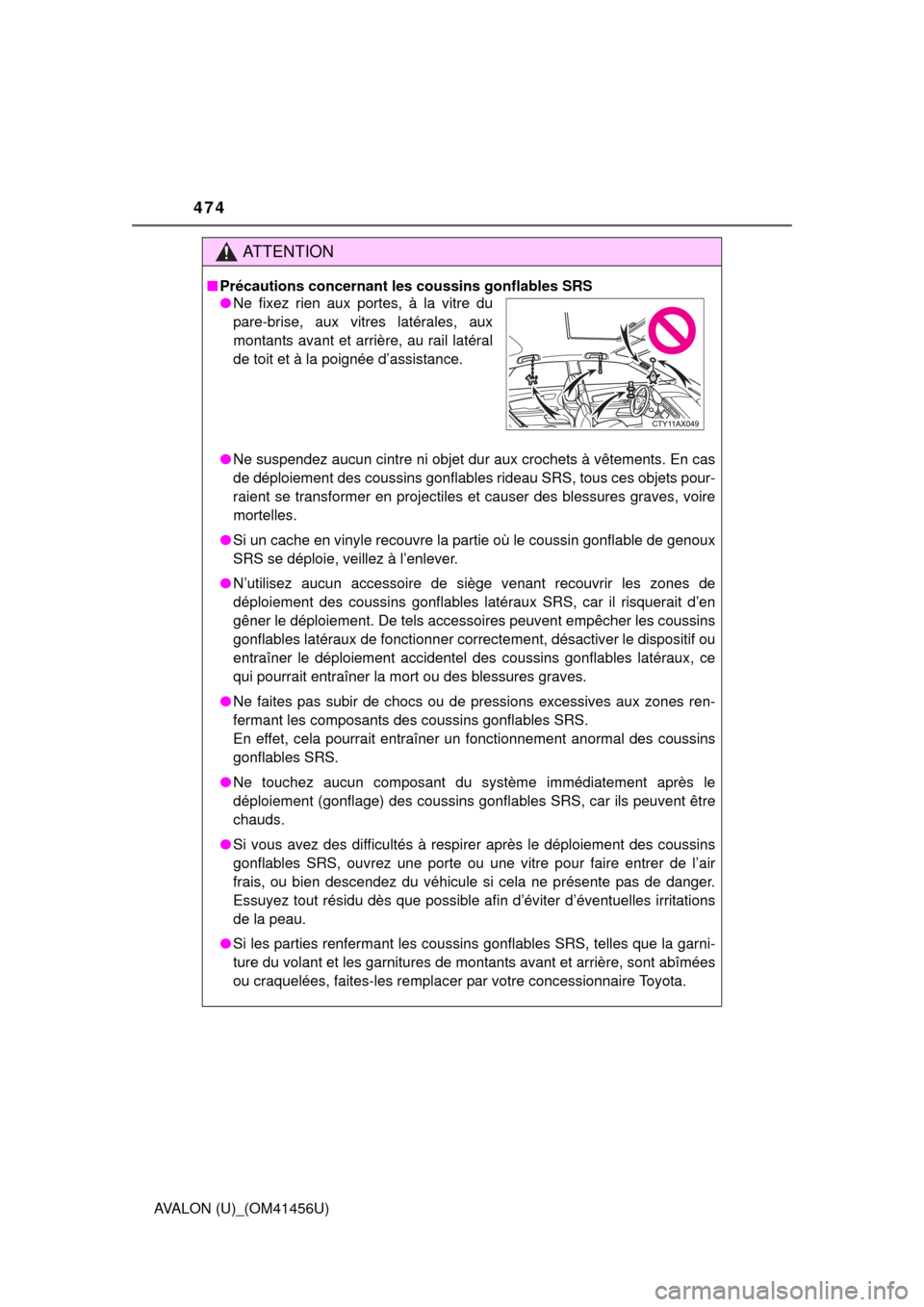
●Ne fixez rien aux portes, à la vitre du
pare-brise, aux vitres latérales, aux
montants avant et arrière, au rail latéral
de toit et à la poignée d’assistance.